Showing posts with label Roman Catholic Church. Show all posts

Saturday, October 24, 2026

Observer asks Leo XIV to show us the money, halfway misses the point

The Observer, reaching way outside Texas, calls on the Vatican to crack open its $73 billion gold mine. The author is triangulating off Leo XIV's recent "Magnifica Humanitas." The problem, or the reality, is several-fold, without excusing Rome. First, not all of its assets are liquid. Second, at $73 billion, not trillion, that's one-tenth of what Elmo Musk or Bozo Bezos are worth, at least on paper. And, that's just the richest of plutocrats, not the whole schmeer. Third is that the author is privileging the United States, and possibly Mexico, when il papa rules Catholics around the globe.

Fourth, you're asking a man who wears ruby-colored, and perhaps ruby-edged slippers while carrying a gold crozier to do this?

Fifth, many of the assets that would be liquified to get to this point would be bought by plutocrats. That said, if the Vatican were to sell, say, the entire ceiling of the Sistine Chapel, that alone would bring more than $73 billion.

Sixth, you're asking a religious leader who runs a body that still opposes women in leadership, still opposes  women's reproductive freedoms and other things, to show the world "magnificent humanity" through money alone? 

And, I didn't even mention the priestly sexual abuse scandal that Leo's predecessor left smouldering. 

The piece seems somewhat simplistic. 

Friday, July 03, 2026

Fuck around with Pope Leo XIV and find out

 After the Society of St. Pius X, who had had bishops previously excommunicated by Pope John Paul II restored by Ratzi the Nazi, aka Benedict XVI, decided to ordain four new bishops, one wondered just how hard Leo would come down.

Wonder no more.

He not only excommunicated the four, but the entire order. 

Last Wednesday's ordination came 38 years to the day after JPII excommunicated Archbishop Marcel Lefebvre, the founder of the anti-Vatican II group.

Beyond that, the Swiss event was itself not wholly authentic, as the sermon was not in Latin. Yes, that was the norm pre-Vatican II, but that's the whole point. Vatican II made the liturgy as well as the sermon accessible.

Beyond that? Neither the Tanakh nor He Kaine Diatheke was written in Latin. 

As to why?

After Benedict reversed the excommunications, Francis continued dialogue. Leo might have done that, but, even if SSPX's two remaining bishops were aging out, he wasn't prepared to go further at this time, and so surely felt he had to draw a hard line.

FAFO will now be seen, in English, throughout the Vatican world. 

Thursday, June 04, 2026

Of nonexistent "womenpriests" and Christian Scientists

 Re the Amateur Exegete's May 24 piece, and as I commented at YouTube on the actual video, there IS no such thing as a "Roman Catholic womanpriest." There's women who want to be priests in the Roman Catholic church, but having wanting in one hand is like having shit in the other.

Yes, there is an organization that ordains such women, but such women are automatically excommunicated, like a dead man's switch, upon ordination. So, they're no longer Catholic.

And, of course, the interviewer, Shirley Paulson, asks the woman-not-priest about gnosis. AND? Beyond New Agey, which was my first guess? Shirley Paulson is a Christian Scientist.

And, this is yet another reason why, although I keep Ben on my blogroll to be reminded of, and cash in on, free ebooks, he's otherwise not very useful and not very critically minded. 

Friday, November 28, 2025

Pope Leo, immigration, sexual identification, and Protestantism

 This is a different take on a piece last Friday at my main blog.

If you're politically awake and not under a rock, you probably heard last week about the US Conference of Catholic Bishops, nearly unanimously (five noes, three abstentions) passing a sternly written policy statement about humane treatment of immigrants and explicitly rebuking ICE thuggery.

Per that piece, the statement was pushed by the new pope, Leo XIV, himself. Links at the Substack piece include the National Catholic Register as well as mainstream media.

Let us go to that NCR piece, skipping Hale's intermediary, in part for reasons at the bottom. Here's the nut graf:

"We are concerned about the conditions in detention centers and the lack of access to pastoral care," the bishops said. "We lament that some immigrants in the United States have arbitrarily lost their legal status. We are troubled by threats against the sanctity of houses of worship and the special nature of hospitals and schools. We are grieved when we meet parents who fear being detained when taking their children to school and when we try to console family members who have already been separated from their loved ones."

And, read on as you desire. 

With that, off to the second half of the header.

What ARE "conservative cafeteria Catholics," you might ask?

Nothing other than the flip side of "liberal cafeteria Catholics."

You'll note there is no such thing in world as "cafeteria Catholic" without the political adjective qualifier. I have written extensively before about mainstream media getting this wrong.

That's because many of the people playing "gotcha" on liberal cafeteria Catholics like Nancy Pelosi, Joe Biden, etc. on abortion and birth control fail to follow the official Vatican line on the death penalty and are therefore ...

"Conservative cafeteria Catholics," period and end of story.

There are a few who walk the Catholic walk on both. 

At the national level, I am only aware of Bob Casey, recently voted out as one of two U.S. Senators from Pennsylvania, and Dan Kildee, Congressman from Flint. So was his uncle, Dale Kildee, whom I know personally.

I've called out hypocrisies of conservative cafeteria Catholics on the abortion issue before, too. 

This all said, let us not hold Christopher Hale up as some sort of saint. Beyond things like The Bulwark, bad enough, his "follows" on Substack include Bari Weiss's odious, genocide-supporting Free Press, a bunch of Obamiac / BlueAnon accounts, but not a single pro-Palestinian one. 

But, let us instead get to the rest of the header and the rest of that statement.

First, modern US Protestantism arguably divides into six main types.

The first is the conservative, usually fundamentalist, portion of old "mainline Protestant denominations. "Fundamentalist" is still appropriate, even if they're not all Calvinists following J. Gresham Machen's "Five Fundamentals." This includes the conservative wing of Lutheranism. (My sister and other family don't like this, but facts are facts. You have a Lutheran version of "five fundamentals." Indeed, none of the "Five Fundamentals" as first formulated take a position on either side of most of the TULIP acronym, or the standoffish Lutheran third side. In fact, these generally would be accepted by modern conservative evangelicals, while downplaying literal inerrancy, among other things, and having a differing stance on cultural and political involvement.) A lot of American biblical publishing houses have roots in this, even if they've at least partially moved beyond.

The second is the liberal half of these old mainline organization. We're talking United Methodist Church, Protestant Episcopal Church, Evangelical Lutheran Church in America, etc. 

The third would be neo-fundamentalists. I'm not sure that this fits in with Lutheranism, but with some modern Calvinists not only doubling down on some sort of Five Fundamentals but the TULIP? Yes, it's there. Some sort of wingnut searchers like Primitive Root Wiener loving Rod Dreher might fight here too.  There is bits of leakage into conservative evangelicalism at times, both on how strictly to hold to certain fundamentals and how much to not engage with the broader world, whether political world or general social world.

The fourth would be evangelicals. The main evangelical denomination is the Southern Baptist Convention, of course. There are some lesser ones; the Disciples of Christ and other "Campbellite" types might fit here. Most megachurches would.

Fifth, if you will? Liberal evangelicals. The American Baptists might fit here, or might fit more in the liberal half of mainline Protestantism. (I would NOT put the SBC in category 1.) I hesitate because, although not called "evangelical," a root of Baptists in the US in general is being evangelical-like. Sojourners folks aren't that liberal.

Sixth would be holiness tradition folks like Church of the Nazarene, and Pentecostalism. These folks are, like the fourth, generally conservative on political and social beliefs, though not necessarily tightly overlapping with conservative evangelicals.

OK, now to the rest of that policy statement. It covers sex, gender, and health care issues. And, on this, like abortion and other reproductive choice issues (where many socially conservative Protestants are drifting toward Rome at least a bit), it's right-wing, if not necessarily far right.

Here's one part:

In their public session, the bishops also approved the revised text of the Ethical and Religious Directives for Catholic Health Care Services by a vote of 206 in favor, 8 against and 7 abstaining. 
The revised directives, which are described as the "authoritative guidance" for U.S. Catholic health care institutions, now mandate that Catholic facilities not provide gender-affirming medical treatment to transgender patients.

And another:

In Part III of the revised directives, Catholic health care institutions are instructed not to perform any medical interventions "that aim to transform sexual characteristics of a human body into those of the opposite sex." 
Catholic health care institutions are called upon to "employ all appropriate resources to mitigate the suffering of those who experience gender incongruence or gender dysphoria," while only using means "that respect the fundamental order of the human body."

That should be a good starter. And here's a summary:

The doctrinal note said gender-affirming medical treatments — which may include hormonal therapies and surgical procedures — are "injurious to the true flourishing of the human person," and said that Catholic health care services must not perform them. 
The note added that such interventions "do not respect the fundamental order of the human person as an intrinsic unity of body and soul, with a body that is sexually differentiated."

There you go. 

First, my background take.

First of all, sex is not gender, though gender roles, understandings, etc., in different cultures evolve out of sex.

Second, on what I'll call sexual identity affirming care, and add in gender-affirming care, while noting the two are different, I uphold Mayo Clinic guidelines for use of puberty blockers, and related issues that it may have spoken on. If "gender affirming care," used properly, means letting a biological male wear makeup or women's clothes? Have at it. But, it's clear the bishops are talking about sexual issues.

Related? Per this LONG piece of mine, which had poxes on four or five houses, since this is DEFINTELY a non-twosider issue? I totally oppose sexual reassignment surgery for minor children. Period and end of story. So do many within the transsexual and transgender world. For adults who are consensual and well-informed, fire away. But be WELL informed. There's literally pretty much no going back. (Yeah, reversal surgery can be done, but you have yet more complications, and they're certainly going to be psychological, not just physical.) 

Also, none of this is to say that either transsexual or transgendering people don’t have certain civil rights. They do. They may not always be the same, per at least one seemingly stereotypical but actual set of circumstances about things like women’s shelters, where I am OK with admitting fully transitioned male-to-female transsexuals, but not at all transgendered.

That said, per the non-joke "joke" about theoretically celibate Catholic priests making pronouncements for women? That goes double for talking about birth sex, when "ensoulment" can't deal with teratomas and other cases of reproduction going awry, nor can it deal with spontaneous abortion and ensoulment, or with related issues. That said, how do Baptists et al deal with the age of accountability and ensoulment?

Beyond serious philosophy mixing with snark? Catholic hospitals already ban things like tubal ligations because they prevent an "implantation." 

In short, the socially conservative religious (this includes non-"Western" monotheistic traditions) should shut up about anything and everything related to sex, pretty much. 

Tuesday, April 22, 2025

Ethical and pontifical thoughts on the death of Pope Francis

Francis, who died Monday morning at age 88, was certainly a reformer pope when contrasted with his successor, Benedict XVI. But, how much? Per the Associated Press's obituary, he really wasn't much of a reformer on the Catholic Church's sexual abuse scandal. He had a mix of defiance and diffidence for at least the first five years of his pontificate, and I'm not sure he ever really "got it."

On the broader picture, the way he distanced himself from liberation theology in his pre-bishopric days as Argentinian leader of the Jesuits, long before coming a cardinal, also means that "reformer" should be placed in context.

He was a critic of capitalism, yes. But, so too was not only Benedict but John Paul II; Benedict may not have been that vocal, but JPII was at times. Conservative Protestant fundagelicals in the US don't get how much this issue is woven into Catholic teaching. (For that matter, neither do conservative Catholic laity, or maybe the truth is more that they refuse to accept it rather than that they don't get it.) 

As for his legacy? I don't think he really stanched the decline in attendance in Catholicism in the western world, either among more liberal or more conservative attendees. As for the ethical legacy? The sexual abuse scandal still has a degree of haze over the church. Women priests and abortion, though they will be no-go lines for any pope, are alienation for some of the laity.

And, while serving longer than Benedict, it's still an issue how much he reformed the curia and the College of Cardinals. His successor will be no more reforming than him even outside the bright lines on the priesthood and abortion.  Don't forget that evolutionary biologist Francisco Ayala, who called god "the great abortionist," identifies as Catholic.

The real issue isn't Benedict. 

There are two others.

One, per "Saint Acutis," whose canonization Francis now will not see, is that Francis doubled down on John Paul II's acceleration of the sainthood process, and, with people like Acutis — and Antoni Gaudi, who is in the pipeline, tried to modernize the church by looking for "saints of the gaps." Unless a future pope canonizes Francisco Ayala (joking), or more seriously, someone like the Belgian astrophysicist and diocesan priest Georges Lemaitre, the attempts of the church to straddle two stools on scientific issues will probably see those stools widening ever further.

The other is that, despite John XXIII's pronouncements absolving "the Jews" for the death of Jesus, the whiff of past papal antisemitism stands unaddressed.

"Cultural Catholicist" Tim O'Neill, who identifies as an atheist, but acts as a papal apologist on issues like this, refuses to read the likes of David Kertzer.

The reality is that Pius XI served 17 years, from 1922-39, and cozied up to Mussolini then Hitler. Pius XII served even longer, 1939-58, continued to cozy up to fascists, did minimal work in trying to save Jews, and helped with the "rat line" to let Nazis escape to Latin America after WWII.

Kerzer has written full books not only about Pius XI and Pius XII, but about papal antisemitism. Per the first, Pius XI looked ready to backtrack at least a bit, near his deathbed, but the future Pius XII, as his Vatican Secretary of State, destroyed that statement. In the second book, Kertzer actually calls Pius XII a fascist. In the third, from 1800 through at least 1945, Kertzer notes that Catholic antisemitism emanated, in many cases, from the Vatican itself.

Will a future pope fully and honestly address this? John XXIII's absolution for "good Friday" didn't go beyond that in specific. So, I doubt it. 

On Francis? Many Zionists claim that he's led the Vatican backward from predecessor popes. Other Catholics, and the likes of Mondoweiss, say rather that it's overdue outreach to the Palestinian world. (Don't forget that Palestine still has Christians — even while taking note of Paula Fredriksen's warped take on why the Christian-Muslim ratio has declined, and that Palestinian Christianity is a mishmash of Catholicism, Lutheranism, Eastern Rite Catholic and Orthodox.)

As for jokes making the rounds of Shitter Monday that Bagger Vance was the antichrist for killing Francis?

That said, the conservative Lutheranism of my childhood — which still refuses to address the antisemitism of founder Martin Luther — thinks the office of the papacy, beyond any individual pope, is the biblical antichrist. John Calvin proclaimed the same.

That's good old Leo X in the middle if you can't tell.

Actually, it wasn't just Luther and Calvin and it didn't start there. Arnulf of Reims first made this claim in in the late 900s CE.

So, with Francis' death, per acclamations of new medieval kings? "Antichrist is dead; long live antichrist!"

Jokes aside, in reality, this is incorrect. I wrote in depth, long ago, about how "antichrist" is NOT "the beast" of the mark of such and number 666 in Revelation, and now also, neither of these is "the man of lawlessness" in 2 Thessalonians. 

That said, if used generically, and really meaning "the man of lawlessness"? Luther and Calvin weren't all wet. More correct yet since another Pius, Pius X, proclaimed papal infallibility at the First Vatican Council. And, Pius IX was pontiff at the time of the Edgardo Mortara kidnapping. What is it with these Piuses?

As a secularist, it’s of one sense no mind to me if the pontiff still is the man of lawlessness in some way, shape or form. But, since the Christian Right tries to keep control of the United States, and since there are conservative Catholics nuttier than Opus Dei — Catholic versions of dominionists like Ted Cruz’s dad — it’s a political concern. A weird part of this is the fascination many Protestants in the U.S. have with the papacy, almost as weird as the fascination many Americans have with the British monarch.

That said, there’s little new on that. When St. Ronald of Reagan officially established diplomatic relations with Vatican City, he faced little pushback from fundagelical Protestants on either theological or First Amendment grounds. I was still religiously Lutheran then; I didn’t totally like it on the first basis. Today? I find it abhorrent on First Amendment grounds.

==

Update, May 8: From my main blog, here's my take on the new pope.

Thursday, December 12, 2024

The "patron saint of the internet" — including the Sacred Heart of Acutis!

No, really, in a "you can't make this shit up."

Francis the Talking Pope has decided there should be a patron saint of the Internet, and per that link, he's got his boy.

Carlo Acutis, who died of leukemia in Italy in 2006 at age 15, will be canonized during the Jubilee for Adolescents on April 25-27, according to Vatican News. The church has attributed two miracles to Acutis, who was born to Italian parents in London and was informally known as “God’s influencer.”

I remember that, at one time, the Vatican was having outsiders, allegedly at least somewhat skeptical, look at the two alleged miracles.

I guess that's out the door, and instead, the miracles are marked "Top Secret":

The church has not detailed the miracles.

I think part of the deal is that Rome feels it needs a patron saint for everything.

In that case, per Monty Python:

Who's the patron saint of sperm?

Indeed, Rome DOES feel that way (other than no patron saint for sperm, surprising, given its stance on reproduction). Francis said so:

It was Francis who had fervently willed the Acutis sainthood case forward, convinced that the church needed someone like him to attract young Catholics to the faith while addressing the promises and perils of the digital age.

There you are. I guess rave-type Masses, unlike megachurch Protestant services of that type, aren't allowed. 

And per this Guardian piece on the modern canonization process, this push for a saint for everything started with — who else? — John Paul II.

Until 1983, when Pope John Paul II attempted to modernise the process, a Cause could not even be opened until the candidate had been dead for 50 years. (He reduced the waiting period to five years, halved the number of miracles required, and did away with the office of the “devil’s advocate”, established in 1587, whose role was to raise objections to every case.)

That last part gets back to what I said above. Before JPII, these "devil's advocates" wouldn't be members of the Vatican hierarchy and could theoretically not even be Catholic.

Other changes have happened over the decades and centuries. The need for an "incorrupt body" was tossed eons ago, for example.

Essentially, like a "god of the gaps," you have "saints of the gaps" now. Their "miracles" are far fewer because of modern scientific knowledge. And, it doesn't allow for further medical and scientific advances, nor in the case of medicine, does it allow for secularly "miraculous" spontaneous remissions.

Here's Jacalyn Duffin, a historian, and a hematologist, on that:

“The truth is that sometimes things happen that have no scientific explanation. If I can’t explain it, who am I to tell the patient, who believes that she can explain it, that she is wrong?” Duffin said. “Why can’t we have miracles and not believe in God? Wonderful things happen that cannot be explained.”

Exactly.

Acutis? He even has a sacred heart, like Jesus!

This autumn, a fragment of Acutis’s pericardium, the sack that encircles the heart, toured North America.

Oy.

And, this is why Spanish Catholics mocking Aztecs for human sacrifices with bleeding hearts, and their modern successors, have no room to talk.

If a patron saint of the internet isn't enough, surely a patron saint of social media is next. Besides saints of the gaps, you get sainthood of the gaps.

Finally? To switch from systematic or dogmatic theology to exegetical theology, per divisions within religious studies and religious criticism? How can you talk about patron saints for issues not mentioned in the bible? This is kind of like originalism vs non-originalism in US constitutional studies, but cutting across fundamentalist vs non-fundamentalist modes of exegesis. 

==

Update, March 31, 2025: Well, maybe Francis the Talking Pope was on to something, per the AP. It's still a month before his official canonization, but more than a million people have visited Assisi (he's from there, like Francis' namesake) to pay homage. 

Update, April 26: Sorry, Acutis devotees, but with Francis' death, his official canonization has been postponed from tomorrow. Some of his fanbois were actually disappointed with the postponement. No "date certain" has been announced, but it could be somewhere in the July 28-Aug. 3 slot of a youth jubilee.

Update, Sept. 5: This Sunday!

Thursday, September 12, 2024

Catholic Fort Worth Diocese enshrining Padre Pio

Rome loves to talk about how it will "follow the science" on something like evolution by natural selection (with a theistic evolution carve-out for us humans, of course).

It doesn't always.

Ensoulment is of course one biggie.

Then, per the header? This:

Bishop Michael Olson of the Catholic Diocese of Fort Worth announces the dedication of a permanent chapel which will house a first-class relic of Saint Padre Pio of Pietrelcina who lived a life of deep humility and prayer while performing miracles.
The Saint Pio Chapel dedication will take place on September 18, 2024, at Saint Peter the Apostle Catholic Church, 1201 South Cherry Lane, Fort Worth, Texas. A first-class relic, consisting of a bandage stained with blood from the wound on Saint Pio’s side, will be on display in a reliquary at the parish./

Well, OK now.

 As with John Paul II and other recent cases, the Vatican's sainthood verification process is set up to allegedly allow skeptical questioning, but the results of said questioning then get ignored.

The actual Padre Pio?

Just working off that Wiki link for starters. Stigmata are not supernatural. And such bodily changes aren't limited to Christian intense devotion. There's also the question, per Wiki, about whether he actually had the stigmata or not. And, if he did .... er, why?

There's also the fact that the Vatican itself was skeptical of him for some number of years. He wasn't fully rehabilitated until Pope Paul VI.

Add in, per the book "Padre Pio: Miracles and Politics in a Secular Age," that Pio himself, per an uncovered letter, once asked for carbolic acid, which can, of course, be used to create "stigmata."

Now, to world-class skeptic Joe Nickell. He notes that things like "bilocation" claims are all anecdotal. Ditto on claims of healings, which, if they happened, would be easily explained by psychological placebo effect anyway. (See "Rasputin, Grigorii" and "Tsarevitch Alexei.") And, he notes that others have faked stigmata — and later confessed in at least some cases.

Thursday, July 18, 2024

"A quarter of a quarter of a quarter" — the real number of "bona fide" Catholics

An interesting story in Texas Monthly about state attorney general Ken Paxton vs El Paso's Annunciation House as a migrants' refuge. But, the "quarter of the state" following Catholic teachings? More likely "a quarter of the quarter," if that.

For example? Gov. Greg Abbott, like many a wingnut Catholic, is a Conservative Cafeteria Catholic because he doesn't follow the Vatican's official stance against the death penalty. And, of course, there are plenty of Liberal Cafeteria Catholics on reproductive issues. I know that, among national Catholic politicians, there's only two I'm aware of — Pennsylvania Sen. Bob Casey and Michigan Congressman Dan Kildee (I knew his dad) — who walk the walk on both. So, it's more likely "a quarter of a quarter of a quarter." Yes, that means 1/16 of Texas Catholics follow Rome on all major doctrinal issues.

I've just mentioned the two biggest.  Those two together, with ancillary issues, make up the first of the seven pillars of Catholic social justice. 

The second is about the family, including marriage. We know Francis the Talking Pope opposes gay and lesbian marriage. Could be a few conservatives that support it. About all liberals do, of cours.

No. 4? The poor? Many non-leftist Catholics are essentially Catholic neoliberals, so this is a further split.

Ditto on No. 5 on the rights of workers. Many librul but not leftist Catholics reject the likes of a Dorothy Day.

Thursday, June 13, 2024

Catholic consecretation of perpetual virginity: patriarchy at work

 Well, this one's creepy.

You can live a public life, not become part of any order of nuns, but yet, get an official consecration as a perpetual virgin.

Second, it's clearly a perpetuation of patriarchy. No such vow or consecration is promoted for male perpetual virgins. I quote from the Consecrated Virgins organization website:

The consecrated virgin in a particular way images the Church as virgin-bride of Christ, and, because of this, it is assumed that a woman who aspires to Consecration has been living tranquilly a private resolve of perpetual virginity for the sake of Jesus Christ for several years. She has the gift of physical virginity to offer to Christ, as she has not knowingly and deliberately engaged in sexual relations at any time during her life. [It is important to note that women who may not have the gift of physical virginity to offer to Christ may still make some form of personal consecration to Christ or pursue another form of Consecrated Life, such as being a member of a religious institute or a secular institute, or living an eremetical life.] A woman who has engaged in sexual relations before Baptism, or a woman whose marriage has been annulled, is not eligible to receive the consecration of virgins. In cases in which the loss of physical virginity was not intended by the woman, for example in case of rape or involuntary incest, she remains eligible for the consecration of virgins.

Unless one believes in a gay Jesus and a male bride for him (is that you, Morton Smith?) then this is women only. Well, the language says women-only, but, it's a good opening to kick Rome for opposing gay marriage, and to kick Morton Smith for being Morton Smith while I'm here.

It also vaguely reminds me of the Catholic May Crowning ceremony, about which I wrote three years ago.

Thursday, May 30, 2024

Not a shock that Catholic churches are reversing the clock

Nor are most of the results.

The AP story on this trend nails the reason why in the second paragraph: Catholic churches are "aging out" on more regular attendees in many places. Often, people who are somewhat more culturally or socially conservative in general want more of that as they get older.

I suspect a related factor is the dead weight of decades of the papacies of John Paul II and Benedict XVI still having influence on American Catholic seminaries.

“There really aren’t very many liberals in the seminaries anymore,” said a young, recently ordained Midwestern priest. He spoke on condition of anonymity because of the turmoil that engulfed his parish after he began pressing for more orthodox services. “They wouldn’t feel comfortable.”

As for what those seminaries are turning out? A lot of hot young buck priests appear to be even more "egg breakers" than their 1960s predecessors. 

The overall influence of JPII, as in at the 1993 Catholic World Youth Day in Denver, is mentioned.

As for Francis the Talking Pope, here's what he thinks:

The U.S. church has “a very strong reactionary attitude,” he told a group of Jesuits last year. “Being backward-looking is useless.”

How much he can do about it? Different story.

So is the fact that many more progressive Catholics, as they see their particular congregations taken over, are running further away.

And, why wouldn't you, when you're getting, in some places, not just the return of the Tridentine mass, but this:

It ranges from Catholics who want more incense, to Latin Mass adherents who have brought back ancient prayers that mention “the perfidious Jew.” There are right-wing survivalists, celebrity exorcists, environmentalists and a handful of quasi-socialists.

"Environmentalists" and "a handful of quasi-socialists" aren't really new, so don't know what they're doing there.

A side benefit of this could be more people pushing back against six Supreme Court justices' Catholicism potentially intruding into their rulings.

A focus of the piece, re younger Catholics, is Benedictine College in Atchison, Kansas. (Note: A few HS grads from my little newspaper burg have gone there.). And holy shit, it sounds like a half-Baylor school:

(A)t Benedictine, Catholic teaching on contraception can slip into lessons on Plato, and no one is surprised if you volunteer for 3 a.m. prayers. Pornography, pre-marital sex and sunbathing in swimsuits are forbidden.

No sunbathing in swimsuits. And, what does Plato have to do with contraception? The Good, the True and the Beautiful being sex for procreation only?

Or, re half-Baylor, per the picture? Something I have commented about before?

That looks like a Catholic version of "quiverful" theology in the developing.

Speaking of? These conservative Catholics in the pulpit, like the Rev. Scott Emerson, are getting political just like the six in black:

Protection is needed, he said in a 2023 service, from “the spiritual corruption of worldly vices.” He has warned against critics – “the atheists, journalists, politicians, the fallen-away Catholics” – he said were undermining the church.

MAGAts in the pulpit! And, that's not joking. The attack in journalists is scary. And, "politicians" surely doesn't mean all of them, you know?

That said, the departing are voting with their wallets. As for Emerson saying "the church has buried every one of its undertakers," really? Been to Western Europe recently?

And, I suspect that priests like Emerson will also be unapologetic about any stones that sitll get turned over in the church's sexual abuse scandals.

From my recent experience at being inside Catholic churches, I can say anecdotally that about 7-10 percent of women under the age of 50 wear some sort of head covering. A few within that, it may be an actual veil. A number of teenaged girls are among this. How much overt or covert prodding is involved with them, I don't know.

Saturday, November 11, 2023

Nice Catholic school hypocrisy

 An area Catholic high school had an alumna "cheer-off" for homecoming recently. Groups of classes across decades performed at halftime to various dance tunes.

One group had "Everybody Dance Now" chosen by the organizer.

THAT "Everybody Dance Now."

To refresh you on the lyrics:

And I'm here to combine 
Beats and lyrics to make your shake your pants 
Take a chance, come on and dance 
Guys grab a girl, don't wait, make her twirl 
It's your world and I'm just a squirrel 
Tryna get a nut to move your butt

There you go.

Duck Duck Go even had a suggestion for "Everybody Dance Now clean lyrics" when I was searching.

OK, now it's possible the school used clean lyrics. It's highly unlikely they went without, but that, like clean lyrics, would itself be a bit of "red-facedness." Or it's possible they played the original straight up.

Thursday, July 22, 2021

Boo hoo for Catholic fundies crying over the Latin Mass

Per this AP piece, Francis the Talking Pope has reversed a papal action by Benedict XVI, aka Ratzi the Nazi, which had loosened the reins on the celebration of the Latin Mass.

First, Francis is right that it has been and is divisive. The reactions to his action show that; Tridentine Mass parishes, and even sub rosa ersatz bishoprics have become underground (or not so underground) centers of reaction to Francis' glasnost on divorced Catholics and other issues. The HATE in all-caps? It's on them, not on Francis.

Francis is also right that in many cases, it's a rallying ground against not so much him, but everything in the truncated (for many modern Catholics) reforms of Vatican 2:

For years, though, Francis has made known his distaste of the old liturgy, privately labeling its adherents self-referential naval-gazers who are out of touch with the needs of the church. He has cracked down on religious orders that celebrated the old Mass exclusively and frequently decried the “rigidity” of tradition-minded priests who prioritize rules over pastoral accompaniment.

Couldn't have said it better myself.

The Twitter reactions last week were hilarious.

One alleged former atheist said that the Latin Mass was an important part of his return to the faith. He probably forgot to capitalize The Faith.

As a good ex-Lutheran, I quote-Tweeted:

It's true.

And, it is sad. Besides, having been to more than one Orthodox service, one can chant the liturgy in a modern language, have the faithful know the sung, not spoken responses, and go all out with the lessons in Greek, not Latin. And, if the Latin Mass is considered "beautiful," the Divine Service makes Catholics look like Baptists. 

In addition, the "original language" is Aramaic, not Greek and certainly not Latin, anyway.

Then, to others, I Tweeted:

In a hugely Catholic small town with a Catholic K-12 school, I've been inside the parish for parts of a Mass or two. And, that's EXACTLY what the transubstantiation bell reminds me of.

If you're not familiar, the priest who converts, changes and transubstantiates nothing, starts Jesus' Words of Institution in Latin with "Hoc est corpus meum," then "hoc est sanguis meum," that is, "This is my body / blood." With the proliferation of Masses for the dead and other endowed Masses in the late Middle Ages, priests who were paid for such rushes through these Masses in 15 minutes, hence, "hocus pocus." As Luther discovered during his trip to Rome, either before, after, or even during, some priests would say "blood you are and blood you shall remain."

That said, per that link? A change for the good, for people in the pews, that came out of Vatican II was better preaching. It's not quite a Baptist or Lutheran sermon focus (albeit with different styles of those two), of course, but, it's a lot better than old priests who entered parishes pre-Vatican II.

====

Side note: Many post-Zwinglian Calvinist Reformed argue that Luther actually accept Calvin's spiritual presence, while noting Zwingli believed the same, but involved in direct disputations with Luther, focused on the "no bodily presence." See here, near the end. Yes, Melanchthon did, but ... IMO, Luther more ignored Calvin in silence than anything. He was focused on intra-Lutheran issues post-1530 more than anything else. And, this is itself a claim from silence. Sure, Luther accepted Calvin's "spiritual presence" — as far as it went. And condemned it for not going further. In reality, Calvin stood with Zwingli and against Luther on "local presence" vs "illocal presence," and on rejecting Luther and Rome on what's technically called "oral manducation" or similar. See here.

Indeed, until writing this post, I'd never heard of claims that Calvin and Luther agreed on the Eucharist. Tosh!

Thursday, July 15, 2021

Top blogging of April-June

Unlike at my main blog, I don't think it's productive to do a top blogging of the month post.

But, top blogging of the quarter, instead of only an annual roundup? Why not?

So, here goes the first run.

No. 1? An oldie but a goodie from a year ago. St. Anthony of Fauci’s Platonic “noble” lie about masks.

No. 2? PTSD, journalism and existentialism, about a weird piece in Atlantic from an ambulance-chaser reporter.

No. 3? The other Platonic lies of Fauci.

No. 4? “Once more on Hume and slavery,” part of a series deconstructing his thought on Africans and other things.

No. 5? Libertarian pseudoskeptical pseudoscience is about Brian Dunning above all, then about Michael Shermer, then about Skeptics™ in general and even older than Fauci takes. 

No. 6? It's kind of related to No. 5. Skeptatheism, fossilized looks at fossilization in Skeptics™ and Gnu Atheist movements.

No. 7? Martin Luther vs. Charles V, part of my Reformation 500 series.

No. 8? Talking about Jeff Kloha and Hobby Lobby in my personalized connection to Museum of the Bible’s Dead Sea Scrolls forgery.

No. 9? A non-gnu atheist has thoughts from seeing his first May Crowning.

No. 10? In response to Zionists and others, the true meaning of Hanukkah.

Thursday, May 20, 2021

North American Lutherans and Reformed: Chasing a Roman will o' the wisp?

While reading Schilling's biography of Luther, one thing that was new to me (and never taught at my conservative American German Lutheran seminary), Schilling does note that Europe-wide (it eventually extended beyond there), Lutherans and Reformed came to an agreement in 1973 in Leuenberg, Switzerland. The semi wingnut Lutheran Church-Missouri Synod doesn't discuss this, nor does the full wingnut Wisconsin Synod Nor, seemingly, does the ELCA in detail. It led to a United Protestant Church in France and was 13 years in the making. It covered other doctrinal issues as well, and led to a fellowship of Lutheran, Reformed, and Prussian Union type churches in much of Europe, which also included … Waldensians!

Besides the Eucharist, other areas of discussion and eventual agreement included Christology [remember the old “the finite is not capable of the infinite”?], predestination and justification. European, including British, Methodist churches joined in 1997. Interestingly, though it has spread to the New World, with America's UMC, among others, and even to Lutheranism and Reformed in Argentina, no Lutheran body in either Canada or the US has signed on to the Leuenberg agreement.

The header is the off the top of my head reason why I can draw such a conclusion in the header. Even that, though is weird. The ELCA is in "altar and pulpit fellowship" with the Reformed Presbyterian Church USA and the Reformed-derived, now quasi-Unitarian United Church of Christ, and with the United Methodist Church. The Moravian Church, which is one fellowship worldwide, including US churches, is a member of Leuenberg.

Of course, it cuts both ways. The PCUSA and other US churches aren't there either. Ditto for Canadians.

It's true that, per the member churches website, plus the Wiki page, that the agreement's members are referred to as "The Communion of Protestant Churches in Europe." (Interesting that English is the language.)

But, again, there's those Argentinian churches.

And, it's not like this undercuts the World Council of Churches or something. In fact, per the Wayback Machine, the history of Leuenberg negotiations says the WCC encouraged the whole process.

About two-thirds down, the piece speaks to non-European ramifications, and references the ELCA's fellowship agreement with the three other churches.

Part of why none of these churches may have jumped on Leuenberg is mentioned by the author of that timeline:

As we have seen, the Lutheran-Reformed conversations are among the few bilateral dialogues where church fellowship has not only been proposed but actually ratified. Why has this result not had more far-reaching consequences? The explanation is to be found in the ecumenical movement itself. The early seventies were probably the last moment at which the Lutheran-Reformed conversations could still be brought to a successful conclusion. A few years later an agreement between the churches of the Reformation would have encountered far stronger opposition. A strange development took place in those years. There was a growing fascination with new relations with the Roman Catholic Church. In the Lutheran World Federation in particular, priority was being given almost exclusively to the dialogue with Rome. The fellowship among the churches of the Reformation was of course still basically welcomed, but at the same time it was felt to be a complication. If the dialogue with the Roman Catholic Church was to be conducted on the basis of Lutheran confessional criteria, the challenge of the Leuenberg Agreement had to be kept within limits. Warnings were reiterated about unacceptable bloc-building in the Protestant camp. A strange kind of "ecumenically justified immobility" has resulted. Again and again the realization of fellowship with Reformation partners is postponed in the name of a supposedly wider ecumenical fellowship. Instead of putting into practice the fellowship possible here and now among the Protestant churches, the status quo is left in place in the name of an as yet unattainable fellowship.

Interesting indeed.

I wonder if this is still the case, as it was 20-something years ago.

I mean, Rome under late-term JPII and Benedict XVI enlightened not one bit on a married priesthood or women as priests or even as lay ministers.

The author offers an update on this and other issues at the end.

He notes that attempts were made to move Leuenberg beyond Europe, but in part because of the siren song of Rome, they didn't gain much traction. Plus, Leuenberg member churches have to decide whether to view other fellowship efforts either through the lens of Leuenberg or through that of their confessional tradition.

Finally, he notes, where do union churches fall, within the WCC, the Lutheran World Federation or the World Alliance of Reformed Churches?

One thing Vischer does not address is that of greater fellowship with Orthodoxy. As with Rome, the question of how Leuenberg churches pursue such fellowship — what framework they use — seemingly looms large.

This gets much more into the weeds of inter-Christian issues than is normal for here, but ... I scratched an itch!

Saturday, May 08, 2021

May Crowning: The Catholic Juggernaut of sorts

 Showing that there's nothing new under the sun of religious practice?

Earlier this week, the local Catholic school had a procession Wednesday afternoon. It looked to be a purely religious event, what with seeing some girls wearing what looked like First Communion dresses. A statue of Mary was in a cart. We're in Texas, not on the border, and the statue was blue, so it couldn't be a Cinco de Mayo Black Madonna deal.

So, on Thursday I did a Google. I didn't think it was Corpus Christi; this good Lutheran knows that that's normally further after Easter (it's in June this year) and that this would have been a church, not school, processional, and I have not heard of the local church doing a Corpus Christi procession. (That said, since then, both churches in my news area have gotten new priests.)

Well, my Googling, or Duck Duck Go-ing, quickly led me to "What is May crowning for kids?" And here's a description from a Catholic church.

And, with the statue of Mary in what was essentially a large flower cart or a small Mormon handcart, and, knowing the Hindu roots of the English word "juggernaut," I was reminded of that. The article notes that, in fact, Franciscan missionaries of the thirteenth century were the first Westerners to record the event. That, in turn, is part of the larger Indian phenomenon of temple car.

Now, no Catholic throws themselves under the Mary cart, which unlike the temple cars for Jagannath, the namesake of the English word, aren't big enough to crush people. (That said, the idea that the faithful threw themselves under the cart wheels seems to be mainly if not entirely a European visitors' religious urban legend.) Well, maybe some Penitentes types do? I don't know. I'm thinking of the secret flagellationists, many of whom still carry a cross on Good Friday and a few of whom, in secret events, actually will be hung from one. (Side note: the veneration of Jagganath appears strongest in portions of Eastern India with the highest percentage of Dalits and Scheduled Classes for most of the country outside Kashmir. And, the fact that Kashmir is high on Scheduled Tribes is a further "interesting" item vis-a-vis the post-1947 history of Kashmir.)

For something less severe than that, maybe some Catholics throw written Lenten vows in the cart or something?

Finally, is there some explicit syncretism involved? May Crowning recognizes Mary as "queen of heaven," and Jagannath comes from two Sanskrit words meaning "lord of the universe." That said, Wiki says that before the rise of Hairy Fishnuts (thanks, Opus), aka Hare Krishnas, aka, International Society for Krishna Consciousness, Jagannath was little known in the west.

And, Wiki also has a piece about May festivals for Mary. It says the May crowning didn't start until the 1700s CE and its roots are unknown. For American Catholics, it's gotten tied to Mother's Day. Also per that, I blame John Paul II for its revival. Eastern European Catholic and Marian devotee.

To wrap up? Mary as "Queen of Heaven" comes from the official declaration of her as Theotokos at the First Council of Ephesus. And, THAT in turn is another sign that old Martin Luther himself didn't go far enough, vis-a-vis his Reformed counterparts, in rejecting Marianism.

Thursday, January 02, 2020

Top blogging of 2019

 It was a very interesting year here by what readers liked.

A mix of debunking, takes on things Luther, pseudoscience debunking, philosophical hot takes and my poetry made up the 10 posts most read by readers this last year. More than half of the posts were pre-2019, but that's fine. Good stuff ages well.

No. 1? A decade-old blog post that I'd originally forgotten to put a header on and that eventually took off. (Spammers, maybe?) It was about "libertarian pseudoskeptic pseudoscience" and looked at some of the worst in pseudoskepticism, and sometimes pseudoscience, by leading libertarian lights in the Skeptics™ world like Brian Dunning and Michael Shermer.

No. 2? My take on a recent revelation that  early research on which Benjamin Libet based his "brain delay" studies, "undermines his research angle but also reinforces his philosophical scrivening." I chided some not to throw out the baby with the bath water; in other words, Libet ain't dead yet.

No. 3? My rewrite and update on Edward Arlington Robinson's classic "Richard Cory."

No. 4? A throwaway post, at least on the surface, from a decade ago. I encouraged intellectual types to be themselves in making small talk.

No. 5? An update to a 2017 blog post, where I further call out the cultural Catholicism lies of alleged atheist Tim O'Neill and his History for Atheists blog. (I found out, in the process of the update, that I'm far from alone.)

No. 6? Gun Nuts for Luther? Headquartered here in Tex-ass? My brother a member of their Facebook group? Whoda thunk? Here's the details.

No. 7? More Luther, this time my extended review of Lyndal Roper's 2017 biography. A solid 4-star work, but at the end of the year, with books newish and older, I still hadn't found a total 5-star tome.

No. 8? My uncle died just over a year ago. Rather than attend the funeral and be laden with religion and religious-based guilt-tripping, I wrote a poem about all that.

No. 9? Also from late 2018? I smacked around Andrew Sullivan for his latest (at that time) stupidities, and attached one of my most delightful Photoshoppings.

No. 10? Daring to touch the third rail of American foreign policy discussions, and based in part on my review of Yuval Noah Harari's "Homo Deus," I dared ask "Who's a Jew vis-a-vis Zionist claims?"

Finally, it was the most productive year blogging here since 2012. It's given me a diversion from my main blog. And, as 2019 readers can see, for the next two years, expect more Lutheran Reformation 500th anniversary posts.

Friday, November 08, 2019

A few thoughts on Catholic projectionism, partly Reformation connected

I'm using the word "projectionism" in its normal everyday psychological sense, made more popular perhaps by Freud but existing as an intellectual concept long before him.

As I noted before, Catholics don't seem to miss a dollar with church bulletin ads.

Nor, per my most recent post before this, do they miss a dollar with tchotchkes related to the Sacred Heart of Jesus cult.

And, even though Chimayó is not a wealthy place, the squabble between the Archdiocese of Santa Fe and other folks, plus the fact that it doesn't work even though it has swag for sale and takes donations, show that no dollar is missed there either.

And, the early modern Catholics who developed the Cult of the Sacred Heart (while condemning Aztecs for something, arguably in a symbolic sense no more grotesque) were lusting for gold in the New World.

And, on the reality side of legend vs reality on Martin Luther, the medieval indulgences system was a money-grubbing gold mine, and lots of Germans' beliefs about a ravenous Curia were true.

So, the projection?

First starting around, oh, 1095 CE and the First Crusade, then articulated by kings and emperors (often with Church-blessed titles) who didn't want to pay off bank loans, seems to me that about 1,000 years ago, and moving on from there, talked about "money-grubbing Jews."

Projectionism.

And, the bloodiness of the Sacred Heart, at least symbolically? The ancestors of the priests at Chimayo, the Franciscan missionaries who flagellated themselves (Puebloan society and moiety leaders also did)? The re-sacrifice of the Mass, which comes off not as metaphorical or symbolic, but, yes, as the church proclaims, a re-creation, a re-enactment, and which I also don't get as atheist or ex-Lutheran?

Versus those bloody pagan Aztecs, or other bloody pagans?

Projectionism.

I'm sure Tim O'Neill, cultural Catholic (maybe actual Catholic and not total atheist) proprietor of the deblogrolled History for Atheists will object.

Not that Protestants might not have some projectionism of their own on "pagans." Nor, given British then American capitalism and the so-called Protestant work ethic, that there's not Protestant projectionism on money-grubbing Jews.

But, I'd argue that, once we get past the early Baroque and into the Age of Enlightenment, Protestant monetary projectionism onto Jews was lower than Catholicism's. And, that lacking a cultus of sacrifice, that even if Luther himself held on to elements of the Sacred Heart myth, there still wasn't the same projectionism onto "savages" in this way.

Friday, October 11, 2019

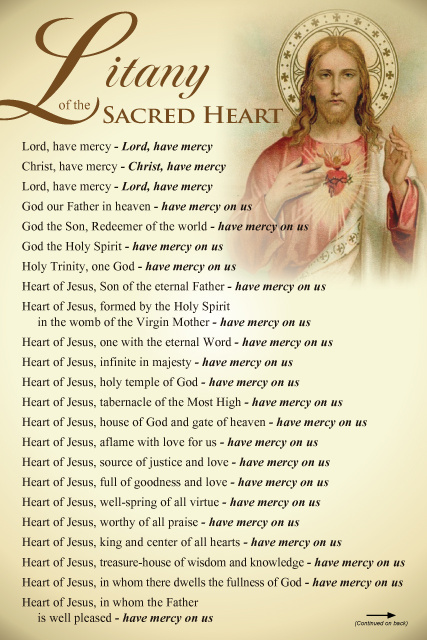
Praying to the Sacred Heart of Jesus

This, like the ritual of the Mass itself, the alleged moment of transubstantiation, is another of those Catholic rituals I simply can't accept, and don't get, as both a secularist AND an ex-Lutheran.

And, no, any Catholics, do NOT tell me these are prayers to Jesus. They are prayers to his sacred heart. And they're as literal, even literalistic, as Ken Ham or other Protestant fundamentalist beliefs and belief statements.

The image at left, along with many others like it on the Net, makes that clear, as do the countless prayers, novenas and other words of devotion that can also be found online.

I've elsewhere said that pre-Columbian Contact Aztecs who ripped beating hearts from still living sacrificial victims show that many New World First Peoples were NOT Rousellian noble savages. At the same time, as with Puebloan "versus" monastic flagellation (yes, Puebloans did it pre-contact), it seems like there was openness to cross-pollination.

The Sacred Heart devotion, like indulgences and other nonsense, started in the late Middle Ages, even though the first Feast of the Sacred Heart did not get celebrated until 1670. It arises out of older meditational devotion to the wounds of Christ.

That itself, per the Aztecs above, is itself blood-drenched and bloodthirsty enough. Per devotion to all five wounds, it comes off like Roman augury, that the wounds of Jesus might not just be comforting, but with enough meditation, might even have revelatory messages.

And yet, Martin Luther himself did NOT condemn it, unlike many other Catholic things, including the veneration of relics, which kind of parallels this. As shown at left, the famous Luther Rose has a heart at the center, which cannot be but a less bloodthirsty version of the Sacred Heart, even if Luther said the heart in his rose was the heart of faith.

As with the best biblical interpretation of the Lord's Supper, I think Luther was wrong and the Reformed were right. And it's not just the Reformed. Orthodox accuse Catholics of Nestorianism with the Sacred Heart. Arguably they're right, too.

And, of course, because there's a Sacred Heart of Jesus, as Mariology grew, especially the Immaculate Conception, there's an Immaculate Heart of Mary. And, with qualifications, Marty would probably be OK with that, too. Other than rejecting her as redemptrix, Luther's Mariology was basically pretty Catholic his whole life.

Speaking of finding things online, per a previous post of mine about advertisements in Catholic church bulletins, it seems like Catholics don't miss a chance to make a buck when devotional dedication is the issue. Check out this page, which I was led to on Googling. And, I'm going to go further on this in a follow-up post. I mean, who could resist a prayer pillow case?

And, speaking of philosophy and beating hearts, the Aztecs practiced philosophy just as sophisticated as the Thomist system that the Spanish Inquisitors brought to the new world.

Thursday, July 11, 2019

Catholics really don't miss a dollar

For some newspaper work recently, I needed to find a bulletin from one of the local Catholic churches.

I did so, online.

And was jarred into something I hadn't seen in several years.

Advertising on a church bulletin.

I'm not sure why Catholics do this in general, let alone so much. (This bulletin, on 8 pages, had one that was all ads, and a second that was just about so. Most of them not huge, but rather, a church bulletin equivalent of newspaper "sig page" ads.)

Anyway, they do do it; I've seen it in Catholic bulletins elsewhere. It had just been a while for me to have seen it.

So, the "why" in general has several parts.

First, why do they do it and Protestants don't?

This, in turn, has two parts.

One is, IMO, because there are many Protestant churches but only one Catholic one. So, less competition to get ads.

In turn, advertisers of non-Catholic owned businesses may think the same way.

Another may be church finance related.

Catholic churches generally ask members as part of stewardship to pledge a specific amount each year. WHY a parishioner chooses a certain dollar amount is on their religious conscience; Catholics, like mainline Protestants, preach stewardship and not a literal tithe. That said, a Catholic business owner may prorate their company's ads in a church bulletin as part of that tithe.

Related to that, this may be, for Catholic business owners seeing a captive audience, a Catholic version of fundamentalist type Protestants putting the fish symbol on their outside-world ads, etc. But, Catholics, per the one church vs many churches, don't have to do that. So, those two whys tie together.

There's a second "why," though, that's also versus Protestants — and perhaps vs the Orthodox, where, in most places in America where there is an Orthodox presence, it's usually limited to just OCA or else one of the nationalist Orthodox churches, meaning they could pull it off, but I've not seen it, at least ransacking my memory.

That's a more theology-related why.

Narrowly speaking, this is an adiophoron, but ....

It treds close to the line, of this secularist former Lutheran, of trying to worship both God and Mammon. At a minimum, it feels religiously distasteful to pop open a church bulletin and see a bunch of ads.

Were I still religious, the distastefulness would be of a sort to challenge my spirituality.

But, it's clearly entrenched in American Catholicism.

Of European Catholicism, I have no idea. I've been to the Continent once, and to a few churches, including one cathedral, but I didn't go around looking to glom on to bulletins.

Thursday, May 30, 2019

An ex-Lutheran still can't stomach a Mass
as either a Lutheran by heritage or a secularist

I recently attended a Catholic high school graduation. It wasn’t out of personal choice, but rather I was on the newspaper clock. One of the two communities I cover as editor of two newspapers has a Catholic as well as a public high school, and yes, it’s rare for a Catholic high school to be attached to a single parish and in a small town unless it’s VERY Catholic.

Some regular readers here know my background as a Lutheran-turned-secularist, who started that turning halfway through seminary, and comes from a dyed-in-the-wool Lutheran family, including ministers and teachers.

And, that’s the setting for the rest of the story.

The graduation ceremony was at the local church, and was part of not just a worship service, but a regular Mass.

And … my skin almost crawled.

I still can't, don’t, and won’t accept the "re-sacrifice" of the Mass itself from a Lutheran perspective, let alone a secularist one. My Lutheran background understands why Luther himself, and other Protestant Reformers both Lutheran and Calvinist, recoiled at this.

If Jesus were the once and for all sacrifice, being fully divine as well as fully human, on a vicarious atonement theory of his death, then he was sacrificed once. Period. That’s the whole thrust of John’s version of the Passion, setting Passover a day later than the Synoptics and having Jesus as the perfect replacement for the Passover lambs.

I’ve attended a couple of Masses before, but they were for comparative religion classes or other things, and all Saturday night quickies (the priest wasn’t even vested in a couple of cases, just wearing his "dog collar" [as an ex-Lutheran, not ex-Baptist, I can say that]) and I got out. And wasn’t reflective on what was really happening at ones I had to attend for class reasons. (Ditto on some of the more interesting non-Lutheran Protestant churches I attended.)

There were other offsetting things that I heard.

One was the reference to the "sacrifice" by believers before the Eucharist itself. It makes me understand more clearly the Catholic emphasis on giving something up for Lent, which most Protestants, let alone the Faitheist groupies of Original Faitheist Chris Stedman just don’t get. If they did, they wouldn’t dive into their own version of giving stuff up. (Faitheist the book and the cult of Chris Stedman are so shoddy I blogged about it the book, him and it the cult not once but twice, the first time in fair detail, the second time massively so.)

Per James Carroll's new longform in The Atlantic, well worth a read, primarily about clericalism in Catholicism, the whole guilt-laden background is what seems to drive the focus on ongoing sacrifice. And, as a good ex-Lutheran, I know that guilt-laden background weighed quite heavily on Martin Luther.

I also found it interesting that the Mass — the actual Mass, not the larger service — edits the biblical language. The priest began the consecration and transubstantiation (have to add that word) like this:

"On the same night he was betrayed when he willingly entered his sacrifice ..." The Bible says no such thing at the time, of course, about his willingness. And, Paul wrote 1 Corinthians before any of the Gospels, let alone the Jesus of piety of Luke.

AND, I've said before, that παραδίδωμι in Paul's Greek can have a middle/intransitive as well as a passive meaning. In which case, in English, Paul says:

"On the same night he was arrested, he took bread ..." There was no betrayal, contra later Christian peshers mining Psalm 119 and other spots for a dark betrayal by Judas (which has its flip side in Gnostic thought with Judas Thomas, and Thomas being the Aramaic of Didymus, which is just "twin" in English. Here, Jesus and Judas are part of a cosmic Gnostic-Jungian play.) I have also blogged about THAT not just once but twice, both times in the context of larger issues of biblical criticism and in re Jesus mythicism as well.

Next?

"The new and eternal covenant."

It’s certainly not called that, either. That said, Christians believe it is.

THAT said, if you believe that, you’ve undermined your own idea of the Mass as a re-sacrifice, haven’t you? You've also raised questions of the intertwining of god's foreknowledge, predestination, omnipotence, etc., as in ... to be snarky ... "Couldn't got get that covenant right the first time?"

On the bit more cynical side, or knee-jerk crude humor side, Pavlovian thoughts popped into my head when I heard that bell. Maybe there's a serious angle to that, too.

==

I will say, and I don't know if it was more the particular priest (raised Baptist himself) or more percolation years for post-Vatican II emphasis on preaching in Catholic worship, but the father wasn't bad on his graduation homily.