Showing posts with label Christian fundamentalism. Show all posts

Thursday, April 24, 2025

There's more to agnostics than meets the eye?

 Well, maybe, or maybe not, if the eye observing the agnostic is critically perceptive enough.

PsyPost confirms what I think many of us have already known.

Using "atheist" in its modern Western sense of "irreligious" (after all, tens if not hundreds of millions of Theravada Buddhists are quite religious and quite atheistic), it says that agnostics have a different psychological mindset than either atheists or the religious. 

Research findings indicate agnostics possess a distinct psychological profile characterized by higher indecisiveness, greater neuroticism, and a stronger tendency to search for alternatives in life compared to both atheists and religious believers. ... Agnostics exhibited a greater tendency to search for life alternatives, suggesting they maintain a broader orientation toward keeping options open rather than simply being uncertain atheists.

The study, from the UK, has enough participants to be reasonably solid versus small sample size issues.

The study also notes this:

Strong agnostic identifiers rated both themselves and others positively on traits associated with being a “nice person” without exhibiting the “better-than-average effect” seen in the other groups. This pattern may reflect a form of humility or reluctance to assert superiority consistent with the agnostic worldview.

Which in turn reflects on part of why people like me scorn Gnu Atheists, seeing them as the Western atheism version of the religiously fundagelical.

Speaking of?

How much can these findings about agnostics be extended to non-Gnu Atheists, especially the type of people listed in religious   atheistic (in the western sense, of course, excluding Theravada) spectra in old books, i.e., people who were once called "soft atheists"? That's probably a bit firmer than "uncertain atheists" but might still have people who have the humility issues locked in more than at least the Gnu, or fundamentalist, atheists. That said, the study doesn't talk about how the religiously fundamentalist compare to the religiously latitudinarian. Nor does it talk about how monotheisms compare to Eastern religions.

Thursday, April 17, 2025

Holy Week: A secularist perception 30 years out


Salvador Dali's ethereal version of The Last Supper, not the Lord's Supper. The title is theologically correct per Matthew.

It's actually been a bit over 30 years since I graduated from Concordia Seminary in St. Louis, Missouri with my master's of divinity degree, realizing before graduation that, at minimum, I wasn't a fundamentalist Lutheran.

But, I "searched" for a couple of years, looking mentally at more liberal Lutheranism, and bits of other more liberal Protestantism, too. I looked at Unitarianism. Went to a few services. Looking for a possible full-time career, as I realized I couldn't do liberal Lutheranism, either, I inquired about the Unitarian ministry. I was told I'd have to do another full-year internship, and then, there was still no guarantee of a hiring, of course.

Went to a few meetings of the St. Louis chapter of The Ethical Society; already then, it may have been the largest outpost of the organization.

I also ran through Buddhist ideas, what I knew then, in my head. (And, yes, once again, contra Robert Wright, it's a religion. Still is.)

I didn't think much about Hinduism, despite Eckankar having an office or whatever across one side street from the seminary's grounds. (Said grounds, with lots of semi-forested area, also attracted several people I am guessing were Shinto. And, real Shinto, not Meiji state Shinto.) Never thought about Islam.

Anyway, I passed on all of them, and by 30 years ago, was a confirmed secularist. Here's the last of a six-part series on my journey.

A few years later, encountering the self-help world, I tried to do that. Even read some of the "manifestation" type books, and — I couldn't.

About 20 years ago or a bit more, I got lost while hiking in Canyonlands National Park, in late July. I ran out of water. I cycled through prayers to Yahweh, Jesus, Allah, Olympian and Norse divinities, Vishnu and more — and then stopped.

Anyway, here I am today.

Whipping through friends' of friends' Facebook pages yesterday, I saw .... gack.

Along with pious Lutheranism, cheapish memes. AI-generated versions of Maundy Thursday and Palm Sunday art. (This sets aside Hyam Maccoby's claim that this event probably happened on Sukkoth, not Passover [if it happened at all].)

Not on Lutheran friends' of friends' pages, but elsewhere, I've seen the "If Jesus had a gun, he'd still be alive." Some wingnuts may be trying to "own the liberals" with that, but others may not have a clue that most varieties of Christianity preach a substitutionary atonement. So, no, Jesus with a gun defeats the whole purpose, according to Christianity. (And yes, the idea that many self-professed [self-alleged?] Christians might be that theologically illiterate is no shock to me and shouldn't be to you.)

Anyway, even without the more cringey stuff on friends' of friends' pages, college or seminary alums of mine, I realized just how foreign that all is to me. 

It's not as distant as it may be for an Orthodox Jew, let alone a Buddhist, but ... it's foreign.

That said, Gnu Atheism — especially Jesus mysticism subvariants that seem to believe Jesus MUST BE and MUST BE PROVEN TO BE nonexistent for atheism to be firm, are just about as foreign. And possibly even more stupid. It's definitely more illogical.

And, with that said, as a good secular humanist, as long as fundagelically religious — and Gnu Atheist — neither pick my pocket, nor break my bones, per Thomas Jefferson, I have less and less interest on a regular basis at going attack dog on either one.

Thursday, July 14, 2022

So, there's a herd of "other evangelicals" eh?

 So claimed a friend of James McGrath on Facebook. (McGrath posts as "public," so violating no confidences.)

The friend touts a study by a prof at Carlton College saying that 35 percent of evangelicals may be of this "other type," who the prof hints aren't diehard MAGAts.

Problems? They abound.

First, as I told John W. Moreland, a prof at Multnomah Bible College who posted the link and has good PR reasons to push it? (McGrath's OP had been a piece by John Pavolovitz.)

There's NO DATA. No Pew Research etc.

Second, he pulls back on that right away, saying "15-30 percent" identify as "left-liberal." I have no idea what "left-liberal" means to him, but it's probably several degrees to the right of what it does for me.

Thirdd, in my world of political and religious observation as a newspaper editor secularist with a graduate divinity degree, "other evangelicals" would be reading Sojourners not Christianity Today.

Fourth, per Matthew 7:16, "they will know you by your deeds," are they acting on this? Probably not:

At times, the other evangelicals’ styles of public and political engagement look uncomfortably similar to the conservative evangelicalism against which it is constructed. They reduce complex political issues to dogmatic religious positions. They develop litmus tests to assess the purity or pollution of fellow believers and their political views. They ignore race and its role in maintaining contemporary social, economic, and political inequity. They use strident religious language that suppresses dialogue and dissent. In these moments, despite being substantively opposed to Christian Right style public and political engagement, the other evangelicals, like a mirror, reflect and reverse the original image.

There you go.

As for the one Pew link Markofski DOES have? Millennial evangelicals are still a lot closer to fellow evangelicals than to fellow Millennials. (Other Pew research says they'll likely stay GOP.)

Moreland also ignores that racism and dogwhistles go back to Reagan at the Neshoba County Fair.

Thursday, April 28, 2022

The bullshit of Jonathan Poletti reaches a new low, on the Shroud of Turin


Poletti, who has a Medium site popular with what I'll call "edgy evangelicals,", people who promote "dudebro Christianity" or whatever, claims the Shroud of Turin artifact really is 2,000 years old and that a new study proves that.

My response? Expanded from what I posted on Medium:

Bullshit by Poletti reaches a new level, including a flat-out lie with the Fox News line of "I report, you decide" in your headline, you explicitly claimed it's 2,000 years old, which even your new study doesn't, hedging your bet.

Bullshit on the original and bullshit squared in your response to CA in comments. CA is right; the test is NOT designed to test the Shroud's age, and in fact, the way it's conducted, and framed, comes off as handwaving to try to get the gullible to ignore that it's not designed to test its age and to give the Shroud-grifters (anybody you know?) an ammunition head fake.

The testers also give away the game with their statements about presumed and required preservation history. Anybody who knows anything about Turin knows it gets well below 20C in winter and that damp medieval castles and cathedrals got and remained well below 20C for weeks at a time without central heating. Humidity could also have gone well above 75 percent.

As for getting about 22.5C? Erm, there's this fire that burned the shroud that the authors (refuse to call them "researchers" as they're not) conveniently ignore.

(The original pseudo-research presumes the shroud was kept consistently between 20-22.5C and 55-75 percent humidity.)

Poletti admits the fire, and flooding as well, which would have pushed the shroud above 75 percent humidity. 

More specifically, here's their claim:

Moreover, it is interesting to point out that our analysis has shown that, in order for the TS fabric to be about 20 centuries old, it should have necessarily been kept at an average secular temperature of about 22.5 ± 0.5 °C and an average relative humidity of 55 ± 5% for 13 centuries preceding the XIV century. From Equation (5), it follows that if the average relative humidity was of the order of 75 ± 5%, to obtain the same value of the measured natural aging of 0.60 ± 0.02 for the TS sample, the average secular room temperature should be about 20.0 ± 0.5 °C. Therefore, from our WAXS characterization it follows that we have a range of allowed secular average room temperatures of 20.0–22.5 °C, correlated with a range of average relative humidity values of 75–55%, as climate constraints, for the TS to be a 20-centuries-old relic. These physical constraints on the secular average room temperature and the average relative humidity, obtained by measuring the natural aging of the cellulose of the TS sample, here realized through WAXS characterization, could help historians test their hypotheses throughout the possible locations in the world and historical periods in which the TS could have been kept during the 13 centuries before its documented history in Europe.

And, we know that the shroud was NOWHERE NEAR that well preserved on this tight of a temperature and humidity range.

Oh, "appears to be Jewish" means nothing. I "appear to be Jewish" because of what a hospital doctor did days after I was born. So that's a bullshit framing line, Poletti. As for details of why it might "look Jewish"? Per the Wiki link, probably because it's a deliberate forgery, and modern researchers have shown how it could have been done.

Back to the Fox News line of "I report, you decide," Poletti.

It comes off as an oxymoron, but will you be honest enough to admit you lied?

I already know the answer and it's "he won't."

He's an evangelical evangelizing doorknob. I've argued with him before but never busted him in a flat-out lie. 

And, hypocritical in that, if he's following the Calvinist version of the Ten Commandments, the shroud at least approaches being a graven image. It certainly is the spirit of one. It's an idol. That's especially true with it not only being a medieval creation, but — as recognized in that era, no less! — it likely being a medieval forgery.

==

But, the authors not researchers are themselves liars with the heading of their study, too: "X-ray Dating of a Turin Shroud’s Linen Sample." The study itself doesn't claim to actually date anything, once you look past the handwaving.

And, there's lies in their full study text:

Moreover, other dating methods agree in the assignment of the TS to the first century AD [5,10,11,12]. Spectroscopic methods, based on Fourier Transform Infrared spectroscopy/Attenuated Total Reflectance [10] and Raman spectroscopy [11], date the Shroud to 300 Before Christ (BC) ± 400 years and 200 BC ± 500 years, respectively. The mechanical multi-parametric method, based on an analysis of five parameters, including the breaking load and Young’s modulus and the loss factor, after an adequate calibration based on the results of two dozen samples of known age, dates TS as 400 AD ± 400 years old [12]. Estimates of the kinetic constants for the loss of vanillin from lignin suggest that TS has an age range from 1300 to 3000 years [5]. A recent numismatic analysis [13] proposes that TS was already present in 692 AD.

Bullshit.

Let's quote Wikipedia in response:

After years of discussion, the Holy See permitted radiocarbon dating on portions of a swatch taken from a corner of the shroud. Independent tests in 1988 at the University of Oxford, the University of Arizona, and the Swiss Federal Institute of Technology concluded with 95% confidence that the shroud material dated to 1260–1390 AD. .... The most recent analysis (2020) concludes that the stated date range needs to be adjusted by up to 88 years in order to properly meet the requirement of "95% confidence".

And add this from a separate piece on radiocarbon dating of the Shroud:

Despite some technical concerns that have been raised about radiocarbon dating of the Shroud,[5][6] no radiocarbon-dating expert has asserted that the dating is unreliable.[7]

Period and end of story. People working at some crystallography institute are grasping at straws.

Let's also note these are all native Italians. This underscores my contention that while formal church-going religiosity may be much lower in Western Europe than the US, non-structural religiosity is still pretty high there.

Finally, per Wiki's article on it, wide-angle X-ray scattering is not a scientific dating tool.

I also see, per Wiki's link on radiocarbon dating, that this is NOT the first time Sgr. Giulio Fanti has promoted Shroud bullshit. And, not the first time he's engaged in scientifically iffy methodology as part of this. Oh, and publishing your findings at places like the London School of Economics and Political Science also undermines you.

Fanti has also claimed to be able to date the shroud with infrared light, Live Science notes. So, if that was so perfect in 2013, why did you need to do it again with WAXS? Oops. And, because it of course needs to be said, infrared light is not a scientific dating tool. (Let's note that he self-references in the new study, to this study, when claiming that previous studies confirm a circa 2,000 year old date. Also note that he uses wiggle room by saying it's around this time — lest anybody accuse him of doing exactly what he's doing, namely, stacking the deck.)

And, Fanti is ALSO listed at another Wiki piece on "fringe theories about the Shroud of Turin." And, he's been called out for that bullshit.

Saturday, October 16, 2021

IF fundagelical Christianity is dying, why?

 In a piece a couple of days ago, looking at comments by resigned Southern Baptist Convention ethicist Russell Moore, I said that if fundagelical Christianity is dying, its wounds are self-inflicted in ways that Moore's prescription won't heal.

Moore in part worries, basically, about "Trumpism" infecting his denomination. With a sister who's a preacher's wife in the main conservative wing of Lutheranism, I know that's becoming a problem there, too. Sidebar: German-Americans, among white ethnic divisions, broke harder for Trump than anybody else.

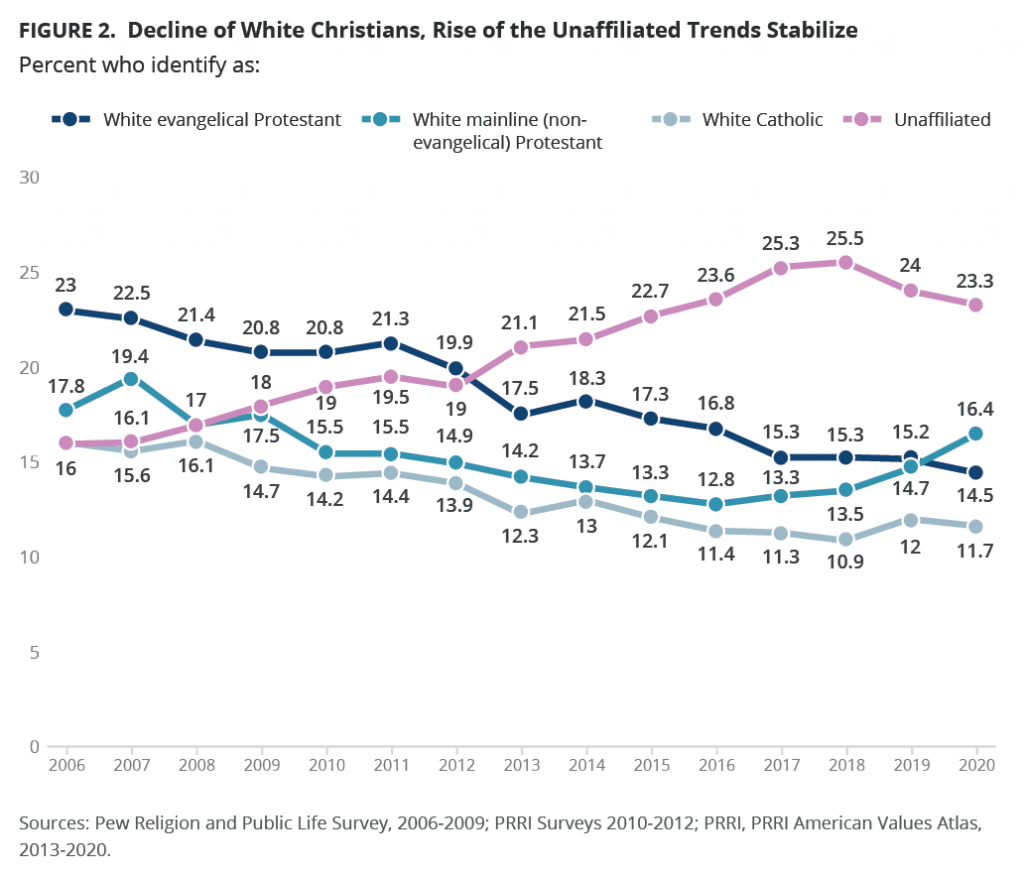
But, in the last few years, mainline Protestantism has ticked up even as the fundagelical world has declined:


Is that in any way connected to Trumpism in religion?

An actually interesting person at Medium, originally blogging elsewhere, talked about it. That said, David Gamble may be wrong on this one.

First, the fundagelical decline has been happening for a long time, at least among Whites. And, already pre-Trump, it was sharper than the White Catholic decline.

Second, White mainline Protestants trending upward in 2017? Trumpism may have been a factor, but probably not the only one. It's likely that the majority of "leavers" of fundagelicalism were becoming Nones.

Third, and in anticipating a future post? One thing about this is problematic.

The line graph has "White" for everything but the unaffiliated, the "Nones." 

That said, that's partially rectified later with further information and additional graphs.

Asian Americans and the multiracial are most likely to be Nones. American Indians are third, which indicates that Nones includes indigenous religion. The percentage of Whites who identify as Nones is only two points ahead of Blacks, which in turn is two points ahead of Hispanics.


Thursday, October 07, 2021

Unmaking the myth of the "white Christian worldview"

 Robert P. Jones, an ex-fundagelical of some sort, talks at Time about escaping the "white Christian worldview."

But, as two Tweets of mine say to him, to avoid typing twice, the piece is problematic and simplistic.

First, the reality of American Christianity today is more complex than his Mississippi birthland:

My midwestern Lutheranism, while socially and religiously conservative, was nothing like his religious childhood. (I've been to white and black Baptist services, I'll add.)

Within the piece, he mentions the recent sharp decline of Southern Baptists. Yes, and mainline Protestants declined before that. And Catholics are declining as well. And, as time and motion studies have shown, Americans have long lied about frequency of church attendance, even before the rise of the "nones." (That said, the rise of the nones is NOT all it's sometimes cracked up to be.)

Second, the reality of American Christianity when he was a young'un and St. Ronald of Reagan was running for president was more complicated outside the South than he notes, which leads to this.

It's true that Reagan (maybe told so by his horoscope, and yes, he believed them, as he turned Nancy on to astrology, not the other way around) pandered to the Religious Right and helped fuel this fusion, but that helps make the point of my second tweet! Especially when you tie this to the lying about church attendance. It's cultural Christianism, a fundagelical version of Samuel Huntington's angle.

That said, in some way, shape or form, that's been the case in much of the Christian world since Roman emperor Theodosius made Christianity the state religion of the empire nearly 1,650 years ago. Political types (and, yes, politics exists outside democracies) have long grifted on cultural Christianism. It hasn't had racism attached to it; "racism" as we know it today didn't really exist in antiquity, after all.

But, if he wants to talk about real Christian sins, he should deal with that.

Since I'm a secularist, I've written enough about another rescue attempt for American Christianity.

Note: This is part one of a three-part series. The second will expand on the decline of evangelical Christians. The third will note that the rise of the Nones has itself hit a speed bump. Both will rely on new polling and analysis from this summer by Jones' outfit, PRRI.

Saturday, June 05, 2021

More Jesus stupidity from Xn evangelicals

 More and more, I think of Medium as the place where bad blogging hot takes filled with clickbait stupidity go for a new life. Medium's multiple business model fails reflect this.

Now, for the unfamiliar, although some atheist types use the mash-up word "fundagelical," not all evangelicals are literalists or even full-on biblical conservatives. That said, I reject the idea of truly liberal evangelicalism, as I take it a a sine qua non of evangelicalism that not only is salvation through Jesus universal, so is the need for it.

OK, back to the current round of stupidity I ran into on my email algorithmic feed yesterday. And, given that I take time not only to read, but to argue with, these nutters means its my fault for Medium shoving more of this at me.

===

On the first piece, a Medium "brand" having the name Koinonia kind of gives the game up right there.

Second, no, Kyle Chastain, contra your claim, Jesus wasn't "dangerous" in the way you claim, though that's a common evangelical trope, along with the claim that Jesus says "you don't need to change anything, just everything."

Reality is that Chastain ignores the broad variety of Judaism and instead has Jesus rebelling against some sort of "system." I think he's stereotyping temple Judaism as being all Judaism, or maybe also using the stereotyped caricature of Pharisaic Judaism as a "system," but he's not clear. 

He IS, though, wrong. As I said, Judaism was indeed broad, and there was no "system" against which Jesus revolted.

AND, to the degree he challenged certain types of Judaism, he was far from alone. John the Baptizer was an even more ferocious challenger. Rome executed yet other Jews, or their client kings did.

Chaistain has other modern evangelical errors, like claiming that in ancient Palestine, church and state were one, when in Roman, or Maccabean, ears, such framing was simply nonsensical.

The biggest error is the logical conflict in trying to claim Jesus was such a system-breaker while at the same time trying to proof-text the Tanakh for "all about Jesus."

The second-biggest error, once one throws out circular arguments from claims of Jesus' divinity, is not asking if he's really got the BEST answer for "living outside systems." 

Finally, since modern critical scholarship claims that many things allegedly said (or done) by Jesus actually weren't, what system he was rebelling against, and what system he was NOT rebelling againts, are still up in the air.

==

Second is Jonathan Poletti, whose nuttery I've run into before. He claims there are 10 things Christians don't know about Jesus. First, it sounds like we're in strawmanning territory right away. Second, he must not have originally been inspired, because the URL says "7 things."

Some are things that a fair amount of Xns surely DO know, but that's not where I'm headed. 

Rather, Point 9 is surely wrong and Point 10 almost surely so

On the first, Jesus was very likely NOT LGBQTIA, "tia"? bah "firendly." The claim that the Roman centurian was gaybagging the slave he had Jesus heal is as laughable as the claims Abe Lincoln was gay because during his frontier court hustings he occasionally shared a bed with a man while on the road. Poletti, in responding to a comment there, didn't understand the analogy or parallelism, so I spelled it out in more detail, and said it was an argument from silence.

In addition, Jesus as a good observant Jew come to "fulfill the Torah" would have almost certainly looked askance at gay sex. Paul did, and don't @ me that he didn't, atheists. I've covered this in EXTREME detail, with updates, and looking at that, am now reminded that Poletti is not the first to make this stupid claim that the centurion and the servant were gay lovers, and I clearly refudiated it before.

Also, Jesus not being omniscient, even if there WERE a gay relationship, as only the centurion visited him, and surely didn't say, "I love him, Jesus, as in I LOVE him," Jesus wouldn't have known they were gay lovers.

Fourth, beyond the Torah, as a backwoods Jewish peasant, he likely would have been repulsed by such things.

On the second, no, Jesus almost certainly was NOT raped as part of crucifixion humiliation. There's reasons that critical scholarship has largely killed with silence David Tombs' 1999 paper, and that's because Tombs himself is arguing from silence almost totally, about crucifixions in general. (Update: Poletti claimed it wasn't an argument from silence. In my reply, I said "yes it was," told him he wasn't the first to make this idiotic claim, and pasted the link above.) The tombs paper isn't "famous," at least not outside evangelical circles. And, when I did a search on "were Roman crucifixion victims raped," one gets fundagelicals plus Mel Gibson Catholics. 

Poletti himself is more clickbaiter than fundagelical, with pieces such as the one claiming Codex Bezae is a different New Testament, for example. (Update: In reply, I then told him I actually knew more about the bible than he did and that he WAS a clickbaiter IMO.)

And, wrong elsewhere.

First, Christians did NOT come up with the vocalization of Yahweh. He ignores his own piece stating that the Tetragrammaton wasn't included in post-150 CE Septuagints, and also ignores the Masoretic Text, its development of Hebrew vowel pointing and related matters.

Yes, contra Poletti, the bible IS anti-gay. See my link above.

No, an earlier bible was NOT discovered in 1883. (I've actually read a book about this.)

Wednesday, December 30, 2020

Thoughts for liberal Christians on the "solstice star"

Jupiter and Saturn on Dec. 21 had their closest conjunction in 400 years and their closest nighttime, visible one in about 800 years.

And, fitting for methodologically naturalist science, it's on the winter solstice.

And, I appear to have indeed gotten it, as ragged as it is, on camera, handheld, as you can see at left. That would be Jupiter at left in the photo, and I believe Io above and Europa below.

And, per a blog post of several years ago on my primary blog, as far as modern explanation of the development of our Solar System, Laplace is the reason for the season. That's French astronomer Pierre-Simon Laplace, who articulated the "nebular hypothesis" more than 200 years ago.

For  latest modern modelings on how the nebular Solar System developed, see this great Nautilus piece. Among other things, it explained why Jupiter and Saturn likely moved out, rather than in closer to the Sun, as they gained mass.

From here on out, I'm going to expand on what I wrote on my primary blog about this conjunction, to reflect further on the title of the post here.

Per two paragraphs above? As a secular humanist, I can appreciate the wonder and joy of astronomy without having to put either Christian or New Age veneers over it. I can also appreciate the wonder of reaching across 800 years of history. But also, unlike some of Laplace's older peers (Diderot, d'Holbach even more) I don't have to act like a Gnu Atheist, either.

After I did editing of pix and an initial wrap on the blog post (I already had the Nautilus and my old blog post in place yesterday) I started thinking about "miracles" of human ingenuity.

First, of course, is the cultural evolution in astronomical understanding that led Copernicus to re-invent the heliocentric theory and for it to gain acceptance. Then came the big step of Kepler's gathering of empirical evidence to establish elliptical orbits. Then, Galileo with Venerean phases giving empirical support for heliocentrism. And so forth.

On the personal side? The camera and lens I used to shoot that photo? Arguably better than ones I would have paid 10 times as much for 15 years ago.

And, per the verse from Proverbs? Not always, but often, with all our new knowing, has come new understanding as well.

And, now to the header in more detail.

I saw plenty of #ChristmasStar hashtags on Twitter. This ignores, of course, that it fell on the solstice, per good old Laplace. It also ignores that the ancient world had all sorts of winter festivals, that Christianity "pegged" Dec. 25 as Christmas' date because of a festival of Mithras and other things, such as the date that the Romans celebrated the winter solstice and emperor Aurelian setting the festival of Sol Invictus on that date. Also, fittingly, since Saturn is one of the two planets in the conjunction, and Saturnalia ran Dec. 17-23 on the old Julian calendar, that we could call it the #SaturnaliaStar just as much as the #ChristmasStar.

To this point, I'm primarily refuting fundamentalist and conservative evangelical Protestants, traditionalist Catholics, etc.

But, now we're going to speak to liberal members of suburban and urban congregations within ELCA Lutheranism, the United Methodist Church, etc.

Some of you were tweeting #ChristmasStar, too, of that I have no doubt.

Well, let's look at Matthew's story, specifically 2:1-2, 9:

After Jesus was born in Bethlehem in Judea, during the time of King Herod, Magi from the east came to Jerusalem and asked, “Where is the one who has been born king of the Jews? We saw his star when it rose and have come to worship him.” … 

After they had heard the king, they went on their way, and the star they had seen when it rose went ahead of them until it stopped over the place where the child was.

A few notes.

The opening would seem to indicate a traditional star (including the "planetoi," as known in Greek), interpreted in the light of Zoroastrian / Babylonian astrology.

But, ordinary stars don't stop. Planets do. Venus and Mercury, being inside Earth's orbit, cannot stop overhead, though. So, that would leave Mars, Jupiter and Saturn.

But, would that really be enough for Magi to say "This is it!"? After all, Mars in opposition and standstill is stopped relative to every place on Earth. Ditto for something like a Great Conjunction, excepting nearness to the horizon affecting visibility, of course. (Update: Mars and Venus have their own "great conjunction" on July 12. And, although Venus cannot be directly overhead, arguably, because of its moving, it could kind of fulfill the Magi's alleged perception. Plus, Venus is brighter than Jupiter and Mars is brighter than Saturn. OTOH, Venus-Mars conjunctions happen much more often than Jupiter-Saturn ones. As in, every 2.1 years on average, 10 times more frequently than Jupiter-Saturn, meaning that it would be no big deal, even a really close conjunction.)

So, we are presumed to be invited to see this as a miracle. Just like Joshua making the sun stand still.

Well, if you're a non-literalist Christian, that leaves you with only two logical alternatives.

Either you accept that there was a literal miracle, or you accept that Matthew, writing some sort of pesher on various passages from the Tanakh, went way overboard on trying to sell this as a literal miracle.

Because, just like Joshua making the sun stand still, and contra the bogus story that there's a computer that traces planetary and solar moves back 3,100 or whatever years until it hits a glitch, there is, per people from David Hume to Carl Sagan, NO EVIDENCE for such a thing. That doesn't even take into account the psychological factor that there were world civilizations 3,100 years ago that would have reported a 28-hour day or whatever.

And, an ordinary planetary opposition, or a close conjunction even with an opposition, would not have been eye-catching like this, quite literally.

So, non-literalist Christians about Moses or whatever? You're invited to extend your non-literalism further.

Thursday, August 20, 2020

The NYT and sheltered big media coverage of religion

On my primary blog, I recently discussed a New York Times story about President Donald Trump's continued support among the religious right, especially in rural heartland areas.

Here, I'm going to shift that focus more to the New York Times' coverage of religious issues, to the degree they're exemplified by this.

"Christianity will have power"? Yes, it's a nice phrase, but ... was one line in one speech in Iowa enough to elevate the speech into Donald Trump's version of a Cornerstone Speech vis-a-vis his relationship to the Religious Right? And, if so, why?

The New York Times would have you think so. But, I don't see it making the case, and its "marketing" efforts don't sell me any more than the story itself.

First, two of those marketing Tweets and my responses:
Uhh, no. I don't "need" anyone.
There you are, Mr. NYT National Editor Marc Lacey.

Then this:
Sorry, but no translator needed, Ms. Deputy National Editor Yang.

Here you are:
Just what did Dias leave off the table?

First, why Trump instead of Ted Cruz? That speech was in January 2016, before the Iowa caucus vote. On paper, Dominionist Ted Cruz and his Seven Mountains daddy were the ideal candidates for the Religious Right to back. So, why didn't they? (Pew notes that, in polling, the most devout among the evangelicals DID tilt Cruz, even though, overall, the Religious Right tilted Trump. Obvious deduction? Lots of these people may be sincere in their belief claims but don't go to church that often!)

If you're going to have someone with a graduate religious degree from Princeton work on this story for, I presume, several weeks, and you can't answer that? The story comes off as election-year pandering, in my book. True, you would still want the focus on Trump, but if you can't explain why him, not Cruz, then you can't fully explain "why still him" today, can you?

That said, assuming some of the lower-star ratings of a book that Dias edited are true, maybe that Princeton degree is not worth that much. A decade ago, I came across a friend of a good online friend who was in the graduate program at Harvard Divinity and who insisted that Plato's Euthyphro dilemma didn't apply to Christianity, so this isn't a "sour grapes" issue, it's a real observation. And, no, religious right idiots, claiming that good is good based on god's nature does NOT avoid the dilemma.

Second is Dias claiming that this is all new:
The Trump era has revealed the complete fusion of evangelical Christianity and conservative politics, even as white evangelical Christianity continues to decline as a share of the national population.
In reality, with data research sites like Pew having written about this for three or four years straight now, the "Rise of the Nones" (which is a broader issue than just the decline of conservative evangelical Xianity, and blogged about me three years ago, as well as last year) is yesterday's news. Indeed, the piece of mine three years ago noted that, by this year, per Pew estimates, "nones" would equal Catholics in the American population.

The problem is not just that the NYT is behind the curve on Nones. It's that a lot of people who might fall into "Nones" territory may not know this if they get much of their religious news from the Times, or from outfits following its lead. This ties to how politicians think their constituents are, overall, even more conservative than is true.  

As for the "complete fusion" issue? Forty years ago, the Religious Right backed for president a man who had expanded abortion access while governor of California, who never went to church and who consulted astrologers. (Ronnie turned Nancy on to that, not the other way around.)

Whether Dias personally believes this or not, I don't know. But, this is a common trope from the MSM, and from much of national Democratic leadership, and not just about religion. Trump is indeed an outlier on the vulgarity of expression of his stances. He may be a minor to moderate outlier on the degree of severity of some of his stances. But, no, nearly complete fusion within today's Republican Party on a lot of issues was around long before Trump.

Now, onto my original Twitter thread, with this blogpost being added to the end of it after being finished.

First:
See, that "bully" part is important. Per "The Rise of the Nones" issues, the Religious Right has been losing power for some time. Rather than sidle up to Hillary Clinton and her conservative DC prayer circle warrior background with The Fellowship, though, because she was pro-choice, and ignoring that Trump long had been so, they backed Trump.

This, too, was not really covered.  Nor were related issues. Looking from January 2016 to the fall general election, Dias appeared to ask none of the interviewees if they knew what Clinton's beliefs were, or even cared, which would itself be an issue. (That said, Clinton's lack of focus on Iowa allowed these folks to not even ask themselves what her beliefs and values might be.)

She does note that just 11 percent of people in Sioux Center caucused for him. But, she doesn't discuss why Trump instead of Clinton — or the option of not voting — was the choice in Novemer.

The bullying? Bullying and shaming people into expression of religious belief in small town America, even in blue states (Galloway vs Town of Greece) was and still is a real thing. Remember, most members of the Religious Right hate atheists even more than gays, and may hate non-Christians, especially Mooslims, almost as much.

The desire for bullying is far from new.

All one has to do is go back 1,800 years and read Tertullian's description of Christians in heaven rejoicing over the torments of the damned in hell. Maybe Princeton graduate divinity school grad Dias didn't want to look too much under that hood.

Anyway, again, when a lot of the most urban parts of blue America, or beyond, like Green or Socialist-red America, get a lot of religious news from sources like this, they get a skewed image.

They also get other skewed images. Even I did.

Did you know that Sioux Center isn't THAT small? More than 7,000 people and growing quite nicely since 2000, per City-Data. Did you know that, including the college students who claim residency there, it's still better-off than the Iowa average? Did you know it's less than an hour from Sioux City, Iowa, population 80,000 and metro area 180,000, and a flat hour from Sioux Falls, South Dakota, population 185,000 and metro 265K?

In other words, Sioux Center isn't the Idaho Panhandle or something.

Saturday, March 14, 2020

My personal academic tie
to the Dead Sea Scrolls forgery story

The world of biblical scholarship was hit yesterday by confirmation that a set of 16 alleged Dead Sea Scrolls fragments at The Museum of the Bible, owned by Hobby Lobby prez Steve Green, are forgeries.

And crude ones at that.

Ancient leather. Yeah, it's ancient, but leather, not parchment.

Modern ink.

Some were purchased from William Kando, son of the primary discoverer, or at least the primary peddler, I should say, of the actual scrolls. Others may trace back to him indirectly. The independent researchers hired by the museum in 2017 to investigate believe, but aren't sure, that all the forgeries were created by the same person or persons.

I've mentioned it elsewhere as the "BAR effect."

That's as in Biblical Archaeology Review, which promoted Holy Land-itis among evangelical Christians and has long run a thriving display advertising service for antiquities, as well as running puff pieces on things like the fraudulent James Ossuary.

I have a personal tie to this, not the forgery itself, but the investigation. I know the Jeff Kloha mentioned in the piece.


Yes, per the link to Museum of the Bible chief staff, he's Jeffrey Kloha today. But I went to seminary with Jeff Kloha. And, per his picture, he's aged better than I have.

First thought is not about the forgery but about how did Kloha get to this position? He looked ensconced at Concordia Seminary and certainly comfortable there. I didn't even know he had left. Frankly, I had him fingered as a candidate for seminary president in the future. (He had started there in 1999, I believe, as an associate professor and then became provost a few years ago.)

On the other hand, already back then, Kloha was argumentative (he'd be arguing with me over this piece, now, for sure), and, to the degree I can recall across the decades, politically pretty conservative as well, though not as much so as classmate and later (and still) seminary professor David Lewis. I can see him as seeing this as an opportunity in other ways. (I also wonder how much he and Lewie talked when Kloha had the opportunity come up three years ago.)

When we were at Concordia a "few" years ago as fellow M.Div. program students, he and I both concentrated on what's known as exegetical theology — the study of individual biblical books, their formation and related issues. I started a petition drive for a class in textual criticism, which, shockingly, a theoretically academically strong seminary with doctoral degrees, not a fly-by-night Bible college, didn't have one of. Jeff was one of the first people I approached to sign, he did, and we got the class, taught by Jim Voelz, who, even more than Kloha today, probably, looked for the bits of wiggle room he could find within conservative Lutheranism. (He was big on oral transmission ideas, following on Albert Lord's work, and encouraged us in his class to see Stanley Fish at Washington University, back when Fish was just starting to hit the really big time. That said, he ignored the limitations of oral transmission theory on non-poetic works and also rejected Markan priority theory on the Synoptic Gospels. But I digress. A bit.)

Eventually, I read enough critical theology, accepted most findings, and did intellectual judo on my conservative Lutheranism. Following in the general track of James Voelz, our prof in that class, Kloha found the small bits of wiggle room he could within conservative Lutheranism and its confined school of biblical interpretation, shared with many other conservative Protestants, or so I presume, and went his way.

Update: That said, speaking loosely from some personal conversation with a good friend, also from those days, I think that even the bits of wiggle room he had found were too much for too many in the Lutheran Church-Missouri Synod. He as provost along with the Seminary president were put on denominational hierarchy leashes on hiring decisions and more. So he bailed. Can't blame him. From the outside, I've been seeing the LCMS move more and more from conservativism to outright fundamentalism, like has happened with the conservative Presbyterian offshoot that left the PCUSA.

(Update to this update: Semi-wingnut LCMS jefe Matt Harrison is now facing a big legal [and ethical] imbroglio over the closure of Concordia University Portland.)
 
(Update, Nov. 26, 2024: I don't know whether he left on his own, or got kicked to the curb, but Kloha is no longer at the Museum of the Bible, per his LinkedIn. In a post, he says it was his decision, but, nonetheless, that could be a decision that was constrained or nudged in some way. Per this post from his new freelance life? It's interesting. Maybe he's less argumentative than in the past. That said, does his enlightenment about political discourse also apply to political discourse?)

Had I not been in a state of some sort of chronic low-grade depression once I made my "commitment," I might have followed the path of a Bart Ehrman, but that didn't happen. This all relates to my story of how I became an atheist, which starts here with part 1.

Anyway, I want to comment on a couple of Kloha's comments at the story, as they're comments that come from him making his choice within the Missouri Synod Lutheranism world. They're comments and observations with which I disagree.

Basically, this is the biggie:
“The Dead Sea Scrolls are inarguably the most important biblical discovery of the last century,” Kloha says. “That pushed our knowledge of the biblical text back one thousand years from what was available at the time, and showed some variety—but especially the consistency—of the tradition of the Hebrew Bible.”
This is a mix of not true and narrow construal of the scrolls.

First, on the textual side, the Dead Sea Scrolls confirmed that major Septuagint variants from the Masoretic Texas in the order and content of Jeremiah, a number of Septuagint modest-moderate variants in Joshua, Judges and First and Second Samuel and a few in the Torah, especially Exodus all had old Hebrew-original support. And, in a few cases, we found the DSS disagreeing with both the Masoretes and the LXX.
 
Beyond that, Kloha has an unrevealed "anchor" within his "consistency" claim. As a fundamentalist Lutheran, he believes that (with a few asterisked verses like his own death) Moses large wrote the Torah circa 1200 BCE, or circa 1,200 years before Qumran. So, "hey look at how authentic Moses is!" The reality, of course, is that the Torah only reached its final form under Ezra, and if you take a late, 400 BCE date for him, you've whacked two-thirds of Kloha's timespan away.
 
That said, the greater variants in books like the Former Prophets shows their lesser relevance to early Judaism or proto-Judaism. And, why not? They're mainly about rulership, irrelevant to Jews again until 164 BCE.
 
Continuing ...

Within the Wikipedia entry, I note it quotes the Oxford Companion to Archaelogy:
While some of the Qumran biblical manuscripts are nearly identical to the Masoretic, or traditional, Hebrew text of the Old Testament, some manuscripts of the books of Exodus and Samuel found in Cave Four exhibit dramatic differences in both language and content. In their astonishing range of textual variants, the Qumran biblical discoveries have prompted scholars to reconsider the once-accepted theories of the development of the modern biblical text from only three manuscript families: of the Masoretic text, of the Hebrew original of the Septuagint, and of the Samaritan Pentateuch. It is now becoming increasingly clear that the Old Testament scripture was extremely fluid until its canonization around A.D. 100.
Sadly, overall, Wiki's entry is very, very uneven. In this same section, it has Presbyterian scholar Millar Burrows and conservative evangelical Gleason Archer wrongly agreeing with Kloha's take. (But of course!) And, Wiki's own introductory paragraph makes the same claim. (Even worse, elsewhere in the entry, Wiki called BAR founder and antiquities-monger Hershel Shanks a scholar, as in a biblical scholar. He's not. He's a lawyer by training, and not a constitutional law scholar or any other type of legal scholar that I know of. I made an edit, and in my explanation, told Wiki not to reverse it.)

Did any of these variants have Yahweh called Satan or Judah called Edom? No.

But, within those books that form, in the Hebrew canon, the "Former Prophets," which includes First and Second Kings, they showed a number of discrepancies in details of alleged pre-kingly Israelite history. Such variations support critical scholarship's questioning of biblical historicity and to some degree, within that, support Copenhagen School-type radical questioning. And, they also show that broader textual fluidity that, in turn, would point to larger doctrinal and sectarian fluidity.

That leads me onward.

Outside of textual criticism? Here, Kloha is engaged in "framing," and a framing of the issue that's different than mine. (His comment about "Hebrew tradition" is referring to textual tradition, not the larger theological tradition, but that's where I'm headed next.) Framing is what he was doing earlier with his unspoken stance on who wrote what when.

The typical blue-haired lady pearl-clutcher in an upper Midwest conservative Lutheran congregation, just as much as the chic pearl-flaunter at whatever megachurch in Oklahoma City the Greens attend, probably think the Dead Sea Scrolls is all biblical stuff.

And, of course, it's not. And, of course, Kloha knows that.

And, when we talk about the totality of the DSS and the totality of the Hebrew Bible, and what the Scrolls are believed to show about the sectarians who are believed to have lived at Qumran, it's a different story.

Approximately 60 percent of the DSS is non-biblical scrolls, first. Of that, half is from what was not canonized for Jews, but was already known elsewhere. Some of this entered the Catholic and Orthodox Christian bibles as "deuterocanonical" material; the majority, though, is apocalyptic material like 1 and 2 Enoch. The other half of the non-biblical material, or 30 percent of the whole, was brand new, though. And it's this material that refutes Kloha's framing.

The Community Rule, the War Scroll, the Damascus Document (a DSS but discovered before the 1946 dam-breaker), the Son of God text and other documents show that Judaism at the turn of the eras was far, far more sectarian than previously believed, first of all. That, in turn, presents the rise of Christianity as one version of Jewish sectarianism in a new light. (Some elements of the Nag Hammadi corpus present the rise of Mandeanism, a sectarian competitor based on a non-Christian interpretation of John the Baptizer, in a similarly new light, and even more, shed light on Christian Gnosticism.) And, per the Oxford Companion comment, these other materials at Qumran were not just written before 100 CE, many were written before the change of eras and some may well have been written before 100 BCE.

And, tying that back to Kloha's comment? Certainly from a Christian-only perspective, rather than Judeo-Christian, the DSS are NOT "inarguably the most important biblical discovery of the last century," depending on what exactly one means by that phrase.
• First, Gnostic gospels like those at Nag Hammadi were Gospels for Gnostics, even if there never was an organized Gnostic church to declare a Gnostic canon.
• Second, similar holds true for second-generation and third-generation Gnostic Christian writings. Between points one and two, The Apocryphon of James, Apocryphon of Paul, Gospel of Truth, The Thunder Perfect Mind, and Gnostic Apocalypse of Peter are all major Gnostic works. Having nearly complete to complete copies of them allows modern scholarship to no longer have to read them through a lens of "orthodox" Christian church fathers. It also allows for improved dating of them, putting estimates on several of them at pre-200. 
• Third, as a New Testament scholar and exegete, he knows the discovery of the full Gospel of Thomas at Nag Hammadi was huge. (It gave underpinning to a theoretical "Q" source as part of a two-source theory of the synoptic gospels. [Side note: Twentieth-century proponents of a two-gospel theory of the synoptics claiming that independent writing was in part because of Deuteronomy 19:15's call for "two or three witnesses," I find laughable. Side note two: Independent transmission theorists' claims that the three synoptics really don't look that similar on closer inspection I find almost as laughable.])
• Fourth, which is itself a framing issue, Kloha doesn't mention that for reasons related in part to the formation of the state of Israel, only Christians (or lapsed ones) but no Jews were on the initial Qumran scholars group. Read this long and interesting interview of John J. Collins for more.
But conservative scholars can't spin Nag Hammadi. So, all you can do is try to lessen it. (Or, slam it as "heresy.") I know this is a strong reaction, seemingly, to what he's saying. But, I know Jeff Kloha's mind from decades ago, and there's a lot of vinegar behind that "inarguably." When connected with the "especially the consistency" claim about the Jewish Tanakh/Christian Old Testament, it can't go unchallenged by me. In other words, while LCMS wingnuts challenged even the relatively small wiggle room within historical-grammatical exegetical ideas, versus a flat-out "god revealed it," at the same time, I think Kloha, if that wiggle room wasn't challenged, was comfortable staying within it.

Besides questioning Kloha, on the provenance of these faked scrolls, I find this by Emanuel Tov simply laughable:
I will not say that there are no unauthentic fragments among the MOB fragments, but in my view, their inauthenticity as a whole has still not been proven beyond doubt. This doubt is due to the fact that similar testing has not been done on undisputed Dead Sea Scroll manuscripts in order to provide a base line for comparison, including the fragments from the Judean Desert sites that are later than Qumran. The report expects us to conclude that abnormalities abound without demonstrating what is normal.
First, the burden-shifting attempt is laughable.

Second, all major authentic DSS have had radiocarbon dating and he knows that.

Third, per his background, Tov is FAR from a disinterested observer.

I also am simply incredulous that as big a DSS scholar as James Charlesworth ever even halfway signed off on these scrolls' authenticity. This isn't quite as bad as Hugh Trevor-Roper and the Hitler diaries, but it's not that far off, in my opinion.

Update: A new blog post by me, discussing the details of Augean stable-cleansing work that Kloha faces, and wondering if he's fully up to speed on the Greens' history of ill-gotten booty.

Update to that, July 27, 2021: With the DOJ getting a court ruling today that Hobby Lobby must forfeit the Gilgamesh Dream Tablet, sounds like Jeff Kloha has more Cleanup on Aisle 6 to do. Details? The tablet was shipped to the US in 2003 by Jordanian Antiquities Authority, without proper paperwork but with the claim it was found in miscellaneous rubble in 1981. In reality, like much other stuff the Green family got its mitts on, it was apparently looted from Iraq. There is no honor among thieves, and we'll see how much remorse there is. (I'll primarily update off that first update link.)

Thursday, December 19, 2019

Antichrist vs the man of lawlessness vs
the beast and the mark of 666 or whatever

Christian fundamentalists (that includes you standoffish, smug conservative Lutherans), non-fundamentalist conservative evangelicals (and I suppose, more literalist types among the Catholics and Orthodox) generally get all three of these critters confused.

(Per the first paragraph, the term "funadgelicals," which I've seen on some Patheos blogs, might be better than using "fundamentalist" for all conservative Protestants. On the other hand, politically and theologically moderate to liberal Protestants in mainline denominations refer to themselves as "liberal evangelicals," among other things, and are represented in thought by magazines like Sojourners, so, it's actually not such an ideal alternative. But I digress.)

Well, not confused as much as claiming they're the same.

They're not.

First, there is NO "theology of the New Testament." There's theologies of different authors. And, one might even distinguish early from late Paul, and I'm not even counting the "Pauline" pseudepigraphal works.

Second, they're simply not the same.

First, Paul's man of lawlessness in 2 Thessalonians:
2 Thessalonians 2:3-10 New International Version (NIV) 
3 Don’t let anyone deceive you in any way, for that day will not come until the rebellion occurs and the man of lawlessness[a] is revealed, the man doomed to destruction. 4 He will oppose and will exalt himself over everything that is called God or is worshiped, so that he sets himself up in God’s temple, proclaiming himself to be God.
5 Don’t you remember that when I was with you I used to tell you these things? 6 And now you know what is holding him back, so that he may be revealed at the proper time. 7 For the secret power of lawlessness is already at work; but the one who now holds it back will continue to do so till he is taken out of the way. 8 And then the lawless one will be revealed, whom the Lord Jesus will overthrow with the breath of his mouth and destroy by the splendor of his coming. 9 The coming of the lawless one will be in accordance with how Satan works. He will use all sorts of displays of power through signs and wonders that serve the lie, 10 and all the ways that wickedness deceives those who are perishing. They perish because they refused to love the truth and so be saved.
Actually, "Paul" should probably be in scare quotes; the majority of modern scholarship considers this pseudepigraphal, albeit with lack of consensus on when it actually was written, per the intro to this quote. In addition, the "don't you remember" of verse 5 reads exactly how I would expect a pseudo-Paul to read.

Anyway, this appears to be almost like an evil version of the intertestamental Metatron. And arising from within the faithful.
 
BUT! He's not currently present in this realm. He's being held back. And, this seems to be part of "Paul" explaining that the eschaton will come — when the man of lawlessness is revealed. In other words, part of 2 Thessalonians explaining away the immanent eschaton that pervades 1 Thessalonians.

It is this critter that is fused with the 666 of Revelation, but given the name of Antichrist. It is this critter that, given his internal rise, Luther identified with the papacy. Note: The office, not any individual pope.

And THAT said, I just had a brain flash.

What if this is a vaticinium ex eventu, with the "coming" in verse 9 being Rome entering the Most Holy Place? As in, the Jewish War. Or, if this is allegedly from "inside the faith," or kind of like that, it would be the Zealot rebels, or the worst of them. That would probably mean that the early end of critical dating of 85-115 is correct. The Bar Kokhba War is too late a date, as Marcion had it in his canon, and much later than 85? The Temple Revolt might not be a good sign. Maybe we could date as late as 95 or so, the time of the Christian sections of Revelation.
 
Per what I said above, if connected to the Jewish War and the temple, it can't be Titus, as he doesn't arise from among the faithful.

And with that, on to "the number of the beast."

First, given that no word is intended, "616" is not the text-critical tougher read. The Greek for “666,” χξϛ, has a “triple sibilant” sound which the Greek for “616,” χιϛ, does not.

Second? "Nero Caesar" in the Hebrew alphabet is נרון קסר‎ NRON QSR, which when used as numbers represent 50 200 6 50 100 60 200, which add to 666. And one does not have to be a preterist to accept this. (If you drop the final "ן" [which has you at the nominative singular of the name Nero in Latin], you get "616." That might mean that a scribe familiar with Latin did an edit.)

[Update, May 5, 2026: Paul Davidson notes, in this great piece on Revelation 13, that the Greek word "θηρίον" for "wild beast" also becomes 666 if kept in Greek but spelled with the Hebrew alphabet. Could the author have been thinking of that? Well, apparently Aleister Crowley was. Paul discusses this in the context of Nero often being called beast-like in some way.]

J. Massingbyrde Ford, in her Anchor Bible volume on Revelation, had the interesting theory that the central sections were written by John the Baptist. My review is here.

Just one problem. Not only the Christian gospels but Josephus claim that Antipas killed John. And, I've never seen that Josephus passage credibly claimed to be a Christian interpolation.

BUT! As noted in my review, we know that disciples of John were running around during Nero's imperium. Says who? The author of Acts, in chapter 19.

So, say one of them wrote Revelation 4-11. (Some other scholars, like James Tabor, favor ideas along this line.) But the beast is in chapter 13. 

Can we extend Ford's thesis to see strands later on? It's tough. Unless one wants to claim that John's followers had a Messianic view of him by this time, and the Christian final writer of Revelation did a copy and rewrite even past chapter 11, it's tough. But, from what we've seen in the Dead Sea Scrolls, as well as, of course, what Paul promulgated about Jesus, not impossible. (Per some recent critical scholarship on the ante-Nicean era and its larger milieu, trying to find actual historical ties from Mandeanism to the Baptizer is a mug's game.)

In case you're wondering, some of the specifics from the first three chapters of the book date it to the time of Domitian, pretty strongly. (At Vridar, Neil Godfrey references Adela Yarbro Collins, among others, on this dating and the information that's a hinge.) So, traditional unitary authorship theories, or even Ford's idea if we can't extend the central area through chapter 13, throw Nero as the beast out the door.

At the same time, chapter 14 refers back to the mark. And chapter 16 refers back to this beast. Chapter 17 refers to another beast, based on Daniel imagery.

But the Babylon throughout could be Jerusalem, not Rome, with a Johannine follower saluting its overthrow. Certainly, if one rejects prophecy other than vaticinium ex eventu, Babylon can't be Rome. AND, the name of "Jesus" does not appear until Revelation 20, which can, on other grounds as well, be seen as starting something new.

Or, whether Johannine or Yeshuite, the core of Revelation could be dated later than the 60s. This, Revelation 13:14:
Because of the signs it was given power to perform on behalf of the first beast, it deceived the inhabitants of the earth. It ordered them to set up an image in honor of the beast who was wounded by the sword and yet lived.
Could be seen as reflecting Nero Redivivus legends that flourished years, even decades, after his death. Indeed, a pretender arose during Domitian's time. (Collins and others mention this, too.)

In any case, this beast is NOT the man of lawlessness. It arises from outside the congregation of the faithful, and operates by forceful, violent opposition, not deceit.
 
Godfrey elsewhere discusses the whole book coming from Nero's time. This, and other updates, come from a subReddit post about a British academic claiming that the eruption of Vesuvius was the target, with VERY specific alleged terminus a quem/ad quo dates for the writing range. Color me skeptical. That's even more so since Alan Garrow also claims the first part of the Didache precedes even 1 Thessalonians. He gets there by saying this is the same as the "Jerusalem Council," which he claims actually happened and also claims that Acts 15 is paralleled by Galatians 2:1-10. Really? Pass. I get the feeling that some young bucks at r/AcademicBiblical are looking for young bucks in biblical scholarship who have one foot, at least, halfway in the Sokol hoax camp. And, Garrow's Sokol hoax is a Didache fetish. Side note: Now that I've been comment banned for calling a quasi-Nazi moderator just that and other things, I'll say there's a fair amount of nuttery in that subReddit.
 
Anyway, beyond anything past the first sentence above, I'm skeptical about Godfrey, especially the idea that Nero redivivus became a big deal shortly after Vespasian became emperor. In any case, he doesn't allow for a two-stage composition. And, the idea that it was one-stage, but Jewish, and promulgated by the Bar Kokhba revolt? I'll reject that period.

And neither the beast nor the man of lawlessness is the antichrist(s) of 1-2 John, specifically 1 John 4:2-3 and 2 John 1:7. Per the parentheses, more than one person is referred to.

My personal guess is that, the "denying that Jesus has come in the flesh" has the author (authors?) battling some sort of Docetism. This is neither a deceiver leading one to Satan (2 Thessalonians) nor a mighty emissary of Satan (Revelation). That said, that only encompasses two of the four references. A third would seem to be against Ebionism or similar, calling those who reject Jesus' full divinity antichrist. The final verse, but, the first in order, seems to anticipate one final antichrist, but without any further definition.

In any case, all the 1-2 John references are theological ones about what would later be called Christology. And, the battles already in these books are a pretty good support for a second-century date of writing. And, the different reference in 2 John might indicate that, within a "Johannine school," it and 3 John have a different author than 1 John.