Showing posts with label Plato. Show all posts

Thursday, January 15, 2026

We're not teaching Plato at Texas A&M

Plato is off the philosophy course list for one class, at least, at Texas A&M because he somehow might say something anti-wingnut about race or gender:

Professor Martin Peterson submitted his syllabus for PHIL 111, Contemporary Moral Issues, for review Dec. 22. On Tuesday, his department head told him he had two options: remove the modules on race ideology and gender ideology, including readings from Plato, or be reassigned to teach a noncore philosophy course. The email, obtained by the Tribune, gave Peterson until the close of business Wednesday to decide. Peterson responded that he would revise the syllabus, saying he plans to replace the Plato readings with lectures on free speech and academic freedom.

Then, A&M regents came up with this spin:

In a statement to the Tribune, A&M said the decision did not amount to a ban on teaching Plato and that other sections of the same course that include Plato – but do not include modules on race and gender ideology – had been approved.

Sure now. 

As many may recognize, per Literary Hub, "The Symposium," with its multiple sexes (not genders, LitHub, see Wikipedia) as far of its human origin story is the trouble spot. Its relatively open celebration of pederasty is also surely an issue.  

Thursday, June 29, 2023

Plato vs Diogenes: Dueling biographies

 At the Atlantic, Kieran Setiya reviews what is billed as the first full-length bio of Plato, and a new English translation of a relatively recent bio of Diogenes.

I agree at least in part, though not necessarily fully, with the main points on both philosophers.

Plato:

Dull;

Mixed and muddied Socratic ethical thrusts with metaphysics;

The ancient version of an academic theoretician.

Diogenes:

Man of ethical action and truer heir of Socrates;

Unlucky in philosophical history;

Allegedly learned about reinterpreting Delphi.

Note that I said I don't fully agree with either.

Aristophanes said Socrates was a Sophist; I agree, contra protestations of many philosophers, including friend Massimo Pigliucci. Setiya doesn't mention this. It's why Plato surely redefined Sophism in some ways. And, one doesn't need to learn Greek, unlike Izzy Stone, to see not just problems with Plato's portrayal of Socrates, but what was likely genuine to semi-genuine in that portrayal. Above all, re the "Wisest man in Athens" BS, Socrates was not what Plato cracked him up to be, and on this, I think Socrates was cracking himself up to be this, too. And, I remained unconvinced that Socrates was metaphysics-free. In fact, I think he had musings on the metaphysics of his ethical rhetorical questions that led Plato to his Forms.

Diogenes? The idea that Delphi told him to "debase the currency" and that he later realized that was meant to be metaphorical has struck as being more likely to be urban legend than truth. Setiya ignores that Diogenes was assisting his dad in this. It's a nice philosophical cover story, but probably no more than that.

Otherwise? Yes, sadly, Zeno of Kitium muddled Diogenes' ethical imperatives to live away from culture with Stoic metaphysics, even though he was a second-generation disciple. Setiya misses the issue that under Alexander's Diadochoi, then the Roman imperium, that this had to be trimmed to the sails.

Both books could be good in their own right. Or not so good. The end of Setiya's piece indicates that Plato biographer Waterfield appears to cut semi-blank checks, at least, to the fascism of The Republic.

Thursday, February 27, 2020

Christianity-spouting presidential candidates versus philosophy and biblical interpretation

So, a lot of people, and not just her most ardent backers, applauded U.S. Democratic presidential candidate Elizabeth Warren for raising Matthew 25, namely, the phrase about "whatever you do to the least of these, you have done unto me.

Well ... it's not so nice, in two ways that I mention on Twitter and one way that I'll add to that.
So,.what is this dilemma?

Per the link (and you can find it at any basic philosophy website, too, as I slack on a vow to use Wikipedia less this year and stop rewarding its Zionist owner), it's pretty simple, and it comes from Plato. Whitehead wasn't right that all philosophy, or even all Western philosophy, is but footnotes to Plato, but most of pre-1900 Western philosophy mostly is. But I digress.

Plato had Socrates ponder to Euthyphro:
"Is the pious loved by the gods because it is pious or is it pious because it is loved by the gods?"
And it IS a dilemma.

In case you don't want to think it through, let me help.

Substitute the word "good," and it becomes yet more stark.

If something good is loved by the gods because it is good, then the idea of goodness stands outside of the gods. If something is good because it's loved by the gods, then divine decrees could be arbitary.

And, yes, Plato used "the gods" plural. But, many classical Greeks were some sort of henotheists, at a minimum. Besides, it actually applies in spades to the Greek-extracted omnipotent + omnibenevolent god of Christianity.

(I had a graduate student at Harvard Divinity, a deep drinker from the "Ground of Being" [use solemn voice] Paul Tillich idea of god claim it didn't, but he was simply wrong.)

So, that's the philosophy issue: Trying to ground human ethics on a divine pronouncement gets you in trouble.

And, per that Wiki link, it's not a false dilemma and the idea exists independently of Platonism.

Per the tag, I've obviously blogged about this before.

==

And now for the biblical interpretation side.

Click this link to read Matthew 25, especially the last part from which Warren extracts "the least of these," if you're not familiar.

Three originally independent chunks of text, with a loose unity, come together.

The Parable of the Wise and Foolish Virgins is about being prepared for the Last Judgement.

The Parable of the Ten Talents is about manifesting one's faith while living a life expecting the return of the king — "The Return of the King" — it's about expecting the Last Judgement and manifesting faith, not about expecting Aragorn. The parable talks of the "master," to be honest, not a "king," but I couldn't resist the joke.

It doesn't come off as much of a parable as the Virgins, but, the passage begins with "again," indicating that it too should be regarded as a kingdom parable.

The Sheep and Goats ends us.

I don't call it a parable at all, though many commentators do. There is no "again" connecting it, and there is no "the kingdom is like" introduction. "Pronouncement story" (extended) or something like that is a better descriptive.

Anyway ...

It's a story about that Last Judgment to which the two parables above point.

Yes, Jesus does say to the "sheep" just what Warren quotes.

He also sends the goats to an eternal hell. It says that quite explicitly at the end of the story.

So, my second tweet:
And, yes, all of that, including the Tertullian stuff, is quite true. Yes, it's a punishment based on good works, not Pauline faith, faith, faith. Still, it's an eternal punishment based on this-world temporal evil. Arguably, the Jehovah's Witnesses idea of annihilation is less painful.

But, this is the Golden Rule, right?

Yes, and ...

The Silver Rule, as it's often called, is better. It's more laissez-faire. It's less meddling.

And, it is?

"Do NOT do unto others what you do NOT want done unto yourself."

In other words, live and let live in an ethical sense.

So, all political candidates, above all, presidential ones? "Judge not (by what biblical passages you cite) lest ye be judged."

Thursday, May 10, 2018

Socrates moves further down the overrated philosophers list

I've blogged before about overrated philosophers, and why Socrates' earns his place on the list. And I've explained that there's the myth vs. the reality, and my moniker is based on the myth.

Philosopher Massimo Pigliucci, in the latest installment of his Book Club extended blogging series, is tackling Plato's early dialogues in the Penguin Classics series. Well, in this intro to the book initial post in the series, he's sharpened exactly what I think about Socrates and why, therefore, he's overrated.

First, we have the problem of the "historic Socrates." Just like the historic Jesus. I disagree with the likes of Gregory Vlastos as to just how much Socrates can be untangled from Plato, just like it's questionable how much we can untangle a historic Jesus from a New Testament and early Christianity as it evolved down to us today largely based on the weighty shadow of Paul.

To the degree we can disentangle, I think the Socrates of the middle dialogues is already pretty much a Platonic mouthpiece.

Next, what about the other people who sketch him? Throw away Xenophon, but I'm still half convinced or more than Aristophanes was at least half right in depicting him as a semi-Sophist himself. Certainly, in many of his dialogues, Socrates does little more than eristic type arguments designed to refute Sophists – or strawmen versions (remember, other than Gorgias, we have almost no extant writings of them) — without saying "I therefore say virtue is Y," rather than just letting them appear to founder.

I told Massimo about that, too;
-->
I know that in many cases, Socratic answers are implied from Socratic questioning. But, I think Plato doesn’t spell this out so that Socratic reasoning doesn’t get subjected to its own elenchus. 
It’s like a trial, per the parallels, where you don’t have one attorney do a formal closing statement — so that the other one can’t make his or her own closing statement! And, yes, I mean that, too. Because, if Plato as the author gave the ancient equivalent of a semi-formal, stipulative closing argument to Socrates, in some cases, his straw men would look too obvious. While, among the Sophists, we only have writings from Gorgias today, except for scraps, circa 2400 BCE, all the major Sophists had their own books and pamphlets out, of course. In other words, holding a thumb on the scale might work, but three whole fingers would be overkill. Doing it this way? “Made the stronger argument the better,” at least for Plato’s students.
It's very convenient. And, to extend a biblical parallel, that may be part of why Mark, like Philostratus' "Life of Apollonius," doesn't have actual resurrection appearances.

I then realized more about Socrates as an elitist. I do think Izzy Stone projected too much 20th century America into his take on Socrates as an elitist, and didn't look at Athenian, or Hellenic, context.

First, Athens wasn't the only Greek city, or colony, to at least dabble in democracy at this time. Corinth and Syracuse are two other examples. Take note that all three were cities with large revenues from trade.

Note second that Sophists claimed to be able to teach one how to succeed well at "all things polis."

The old, landed gentleman had the time to learn this on his own. The equivalent of "nouveau riche" did not. But, since money can be timelike at times, to reverse a cliche, they would certainly pay for a crash course on operating in the ekklesia, the boule and the court – even if as part of a group rather than one-on-one.

Note that the Sophists weren't teaching in Athens alone. They were visiting other cities. They probably targeted cities like Corinth and Syracuse that were having similar large socio-political shifts.

Sure they were teaching how to make the stronger argument better. Don't tell me that most of Socrates' peers in Athens' "ancien regime" didn't do similar. Socrates' elenchus just has a better press.

Socrates, in this sense, strikes me as a mid-1800s British Tory landed gentleman caviling against Whig merchants seeking more political, and social, power. Remember that Britain passed its first political reform bill in the 1830s AND started shifting toward free trade at that time, both of which benefited these Liberal-leaning merchants. Disraeli's bid to further expand the electorate in the 1860s was a direct bid for more everyday voters to join the Conservatives to offset this.

Finally, there's the broad picture of Socrates that Plato paints. In a different way, he looks like as much a strawman as most of his Sophist (and other) opponents. That's especially true when you factor in what Plato said about how he was Athens and why – and the Oracle of Delphi saying that.

Add in Socrates' claim to have been motivated by his personal daimon since childhood, and you get someone who comes off as smarmy at a minimum and sanctimonious at a max.

Here's my take on that, befitting for an Existential Comics strip, of a boiled-down version of Socratic dialog:

-->
Socrates: Hey, Gorgias, do you know what the oracle at Delphi said about me?
Gorgias: No, what?
Socrates: That I’m the wisest man in Athens.
Gorgias: Really?
Soc: Of course, I’m far to humble to believe that, at least not without testing it.
Gor; Of course not.
Soc: So, I figured I would ask others, people whom I and society deem wise, what they know about things like virtue and goodness.
Gor: I see.
Soc: So, that’s why I’m talking to you now.
Gor: OK, so what would you like to talk about.
Soc: Can you tell me what you understand virtue to be?
Gor: Virtue is A.
Soc: Nope.
Gor: Virtue is B.
Soc: Nope.
Gor: Virtue is C.
Soc: Nope.
Gor: Virtue is D.
Soc: Nope.
Gor: I give up.
Soc: You know, I’ve talked to 14 other philosophers, Sophists and non-Sophists alike. You know what else, Gorgias?
Gor: NO, I don’t know what else, Socrates.
Soc: Glad you asked back. Every conversation has ended this same way.
Soc; You know what that means, Gorgias?
Gor: NO, I DON”T know what that means, Socrates.
Soc: I guess I am the wisest man in Athens. I at least admit what I don’t know.
Soc; And you know why?
Gor: NO, I DON”T know why, Socrates.
Soc; Because, from childhood, I’ve been guided by this wonderous inner daimon, to whom I owe my ultimate authority.

Smary at the least? Sanctimonious? Insufferable even? At least somewhat, and at times?

If the Platonic caricature is halfway close to reality, I don’t understand why Socrates wasn’t hauled up on charges earlier. Perhaps he was tolerated ‘on sufferance,’ to be mocked by an Aristophanes and others, until the loss of the Peloponnesian War and the two coups made people finally admit they were that tired of him.

Wednesday, January 21, 2015

Say "mu" to Camus on meaninglessness

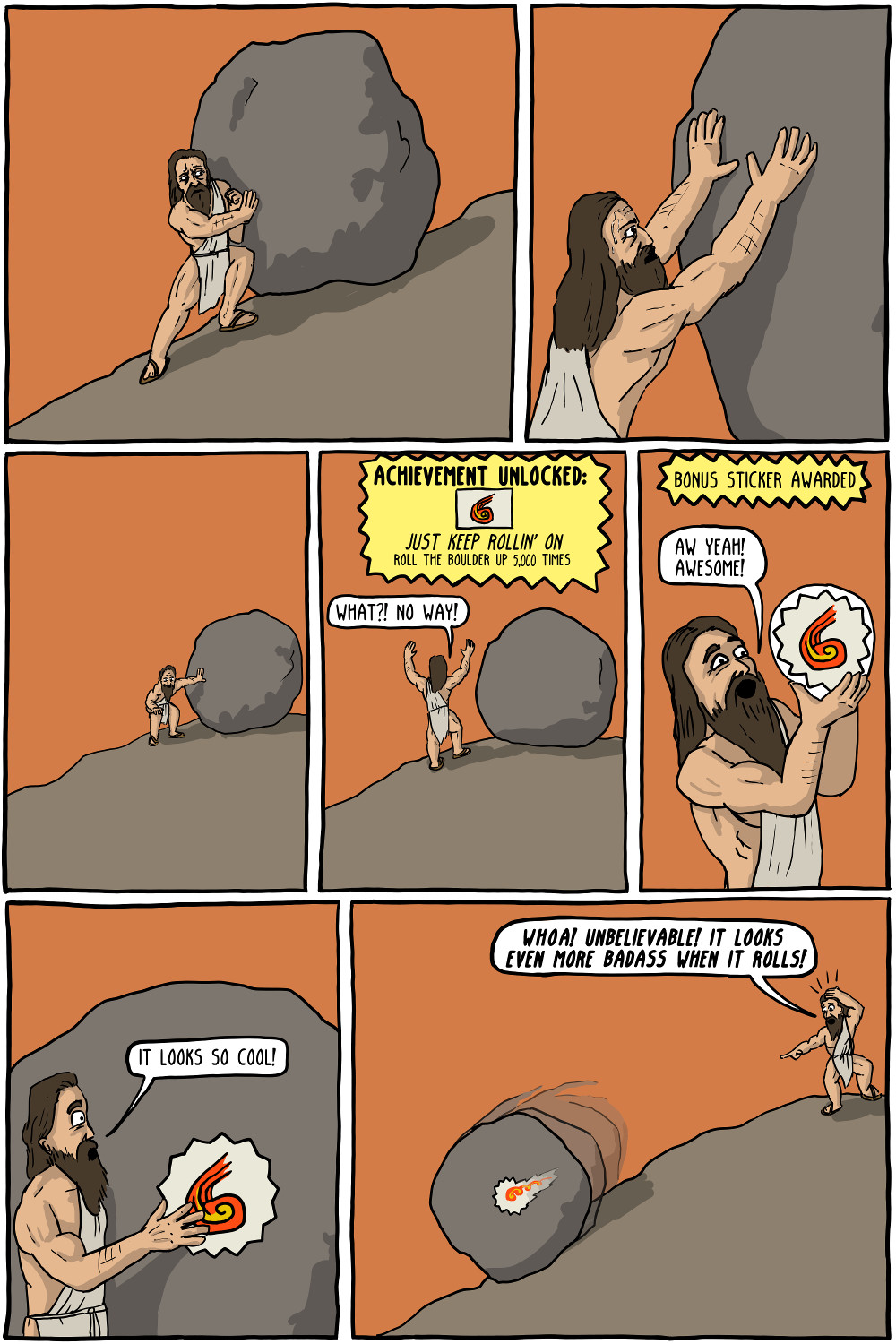
Albert Camus famously or infamously said in "The Myth of Sisyphus" (summary and Wikipedia) that there is one ultimate issue in philosophy:
There is but one truly serious philosophical problem and that is suicide.
Of course, that relates to, and cornerstones, issues in his absurdist philosophy, and in the related existentialism of Jean-Paul Sartre and others.

Theists, especially Christian apologists, have used this as a cudgel, whacking secular existentialists over the head with the idea that they, or we, claim that life is "meaningless" and that there is therefore no recourse at end but suicide.

Well, a new essay at Massimo Pigliucci's Scientia Salon, by John G. Messerly, deals with this issue in part. And, it's stimulated me to yet further thought, reflected in part, and starting with, my second comment on the essay.

That said, let's unpack this issue a bit further. I'll then get to the second half of that second comment and go from there.

Camus, of course, said suicide was not the answer — revolt was. Which might be true. Revolt while accepting the modern absurdity of life.

Modern humanistic psychologists of a secularist mindset say that meaning is what we bring to the table.

But, beyond that, what if "meaningless(ness)" as traditionally defined in philosophy and psychology isn't exactly the issue?

And now, to that comment.
I think Camus was asking the wrong question. 
 Life is neither meaningful nor meaningless, if we take “meaningless” to be the opposite of “meaningful.”  
 If we instead, talk about “without meaning” or “meaning-less” (sic) we can hopefully understand this not as an opposition to “meaningful” but simply that the issue of “meaning” is, if not a category mistake, one of those issues about which we should be silent, or even more, per logical positivism, a question that is itself … without meaning!
 It’s true that, as part of our attempts to control our surroundings, we probably have “meaning seekers” as well as “pattern detectors” and “agency imputers” halfway hardwired into our brains. 
 But, per Hume’s is ≠ ought, that doesn’t mean that we have to follow them in falsely looking for agency — or falsely imputing meaning where it doesn’t exist, or falsely looking for it when it’s not part of the issue.
Let's go a bit further.

"Meaning" and "meaninglessness" also seems to be one of those polarities, like "free will" vs. "determinism," that's wrong in other ways.

First, it's presuming that a polarity should exist.

Second, it assumes that one should, in some degree at least, "reduce" to the other, rather than both be "unified" in a larger theory, just like general relativity and quantum theory will surely "unify" rather than having one reduce to the other.

Third, like the free will half of that first duality, a desire for meaning — or, a desire to frame ordering one's life around meaning, and trying to justify how to frame it without meaning — seems based in part on religion. I've said that this seems true to some degree of many secular defenders of classical free will, on religion and guilt connecting to free will.

Indeed, the Sparknotes summary, on the first link, puts this in is vs. ought terms, as far as how Camus treats Sisyphus:
As his starting point, Camus takes up the question of whether, on the one hand, we are free agents with souls and values, or if, on the other hand, we are just matter that moves about with mindless regularity. 
 Camus is interested in finding a third alternative. Can we acknowledge that life is meaningless without committing suicide? Do we have to at least hope that life has a meaning in order to live? Can we have values if we acknowledge that values are meaningless? Essentially, Camus is asking if the second of the two worldviews sketched above is livable.
But, just as I have repeatedly, most  notably here and in my own essay for Pigliucci, said that we should say “mu” to the traditional “free will versus determinism” polarity, I think we need to similarly “unask” Camus here.  (And Monty Python.)

So, per my pull quote from my comment at Massimo's, if life should not be viewed though a "meaning versus meaningless" filter, what should we then do?

Well, the reference to Farmville, Candy Crush and other Facebook games aside, in this issue of Existentialist Comics, keeping an intelligent Sisyphus happy is probably harder than this. That's especially true for those like Camus and other professional and amateur philosophers who wrestle with these questions. We are "cursed" with intelligence, and speculative intelligence in general.

That said, where do we go from here, to find a better, more authentic contentment than Sisyphus?

To me, the original existentialism, or the Zen of the east from which I get my "mu" to Camus' question, is our starting point.

Recognizing that life simply "is," not in the scientific sense, but in a philosophical and a psychological sense, is the lodestar.

From there, finding contentment comes next. Contentment, to me, is both "deeper" psychologically and less ephemeral than "happiness." The likes of Daniel Kahnemann and other modern psychologists strongly agree.

And, it's not necessarily based on old ideas of how we "have to" find meaning, or create meaning, to be happy.

Second, per the essay that I linked that sparked these comments, as one other commenter noted, "progress" is usually defined in teleological terms. People often define meaning in the same way, which of course is another problem, and one recognized in part by existentialist and absurdist philosophers.

If your meaning is defined from achieving a goal, then you are doomed to frustration in never achieving it, or, like Sisyphus, having your "achievement clock" reset, or new layers added to it, or whatever.

And, what if you do achieve a goal of teleologically-based progress? What then? In the modern West, often, "emptiness," followed by chasing after some new goal.

"Revolt" might be one way of achieving this. But, I think it needs to be somewhat more comprehensive, maybe even somewhat more Cynical, as I discuss in calling for a neo-Cynicism, than Camus realized. The revolt has to include a revolt against teleology.

Even "authenticity" must be put under our Cynical microscope. Too often, "authenticity" is seen in a quasi-Platonic sense, as in "There's some ideal Me out there, and that's what I want to be."

Well, no there's not.

Each one of us is the result of massive contingency in a materialist universe. There's no way any ideal Me or You exists.

So, authenticity means rejecting the strictures of society that don't agree with deeper layers of our selves — before they become part of those deeper layers.

At the same time (heads up, Black Bloc!) it means questioning the idea of "revolt for revolt's sake" (sorry, any hyper-Camuseans) or any other "X for X's sake."

I'm not a process theologian, or anything close.

But, I will call myself a sort of "process psychologist."

As such, meaning is created, not found. And, it's created on an ongoing, not a static basis. It's part of a dialogue between a changing self, a current moment, and a current moment that is part of a larger stream of time.

And thus, meaning changes throughout life. Why wouldn't it?

Sunday, June 29, 2014

Plato sells his soul to Google at the Googleplex

Plato at the Googleplex: Why Philosophy Won't Go AwayPlato at the Googleplex: Why Philosophy Won't Go Away by Rebecca Goldstein

My rating: 2 of 5 stars


I finally went with a 2-star rating for this book. I will note that Goldstein did stimulate my thought at times, albeit half the time to take notes on how she was wrong, and did get me to modify somewhat the harsh take I’ve had on Socrates since reading Izzy Stone, but, the book is still not that good.

First, a couple of overarching issues.

I am discomfited by a professional philosopher diving into the tank of commercial toutery. Plato can’t just have a laptop, he has to have a Chromebook. He can’t just like the Internet, he has to like Google for searches rather than using a generic term for Internet search. He has to like Google’s cloud-based services. He has to like Google so much that, per one chapter that gives the book its title, he does indeed visit Google’s Googleplex, where much of the chapter’s dialogue is taken up by a Google PR flak.

Frankly, it made me want to vomit. Strangely, even among “negative” reviewers, I’m seemingly the first to hit that much on this issue.
The second overarching issue, is despite all the puffery on the blurbs and on some five-star reviews, Goldstein is not that good of a writer in my opinion. The book lacks some coherence, including exactly how she’s trying to make Plato relevant for today and why. Plus, some specific writing tricks do not float my boat.

On page 192, she says in a footnote: “I’m not sure whether Plato is just managing Munitz here or is really implying that she’s guardian material.” Bulls***. Don’t go Stanley Fish on me. You know full well what your conscious intention was with the passage you footnoted.
I'm skipping around a bit, in part to get more feel for the book, and in part because it hasn't floated my boat that much so far, despite all the advance touts it's gotten.

First, Goldstein, while noting Whitehead's observation about all later philosophy being but footnotes to Plato and Aristotle, then noting many modern philosophers disagree, doesn't explain why she, essentially, comes down on the side of Whitehead. And, as a philosopher, she knows that for a philosopher not to “argumentatively” justify one’s decision or stance on something like this is …. Unphilosophical!

Second, some of her specific stances related to Platonism are ones that are also contentious. The idea that there’s no single character in Plato’s dialogues that truly represents him? I know that’s nowhere unanimous. One need not believe that Socrates is Plato’s sole voice to nonetheless believe that he is his primary one, and certainly so in his early and middle dialogues.

Third, she buys wholeheartedly and blindly into Plato’s description of who the Sophists were. Plenty a critic of this position has noted that the elitists like Socrates, and arguably, Plato, disliked the Sophists not because they proposed to teach “sophistry” in its modern English terms, but because they proposed to, relatively inexpensively, teach the basics of rhetorical tools that would help level the social and legal playing field between the rich and the non-rich.

Related to that, even if Plato's description of Socrates isn't the be-all and end-all of who Socrates was, she certainly seems to take at face value Plato's presentation of Socrates as a straight shooter, never engaging in sophistry himself. Nor does she ever entertain the idea that, if Plato is a mouthpiece or tool of Socrates at times, in turn, his "opponents" are just straw men for positions they never actually held.

Fourth, she’s not proven at best, possibly wrong at worse, on the background of “Ivriim,” which may be the root the Hebrew word for “Hebrew.” Yes, it does mean “pass over,” or “pass through,” in its verbal root, but, that doesn’t necessarily mean that the Hebrews applied it to themselves as “over the Jordan.” First, no ancient people are likely to define themselves this way, in terms of another culture or nation’s geographic point of view. Nor are the Jews likely to have said this about themselves because their mythical ancestor came from Transjordan and beyond. And, her interpretation starts with the noun form.

Better understandings of the root of this word are that as people “passing through,” it can mean immigrants, without geographic reference. Again, though, would a people likely refer to themselves that way? Interestingly, the verb is used in Genesis 15, where the torches pass between the cuts of meat during the Abrahamic covenant ceremony. That is one possible alternative etymology.

Another? “Hebrews” may well instead be a patronymic from alleged ancestor Eber (same consonantal Hebrew). And, the older attempts to connect them to the Egyptian “Hapiru,” while left by the wayside today, may not be totally dead.

Anyway, the fact that Goldstein, in a book about Plato, feels the need not just to talk about “Hebrews,” but the Hebrew etymology more than once, and possibly getting it wrong each and every time, is also disconcerting.

That’s from the first chapter.

On talking about the Republic, she made me realize that, of course, Plato’s ideas for youth education founder on Piaget’s stages of development. Pre-adolescents wouldn’t have been ready for his program. Surely, somebody else has mentioned that somewhere. But, she doesn’t.

Related?

I just realized that Plato's Allegory of the Cave has two holes in it as an analogy. First, if all we see our shadows, each of us has to be in our own cave; we can't be in one common cave because, of course, other people have to be shadows, too. Of course, to write it that way would wreck some of its force. Second, Plato talks about one person being freed then compelled to re-see things. Plato doesn't mention a personal agent, but the language sure implies one. And, of course, no other person can compel new knowledge. Even if an agent is not intended, the passivity of the allegory, the "being freed," is just wrong.

Also, one need not agree with Izzy Stone’s attributing Socrates’ death entirely to legitimate politics to nonetheless say that it was part of it.

What I got from all of this is a Goldstein who largely believes in the largely idealized picture of Socrates that Plato has handed us.

So, I guess she stimulated my mind to reject the Whitehead idea that the rest of philosophy is but footnotes to Plato and Aristotle.

Besides the Googleplex chapter, one other one rings very false. That’s the one about Plato appearing on a would-be Fox News with an ersatz Bill O’Reilly.

It all adds up to the fact that she is NOT a skilled writer, period and end of story, despite the fluffy touts from A.C. Grayling and many another. She needed an editor with a good understanding of both philosophy and classics, and a firm and heavy hand, and got none. (Sic semper the decline of the modern book industry.)

Finally, from all this, no matter my interest in philosophy, I won’t be reading another book of hers.

I'm not sure which bothers me most — the commercialism itself, the commercialism without warrant (philosophical or otherwise), the failure to defend the modern relevance of Plato before jumping in to chapters, or the failure to justify her interpretation of Plato.

In any case, it's a failure. There's also, in a Gertrude Stein sense, no "there" there. There's not a lot of unification between chapters.

Update: Now I know more of why it's bad: Goldstein is Steve Pinker's wife.

View all my reviews

Saturday, September 17, 2011

‘Critical’ Xns not any more rational than fundys?


Or at the least, they can be just as determined in their habits and depth of motivated reasoning, perhaps.
In one particular case, I know that’s true.

In an extended debate on Google Plus with a new Harvard Divinity School student, I wound up learning a number of things along that line.

I started the thread with this post:
If God wants us to be unselfish and think of others first, then why does he want us to think above him above everyone else?
I explained that this was influenced by an actual religion column by a conservative, mainline Protestant (Lutheran) but nonfundamentalist minister.

Eventually, Mr. Harvard Div responded:
When you base your joke on an if that presumes the Christian God, you leave the question of whether God exists behind. You enter a world that assumes such a God exists.
So, thing No. 1 I learned?

This person thinks a rhetorical device use of “if” thinks that I’m actually committed to the propositional statement that follows the “if.” Either he’s clueless about use of rhetoric, or he’s willing to distort my rhetorical stance that much that he’s willing to engage in intellectual dishonesty. Or a bit of both.

Anyway, he then goes on to make a claim I expected more from a conservative, non-critical-scholarship Christian.
So you seriously think that, granting a creator of everything, literally an author of everything, that one could effectively do good without loving the author?-- and further you believe that so strongly that you think it's not even a passably good argument?
I responded in two ways, saying, basically, I and many other secularists feel that way, and we have nearly 2,500 years of philosophical history behind us.
Plato raised this issue 2500 years ago in the Euthyphro are things good because god(s) say(s) so, or is/are god(s) good because they follow an order of goodness outside it/them? Plato saw way back then that one cannot logically anchor morality on the existence of adivinity. I know many Christian apologists claim he presents a false dilemma, but their counterarguments are weak. … The answer to your question, not just from me, but from many secularists of all sorts of nametags ... is YES. Yes, I believe one can do good without loving a creator, and that logically, claiming a creator is necessary is horribly illogical.
By this point, I wasn’t expecting him to accept Plato’s argument. And he didn’t, with this response:
Plato's gods in the Euthyphro are not all that similar to the Christian God which you were here critiquing, and Christian thinkers have described their God largely in terms that avoid the Euthyphro dilemma.
To which, and other things, I said, basically, “that’s your perception.” It wasn’t the first time in the thread where he made a statement of his opinion, IMO, assuming it was right. 

Beyond that, the Wiki article on the Euthyphro dilemma, linked above, directly addresses his absurd claim that Plato’s thought can’t apply to the Christian god.
The dilemma can be modified to apply to philosophical theism, where it is still the object of theological and philosophical discussion, largely within the Christian, Jewish, and Islamic traditions. As Leibniz presents this version of the dilemma: "It is generally agreed that whatever God wills is good and just. But there remains the question whether it is good and just because God wills it or whether God wills it because it is good and just; in other words, whether justice and goodness are arbitrary or whether they belong to the necessary and eternal truths about the nature of things."
The fact that hordes of Christian, Jewish and Islamic philosophers worried about it shows they damn well knew just how much it applies.

And, the disingenuousness of their response shows that, too. Still from the Wiki article:
Anselm scholar Katherin A. Rogers observes, many contemporary philosophers of religion suppose that there are true propositions which exist as platonic abstracta independently of God. Among these are propositions constituting a moral order, to which God must conform in order to be good. Classical Judaeo-Christian theism, however, rejects such a view as inconsistent with God's omnipotence, which requires that all that there is is God and what he has made. "The classical tradition," Rogers notes, "also steers clear of the other horn of the Euthyphro dilemma, divine command theory." From a classical theistic perspective, therefore, the Euthyphro dilemma is false. As Rogers puts it, "Anselm, like Augustine before him and Aquinas later, rejects both horns of the Euthyphro dilemma. God neither conforms to nor invents the moral order. Rather His very nature is the standard for value.”
The last two sentences, per the analytic philosophy that said Harvard Div student showed elsewhere he (for good reasons, I guess, from his point of view) doesn’t like, are basically meaningless. The last sentence, if anything, accepts the first “horn” of the dilemma, that things are good only because (a) god says they are. 

The second-last sentence, combined with it, if it came out of Paul Tillich’s mouth, would be calling God the “ground of moral being.” But, wordplay can’t escape logic.

He follows with this:
Now, you may find such a God logically impossible, but it is still a mis-representation to say that if this logically impossible God exists, then he couldn't do X because it is logically impossible (ha ha, let's all have a laugh because of how these people didn't think of this). They did think of this. Their answer is fully consistent with the nature of God that they point out; if God's nature is the embodiment of moral value, as in Christian thought, then it follows that to love him is to love what is good.
I realize how wedded he is to Tillich-type thought with that statement. In fact, in an earlier thread, on Facebook, he more directly referenced Tillich, in the same comment as saying how he rejected analytic philosophy.

Yep, and we know why.

Well, sir, Paul Tillich is as dead as god, and so is Tillich’s theology. Really, if that’s the best a supposedly broad-minded student can bring to Harvard (it’s his first semester, so, I won’t blame it ON Harvard yet). In fact, I’m surprised the Wiki article on the Euthyphro dilemma didn’t bring Tillich into the discussion. After all, his theology is largely based on ontology, and, as I’ve blogged before about Anselm’s ontological argument for the existence of god, it fails because …

Here’s that damned analytic philosophy again …

Because it commits a category mistake. “Existence” is NOT an attribute.

And, that said, I know where Mr. Harvard Div’s claim that Platonic gods are not like the Xn god comes from. They’re not “the ground of being.” And, that’s why people like this don’t like analytic theology – because it cuts through the attempted word play to get at actual meaning and content.

Anyway, lesson learned. Any time I should again get in a discussion of morals, ethics or related issues, let alone the “problem of evil,” with a “critical scholar” Christian, I’ll ask questions first. Starting with what they think about Tillich in particular and modern “ontological theology” in general.

That said, and again, it’s meant to be snarky … what if a Hindu claimed Krishna was the “ground of being”? I suspect that at least some “enlightened, tolerant” critical-thinking Christian scholars would first laugh, then go on the critical-philosophical attack.

UPDATE: Speaking of, a Western academic Buddhist, on a FB thread, says "Karma and reincarnation aren't falsifiable claims." So, this isn't even a liberal-vs-conservative Christianity deal, with them being the two sides of the same coin, it's really a religion vs. naturalism claim.

I of course responded that David Hume first pointed out, even if not using Carl Sagan's words, that "extraordinary claims require extraordinary evidence." I also, riffing on Ben Johnson's comment about patriotism, politely said the claim "metaphysical stance X isn't falsifiable" was the last refuge of the religious, without adding the word "scoundrel."

For both conservative and liberal Christians, not only is Yahweh jealous – so are his followers. That's the second lesson learned.

Sunday, December 12, 2010

Why Socrates is overrated

Yeah, given my blog name and handle, it sounds ironic for me to say that, no?

Of course, some people might accuse me of being hypocritical, if I do think he's overrated. That said, my blog name trades on the myth of Socrates, which we shall now call into account ... by using some Socratic-like questioning!

Questions
1. If he really were ignorant of so much, how could he always be right in his dialogues -- especially since he proves his opponents wrong in every one of them and therefore he couldn't have learned from them?

2. If he really were so ignorant, and knew that he were, then why didn't he follow Wittgenstein and remain silent about what he did not know?

3. If he really were so ignorant, then how can we believe he understood the Sophists' teachings so well?

Answers

The baseline answer to all of these individual questions and more is that Socrates, that is, the Socrates who is a Platonic mouthpiece (and, an ideal one for Plato, pun intended!) makes straw men out of Sophists and their thought, opposes the democratization (for money) of knowledge that they offer because it upsets his classist views and more.

But, specifically:

1A. The Platonic wordsmith hoists him by his own petard, not to mention, especially in the Cave analogy, also getting hoist on the petard of ineffability.

2A. Because it does that, Plato's Socrates only mimicked the idea of being ignorant.

3A. This builds on the "baseline" answer. In a sense, Socrates, to the degree we can really guess at who he was, DOES know the ideas of the Sophists well — and fears their democratizing strain.