Showing posts with label antiquity. Show all posts

Thursday, December 02, 2021

If the Tacitus passage on Nero, the Great Fire, and Christians is an interpolation, why?

I addressed week before last week how John Drinkwater handles the infamous passages from Tacitus' Annals about Nero's ALLEGED cruel punishment of Christians after the Great Fire. Beyond what I already knew about the Great Fire, about Tacitus in general, and about the Greek itacism and other problems with the specific issues in the passage, I also relied on this piece from a religion Wiki (warning: friendly to Jesus mythicism) which gave me more food for thought.

Tertullian and other Church fathers cite no such passage, and it appears not to be referenced by any Christian before 400 CE.  Sulpicius Severus, ca 400 CE, appears to be the first Christian to write about it, but his account in his "Sacred History" is hugely suspect. It's basically a "blown-out" version of Tacitus. It also gets many other things wrong, starting with claiming there was a massive number of Christians at that time, then that Nero outlawed Christianity along with starting the persecutions. Clement I, especially if one goes by "traditional" date and provenance, would have readers who would have remembered this, had it happened. He doesn't mention it. Celsus surely would have flung this issue at Origin, had he known of it, and of course Origen would have found some way to try refute it. He doesn't discuss it. Tertullian, who cites Tacitus a fair amount, doesn't mention it. Nor Eusebius, the first Christian historian.

And, some early writings actually explicitly counter Tacitus' claim. Brent Shaw, in an academic journal, extracted and summarized here by Charles Mercier, has the details on the possibility this is an interpolation. (Mercier then has a Part 2, which frames Catholic touting of Neronian martyrs within Reformation hagiography.) Shaw, per Mercier's Part 1, doesn't totally agree with the Religion Wiki take on why this is possibly an interpolation. As noted, if the passage IS genuine, the best and most we can derive from it, in my opinion, is that Tacitus was doing a bank shot to smear Nero by saying his torturous deaths were so cruel that Christians got sympathy. (I'm not fully ready to commit to it being an interpolation, as that's an argument from silence, and to do otherwise risks petard-hoisting. That said, [motivated reasoning alert?] the idea that there are degrees of silence would nuance that.)

But, what if it IS an interpolation? Why?

Let's say that Christians of 300 CE or later read Suetonius, and took his account that Claudius expelled the Jews who were engaged in Messianic disturbances (sic on my interpretation of ChrEEStos) and instead took that to be Jesus. 

So, why extrapolate from there to Nero?

Per my big piece about the differences between "antichrist," "man of lawlessness" and "666/The Beast," and John Chyrsostom chiding Christians of his time for visiting synagogues? At 400 CE, Christians still would have known enough Hebrew and/or Aramaic to know that the "666" was Nero. (As I note there, "Nero Caesar" in the Hebrew alphabet is נרון קסר‎ NRON QSR, which when used as numbers represent 50 200 6 50 100 60 200, which add to 666. See the link at the top of the paragraph for more detail.) They would not have know that this could have come from a disciple of John the Baptist who wrote the non-Christian core of Revelation, so they asked, "WHY is Nero the Beast"? And, they created the answer. There may also be angles related to Constantinople as the New Rome and other things.

That said, that leads to a third theoretical option besides Tacitus being true here. That is that there were messianic disturbances at this time, tied to the precursor of the revolt and the First Jewish War in Judea. We have Claudius' previous expulsion of the Jews from Rome. Tom Holland, in his book "Dynasty," notes that, according to Valerius Maximus, the first Roman expulsion of Jews happened way back in 139 BCE. That would have been just after the establishment of the Hasmonean kingdom. And, while the Christian population of Rome at this time (setting aside the issue of them counting themselves separate from Jews or not) was only 1/10 of 1 percent, Jews made up around 5 percent of Rome's population, as the past expulsions had in general not been permanent and Jew/non-Jew and Jewish/non-Jewish, to get at both culture and religion, differences weren't as sharply noticed as in Christian Europe, making returns easier.

But, how likely is that? Suetonius had mentioned the expulsion of the Jews under Claudius; surely he would have mentioned this, too, one would think. Tacitus and Suetonius would have used more explicitly anti-Jewish language, as both were writing after the First Jewish War. And, after the "separation" started, Christians would have cited this among anti-Jewish polemics.

Of the three, an interpolation seems more likely. The double bankshot seems less likely. The Jewish Messianic revolt seems not much more likely than Tacitus telling the truth here.

Update, May 26, 2024: A person at r/AcademicBiblical, in chat with me about a main comment of hers there, where she claims that 1 Clement, stripped of legendary accretions, is about Peter and Paul being killed by fellow Christians, nonetheless, in response to me, claims that the Tacitus is not an interpolation. 

I offered as a sidebar the Option B, that, if genuine by Tacitus, it's still a double-bankshot smear, projecting back from his own interactions with Christians, of what was a non-event, so that he could smear Nero even more than Christians.

As for said person's claims rejecting the interpolation idea? They note that the Correspondence of Paul and Seneca mentions the Great Fire earlier. Two counterpoints: First, on a late dating, only about 20 years earlier. So, it's in the same milieu, even if earlier. Second, the 11th letter of said correspondence is generally believed to be by a second forger than most other letters. Severus himself? Third counterpoint? As mentioned above? Tertullian regularly cited Tacitus, so why not here?

Finally, if you've read both, Severus just reads a lot like Tacitus.

Said person does reject an actual persecution, so they're solid there.

I raised the Tertullian and Celsus issues, and got pretty much a handwaving response.

That one is rather easily explicable. The Annals does not look like it was ever completely finished by Tacitus, or did not receive the full editing required, and so it also wasn't distributed nearly as widely. In fact, Tacitus' works in general were largely ignored, and the Annals was probably just in disrepair. So this isn't surprising nor indicative of much.

We'll agree to disagree. As I said in response, at the time of Severus, Jerome references all 30 books of Annals plus Histories. And, Tertullian wrote no more than a century later. And, got more handwaving in return:

Handwaving, half-truths and more.

Jerome is also writing after Sulpicius, so the Annals were at that point becoming known to Christians, so Jerome isn't surprising or pertinent there. 
And as we know, from the late second century to the early fourth century, Tacitus' works were actually in disrepair and the Annals was not read either by Christians or by Greco-Roman authors. It was just a text almost entirely unknown until there was a revival effort to try and bring his works into public eye (by pagans specifically). Read more

First, Jerome is relevant because it shows he knows them all, and he was enough of a historian for that era to probably have looked at all of them. And, ergo, it directly refutes the "and as we know" of the second paragraph.

I had debated about direct-quoting, even with the first exchange, but this confirmed in me to direct quote both. Especially because it gets even worse after that:

No, actually it doesn't. It shows that from Tacitus' writing, until 250 years later, there is no knowledge the Annals even existed.
And as a case in point, you can read Anthony Barrett's book Rome is Burning, which specifically notes a Roman emperor actively went out of his way to rejuvenate Tacitus' works because they had fallen into disrepair and obscurity. This was the Emperor Tacitus (reigned in 275 CE to 276), who specifically ordered Tacitus' works be revived.
As Barrett notes, even in the sixth century, Cassiodorus still refers to a "certain Cornelius [Tacitus]", using distanced terminology that implies his readers probably would have no familiarity, again speaking to Tacitus' poor reception.
Both Sulpicius and Jerome are writing *after* Emperor Tacitus' attempt to revive his ancestor's work. So no, nothing here is incorrect and is in perfect alignment with the historical record. The Annals were a habitually neglected source, and it was only after Tacitus' reputed descendant the Emperor Tacitus revived his reputation that the Annals started coming to people's attention. Thus, around 70 years later, Sulpicius finally reads the Annals and sees that passage, and Jerome finally knows of them later.

OK, an Emperor who is in the middle of the The Imperial Crisis, aka The Decline of the Third Century and reigns 6 months really has time to puff his namesake? And, certainly doesn't have the reign to make it happen, even if he ordered it? And, the Anthony Barrett who barely touches 4 stars with one book, and can't crack 3.5 on most? And, a handwaving interpretation of what Cassiodorus meant, while continuing to reject my comment about Jerome?

(Update: Per my review of a Melvin Goodman book, this isn't the only bit of suspiciousness from Sulpicius Severus, either.)

Anyway, I promised Crissy the last word. On Reddit, not here.

And, here's why I think that Correspondence piece can't earlier than 380 CE on the 11th letter. Yes, Christianity was legal before that under Constantine. It didn't become the state religion until 380 CE, under Theodosius I's Edict of Thessalonica.) Obviously, despite failings here and there, the Correspondence knew better than to reference a comment from Tacitus if a legitimate one existed.) Before that, no Christian writer would have felt safe blaming Nero. But, once the gloves were off, people besides Severus could simply have reference Tacitus without creating an interpolation, if the actual Tacitus had written something.

And, this leads to me offering further thought on the WHY.

After making Christianity the state religion, Theodosius launched the first attacks on paganism. A Sulpicius Severus would have written his own piece, as well as "dropping a dime" inside Tacitus as alleged proof, in support of these attacks.

"Look at the old Rome! Since the start of Christianity, it has persecuted us!"

Rather than the approach of the biblical gospels and Acts, to have gloves fully on vis-a-vis Rome, it was now time to take the gloves off in service of the New Rome.

Thursday, June 25, 2020

Museum of the Bible's Auguean stables:
Have fun on cleanup, old classmate Jeff Kloha

I blogged a few months ago about the breaking of the Dead Sea Scrolls scandal at Hobby Lobby-owned Museum of the Bible, and how the man dealing with the fallout is old seminary classmate Jeff Kloha, who now prefers the full Jeffrey.

Update, July 27, 2021: The Gilgamesh Dream Tablet has Hobby Lobby back in the news. See my update at the bottom of the piece, including noting that Hobby Lobby is far from the only villain in the drama.)

Said blogging included disagreements between this now-secularist myself and the still-fundamentalist wing of Lutheranism Kloha about whether or not the DSS confirm a pristine transmission of the text of the Old Testament or Tanakh (they don't, Jeff) and whether or not they're "inarguably" the most important biblical discovery of the last century (they're arguably not, and if we focus on Christian development and diversity, Nag Hammadi is arguably MORE important).

But I digress.

NPR has a new piece about all the cleanup work that Kloha, the museum's chief curator, has on his hands.

He said it's looking at returning a bunch of items to Iraq, some of which likely came from its national musuem. That said, he doesn't know for sure:
"All we have is paperwork, and very vague paperwork," says Kloha, a former professor of the New Testament at Concordia Seminary in St. Louis. "Obviously, there are multiple sources for items from Iraq over the past 30 years. So we have no way of knowing where these came from." 
Part one of the fun.

Part two? The Green family bought 5-10 percent fakes among the 8,000 items up for return. Schadenfreude is a bitch.

Part three? Items it has already promised to return are still in the U.S., because the Greens are too cheap to pay insurance. They're hoping to send them back on an Iraqi embassy plane.

Part four? Schadenfreude can spread wide, like diarrhea. Christie's sold a Gilgamesh to the Museum of the Bible, and didn't adequately check provenance. An Afghani Jewish prayer book was likely trafficked by the Taliban.

Kloha told NPR the "few bad apples" story.
"It seems to have been just one or two individuals who were acting as agents and purchasing things for what was, at that point, just the idea of a museum," he says. "It was a handful of advisers who would literally travel the world, make contacts, find things, and then bring them to the Greens for acquisition."
 Not quite, sir.

Part five? Schadenfreude sometimes degenerates into fuck-you privilege. Steve Green, Hobby Lobby patriarch, was flagged by Customs in 2010 for importing an ancient manuscript Bible without documentation. Read the story for details.

And, per this site, let us not forget the Green family's dirty hands on Dirk Obbink's apparent papyrus stealing.

I don't think Jeff is lying. But, it sounds like he needs to get more up to speed on the Green family.

===

Update, July 27, 2021: With the DOJ getting a court ruling today that Hobby Lobby must forfeit the Gilgamesh Dream Tablet, sounds like Jeff Kloha has more Cleanup on Aisle 6 to do. Details? The tablet was shipped to the US in 2003 by Jordanian Antiquities Authority, without proper paperwork but with the claim it was found in miscellaneous rubble in 1981. In reality, like much other stuff the Green family got its mitts on, it was apparently looted from Iraq. There is no honor among thieves, and we'll see how much remorse there is.

Now, some of this is not new, and some of this on the political side is a #BlueAnon dogpile on the Green family. Hobby Lobby surrendered it a nearly a year ago, after federal authorities ruled to that end. Let's ALSO note that Hobby Lobby supports its return to Iraq. The actual court ruling is more icing on the cake than anything, though it gives the feds leverage if there's anything Hobby Lobby tries to keep its hands on.

In fact, it's arguable that Christie's (yes, THAT Christie's) is at least as big a villain as Hobby Lobby.
Christie's, the international auction house from which Hobby Lobby bought the item, previously told CNN that "any suggestion that Christie's had knowledge of the original fraud or illegal importation is unsubstantiated."
Christie's can use the weasel word "unsubstantiated" all it wants. And, yes, "weasel word" it is.

Re Hobby Lobby, Christie's and looted Iraq, there may be plenty of people who aren't hard-right conservative Christians who willingly bought larger or smaller sums of ill-gotten booty pilfered from Iraq, and some of it may have sifted through Christie's hands.

Related to that? I want to hear NOTHING from American do-gooders claiming we should hold on to it because ISIS will just destroy it. First, that would be yet another form of thievery. Second, that's why much of the rest of the world hates American do-gooders. Third, destruction of antiquities has been happening since the rise of civilization. Fourth, Christians have done this in hte past. The Iconoclastic Controversy. Worshipers, led by ex-priest pastors such as Karlstadt, shattering stained glass in the early Reformation. Some "Mark of the Beast" types (generally ignorant) destroying things related to that alleged mark today.

So, the idea, from one apparent BlueAnon do-gooder on Twitter, that it would have been better had it been stolen on the QT, is laughable.

No, really! The "HL" in his Tweet, part of a thread from a now-muted person, goes exactly down that rabbit hole. 
Besides, quis custodiet ipsos custodes? That's true on everything from antiquities to importing exotic plants and animals to a new country or continent. I tweeted back to the guy exactly on that line:
Twitter's non-literalists claimed that the words above were inciting self-harm and locked my account until I deleted that. I of course did a screenshot.


And yes, IMO, that's what it boils down to. I thought of Juvenal's maxim shortly after that. And, see what I said above about Christie's. They may have sold Iraq antiquities to other buyers who made exactly that argument. Or, Christie's senior staff, with their attempt at plausible deniability, may have internally made that argument themselves, that selling these items got them out of Iraq.

No, per the Wiki link, the phrase doesn't come from Plato's "Republic," though the idea behind it is raised indirectly. Plato's answer on how to guard them? The heart of the fascism behind the "Republic" — mind control through the Platonic Noble Lie. No thanks, as I've said about St. Anthony of Fauci, on masks and herd immunity. I don't even consider his "gain of function" a Platonic noble lie. More like a Jesuitical one, or just a plain old grubby one.

As for the value of Gilgamesh? It's at least partly behind the tales of Moses' birth and similar birth stories around the ancient Near East, as well as some documents from Qumran (which tie back to Hobby Lobby's larceniousness as well as to why Kloha was hired) and to the Iliad and Odyssey. Arguably, it's connected indirectly to just about any later epic tale in the ancient Near East and eastern Mediterranean.
 
Update, Nov. 26, 2024: I don't know whether he left on his own, or got kicked to the curb, but Kloha is no longer at the Museum of the Bible, per his LinkedIn. In a post, he says it was his decision, but, nonetheless, that could be a decision that was constrained or nudged in some way. Per this post from his new freelance life? It's interesting. Maybe he's less argumentative than in the past. That said, does his enlightenment about political discourse also apply to political discourse?

Thursday, January 30, 2020

Stealing and selling biblical papyri, but why?

I had heard about the alleged pre-100 CE papyri fragment of Mark (which turned out to not be true on the dating, as even an evangelical admits, and not that close, as Bart Ehrman discusses), soon after the information about it was released. I also wasn't surprised that flunkies for the Green family were behind its touting, and publication.

I guess the fact, or seeming fact, that like the antiquities that Hobby Lobby's Green family got from Iraq, this and other papyri were stolen, shouldn't be a surprise either.

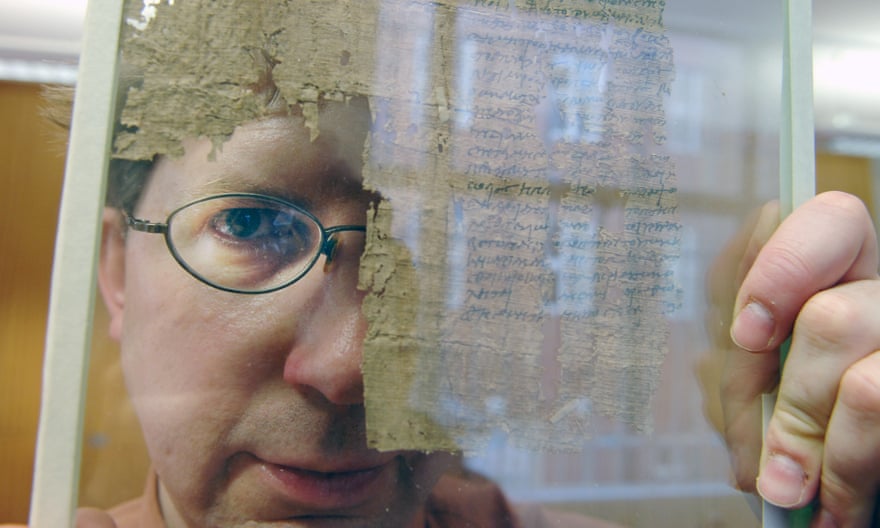
That said, the apparent thief is not some "street Arab," but Dr. Dirk Obbink, an Oxford associate professor and formerly one of three curators of the whole trove of Oxyrhychus papyri owned by the Egypt Exploration Society and housed at Oxford's Sackler Library.

Again, but why?

First, the facts.

Whoever did it was almost certainly an insider, as they stole "provenance information" related to the approximately 200 missing papyri. (They didn't know that much of this was backed up elsewhere, though.)

It would take an insider to know what papyri were of particular value, too.

As for Obbink?

As the story notes, he's an odd duck even within papyrology.

Plus, he is also an incorporated antiquities dealer.

And, as for possible motive? Sounds like he might have real estate debts hanging over his head. Follow the money! That's the saying in journalism.

As for likelihood? The Sappho fragment would seem to indicate him as a suspect. The fact that Oxford didn't renew his curatorial position over concerns over the Sappho fragment further mark him as untrustworthy.

Candida Moss, one of the biblical scholars behind sussing out this issue, wrote about it last year.

==

Now, the $64,000 question for antiquities experts? How light would you like the British government (and US government, if it could be involved) to go on Obbink in a plea deal, in exchange for him spilling ALL the beans? That includes spilling the beans not only on where ALL the missing fragments are, but how active the Greens have been on their end in soliciting items like this. (And anybody besides the Greens.)

I also want to know what other items Obbink has lied about on age, provenance, etc.

==

The second $64K question? How common is this?

I'll bet it's more common than a Candida Moss would like to admit.

I call it the BAR culture. It's the culture from Biblical Archaeology Review that led the Greens to flout provenance issues AND import regs with the Iraqi antiquities. But, Oxford and the Sackler Library aren't US-occupied Iraq, and Hobby Horse Lobby was already being "looked at," so it proceeded slowly and was lucky not to get burned. But Hershel Shanks' plugging of many items of dubious value, dubious provenance, or dubiousness period, like the James ossuary, has fed this whole background.

Wednesday, February 20, 2008

The world’s oldest computer

“Computer” might be a bit of a stretch, but this 2,100-year-old astronomical calculator is a mechanical marvel:
A 2,000-year-old mechanical computer salvaged from a Roman shipwreck has astounded scientists who have finally unravelled the secrets of how the sophisticated device works. …

Since its discovery, scientists have been trying to reconstruct the device, which is now known to be an astronomical calendar capable of tracking with remarkable precision the position of the sun, several heavenly bodies and the phases of the moon. Experts believe it to be the earliest-known device to use gear wheels and by far the most sophisticated object to be found from the ancient and medieval periods. ...

Using modern computer x-ray tomography and high resolution surface scanning, a team led by Mike Edmunds and Tony Freeth at Cardiff University peered inside fragments of the crust-encased mechanism and read the faintest inscriptions that once covered the outer casing of the machine. Detailed imaging of the mechanism suggests it dates back to 150-100 BC and had 37 gear wheels enabling it to follow the movements of the moon and the sun through the zodiac, predict eclipses and even recreate the irregular orbit of the moon. The motion, known as the first lunar anomaly, was developed by the astronomer Hipparcus of Rhodes in the 2nd century BC, and he may have been consulted in the machine's construction, the scientists speculate.

Remarkably, scans showed the device uses a differential gear, which was previously believed to have been invented in the 16th century. The level of miniaturisation and complexity of its parts is comparable to that of 18th century clocks.

One of the remaining mysteries is why the Greek technology invented for the machine seemed to disappear. No other civilisation is believed to have created anything as complex for another 1,000 years.

So, per people attacking Susan Jacoby and claiming how we moderns are so intelligent, let’s just stop and think that one over.
The world’s oldest computer