Showing posts with label Pop Evolutionary Psychology. Show all posts

Monday, October 05, 2020

Is intelligence really about being a better bullshitter?

Or, more politely, about learning to be a better motivated reasoner?

So says Diana Fleischman in the pages of of Nautilus. 

Two caveats.

One, she's an ev psycher.

Two, she's working in part off work by Richard Dawkins.

Nonetheless, this delayed nutgraf:

Intelligence is associated with coming up with more convincing bullshit and with being a better liar, but not associated with a better ability to recognize one’s own bias.

Rings largely true in my book. (With caveats!)

First, one cannot say that intelligence, long before the syllogisms of Hellenic Greek philosophy, evolved "for" human rationality.

Second and related, per Kahneman and Tversky, "slow" thinking has high evolutionary cost, so intelligence wouldn't have evolved for that.

Third, per anecdotes, partially related to Julian Jaynes' book, intelligence probably did evolve in part for us to talk to ourselves better. Including couching our lies better.

So, there you are.

Sadly, sociopaths will read this as a huge self-justification.

That said, Fleitman is missing a page. Or two or three.

The first missing page? That is Goleman's varieties of intelligence. Especially when we get to the whole nine types idea, shown in one form here, emotional intelligence and interpersonal intelligence both offer the ability, even if not evolved for that, to detect others' bullshit.

Second, of course, as I've written many times, much of ev psych is pseudoscience. If Fleitman's ideas about why intelligence evolved are based on things like the Era of Evolutionary Adaptation, well, then they're also pseudoscience.

Finally, of course, we're NOT an ev psycher in this corner, nor are we Aristotelian final causers. Human intelligence did NOT evolve "for" better bullshitting, or "for" anything else. It was adapted "for" certain things after it evolved, and that adaptation was part of cultural evolution.

(Doorknob help us if the Ev Psychers try to trump this with a full-on ev psych based version of cultural evolution. Not that that's not already half their program.)

I will give Fleischman credit for not overstating her case, mainly through using the phrase "associated with."

For my take on Jaynes?


The Origin of Consciousness in the Breakdown of the Bicameral MindThe Origin of Consciousness in the Breakdown of the Bicameral Mind by Julian Jaynes
My rating: 4 of 5 stars

It's been what, a decade or nearly so, since I last read this, so this review (I thought I had done one, but guess not) is from memory.

That said, I first read it in the early 1990s, when finishing up a graduate divinity degree and transitioning into a secularist.

Academics largely savaged the book at the time, but it's made somewhat of a comeback with them as well as the general public since then. In the world of philosophy, Jaynes' ideas somewhat parallel Dennett's subselves. Similar ideas have taken further root in psychology.

But, the biggie? Jaynes remains less than fully convincing in the when and why of how consciousness originated, both on general anthropology and on philosophy of religion.

The idea that god(s) might originally have been inner voices? Yes, not a totally unreasonable hypothesis.

But, why did these voices become "god(s)" when, as more and more cave paintings showed, some sort of religious experience may well have paralleled, not followed, the development of human language? Not really answered.

Also not really answered is why they STOPPED being internalized and instead became externalized.

Finally, although Jaynes doesn't go heavily into New Agey left brain/right brain stuff, he does drift a bit that way.

At the same time, the book remains provocative enough to get four stars, not three.

View all my reviews

Per Jaynes, and per Fleischman, to the degree she's on to something? Many people often tell themselves the best bullshit. And, per Goleman et al, they are highly lacking in intrapersonal intelligence. As a result, they can often get themselves wrapped around their own axle by someone who is transparent and guileless. Some of the greatest short stories in literature and parables in philosophy are about exactly this. 

Friday, June 21, 2019

D.S. Wilson tries to extend group selection to cultural evolution

This looks to be a howler.

Wilson, who along with non-relative E.O. Wilson, tried to turd-polish group selection in evolutionary biology by linking it with traditional genetic selection under the moniker of multi-level selection, is now trying to apply it to cultural evolution.

The biological evolution of individual humans itself is less a driver of cultural evolution than are non-biological changes in human societies. To the degree that group selection on the biological side has some small bit of reality, it obviously would be a small bit of the minority half of biological influences on cultural evolution.

But, apparently DS has a new book to sell. That's all about this.

At least, that appears to be the case in a recent exchange of online letters between him and Massimo Pigliucci, which starts with Massimo's response to Wilson's original, which is above it. Massimo politely torpedoes him.

And I snarkily piled on, on Massimo's Facebook page.
 I didn't know that D.S. Wilson had been trying to apply group selection aka multi-level selection to cultural evolution. And, of COURSE there's a new book attached to it. 
Second snarky comment. Is putting "evolutionary" in front of all sorts of ideas and fields kind of like doing the same with "neuro-"? 
And I smell a blog post coming on ... :) 
I think it's going to be about multi-level evolutionary neurobiology. 
And, does Wilson have any algorithms for this?
(Had to throw Dennett under the bus, too.)

More seriously, Wilson does sound like the neuro-faddists.

Wilson is a kind of odd duck in other ways. He rejects most of the Tooby-Cosmides central theorums of evolutionary psychology while still apparently believing in something like it.

That said, OTOH, I think I accept that evolutionary biology has more influence on average human psychological traits than Massimo does, albeit less than Wilson does.

Because of this, and contra his hint that Tooby-Cosmides might be a minority view, while I'll use the more clunky "evolutionary-biology based psychological development" or something like that, the phrase "evolutionary psychology" is poisoned fruit. So is "sociobiology," again contra D.S. — and E.O.

As for Wilson touting his ideas of the evolutionary development of religion? No soap. I'll take Pascal Boyer and Scott Atran ahead of you any day.

And, that leads us back to the original.

Pace Massimo, the claim that one can find different group levels to study in exegesis of history is laughable.

Or tohu wevohu, per Genesis 1.

Or empty and cognitively meaningless, per logical positivism.

I mean, there are different schools of history, like Great Man, economic, etc., but ...

BUT ...

First, most of them aren't that exclusive; they cross-pollinate and aren't separately selected for.

Second, Wilson doesn't even explain what group selection would be like in cultural evolution, at least not from what he writes Massimo. That's the cognitively meaningless part.

Third, as Massimo points out, Wilson offers no explanatory power, nor testable hypotheses.

Monday, March 05, 2012

Philosophy's the same by any name

I agree in part with Colin McGinn, that many people may have bad conceptions about philosophy. But, his idea of renaming the discipline will have little effect. As for the science-philosophy gap, that comes im large part, in many areas, from scientists believing they're too good to need the insight of philosophers, especially those pesky critters called philosophers of science.

Well, as something like Pop Ev Psych shows, noooooo, scientists often need a lot of philosophical help, even straightening out.

Sunday, February 19, 2012

4 strands of biology, sociology, economics, philosophy connect

The four strands? Competitiveness in general, capitalism, Pop Evolutionary Psychology and social Darwinism.

Regular readers know that I’ve recently written about No. 4, including listing one candidate most wouldn’t put there. I’ve regularly written about Pop Ev Psych and its largely unscientific, occasionally pseudoscientific claims; I’ve been wary of it even when less liberal than I am now, so this is not driven by political issues.

I am that liberal, though … left-liberal of a sort for America, at least. So, in various ways, I’ve definitely written about No. 2, capitalism?

No. 1, competitiveness, somewhat ties all the others together.

Evolution by natural selection does involve a degree of competitiveness, to be sure. However, that competitiveness is usually against members of other species, more than members of one’s own species. To the degree there is intraspecific competition, it’s often sexual selection that’s the driver. That said, at the same time, group selection can be a driver for collaboration with other members of the same species.

So, that’s biology. Pop Ev Psych is sociology, primarily in what it says about its adherents. Ditto for social Darwinism (the fourth modern variety of social Darwinism, New Atheism, has many libertarian adherents, and yes, adherents is the right word). Capitalism is obviously a matter of economics.

Philosophy? Trying to extrapolate from the biological basis of and need for competitiveness to the other three gets us to Davie Hume’s famous is-ought distinction. (It’s worth noting that, in my opinion, many people who claim that Hume’s comments on this are misconstrued, misinterpreted, wrongly implied, etc., have personal reasons for stating this; see ox, whose and goring.)

Just because we have to fight to escape a lion (or per the old joke, run faster than a companion also seeking to escape it) doesn’t mean that Wall Street plutocracy, Pop Ev Psych “just so” stories and the beliefs behind them, or the social Darwinism of either New Atheism or old-time religion has to be that way.

Because it doesn’t.

And, this is part of why the American education system is problematic, and not just K-12 education.

I don’t think I am overstating matters when I say 90 percent of Americans are unfamiliar with Hume’s is-ought distinction. And that’s sad. Hume is one of the most “approachable,” largely non-technical, philosophers in modern, or even modern plus ancient, philosophical history.

Thursday, January 05, 2012

The worse angels of Steve Pinker's bloviating

John Gray nails it; Pinker, as a libertarian with hard Pop Evolutionary Psychology leanings (Gray himself doesn't call Pinker out on that), kind of boxed himself in a corner in "Blank Slate" a decade ago. And, so, "The Better Angels of our Nature" starts out behind the curve.


If people's minds are largely a fixed template, it's hard to explain evolution to non-violence, or lesser violence, isn't it? Of course, Gray does note what I've noted: In the U.S., violence-making has been institutionalized due to the repressive policies of the War on Drugs. And, more interestingly, and more hypocritically, Pinker doesn't object, to the degree he looks at U.S. incarceration rates at all.


He also, as I've noted elsewhere, ignores World War I, WWII, the Holocaust (even using a 1930s European Jewish writer as his starting point) and more.


Timothy Snyder discusses other problems with and failings of the book. To consider violence as strategic, not just hydraulic, a result of societal pressures, means that H. sapiens has great capacity for cynical behavior, among other things. And, it ignores other loads of social science research.


One other brief observation on my part: While Pinker may be right that some people have a Rousellian, or "Gods Must Be Crazy," naivete toward the past, at the same time, he has a Pop Ev Psych "bloody red in tooth and claw" counter-naivete. Fact is that pre-agricultural humans were scavenger-gatherers long before they were hunter-gatherers, among other things that Pop Ev Psychers like to ignore. That issue alone has relevance to the issue of human violence and individual and social psychological malleability.

Saturday, July 09, 2011

First Pop Ev Psych, now Pop Ev Sociology?

Remember those stories of a year or two ago about how things like obesity could be "socially contagious"?

Well, not so fast. It appears that they had a variety of statistical errors, the "research" behind them had never been published in a peer-reviewed scientific journal and other things.

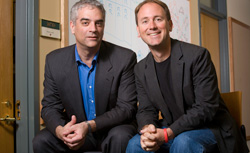
Nicholas Christakis and James Fowler
That said, that didn't prevent the authors from giving a snazzy TED talk (it seems like TED is devolving more and more into pop science of various sorts and not always accurate pop science), and otherwise "selling" their findings.

That includes Fowler appearing on Colbert, where he made claims about losing weight himself as to not "infect" others. But, Fowler wants it both ways; he said he shouldn't have his research judged on comments like that.

Worse, showing once again that even actual science, not alleged science, isn’t perfect, the NEJM, per the story, is standing behind the claims.

And, that's sad, since the mainstream media never gives debunking stories the same play as it does original claims. If the NEJM isn't going to be a better gatekeeper, it's not so "good." Especially since it rejected a piece of debunking research. In short, professional journals like NEJM can "pull a Mooney," not just pseudoscience ones.

And, also "worse" is that Christakis and Fowler shoot legitimate research in the foot with antics like this:
So is obesity contagious? What about happiness and divorce and poor sleep? One irony of the contagion battles is that even if their methods are suspect Christakis and Fowler are obviously correct that peer influence exists and that it may be even more important than we realize. ...

But just because contagion is important in one context doesn't mean something like obesity spreads like a virus—much less one that can infect someone as remote from you as your son's best friend's mother. (For the record, I and my best friend's mother will eat our hats if it turns out to be true, as Christakis and Fowler claim, that loneliness is infectious, too.) Yes, we influence each other all the time, in how we talk and how we dress and what kinds of screwball videos we watch on the Internet. But careful studies of our social networks reveal what may be a more powerful and pervasive effect: We tend to form ties with the people who are most like us to begin with.
In other words, correlation is not always causation. And, to the degree causation is behind correlation, one had better get the correct order of cause and effect understood. Christakis and Fowler appear to be bad social scientists right there.