Showing posts with label Philosophy of mind. Show all posts

Thursday, January 23, 2025

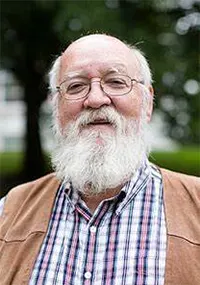
Dan Dennett and Q/qualia, the manifest image and more

Tim Bayne has a very good retrospective on some of Dan Dennett's thought at Aeon.

Two main things jumped out at me. One is his claim that Gilbert Ryle wasn't the only major philosophical influence on Dennett. 

He says we should also look at Wilfrid Sellars:

As the contemporary Oxford philosopher Anil Gomes observed in the London Review of Books in 2023, the key to understanding Dennett lies with another 20th-century American philosopher, Wilfrid Sellars – something of a philosopher’s philosopher. Sellars distinguished between two images of reality, the manifest image and the scientific image. The manifest image is the ordinary, everyday conception of reality – the conception of reality that human beings have prior to science. The scientific image, of course, is the conception of reality delivered by science.

Everybody knows a big part of Dennett's schtick was folk psychology, and Bayne says this was Dennett's version of the manifest image.

The biggie is — where is Dennett at in trying to incorporate some ideas from folk psychology into real psychology as a philosophy of mind? And, Bayne eventually looks at Dennett's idea of the self as a center of narrative gravity. He says this, essentially, stays in the manifest image and not the scientific image, and is based on stories. From this, he goes back to Wittgenstein as ordinary language philosopher. Here's his take on storytelling in general.

Indeed, if Dennett’s analysis of the self was driven by anything, it was driven not by science but by stories – and by stories about stories. At the heart of his paper ‘The Self as a Centre of Narrative Gravity’ (1992) is a story about a story-writing machine

From this, he says Dennett's idea is that, based on Ryle, "we" aren't looking for a causal explanation of behavior but rather sense-making. And, that's where Bayne discusses "the intentional stance."

That said, Bayne says Dennett himself was retreating from his view of intentionality by the end of his life.

Beyond that, aren't "we" as professional and amateur philosophers looking for a causal explanation of mind, beyond but including behavior?

Here qualia pop up.

The Philosophers’ Lexicon – first published by Dennett a decade before ‘Quining Qualia’– defines ‘to quine’ as to deny ‘resolutely the existence or importance of something real or significant’. Dennett coined the term in homage to his undergraduate advisor W V O Quine, who had tried to construct a metaphysics with as few entities as possible. That’s ‘quining’; what about ‘qualia’? Dennett distinguished two senses of this term. In one sense, qualia (singular: quale) are simply the ways that things seem to us in perceptual experience. (To use Dennett’s example, consider how a glass of milk looks at sunset – that’s a quale.) To deny that there are ways the world appears to us in perceptual experience would indeed be in the running for ‘the silliest claim ever made’, but Dennett made no such claim. Instead, his eliminativism was directed towards a certain conception of perceptual experience – Qualia-with-a-capital-Q. To believe in Qualia is to think that the experiential character of consciousness (‘the ways things seem to us’) involves properties that are intrinsic, private, ineffable and directly available to introspection. It is Qualia – and not qualia – that Dennett quined.

As I told Massimo Pigliucci, assuming Bayne has a good interpretation of Dennett's thought, then Dennett comes off as essentially creating a fictive (sic) Platonic idea of Qualia capital Q, and then using that as a strawman to beat down opponents of his thoughts.

Dennett was good at other strawmanning, which leads me to endorse that Bayne IS at least in the right neighborhood. Further confirmation comes further down:

Note, in passing, the absence of science here. There is no mention of single-cell recordings; no appeal to computational models of brain activity; no measures of entropy. Instead, we’re asked to consider a purely fictional scenario. Dennett’s case against Qualia rests on a purely philosophical argument that would not have been out of place in the 1950s. (Indeed – as Dennett himself points out – it is a variation on a purely philosophical argument that was given in the 1950s: Ludwig Wittgenstein’s ‘beetle in the box’ argument.) Although there is background concern here with scientific methods – in effect, Dennett is challenging the Qualia-phile to explain how Qualia might be studied – nothing in the way of ‘brain learning’ is assumed.
Dennett’s rejection of Qualia wasn’t a rejection of consciousness – it was a rejection of a certain conception of consciousness. But if Dennett didn’t reject consciousness, what explanation did he provide of it?

None, of course. Hence wags noting that the proper title for a mid-1990s book of his was "Dan Dennett's Ideas of Consciousness Explained."

There you are. That's our Danny boy!

And hence, while I noted his passing, and followed up on that, I wasn't philosophically crushed. Per that first link, I agreed with John Horgan that Dennett's rejection of at least capital-Q Qualia was a back door to Chalmers' p-zombies. Horgan's piece has a section on this. Second, I also agreed with John that Dennett was a practitioner of scientism, namely in his philosophy. His lack of actual science in his ideas on consciousness is one example. His claiming that evolution was algorithmic and a universal acid beyond biology is another.

In fact, Dennett deserves some Horgan pull quotes. I know Horgan actually deserves them:

Like many philosophers, Dennett clearly gets a kick out of defending positions that defy common sense. But his primary agenda is defending science against religion and other irrational belief systems. Dennett, an outspoken atheist, fears that creationism and other superstitious nonsense will persist as long as mysteries do. He thus insists that science can untangle even the knottiest conundrums, including the origin of life (which he asserts that recent “breakthroughs” are helping to solve) and consciousness.

Followed by:

Dennett accuses those who question science’s power of bad faith; these doubters don’t want their “beloved mysteries” explained. Dennett can’t accept that anyone might have legitimate, rational reasons for resisting his reductionist vision.
Some people surely have an unhealthy attachment to mysteries, but Dennett has an unhealthy aversion to them, which compels him to stake out unsound positions. His belief that consciousness is an illusion is nuttier than the belief that God is real. Science has real enemies—some in positions of great power--but Dennett doesn’t do science any favors by shilling for it so aggressively.

There you are.

That last paragraph may seem a bit harsh, but I would at least halfway accept it, including Horgan's "nuttier."

Too bad I wasn't famous enough to know Dennett while he was still alive and call him a Platonist, too.


Thursday, August 29, 2024

'Catastrophe Ethics': In retrospect, wrong from the title

 I have been hitting a string of cropper and semi-cropper books in touted new philosophy books recently. (Sorry, Little Bobby Sapolsky and determinist fanbois, "Determined" is not a philosophy book, being Not.Even.Wrong, based on a category mistake and more.)

The latest? "Catastrophe Ethics." As usual, what follows is an expanded version of my Goodreads review.

Catastrophe Ethics: How to Choose Well in a World of Tough Choices

Catastrophe Ethics: How to Choose Well in a World of Tough Choices by Travis Rieder
My rating: 2 of 5 stars

This book became fairly disappointing fairly early, contra the hopes I had from the title. In fact, reading backward, in a sense, at the end of the book, I realized the title itself was highly problematic. Even more is it problematic with the expanded review. Let’s start there.

One BIG problem? Nuclear weaponry is never discussed. Given the nuttery of US-Chinese saber-rattling, even to a new US nuclear strategic plan:

(T)he Biden administration has approved a highly classified nuclear strategic plan—the Nuclear Employment Guidance—that seeks to prepare the United States for possible coordinated nuclear challenges from Russia, China, and North Korea

failure to discuss this issue is ridiculous. Even atomic energy gets only mention in passing under climate change. And, the dirtiness of cobalt mining for batteries is discussed later; that of uranium mining is not. Beyond nuclear issues, looking at the weapons side, militarism in general is not discussed, other than a passing reference to threats to Ukrainian power plants by Russia. (Dimona, and the possibility of an Iranian missile hitting it, are not. And, I wonder if further political mindset is behind that. See below.)

Nor, even though we are emerging from a global pandemic and the author is a bioethicist, are pandemic catastrophe ethics discussed in detail. Drug addiction problems are touched on, scatteringly, throughout the book; the war on drugs and related issues are not. I just thought of this at the last chapter of the book, but realized that itself would probably knock it down a star.

And, that relates directly to the book’s title. And, since this is a book of matters philosophical, we’re going to get into linguistic philosophy. What IS a “catastrophe” to Rieder? We’re never given a clear definition, let alone a justification that one would expect to accompany such a definition. Another “missing example”? He talks about consumption behind climate change but never thinks about possibly including current capitalism in general as a catastrophe. Related? The ethics of the developing world wanting to live like the developed world and how that might affect climate change aren't discussed.

Now, Rieder might argue back that the book isn't intended to be comprehensive. If so, theoretically, he still owes an explainer on why he chose the particular catastrophes he did as illustrative.  And, in actuality, we never get that.

His "puzzle," in his details, might be parsed and teased out differently if he used different, or more, disasters to background it.

Chapter 2? The big problem is scientific. Most scientists who are honest climate scientists and not neoliberals say that the degree of temperature change by 2100 will be at least 3C if not more. (Michael Mann is in Rieder’s bibliography but James Hansen is NOT. I have written about this in various ways, including some of the recent study in general and about Hansen vs Mann (and Katharine Hayhoe).) Indeed, per that first link, there's a good chance we hit 4C, and a non-negligible chance we hit 5C, by 2100. And, while I may be gone, if that's the case, there's good chance that Rieder himself, not his child, experiences 3C, and an outside chance of 3.5C, before he passes away.

 Second problem is this is the first, but by no means the last place where he takes individual actions out of collective context. The “joyguzzler” inspires others; the philosophical argument that it’s not problematic becomes weaponized. And, minor harm is not the same as zero harm. And, here, as in chapter 9, there’s a self-conflict over not discussing virtue ethics more here, let alone going beyond the West in a search for philosophical ethics. He finally gets to this, on virtue ethics, in Chapter 11, but that then means we have poor writing and editing; this isn’t a murder mystery where head-faking is not only acceptable but encouraged. It’s logical argumentation. There’s another problem behind that, even more the case in Chapter 12 than in Chapter 11.

Chapter 3’s thoughts on public health did not follow from Chapter 2 on climate change or Chapter 3 on meat. The three have different ethical angles. There is no public health equivalent of “big polluter them” nor an equivalent of big ag’s stranded/marginal costs on factory farming.

Chapter 4 gets us on the beam of good philosophizing. For a chapter.

Chapter 5 is hit and miss. Rieder kind of pulls punches on the second horn of the Euthyphro dilemma, the horn of ethics existing outside of god. So, by not philosophizing about how that, in and of itself, is as wrong as the first horn, the larger picture is a bit short, because the left hand is Kantianism, to put that in more modern terms — command theory without the divine. He also misstates why the post-Peloponnesian War Athens put Socrates on trial. In blunt modern terms, Socrates was a traitor.

Chapter 6 nails “the myth of tolerance.”

Chapter 7: Contra Rosalind Hursthouse, with Rieder missing this? Her definition of virtue ethics by identifying virtuous people is circular. Otherwise, he comes down correctly that trolley problems are as much ethical trick as ethical reality. (And, this is why the r/philosophy subreddit is nutters.)

Chapter 8. Problems with Singer? First is the assumption that happiness is the maximum good, or even, in more stark presentations of Singer, the only good. Second, what is happiness? And, is the hedonistic calculus for measuring that calibrated to the moment? A short term after the moment? A longer term after the moment? I mean, if momentary, then Huxley’s Fordist government passing out soma is the height of good ethics. Doesn’t delve into the “nowhen” issue that parallels the “nowhere,” as in utilitarians cannot have a view from either nowhere or nowhen.

Part III

Chapter 9 His attempt to differentiate between “statistical harm” and “actual harm” seems cavilling. We use insurance actuarial tables to talk about harms all the time and nobody bifurcates them this way. To make this VERY personal given Rieder’s past, insurance actuarial tables will talk about the “statistical harms” caused by driving a motor vehicle while stoned on opioids. To go beyond that to physics? Statistical mechanics is exactly that. Doesn’t make it any less real. And, perhaps with protesting, we as a society accept actuarial norms — until, to riff back to climate change, “we” get bent out of shape when we’re in rural California or the Florida coast and our homeowner’s insurance skyrockets, if it gets renewed at all. Next, he seems to ignore virtue ethics on this issue, looking only at consequentialist and deontological stances. This seems a HUGE fail, and, unlike friend Massimo Pigliucci, I’m not in general a touter of virtue ethics. It’s weirder yet because his farmer friends in Chapter 11 are walking, talking virtue ethicists. Also, Walter Kaufmann, or thoughts similar to “Without Guilt and Justice,” are missing on other angles of individual vs collective justice. See here for a few thoughts on that book.

Chapter 10: Sex is not gender. So says me. So said the late Frans de Waal. So says biologist and philosopher Massimo Pigliucci. Outside of evolutionary biologists, so say some political leftists. This is also, in this case, a linguistic philosophy issue. As a public policy issue, that doesn't mean that both transsexual and transgender persons don't have certain civil rights. Whether they are 100 percent the same in 100 percent of issues? Possibly not.

On duty, obligation and intimacy, his riff on Maggie Little misses another point. We seemingly evolved biologically to be in maximum group sizes of 150. In the modern world, which is “controlling” on my “sphere of intimacy” — biological or cultural evolution? And, his use of Little misses that ensoulment personhood will simply reject this framing a priori. That’s not to say it’s wrong. It is to say that it relies on presuppositions that some would say are not in evidence. Third, claiming Little’s POV on abortion is “complex” medically or ethically is a reach, and it’s also PR, trying to “sell” this precisely because of alleged complexity, as I see it.

Next: No, “reasons” are not a small-granular unit of moral measurement. They MAY be, when purely moral, and later you seem to go back to that, but? You just admitted that reasons often have no moral attachment. There may be plenty of aesthetic good to getting fresh coffee; there is ZERO moral good unless I have some weird disease requiring coffee ingestion.

I agree with him on rejecting duty and obligation on many cases, at least within INDIVIDUALIST ethics. That, too, as well as rejecting Rawlsian liberal versions of political ethics, is something I learned from Kaufmann’s “Without Guilt and Justice.” See more below.

And, by this point, I realized I was sorry I recommended this book to Massimo Pigliucci and that, while it might not fall below three stars, it was quite unlikely to rise above it.

Chapter 11: Uses a farming husband and wife, neo-traditionalist farmers, as a “hook” for turning us back to virtue ethics and an intro to the next part. Not bad, but not failing to talk about the hook in advance is bad non-fiction writing. Also, re the purity ethic in Chapter 12? Are there issues with neo-traditionalist farming that he doesn’t discuss? As in, it’s an “out”? As in, the modern world couldn’t exist with only neo-traditionalist farms? As in, where do all of their customers get their money to pay its higher prices? To put it more bluntly, does this, like planting trees as alleged carbon offsets, act as a sort of environmental penance that doesn’t really do anything? Also, given conversation earlier in this book, would he protest, even raise his hackles, at such thought?

PART IV — finally, after bad editing in Chapter 2 and failing to put a “hook” in either it or Chapter 8 to point forward to Chapter 11.

Chapter 12: Problems with the purity ethic and its similarity to utilitarianism are good. But, there’s a larger problem that Rieder misses, and that’s a problem with **Western** philosophy. Confucianism, for example, has no problem talking about things that would be best called, in the taxonomy of Western ethics, “corporate duty” and “corporate obligation.” Virtue ethics to battle climate change just doesn’t get there. It doesn’t get there on other things. By not looking beyond the Western tradition, in essence, Reider is hamstrung. Also, by looking at duty and obligation as an on/off switch, rather than in terms of degrees, he's further hamstrung. 

I have long thought that the three schools of ethics in Western philosophy fall short. And, this book sharpened that belief, in part because all three schools, while they talk about how an individual's actions affect others, still ultimately are about individualist ethics and nothing more. Virtue ethics is a good example. Aristotle focused on individual flourishing; Master Kung, on that of societal groups.

Let us not forget that the Western world did NOT “invent” philosophy. India’s Charvaka skeptics, for example, existed by or before the Greek pre-Socratics. The Ajnana started about the same time. Beyond the scope of my original review, I realize that, as I get older, this comes more and more forward in my mind. Unfortunately, even a decent-sized public library, while it might have books on the evolution of Hinduism and Buddhism, and maybe even Jainism, won't have books about Indian philosophy. The closest it will get is talking about Philostratus talking about Apollonius of Tyana visiting the "naked philosophers" of India.

Chapter 13: I think it’s too harsh to call Schopenhauer a cynic for his “antinatalist” views. Ditto on David Benatar, whom I’ve also read. Also, to riff on Schopenhauer and Benatar, there’s the question of whether one should stop with one child, whether one’s own progeny or adopted, or go on to a second once that bridge has been crossed, on the grounds that only children may be less happy. Or other things. At least Rieder eventually somewhat softens his view. The only good argument against antinatalism is a selfishly utilitarian one of that it minimizes the happiness of the currently living, especially in developed countries where social safety nets for senior citizens depend in part on youth paying in.

Chapter 14: Racism is horrible. It’s arguably not a catastrophe. See top of this review for more on that issue. And, per books like “Conspirituality,” there are plenty of people who can be environmentalist but racist. Look at the German Völkish movement for 20-30 years before Hitler. Given my note at top about actual or potential catastrophes with ethical issues that Rieder doesn’t discuss, this chapter was a cropper. I’m also NOT a fan of Kendi, among listed authors of Rieder.

Beyond that, as a good non-liberal leftist, talking about racism without talking about classism falls short. Related to that, beyond Western philosophy? The book in general is presented from a Western perspective. The exploitation of Congo over its cobalt is mentioned, but plenty of "developing" nations are exploited for plenty of resources not related to climate change. There's also, again, the issue of the ethics of developed nations saying, "do as we say, not as we did in the past," but offering insufficient help on that.

There’s other things not mentioned on the “participatory” issue. On political action, I assume Rieter is a good Democrat by some of his angles. I’ll venture that he even thinks third-party voters like me waste our votes on climate change. Or nuclear tensions in particular and militarism in general. He might concede this is personal purity ethics but would probably still reject it as good social participation.

View all my reviews

Thursday, October 26, 2023

Sapolsky all wet on "No free will means Yes determinism"

And, thoughts and claims like what Robert Sapolsky is apparently putting into a new book show why, scientism-peddling scientists aside, science still needs philosophy.

I've long said "mu" to the issue of "free will VERSUS determinism," and have gone beyond even that with the wonderful insights of the late psychologist Daniel Wegner, on "The Illusion of Conscious Will."

Just because conscious will is an illusion doesn't mean that determinism is the only counter-answer. That's why I said mu so many times years ago, and also why, per Idries Shah (a philosopher!) this is clearly an issue with more than two sides.

And, specifically, what Sapolsky is talking about is what I've called psychological constraint. It's no more deterministic than our genes are, and an evolutionary biologist knows our genes aren't determinist. Yes, bad childhoods on average, per sociological survey, means that the average person with a bad childhood is more likely to become an addict or whatever. It doesn't at all mean they're predestined for that. It also ignores, as I discuss here, just what words like "agency" and "intentionality" mean.

I have read Sapolsky's most recent book before "Determined," "Behave," and noted that it exhibited muddied and muddled thinking, and I have no doubt this is more of the same, and not worth reading. In fact, on that linked review of "Behave," I said then that Sapolsky needed some philosophy. I also said he was getting close to scientism in general and ev psych in particular. I wouldn't be surprised if "Determined" is yet more that way.

To put it another way? As I said long ago on my main blog, "determinism is often simplistic."

Or, and as Sapolsky demonstrates in this Nautilus interview, determinism is often nothing more than a tautology for methodological naturalism, or more, philosophical naturalism or monism (monism in a non-duopoly, materialist-only sense, and not suggesting anything like Leibniz's monads). This alone, contra a Sapolsky or a Stephen Hawking, shows why philosophy is not dead and why scientists need to stop saying that and stop believing that.

It is interesting that, in that piece, both Sapolsky and neuroscience professor, and free willian, Kevin Mitchell, refer to the Libet experiments. See my most recent thoughts on them here. Mitchell also appears to have not read Wegner. And, shock me that Sabine Hossenfelder, who has plenty of "incoherence" herself, attacks free will as being incoherent. Yet more reason to be glad I deblogrolled her on my main site.

Finally, I reject Sapolsky's idea that determinism is something that, essentially, we need to believe in even if it isn't true, for political science and human sociology reasons.

And thus, I continue to say mu on free will vs. determinism.

Thursday, January 20, 2022

Maybe we're pushing the whole idea of "qualia" too hard

 From a 3 Quarks Daily piece linked by Massimo Pigliucci, my thoughts:

Per your previous posting from Mr. Elgat on qualia, I noted that originally, I heard of qualia in the sense of color, as in Dennett's "redness." 

Well, now we're going to go into evolutionary biology, and touch at the edges of Goodman, the new problem of induction ... and that famous word of his. 

As you know, our primate ancestors long ago evolved a third cone cell and trichromatic vision. So, let's talk about the qualia of "greenness." (Actually, given its peak frequency, it should more be yellow-greenness, and Photoshop will also tell you how much yellow many "greens" have.)

So, in that sense, contra Dennett, we have evolved for a certain type of qualia, it would seem. (Ditto for bees in the ultraviolet, had they the brains to think of such things?) But, at the same time, per Goodman, maybe we should talk of "yellreen"?)

More seriously, you've also probably read studies of anthropologists that show that in "primitive" societies, the first word they have for a color beyond black and white is "red." I think "blue" is second, then either "yellow" or "green" about equal.

So, we have a biologically driven concept of color, but degrees of how color is differentiated are driven by cultural evolution as well. 

But that's not all. 

I said "words." "Language." 

Now, we're also in linguistic philosophy. Insert women joking about how men can't tell mauve from periwinkle. But, that ties back to cultural evolution, or sub-cultural evolution, and a perceived need to be that precise on distinguishing tints, like classical Greek putting five adverbial particles at the start of a word. 

But, perception is not adverbial nuance. Per the evolution of that third cone ... men, of course, often suffer from red-green colorblindness. What I am getting at is that maybe the whole idea of qualia is framed too simply in general. It may not quite be p-zombies, but maybe its usefulness is less than some claim? 

To be more precise, I think we're pushing too hard the idea of qualia as a denoter of consciousness. That said, discussion of what qualia are? Where in the brain they might be located? THAT is indeed a good marker.

Thursday, April 15, 2021

What Searle and his critics AND Turing and others all get wrong — part one

That wasn't the intent of a recent piece by John Horgan at SciAm. Rather, he ultimately pivoted to thinking about what it means to really learn quantum physics.

Nonetheless, he DID provoke the headline thoughts in me.

Expanded from three Tweets to him, here’s the stimulation and light bulbs I got. 

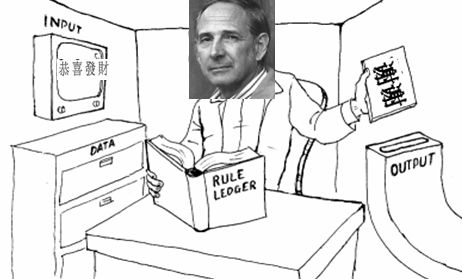
First, here's what both Turing AND Searle (AND many AI friendly philosophers IMO) miss. We and other conscious entities in general are EMOTERS, not just thinkers. No WAY emotions act in a way to be run as a Chinese room experiment.

To riff on our mutual friend Massimo Pigliucci, as consciousness is in part definable as embodied cognition, we need to emphasize the “embodied.” We need to remember that stimuli that lead to emotional reactions come from external sensory perceptions as well as internal cogitation.

Related to that, as I have repeatedly said, our emotional depth and nuance, as well as second- third- and fourth-level theories of mind, is what distinguish us from a cow chewing the cud.

To put it in terms of the Chinese room? The “system” may be answering questions, but it’s not structured to have consciousness because the system as a whole, not just the person inside, is passive. It’s a plant, not an animal. (More on this in a part two.)

Second, the Chinese room is not like Turing OR real-world meatspace. The parameters of a closed vs. open system and related issues are different, plus what the specific intentionality is. Per Daniel C. Dennett, when your intuition pumps are reaching beyond good analogous ideas, you’ll pump out some funky stuff.

In this case, the intuition pumps miss the question of “is it like a plant” or “is it like an animal”? Plants do interact with their environments and do respond to them. They’re not conscious in any animalian sense and I still reject claims that they are.

Third, as for Dennett? His big miss on what you raise is looking at this similar to a black/white on/off conscious/unconscious switch, rather than a "slider" with various degrees of conscious/unconscious between 0 and 100. For guy who talked about "multiple drafts" it’s a bad oversight. But not a shocking one.

Monday, October 05, 2020

Is intelligence really about being a better bullshitter?

Or, more politely, about learning to be a better motivated reasoner?

So says Diana Fleischman in the pages of of Nautilus. 

Two caveats.

One, she's an ev psycher.

Two, she's working in part off work by Richard Dawkins.

Nonetheless, this delayed nutgraf:

Intelligence is associated with coming up with more convincing bullshit and with being a better liar, but not associated with a better ability to recognize one’s own bias.

Rings largely true in my book. (With caveats!)

First, one cannot say that intelligence, long before the syllogisms of Hellenic Greek philosophy, evolved "for" human rationality.

Second and related, per Kahneman and Tversky, "slow" thinking has high evolutionary cost, so intelligence wouldn't have evolved for that.

Third, per anecdotes, partially related to Julian Jaynes' book, intelligence probably did evolve in part for us to talk to ourselves better. Including couching our lies better.

So, there you are.

Sadly, sociopaths will read this as a huge self-justification.

That said, Fleitman is missing a page. Or two or three.

The first missing page? That is Goleman's varieties of intelligence. Especially when we get to the whole nine types idea, shown in one form here, emotional intelligence and interpersonal intelligence both offer the ability, even if not evolved for that, to detect others' bullshit.

Second, of course, as I've written many times, much of ev psych is pseudoscience. If Fleitman's ideas about why intelligence evolved are based on things like the Era of Evolutionary Adaptation, well, then they're also pseudoscience.

Finally, of course, we're NOT an ev psycher in this corner, nor are we Aristotelian final causers. Human intelligence did NOT evolve "for" better bullshitting, or "for" anything else. It was adapted "for" certain things after it evolved, and that adaptation was part of cultural evolution.

(Doorknob help us if the Ev Psychers try to trump this with a full-on ev psych based version of cultural evolution. Not that that's not already half their program.)

I will give Fleischman credit for not overstating her case, mainly through using the phrase "associated with."

For my take on Jaynes?


The Origin of Consciousness in the Breakdown of the Bicameral MindThe Origin of Consciousness in the Breakdown of the Bicameral Mind by Julian Jaynes
My rating: 4 of 5 stars

It's been what, a decade or nearly so, since I last read this, so this review (I thought I had done one, but guess not) is from memory.

That said, I first read it in the early 1990s, when finishing up a graduate divinity degree and transitioning into a secularist.

Academics largely savaged the book at the time, but it's made somewhat of a comeback with them as well as the general public since then. In the world of philosophy, Jaynes' ideas somewhat parallel Dennett's subselves. Similar ideas have taken further root in psychology.

But, the biggie? Jaynes remains less than fully convincing in the when and why of how consciousness originated, both on general anthropology and on philosophy of religion.

The idea that god(s) might originally have been inner voices? Yes, not a totally unreasonable hypothesis.

But, why did these voices become "god(s)" when, as more and more cave paintings showed, some sort of religious experience may well have paralleled, not followed, the development of human language? Not really answered.

Also not really answered is why they STOPPED being internalized and instead became externalized.

Finally, although Jaynes doesn't go heavily into New Agey left brain/right brain stuff, he does drift a bit that way.

At the same time, the book remains provocative enough to get four stars, not three.

View all my reviews

Per Jaynes, and per Fleischman, to the degree she's on to something? Many people often tell themselves the best bullshit. And, per Goleman et al, they are highly lacking in intrapersonal intelligence. As a result, they can often get themselves wrapped around their own axle by someone who is transparent and guileless. Some of the greatest short stories in literature and parables in philosophy are about exactly this. 

Thursday, August 06, 2020

The GIF and Hume, Sapir, Whorf, and Goodman

It's a piece from late 2017, but still quite interesting.

Some people hear GIFs.

Yes, those looped bit videos that have no sound.

Some people hear them, normally in cases where sounds would be expected in real life, such as a GIF of hands clapping, one of police lights (with inferred sirens), and such.

Are such things being heard?

Yes, indeed, an audiologist professor told the Times' journalist.

Two cognitive neuroscientists said it is similar to the "filling in" of some types of optical illusion. They added that people with synesthesia are more likely to do this.

That said, why the author, Heather Murphy, stopped with scientists, I don't know, but it presented a punches-pulled story.

Obviously, this has connections to empirical philosophy of centuries past, and per the cognitive neuroscientists, connections to cognitive philosophy today, namely the issue of qualia, and within that, how specific qualia may be in the auditory world. (Murphy does loop in Christof Koch, but, academically, despite his gushing about pantheism, he's a scientist, not a philosopher.)

Of course, hearing exists inside our heads.

"If a tree falls in the forest, does it make a sound?" It makes sound waves, but it doesn't make a sound until it's heard. (That said, there are plenty of foxes, bears, deer and squirrels to hear it.)

This is partially what the whole idea of empiricism is about. But, David Hume, and his predecessors, didn't really wrestle with the issue behind sensory experience. (Of course, 300 years ago, they weren't really able to wrestle with how the brain works!)

It focuses itself in modern philosophy with the discussion of qualia. As a sidebar, and not to go too Sapir-Whorf, but per Nelson Goodman's new problem of induction, there's the issue of how we experience a sound based on not only our genetics, as in the synesthesia, but also based on our individual developmental histories. (The Inverted Spectrum idea, a thought experiment often discussed in thinking about qualia, more directly connects to Goodman.) To riff on Sapir-Whorf, an Inuit may hear 20 different sounds from snow at different temperatures, different thicknesses and different degrees of compaction and you or I might here three. But, a recording microphone will show the same sonic signatures for the Inuit's 20 sounds and my three.

And, this leads me to wonder aloud on other things.

Other than feeling vibrations from clapping, especially, let us say, large group clapping at a concert, political rally, etc., do deaf people have the equivalent of "hearing" clapping? If so, how would they respond to these GIFs?

Thursday, January 02, 2020

Top blogging of 2019

 It was a very interesting year here by what readers liked.

A mix of debunking, takes on things Luther, pseudoscience debunking, philosophical hot takes and my poetry made up the 10 posts most read by readers this last year. More than half of the posts were pre-2019, but that's fine. Good stuff ages well.

No. 1? A decade-old blog post that I'd originally forgotten to put a header on and that eventually took off. (Spammers, maybe?) It was about "libertarian pseudoskeptic pseudoscience" and looked at some of the worst in pseudoskepticism, and sometimes pseudoscience, by leading libertarian lights in the Skeptics™ world like Brian Dunning and Michael Shermer.

No. 2? My take on a recent revelation that  early research on which Benjamin Libet based his "brain delay" studies, "undermines his research angle but also reinforces his philosophical scrivening." I chided some not to throw out the baby with the bath water; in other words, Libet ain't dead yet.

No. 3? My rewrite and update on Edward Arlington Robinson's classic "Richard Cory."

No. 4? A throwaway post, at least on the surface, from a decade ago. I encouraged intellectual types to be themselves in making small talk.

No. 5? An update to a 2017 blog post, where I further call out the cultural Catholicism lies of alleged atheist Tim O'Neill and his History for Atheists blog. (I found out, in the process of the update, that I'm far from alone.)

No. 6? Gun Nuts for Luther? Headquartered here in Tex-ass? My brother a member of their Facebook group? Whoda thunk? Here's the details.

No. 7? More Luther, this time my extended review of Lyndal Roper's 2017 biography. A solid 4-star work, but at the end of the year, with books newish and older, I still hadn't found a total 5-star tome.

No. 8? My uncle died just over a year ago. Rather than attend the funeral and be laden with religion and religious-based guilt-tripping, I wrote a poem about all that.

No. 9? Also from late 2018? I smacked around Andrew Sullivan for his latest (at that time) stupidities, and attached one of my most delightful Photoshoppings.

No. 10? Daring to touch the third rail of American foreign policy discussions, and based in part on my review of Yuval Noah Harari's "Homo Deus," I dared ask "Who's a Jew vis-a-vis Zionist claims?"

Finally, it was the most productive year blogging here since 2012. It's given me a diversion from my main blog. And, as 2019 readers can see, for the next two years, expect more Lutheran Reformation 500th anniversary posts.

Monday, October 28, 2019

Mental priming: A personal anecdote


Last weekend, I was up on the Red River. I was mucking around right by the riverfront, looking for a better camera angle on some pictures. I eventually stepped into some fairly thick clay mud.

Then I thought, what if this is the edge of quicksand? I didn't panic, but I told myself "get out now!" That was even as two lenses spilled out of my camera bag, with the top strap click-locked, but not cinched as tightly as it could be.

Well, that slippery red Choctaw clay, per the folks who gave Oklahoma its name (I was below the high water mark on the south bank so I wasn't in Texas!) wasn't quicksand, but it IS slippery, and I was sliding on any stuff that had dried out on top but was wet beneath. Fortunately, there was a "sawyer" snag downed right in front of me. I grasped it, then cleaned some of the stuff off my shoes after I got on terra firma.

So, why had I thought it was quicksand at first, at least possibly?

Well, I'd read a Backpacker article about a boyfriend-girlfriend hiking in backcountry in Zion National Park and pushing the weather. They got to a big muddy area with some bits of water in/on it, and figured they could hike through. But the GF soon hit what was quicksand. The BF got her free but got more seriously stuck himself.

He couldn't get out. He told her she had to go for ranger help. Worse? She'd never hiked with anybody but him. (Sidebar: He may have pushed her hiking development level too quickly, methinks.) She eventually did so.

Well, they were also pushing the weather there in Zion. Said BF got a fall snowstorm dropping flakes on him even as he wasn't fully dressed for the weather. (BF was not only pushing GF's hiking development too quickly, but was being young and not fully preparing, methinks.) Well, rangers eventually got there, but they all had to spend a night on the floor there as the guy's one leg was too numb from a mix of being stuck AND how forceful a wrenching (with a rope around his body connected to a ratchet) was needed to haul him out.

After I hit terra firma, I realized that had likely been in my mind.

At that point, conscious of it, it's no longer "priming."

But it surely was before that.

Thursday, March 09, 2017

"What color are these strawberries?" is ultimately a philosophical question, not scientific

A lot of people have probably, via Facebook friends or whatever, seen the photo of strawberries at left, whose production is described here.

I haven't actually opened the picture in Photoshop, but I'll take at face value the claim it has no red pixels.

But, what does that actually mean?

Photoshop's default on color pictures is to present a photo in "RGB" format. That's Red, Green, and Blue — the three primary colors. But, many Photoshop commands let one manipulate not only those three colors, but the three commonly accepted secondary colors of Cyan, Magenta and Yellow, plus a channel for Black. If you've ever heard of CMYK (B already used for Blue) photo editing, that's where it comes from. The Black channel is necessitated by the conversion of primary colors back to secondary.

Anyway, back to RGB colors. Several thoughts here.

First, many colors, even in "normal lighting," whatever that is, aren't what we think. If you use Photoshop much, you'll see that the "green" in grass is about one-third yellow.

Second, does Photoshop's 256-bit format for each color channel imply a level of digital accuracy that doesn't exist? I mean, we can peg light to 500 nanometers. But, is that blue or is that cyan, or turquoise, if we use a non-technical color, or what? Wiki has a full piece on "spectral color" which raises such issues.

And, with that, we're into various issues of philosophy.

Setting aside some aspects of epistemology, we've got what would be either informal logic or linguistic philosophy, first. That is the issue of categories and definitions.

Per what I posted above, where does one color "stop" and another "begin"? That's not a science issue, that's a philosophy issue.

We also have linguistic philosophy issues on how one defines color. Setting aside the Sapir-Whorf hypothesis, which is nonetheless of a certain degree of strength, some languages distinguish between more colors than others. Isaac Newton, with the rainbows produced by his prism, famously distinguished indigo as a seventh color of the spectrum.

To the degree the above photo is an optical illusion, it trades on something else which is related to epistemology, and to David Hume's project of empiricism. That is the idea of qualia, or why do things seem to be the way they are.

The idea of qualia, if accepted in one of its several forms and definings, undercuts the "blank slate" idea of human perception stressed by Hume, and to fair degree by fellow empiricists. A child old enough to point to a red splotch in normal light, when shown this picture above, would not be able to point to claim it has a color similar to that red splotch on the blank slate theory of the human mind. (I frame the example this way to try to bracket the issue of the baby's mind being "contaminated" by explicit written or oral conversation.)

As to opponents of the idea of qualia? As I've gotten older, and more read in modern philosophy, I find Dan Dennett's arguments more and more lacking. The more and more we do current research in robots, artificial intelligence and similar, the more and more we realize human minds don't work that way. Dennett's other objections are somewhat functionalist in nature.

A side issue is that discussions of qualia often get wrapped up with issues of ontological dualism, even though in reality the two are separate items.

There is no logically necessary reason to invoke ontological dualism to explain qualia. That's doubly the case if one understand consciousness and the mind through the lens of embodied cognition and not Dennett's crudely mechanical and scientism-driven computer models.

Let's take this in terms of color. My cone cells in my eye may have slightly different wavelength sensitivities than yours. My optic nerve neurons may respond slightly differently to my cone cell impressions than your neurons do to your cone cells. That's a thumbnail on embodied cognition and color.

Next, let's head to psychology.

If your father, or mother, was a firefighter, your "suchness" of the color red will be far different than mine, at least if their fire department still uses traditional fire-engine red colored vehicles.

Or, as an adult, let's take yellow. If you're a salesperson for French's, as in French's mustard, your "suchness" for yellow will be different than mine if I'm a salesperson for Dole banana. Or for Sunkist, and Sunkist lemons.

Friday, January 18, 2013

Dennett can't admit he's wrong, I guess — even with good thoughts

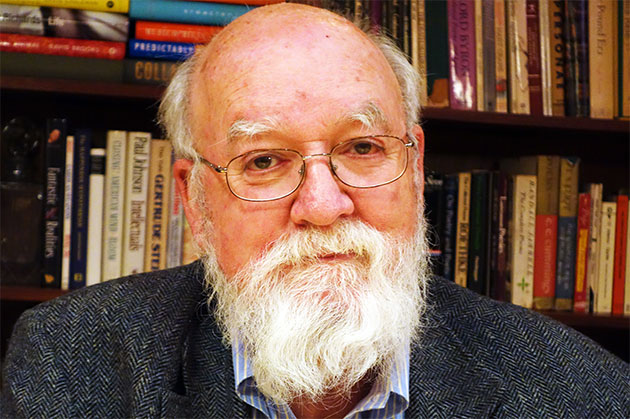
Dan Dennett/Edge magazine photo
Philosopher Dan Dennett has a very interesting interview in Edge.

Key takeaway? He junks a fair amount of what he's said in the past about the details of how the mind/brain is like a computer, 

BUT!

Still holds fast to the analogy that it's ... like a computer!

Let's look at some comments:
We're beginning to come to grips with the idea that your brain is not this well-organized hierarchical control system where everything is in order, a very dramatic vision of bureaucracy. In fact, it's much more like anarchy with some elements of democracy.  ...

The vision of the brain as a computer, which I still champion, is changing so fast. The brain's a computer, but it's so different from any computer that you're used to. It's not like your desktop or your laptop at all, and it's not like your iPhone except in some ways. ...

Control is the real key, and you begin to realize that control in brains is very different from control in computers. Control in your commercial computer is very much a carefully designed top-down thing.  I mean, with all that, there's no need to hang on to his analogy.  
I guess he simply can't admit it's a crappy analogy that just doesn't work, and walk away from it.

Because it was a crappy analogy a decade ago,. and it's in tatters now. (Ditto for his claim that evolution is algorithmic.) 

That said, it's not all hubris in the interview. Dennett admits his new ideas (and it's nice to hear him have some) are speculative enough he'd "be thrilled if they're 20 percent right." And, his comments about brain plasticity, findings that maternal and paternal  inheritance genes in our cells may "war" much more than previously thought, are refreshing. 

At the same time, there IS hubris in other ways. His admissions of plasticity in the brain, combined with the "20 percent correct," should lead him to say that cognitive science, and related things such as artificial intelligence, may have advanced from the Neolithic to the Bronze Age in the last decade, but that's where they are and no further.'

Also unfortunately, his new ideas don't appear to extend to free will.

At the same time, though, the last section, about hypocrites in the pulpit, is great.

He's not talking about moral hypcrites, but unbelieving hypocrites in conservative Christian denominations. This is a follow-up to surveys and other work he and others have recently done.

Here's a sample:
How do they thread the needle so that they don't offend the sophisticates in their congregation by insisting on the literal truth of the book of Genesis, let's say, while still not scaring, betraying, pulling the rug out from under the more naïve and literal-minded of their parishioners? There's no good solution to that problem as far as we can see, since they have this unspoken rule that they should not upset, undo, subvert the faith of anybody in the church.
This means that there's a sort of enforced hypocrisy where the pastors speak from the pulpit quite literally, and if you weren't listening very carefully, you’d think: oh my gosh, this person really believes all this stuff. But they're putting in just enough hints for the sophisticates in the congregation so that the sophisticates are supposed to understand: Oh, no. This is all just symbolic. This is all just metaphorical. And that's the way they want it, but of course, they could never admit it. You couldn't put a little neon sign up over the pulpit that says, "Just metaphor, folks, just metaphor." It would destroy the whole thing. 
From personal experience with my own "coming out," I know how true this is.

Good stuff to end on. Go read it. 

Monday, January 30, 2012

The state of consciousness studies

Science News has two excellent articles on where we are at, part of a just-started ongoing series.

The first, by Tom Siegfried, follows in many of the footsteps of Douglas Hofstadter to talk about consciousness and self-referential systems. The title of "Self as Symbol" gives some hint of where he's headed. And, he says self-referentiality may actually deepen our eventual understanding of consciousness rather than acting as a barrier.


Laura Sanders looks at the neuroscience side of the coin, and what brain studies are telling us these days. Not too much of high specificity, but we're getting ideas on how to refine, and in some ways change, our searching.

Thursday, January 19, 2012

Mu to free will

And to determinism, too.

Folr those of you not familiar with this word “mu,” I’m not being a cow with a French accent. Rather, I’m “unasking a question,” so to speak. The word comes from Zen Buddhism.

If you’re read the magisterial “Gödel, Escher, Bach” by Douglas Hofstadter, of course, you ARE familiar with the word.

Anyway, by “unasking the question,” the word says that the premises upon which a question is based are false.

And, in the case of free will VERSUS determinism, I believe that is very, very true.

First, per Dan Dennett, and many other students of Gilbert Ryle and others, there is no such thing as a little “Cartesian demon” in the middle of our brains, choosing what thoughts in our minds rise to the level of consciousness. Rather, although Dennett at least, here as elsewhere, overextends Darwinian parallels, different subselves are competing, if you will, for which one of them rises to the top. Arguably, more fragmentary sub-subselves are a level lower, but I’m not going to do a Hofstadter-type eternal expansion! Of course, dissociative identity disorder is a case of extreme lack of connection between these subselves.

In short, there’s no “Cartesian meaner” running the projector of a movie theater.

However, Dennett doesn’t go to the logical next step, even though I know he full well knows it IS the logical next step.

If there is no Cartesian meaner generating consciousness, then there’s no Cartesian free willer generating consciousness-level free will. (Or, pace Massimo Pigliucci, no "Cartesian volitioner.")

Now, per David Hume living comfortably every day despite his inability to “grasp” a “self,” we, too act “as if” we have conscious free will. But, that doesn’t mean we actually do, contra the Massimo Piglicccis of the world.

But, just because we don’t have conscious free will, even of a fairly weak sort of compatibilism, doesn’t mean that it’s all determinism, contra the Jerry Coynes of the world. Certainly not in his neo-atomistic physicalist, "hard" determinism.

Nor, pace Massimo, do we have to go down the route of dualism if we reject conscious volitionism. That's especially true if:
A. We see something like free will as developing as an emergent property;
B. We reject "hard" physicalist determinism, too;
C. We see whatever this "quasi-free will" is, and a "softer" psychological determinism as being two endpoints on a continuum, and not two poles of a polarity.
As for what this means?

How “free” or how “determined” our actions are is a case-by-case basis issue, and it depends on which subself seems to be in the saddle at the moment, and how determined or not a particular aspect of that subself is.

I wish we, both amateurs and professionals of the philosophical world alike, could move beyond the “free will VERSUS determinism” issue. It has religious-type moral baggage, at least to a degree, on the free will side, on issues of guilt and responsibility. More and more, it has scientism baggage on the determinism side. It’s so unproductive. But, I’m not holding my breath.

On the free will side, in comments within his latest post on the matter, Massimo admits the issue of guilt and responsibility is why he continues to defend free will VERSUS determinism (or other attacks, or "attacks").
(A)ny talk of free will and consciousness being illusions is a threat to humanism, since among humanist's cardinal principles are that we are responsible for our actions and that we can use reason as a guide to life.
Well, then, per the ways in which I've previously chastised Joseph Hoffmann, humanism, whether explicitly secular or not, without embracing scientism, needs to embrace scientific advances.

Ian Pollack, writing a guest post at Massimo's blog, appears to move a step in this direction, with an analytic philosophy type approach that includes saying Coyne is ... insufficiently reductionistic, of all things, in his use of language.

Here's the core of his thoughts:
So how would I tackle the issue of free will/volition?

Suppose I am driving along an undivided highway when the stray thought
comes into my head that I could steer into the opposing lane, resulting
in a horrible, deadly accident.

Of course, I don’t do so, because... well, I like living and I don’t
much want to kill others, either. And I just washed my car. But I could
have done it.

...Wait, was I right to say that I could have done it?

Yes and no. As we have seen, the pivotal word in that sentence is
“could,” and “could” has at least two meanings that are relevant to the
question of free will.

Meaning #1 maps physical possibility, and in this case returns the clear
answer “No, the physical state of the universe was such that you could
not have steered into oncoming traffic, as evidenced by the fact that
you did not, in fact, do so. QED.” Jerry sees this clearly, and I have
absolutely no argument with him.

Meaning #2 of “could” maps counterfactual statements. To say that you
“could” have done something in this sense is (roughly) to say that IF
circumstances had been otherwise, a different outcome would have
resulted. Meaning #2 returns the answer “Yes, you could have steered
into oncoming traffic, if you had wanted to.”

Meaning #2 is what people actually mean by “could,” most of the time.

If you’ve been sleeping through this post, pay attention now, because
the entire click of compatibilism lies in this realization.

Proposition
#1: “No, the state of the universe was such that it was physically
impossible for you to have steered into oncoming traffic.”


Proposition #2: “Yes, you could have steered into oncoming traffic (if you had wanted to).”

However, to my mind, he still fails. He addresses only the Coyne-type physicalist determinism, not "softer" versions, first. Second, he's committed to the "versus" stance, continuing to defend a compatibilist version of free will versus determinism.

For more excellent thoughts in this general vein, I strongly suggest Walter Kaufmann's book "Beyond Guilt and Responsibility."

Sunday, November 13, 2011

Free will - a "god of the gaps" parallel?

Is "free will," at least as "compatibilists" generally strive to define (and save) it, a philosophical equivalent of "a god of the gaps"? I say the answer is an arguable yes.

Philosophy professor Eddy Nahmias is the latest to try to defend some neo-traditionalist, if you will, version of free will.

Of course, when you start with a straw man howler like this, it's easy for you to get called "a free willer of the gaps":
When (neuroscientist Patrick) Haggard concludes that we do not have free will “in the sense we think,” he reveals how this conclusion depends on a particular definition of free will.  Scientists’ arguments that free will is an illusion typically begin by assuming that free will, by definition, requires an immaterial soul or non-physical mind, and they take neuroscience to provide evidence that our minds are physical. 
First, not all neuroscientists make that assumption. And, philosophers like the Daniel Wegner whom you linked at the start of the column definitely don't link free will, or its absence, to dualism, or its lack.

Then, there's this:
Many philosophers, including me, understand free will as a set of capacities for imagining future courses of action, deliberating about one’s reasons for choosing them, planning one’s actions in light of this deliberation and controlling actions in the face of competing desires.  We act of our own free will to the extent that we have the opportunity to exercise these capacities, without unreasonable external or internal pressure.  We are responsible for our actions roughly to the extent that we possess these capacities and we have opportunities to exercise them.These capacities for conscious deliberation, rational thinking and self-control are not magical abilities.
Well, if you're not going to wrestle with what consciousness is, let alone what standing free will at the level of consciousness has in the absence of a Cartesian theater, you may have a problem. Nahmias does eventually get around to tacking Benjamin Libet and the famous 200-millisecond gap, but only to wave it away:
First of all, it does not show that a decision has been made before people are aware of having made it.  It simply finds discernible patterns of neural activity that precede decisions.  If we assume that conscious decisions have neural correlates, then we should expect to find early signs of those correlates “ramping up” to the moment of consciousness. 
Ahh, this is a petard hoister. It's all in how you define "decisions" as well as "free will," isn't it? Under the Dan Dennett multiple drafts model, this is rather the subconscious impulse that "wins out" to the level of consciousness.

Finally, to riff on Samuel Johnson, Nahmias enters into the last refuge of a free-will philosophy scoundrel: He makes the "fatal" is-ought error.
We need conscious deliberation to make a difference when it matters — when we have important decisions and plans to make.
Need? As in "ought to have"? Ooops.

Some other thoughts from Wikipedia on free will, including reference to Haggard, here.

That said, I think it IS possible to talk about free will in some way, but only in a way that includes subselves and subconscious processes.

UPDATE, Nov. 26: Massimo Pigliucci actually defends Nahmias, claiming he "provides a nuanced and intelligent brief discussion of the topic." Massimo is often thought-provoking and never dumb, but he's just off base on this one. (In the same post, he says that way too much is read into Libet. I'll split the difference and say that somewhat too much may be read into him, and that what Libet's experiments study are somewhat imprecise. But, to claim he's pretty much irrelevant to discussions of free will is a stretch, at the least.)

UPDATE, Nov. 27: Add this excellent essay to your reading. From a neuroscience perspective, it argues that brain systems that evolved to detect actual (or apparent) "intentionality" are a focal point for the rise of an illusion of "self." And, here's the journal essay that influenced that blog essay.

This ties in with Dan Dennett's "heterophenomenology." We assume "selves" in others because of this 'intentionality set" that appears to be built into our brains. But, Dennett doesn't quite note this is a two-way street. Per modern social psychologists, the "self," or what we call a "self" for ourselves, is in part a construct based on our interaction with others. That includes them seeing, and noting, seeming "intentionality" in ourselves.


So, even if there isn't a unitary self, not only do we act "as if" there is, we find it hard not to do so because of this outside conditioning as well as our own brain's mindset.


Now, a Buddhist meditation adept, or a devotee of deep self-hypnosis, might be able to transcend that to some degree. But (and this is why I only half-jokingly say "the only good Buddhist is a dead Buddhist") the person who recognizes, and more than just intellectually understands, that "self" is to some degree an illusion is generally unable to hold on to that idea. The Zen monk rejoins the rest of the monastery; the hypnosis adept walks out the door and into the larger world. And "conventional" ideas of self get reinforced again.

Sunday, June 12, 2011

Chomsky should think again - within himself

Sounds like this is a definite book to read: The Recursive Mind: The Origins of Human Language, Thought, and Civilization.

Michael Corballis, as noted in this review, thinks its recursive thinking, done without any special fluency in language, let alone a language "module," that makes us human.

I've not read that one, but, at my nearest semi-major library, I did find another book by Corballis,  "The Truth About Language" (Goodreads review).

And extractions from that:

The Truth about Language: What It Is and Where It Came From

The Truth about Language: What It Is and Where It Came From by Michael C. Corballis
My rating: 5 of 5 stars

Excellent book from the preface on.

Many people know the name of Noam Chomsky, but they may not know that, while he dethroned B.F. Skinner’s behaviorist approach to linguistics, his own theory, which broadly falls into humanist linguistics, has itself become largely passé.

Two major newer schools, with a fair amount of overlap but with distinct emphases, are in the lead today: functionalist and Darwinist schools of linguistics. Michael Corballis comes from the later, though he’s conversant with the former. In the same broad train of thought as a Michael Tomasello, he talks in this book about the likely route for development of human language.

Corballis says straight up that he knew he would butt heads with Chomsky, Gould and others. He rejects Chomsky’s massive modularity of the brain (as does most modern neuroscience) and rejects Gould for saltationist ideas about the origin of language.

Corballis says that he sees normal, incremental neo-Darwinian evolution at work.

Early in part 1, chapter 1, he calls out Chomsky for ignoring most of the vast variation between languages in his attempt to posit a universal grammar. He even QUOTES Chomsky to that effect.

“I have not hesitated to propose a general principle of linguistic structure on the basis of observation of a single language.”

This is basically like the old “spontaneous emergence” idea of maggots in rotten meat, Galen’s claiming the human liver has seven lobes because monkey livers do, or similar.

Now, after refuting Chomsky, what ideas does Corballis offer up?

First is that language probably in part evolved from gestural issues. He notes that human babies point to things just to note them as an object of attention, vs chimps who point because they want.

Next, he notes humans’ ability to mentally time travel. Tis true, he notes, that corvids may not immediately revisit seed caches if they think another of their species has been spying on them, but that’s about it as far as looking to the future among animals. Elephants and primates seem to retain some memory of deceased loved ones, but of itself, that doesn’t reflect mental time travel backward, really. Only humans seem to have that in great degree. This, in turn is part of larger “displacement” in language, moving ourselves spatially as well as temporally. Related to that is that, in English at least, many prepositions can have both spatial and temporal functions.

Beyond that, he postulates that humans (and possibly earlier members of the genus Homo) having third-order theory of mind, vs primates (and presumably, cetaceans) having only second-order TOM, and a restricted and species-specific one at that, is probably a big factor in language development. Language recursiveness and nesting would seem to underscore this.

In all of this, though, Corballis notes that primates have some gesture usage, and that even dogs can recognize specific human words.

Next, it’s off to grammar. After a basic look at parts of speech, Corballis notes how and why, in English and other language, some things like “helping verbs” evolved … and then, in some successor languages, devolved again. As part of this, and the idea that languages in general started as noun-verb only items similar to modern pidgins, Corballis notes the role of cultural evolution.

Corballis ends with his “Crossing the Rubicon” of how he things language began. (I’ll end there to avoid spoiler alerts.)

UPDATE, July 5, 2024:

Beyond that? Carl Zimmer reports that new research indicates language evolved primarily for communication, and NOT for thinking. Fun sidebar? This is another overturning of Chomsky's claims about language. (I can't say "research," since Chomsky did basically none.) Also, this would tie in with people like Corballis stressing cultural evolution's role in the development of language.


View all my reviews

Monday, April 25, 2011

Just how irrational are we? Very?

Very, or potentially very irrational, defining "irrational" and "rational" in terms of the great project of Descartes and followers, it seems.

In a blog post at Discover, in follow-up to his column last week at Mother Jones, Chris Mooney notes that the journal Behavioral and Brain Sciences has devoted an entire issue to what he covered at Mojo, with links to summaries of key content.

Here's a couple of key outtakes:

First:
Reasoning is generally seen as a means to improve knowledge and make better decisions. However, much evidence shows that reasoning often leads to epistemic distortions and poor decisions. This suggests that the function of reasoning should be rethought. Our hypothesis is that the function of reasoning is argumentative. It is to devise and evaluate arguments intended to persuade. Reasoning so conceived is adaptive given the exceptional dependence of humans on communication and their vulnerability to misinformation. A wide range of evidence in the psychology of reasoning and decision making can be reinterpreted and better explained in the light of this hypothesis. Poor performance in standard reasoning tasks is explained by the lack of argumentative context. When the same problems are placed in a proper argumentative setting, people turn out to be skilled arguers. Skilled arguers, however, are not after the truth but after arguments supporting their views. This explains the notorious confirmation bias. This bias is apparent not only when people are actually arguing, but also when they are reasoning proactively from the perspective of having to defend their opinions.
And more, from a response to some of the issues:
When people reason alone, there will often be nothing to hold their confirmation bias in check. This might lead to distortions of their beliefs. As mentioned above, this is very much the case. When people reason alone, they are prone to all sorts of biases.

In short, as Mooney notes, classical Cartesianism appears m ore and more dead in the water. First, Dan Dennett (and others) said there is no little man, no Cartesian homunculus, making magic rationality decisions inside us.

Now, BBS et al say that, even if there were such a critter, he wouldn't be a disinterested rationalist anyway.

But, not all commenters on Mooney's post want to accept that, it seems.

I responded to one:
Nullius, (you seem to present) a great defense of the “traditional” view of reasoning or whatever …

BUT, I’m going to argue with you.

First, the “reasoning as argumentation” model I think explicitly says this is NOT, NOT, NOT, a “human failing.” Rather, it is, if I may, “human ISness.”

I won’t propose abandoning “rationalism,” but I will say that it is even more unnatural than you may want to admit.

And, that IS a conflict with Cartesianism, which postulates rationality is a cornerstone of homo sapiens.

Sorry, but, either you don’t get the degree of implications this involves, or …
You DO, unconsciously, understand precisely what is up and by your conscious argumentation, actually support the fact at hand.
Of course, maybe I have reasons for my argumentation.

Meanwhile, this SciAm blog explains some of the reasons for our irrationality, in terms of motivators.

Saturday, February 19, 2011

Don't fret over Watson too much?

Wired reminds us that Ken Jennings' human brain used as much energy as a 12-watt light bulb on Jeopardy, while Watson the computer needed special cooling equipment, and that the Deep Blue computer that beat Gary Kasparov at chess was a fire hazard.

And, does Watson have "metaknowledge"? Can it recognize that it can't quite remember something but knows that it's on the tip of its cybertongue? Does it have the emotional power of "knowing"?

Not yet. Watson's interesting. Is it intelligent? No.

Emotions, especially when understood as value judgments, are part of the package of intelligence.

So, while Watson may have been hot under the cybercollar from the heat of his circuits, he never really was sweating, so to speak, because he couldn't.

Friday, February 04, 2011

Sam Harris' Immoral Landscape

Sam Harris' "The Moral Landscape," much lauded by many reflexive, relatively unthinking New Atheists who have made him into a rock star of the movement, falls far short of its hype. In fact, I one-starred it on Amazon.

What's wrong? Harris is a Platonic idealist in drag. He also engages in scientism. Related to both of these, despite his having an undergraduate degree in philosophy, he really appears not to understand a lot of philosophical issues relevant to this book's subject. Or else, he doesn't care to.

Beyond that, his Islamophobia in the early part of this book seems to largely come straight from the neoconservative playbook. Possibly related to that, he creates straw men out of liberals all allegedly being moral relativists.

Sam Harris tries to draw a hard-and-fast dichotomy between science-based morals and ethics and religious-based morals and ethics in this book.

However, this is the real world, not a Platonic idea (Harris comes off as quasi-Platonic in more than one way in parts of this book), and so, it's not totally amenable to Harris' bifurcation.

Take abortion. Many religious people support at least some right to abortion, but noted atheist Nat Hentoff is 100 percent prolife. Ditto on end of life issues. And, if I looked a little bit, I could surely find atheists and agnostics with less enlightened views on gay rights than many religious people.

Now, as to the science part ... the idea that we can have a science-based morality? Harris offers little in the way of actual neuroscience studies on the brain processing moral issues.

We may well get oodles more such studies in the future, but that's not today. Harris also doesn't address the issues of what MRIs measure, how well this correlates with thought output, etc.

Likewise, he discusses little in the field of well-done evolutionary psychology (to distinguish it from Pop Evolutionary Psychology).

Beyond that, he simply ignores that the study of the human mind, whether from the POV of cognitive neuroscience or evolutionary psychology, is at best in the Early Bronze Age and is arguably, at least on the matter of morality and ethics, still in the Neolithic.

So, while science may at some point (far?) in the future offer us significant oversight on specific moral issues, it doesn't today because it can't. And, per the specific moral issues I listed above, it may never be able to.

Indeed, with reference to that, Harris' approach to science and morality smacks of a fair degree of scientism. And, I write this as an irreligious, skeptical naturalist.

That said, there's several other problems with this book. Read on at the jump for the details! I'm going to address several overview issues first, before making any page-by-page critique of the book.

First is the matter of Harris' Islamophobia. Since Islam is in general cited regularly for examples of immoral behavior and beliefs, we need to examine this.

First of all, it seems much of Harris' Islamophobia comes from the neoconservative political playbook. He favorably references an off-the-wall neocon writer, Bat Ye'Or, whose book on Islam's alleged takeover of Europe was one-starred by me.

Secondly, he's confusing a static historic snapshot of history with a moving picture. If we went by snapshots, 900 years ago, Christian Crusaders would have been the poster boys for immoral behavior. 750 years ago it would have been pagan/animist Mongols. 600 years ago, polytheistic Aztecs.

Finally, if we confine ourselves to today, the Hindu Tamil Tigers of Sri Lanka killed 30,000 in their civil war, far more than al-Qaeda has killed.

Second, whence comes Harris' moral stance, ultimately? I believe he is not just a moral objectivist, albeit a consequentialist (a stance more often associated with moral relativism but compatible with objectivism too), but a moral absolutist -- specifically a Platonic Idealist moral absolutist. There's irony there in spades, since the early and middle Platonic dialogues were devoted to Socrates, deconstruction of other people's definitions of moral issues such as justice. (Of course, Socrates usually doesn't offer his own idealist definition back; such things arise only in later dialogues.)

Third, what of Harris' claims to be examining morality and its foundations from a scientific perspective?
First of all, he's not the first to do so. He didn't invent sociobiology or evolutionary psychology. (Let me be clear here -- much of what passes for science in alleged evolutionary psychology is actuallly the pseudoscience of Pop Evolutionary Psychology. However, unlike a P.Z. Myers, there is legitimate work being done in this field, albeit little and far between.) So, Harris isn't new in his effort and he's certainly not new in his hope.

That said, for someone who wants to be scientific, he seems often lacking. (No shock here; I saw the same problem way back in "The End of Faith." First, from an evolutionary standpoint, Harris doesn't address issues of individual vs. group selection. Now, I'm not as bullish on group selection as, say, David Sloan Wilson, but I do think it deserves more consideration than many evolutionary biologists give it. Second, Harris doesn't devote any scientific examination to cultural evolution. Admittedly, there's not a lot to really nail down ant this intersection of biology and sociology, but Harris doesn't even get into what is out there.

Beyond what I mention above, for someone with a graduate degree in neuroscience, he spends about ZERO time referencing actual neurological study of the brain. No V.S. Ramachandran here, folks! Not even close.

Fourth, Harris and philosophy, not just the "is-ought" issue, but certainly including that.

First of all, for people who have read previous works of his, and not embraced him as a bundle of light, his arrogance in dealing with the philosophical background should be of no surprise. But, it still needs quoting.

Page 197, footnote 1: "Many of my critics fault me for not engaging with the academic literature on moral philosophy. ... First ... I did not arrive at my position ... by reading the work of moral philosophers; I came to it by considering the logical implications of our making continual progress in the sciences of the mind. Second, I am convinced that every appearance of (academic terminology) directly increases the amount of boredom in the universe. ... (T)he professional philosophers I've consulted seem to understand and support what I'm doing"
Let's unpack what's wrong with this quote.

1. Harris might actually have learned something by engaging with other moral philosophers either of today or the past. That would include wrestling more with Hume's is-ought; that would certainly include a provocative AND nontechnical book like Walter Kaufmann's "Beyond Guilt and Justice."
2. Is Harris saying he's either too dumb or too lazy to "translate" language of academia to a general audience? Or a too-arrogant mix of both? One of the best classical philosophers on moral issues was Hume, precisely because he wrote in a way for the general public (of a certain educational level) to understand.
3. Neuroscience is a "hard" science with plenty of its own technical language. That doesn't stop Harris from wanting to focus on advances in scientific discovery, albeit while, rather than discussing them in a nontechnical level, not discussing them at all. I smell a HUGE steaming pile of hypocrisy here.
4. In light of what I noted above about Socratic dialogues, Harris never discusses what happens when two big moral issues, like "fairness" and "compassion," collide. This is one of the brilliancies of Kaufmann's book mentioned above.

In light of all that, let's look at Hume's famous is-ought issues.

Hume discusses the problem in book III, part I, section I of his A Treatise of Human Nature (1739):
In every system of morality, which I have hitherto met with, I have always remark'd, that the author proceeds for some time in the ordinary ways of reasoning, and establishes the being of a God, or makes observations concerning human affairs; when all of a sudden I am surpriz'd to find, that instead of the usual copulations of propositions, is, and is not, I meet with no proposition that is not connected with an ought, or an ought not. This change is imperceptible; but is however, of the last consequence. For as this ought, or ought not, expresses some new relation or affirmation, 'tis necessary that it shou'd be observ'd and explain'd; and at the same time that a reason should be given; for what seems altogether inconceivable, how this new relation can be a deduction from others, which are entirely different from it.
Hume calls for caution against such inferences in the absence of any explanation of how the ought-statements follow from the is-statements. But how exactly can an "ought" be derived from an "is"? The question, prompted by Hume's small paragraph, has become one of the central questions of ethical theory, and Hume is usually assigned the position that such a derivation is impossible. This complete severing of "is" from "ought" has been given the graphic designation of Hume's Guillotine.

See Wikipedia for more on the "is-ought" issue.

Several issues here:
1. "Ought" is multivalent. Sometimes, most notably in ethics, it has an explicitly moral tone. Other times, far from that. For instance, in late 19th-century physics, scientists said the ether, the luminiferous ether, "ought" to weigh a certain amount, even though experiment rebelled against that.
2. In the case of ethics, to worry about "is-ought" is to approach the issue the wrong way. Rather, staying within Hume, one can ask what ethics can be naturalistically devised and supported. In this case (contra what Harris seems to say) we turn to evolutionary psychology **properly done** (and not Pop Ev Psych), as well as evolutionary biology of non-hominids. We can, through cultural anthropology, partially reinforce hominid ev psych findings. That then said, we would note that often, there is not one "right" ethical answer to some issues of ethics. We also should note, per someone like Walter Kaufmann, sometimes there is no right answer at all, or that a "right" answer may be culturally determined, or that a "right" answer for an individual may be the "wrong" answer for society. In this last case, no science gives us "the answer" as to whether individual needs or societal needs should prevail. And, for that matter, different religions may give us different answers, or the same religion may give us different answers at different times, as they do on other issues such as collective guilt.

Re a critic of my Amazon review, who invited me to look at a Harris post on Huffington Post.

Harris' "refutation" of his critics actually confirms much of what they say about him on the Islamophobia. Ditto on his .... gullibility, for want of other words, on the credibility of the psi folks.

As for his stance on Buddhism, it seems clear he's trying to have his cake and eat it, too, by purporting to be on a search for "the authentic Buddha," in essence. Shades of Albert Schweitzer!

That said, the review by John Horgan, which Harris loathes? I think Horgan goes too far in taking science to the moral woodshed, but, in a general way, he's right. To this day, Western scientists still have few problems with exploiting indigenous peoples, for example. One might fault Horgan for failing to distinguish science from individual scientists, but this is part of connecting Harris' stance to scientism, I think.

On the good side, though, he does some great petard-hoisting on Harris:
Some will complain that it is unfair to hold science accountable for the misdeeds of a minority. It is not only fair, it is essential, especially when scientists as prominent as Harris are talking about creating a universal, scientifically validated morality. Moreover, Harris blames Islam and Catholicism for the actions of suicide bombers and pedophilic priests, so why should science be exempt from this same treatment?
And more:
Harris asserts in Moral Landscape that ignorance and humility are inversely proportional to each other; whereas religious know-nothings are often arrogant, scientists tend to be humble, because they know enough to know their limitations. "Arrogance is about as common at a scientific conference as nudity," Harris states. Yet he is anything but humble in his opus. He castigates not only religious believers but even nonbelieving scientists and philosophers who don't share his hostility toward religion.
Finally, Horgan raises the same concerns about neuroscience I do:
Harris further shows his arrogance when he claims that neuroscience, his own field, is best positioned to help us achieve a universal morality. "The more we understand ourselves at the level of the brain, the more we will see that there are right and wrong answers to questions of human values." Neuroscience can't even tell me how I can know the big, black, hairy thing on my couch is my dog Merlin. And we're going to trust neuroscience to tell us how we should resolve debates over the morality of abortion, euthanasia and armed intervention in other nations' affairs?
Indeed. But, that, too, is part of Harris' scientism. That said, P.Z. Myers and Vic Stenger, on their claims to have proved the nonexistence of god, show that Harris isn't alone among New Atheists in falling into the pit of scientism.