Showing posts with label linguistics. Show all posts

Thursday, November 07, 2024

The brain is still not massively modular for language

 And thus, Noam Chomsky is still wrong.

But, that's about all you'll learn from Steven Mithen's new book. Actually, if you, like me, knew the former a decade or more ago, you're not even "learning" that.

The Language Puzzle: Piecing Together the Six-Million-Year Story of How Words Evolved

The Language Puzzle: Piecing Together the Six-Million-Year Story of How Words Evolved by Steven Mithen
My rating: 2 of 5 stars

Maybe a 2.5, but I just can't round up it up.

First, the subhed isn't true, or not fully. To use British English, the conclusion chapter is a damp squib. (There is no "the answer" on the origin of language ability. Any body who has claimed so in the past is lying; and, anybody who claims so in the next 20 years, minimum, will also be lying, IMO.)

That wouldn't be so bad, the "big reveal" not really existing, if Mithen had moved the ball forward in some ways with an incomplete answer, either in the conclusion or earlier in the book.

He doesn't.

Chomsky's massive modularity of the brain being dead? That's been known for years, and accepted by about everybody other than bitter-end Ev Psychers. Within the world of linguistics and language evolution, Michael Corballis said so seven years ago, in his much better book — extended review of it with the Chomsky angle, based not just on his book, is here. Indeed, Corballis hoists Chomsky by his own petard.

A "soft" version of Sapir-Whorf being true? Yes, but that's also been known for some time, if we keep the emphasis on "soft," as I've discussed in brief. However, Mithen appears to go beyond a soft version.

Take page 139. Here, he claims in English that many words signifying slowness begin with "cr": that is "creep," "crawl" and others. Took me 30 seconds to think of the "sl" word of "sleek" and "slalom." True, the second is a modern formation off a skiing-specific term, but that's how new words develop.

Side note: There's a moderate to moderately-high, but not extremely high, level of anecdotalism in this book.

On S-W, there is the one good idea, supported by some research, that it is right-eye dominant, with language control being in the left hemisphere the cause. BUT! He has no studies on people for whom language areas in their brain are distributed across both hemispheres, which Mithen says earlier is not uncommon.

Back to the conclusion. I doubt his claims that Homo erectus was using so-called "iconic" words as early as 1.6 million years ago. Even if they did, outside of Africa, such proto-languages went nowhere anyway, and thus are evolutionary dead ends. Also, even if they were using such words, it was only as a proto-language and not an actual language. Maybe proto-proto-language is more exact.

(Side note: Mithen is basically "hominid evolution 101," as far as modern understanding of the hominid family bush's development. There's no deep dives here, whether connected to linguistics or not.)

Conclusion gets worse. Mithen claims that H. heidelbergensis was using words for specific minerals, spears and other implements, etc, by 200,000 years ago. Evidence? None. Because there isn't any, and won't be. At this point, even without a "big reveal," we're starting to get into territory critiqued and criticized by Stefanos Geroulanos in "The Invention of Prehistory." Related to that, I think Mithen may have a semi-saltationist mindset for language development stages as well as its alleged earliness. Read Corballis for other angles.

Also, and also noted by a few other reviewers, the book is highly digressive. Lots of it is about the evolution of words within modern languages, etc., and has basically nothing to do with the evolution of language per se.

Finally? An issue that reared its head in the introduction, but is not unique to Mithen.

That is an essentially axiomatic exclusion of cetaceans from having developed language. No proof is ever offered; just an assumption is made.

Yes, I know that it's harder to study orcas and dolphins, than primates, in the few places where humans still enclose them in cells, and that it's a lot harder to study them, and humpback and other whales, in the wild. But, studied they have been. See Wiki's page on animal language for more. Even if cetacean communication, whether a proto-language or less than that, would not fall in line with human evolution, it could still provide discussion for linguistic development in general, and the philosophy thereof. 

Corballis also falls short on this issue.

Update: These researchers say the laryngeal theory of speech origins is yesterday's news. Via other pieces at PopSci, other ideas of Mithen also appear to be less than firm.

View all my reviews

Thursday, April 01, 2021

Defining "life": a scientific and philosophical demarcation problem

What does it mean to be "alive"? Viruses in general make biologists struggle with that definition, and COVID-19 has brought that issue back to life, especially with having relatively few genes even for a virus.

In one of his latest "Elk" columns for the New York Times, Carl Zimmer weighs in heavily on the issue, not just for science, but to some degree, for philosophy of science, or per Massimo Pigliucci, more specifically, for philosophy of biology.

I think that, per his piece, and what I've read elsewhere, probably a slight majority of biologists would accept viruses as "alive," period ... maybe 55 percent? Another 15 percent might still say "nope." And, the remaining 30 percent would say something like "alive but..."

That said, the piece is worth a read otherwise, especially for the last one-third, talking about viruses and viral DNA entering the animal biome, and namely the human biome. Zimmer first notes that viruses as well as bacteria in our gut are important to our microbiome.

But, that's small potatoes.

The biggie is how, over aeons, viral DNA has entered animal DNA. For example, mammalian females' placenta development is dependent in part on old viral DNA inside mammalian genes. In this and other cases, mammals long ago not only, for the most part, neutralized threats from viral DNA but managed to repurpose it.

Zimmer discusses this issue, and his new book, even more at Quanta, with an excerpt from it.

He cites Wittgenstein, and he's barking up the right tree if we mean linguistic philosophy in general as well as some specific Wittgensteinian ideas. The issue of "family resemblance," per Witty's comment about defining "games," is one important issue.

"Cancer" book author Siddhartha Mukherjee has a review of the book. He notes that Zimmer also discusses modern new studies on things like brain organoids, as well as viruses, in wrestling with the demarcation issue. Spores also make the discussion list. So do multicellular creatures, like snakes in deep estivation.

Thursday, March 12, 2020

Beware the Ides of March and Indo-European cognates


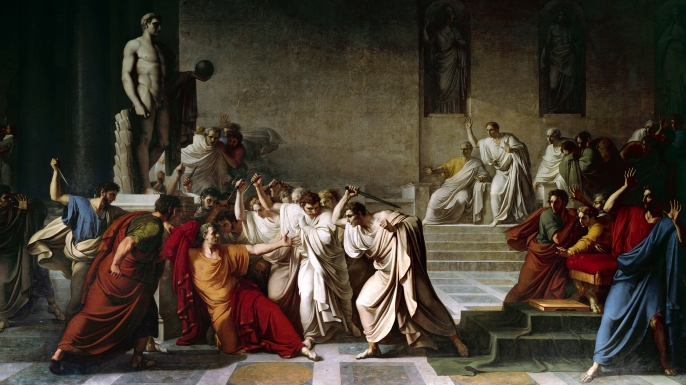
March 15, 2,063 years ago in 44 BCE (there was no 0 BCE and no 0 CE, so when counting from one era to the other, you have to subtract a year) Julius Caesar was murdered in the Roman Senate chambers by Brutus, Cassius and others


Why?

Supposedly, after twice turning down an offer to be named king (anathema in the Roman Republic since its founding, likely some few but not too many years after 509 BCE), he was going to be made the offer a third time, and accept. He had already been named perpetual dictator, going beyond the original Republican idea for a temporary emergency leader.

Shakespearean witch warnings to beware the Ides of March aside, as well as his wife's supposed fear, this is of course reality. And given the reality of Caesar's wife, it appears that both the plot, and the expectation that Caesar would again be offered, and would accept, the title were real as well.

So, what was this title?

Rex it was in Caesar's Latin. Derived cognates include rey in Spanish and roi in French.

Cognates from other Indo-European languages and language groups include raja or similar in Indian languages and shah or similar (picture raja losing the initial syllable, not uncommon if it started with a liquid consonant) in Iranian languages. It's in Irish and rígh in Scots Gaelic. (However, it's brenin or mrenin in Welsh. However, that could be related to the Latin regnum, which is of course related to rex.)

BUT!

The linguistic tail doesn't end there.

German knows no such kingly title. Rather, it's koenig there. Kong or similar in the Scandinavian languages.

But, the word is still there in German. Did Hitler not talk of a Third Reich, following that of the Hollenzollerns and the Holy Roman Empire? Indeed he did, and the word is cognate with our old friend rex.

What if we step further east? It's król in Polish, kralj in Slovenian and similar in other Slavic languages. It's karalius in Lithuanian, paralleling the Slavic. (Note the Finnish composer Sibelius' "Karelia Suite." I'm not sure if the name of the territory derives from the Balto-Slavic root or not.) 

But, that in turn seems connected to a similar word in English, and its cognates in German and Scandinavian languages.

That would be "earl." That, in turn is, yes, related to the name Karl, from the old German karal, which in turn gave the old English ceorl, which was simply the base level of freeman in medieval England. (The German freiherr is the English "baron," but is literalistically "free lord.") That is, in turn, behind the name of Charlemagne / Karl der Grosse / Carolus Magnus.

So, so far, we have cognate words, but a reordering of ranks.

Back to Germany's three empires.

The Romance languages borrowed from Latin imperium or similar for both "empire" and "emperor" while the Germanic languages all did takeoffs on the actual name of our would-be king for the word "emperor." Kaiser. etc.

The Slavic, and Baltic, languages follow the Germanic on on the same two words and differentiation of roots for "empire" and "emperor." Tsar. Etc. (Tsars after, IIRC, Peter the Great actually emphasized the Russian equivalent of imperator more than tsar.

Something that is quite different, at least among Indo-European languages with which I have a modicum of familiarity?

Greek.

There, it's βασιλέας for "king." Modern Greek has αυτοκράτορας for "emperor." But the Byzantines maintained Roman tradition.

Anyway, βασιλέας migrated north. Think of the common Russian name "Vasily." But, as an actual cognate word? Can't think of one in any Indo-European language to the west or north. Nor can I think of any cognates with the Welsh, though it also lists, on Google Translate, words like rhí and riau, obviously cognate with the many others above.

As for one other tragically great actual, not would-be, king of Shakespeare, Caesar was not Thane of Tibur. As for Macbeth's pre-kingly status, though Macbeth was in Scotland, he was, like most kings, a lowland Scot. Middle English, and pre-Norman Viking invasions, had affected Scots language. Thegn, in Old English, was a low-level knight-type person. Think "Sir" in modern British English. Or huskarl in Old Norse, where that Karl from Germanic names and Slavic regency pops back up! (So do witches, but, even within language groupings within the Indo-European family, the etymology on words for those creatures is all over the map.)

As for Caesar's last words? Shakespeare took huge poetic license. Suetonius and Plutarch both have him saying nothing, though Suetonius says that others claimed he said, in Greek, και συ τεκνoν?, which is "you too, child?" in English, to Brutus. (Brutus was just 15 years younger and not Caesar's spawn.)

In any case, he died as neither rex, nor imperator, nor, other than by personal name, as Caesar

Bonus etymology: If you're wondering about the word "ides," go here.

==

Update, March 16, 2023: Caesar was indeed killed for wanting to be proclaimed rex. But, it wasn't just his idea. This piece from JSTOR notes that Antony, among others, thought that he needed to be proclaimed king before battling the Parthians, among other things. I don't follow Antony's reasoning; Pompey had defeated kings in the eastern Mediterranean, already. But, it's a good read for the timing of Caesar's assassination and other motives the plotters had.

Friday, October 04, 2019

More on Wittgenstein, the overrated Platonist

Via Massimo Pigliucci, I saw a new piece from a British magazine — it appears to be some sort of magazine of "ideas," but not philosophy-specific — about the overrated (yes, he's on my list of overrated philosophers) Ludwig Wittgenstein.

It reinforces my idea of a few years ago that part of Wittgenstein's problem is that he is a Platonist. Beyond that link, part of what "triggered" me into this was his work on Haus Wittgenstein. Click that link and Wittgenstein's fussiness seems to me to smack of Platonism.

It also seems to smack a small bit of bipolar disorder, and I wonder how much the two issues are connected. I do not think bipolar disorder causes a tendency toward Platonism in the philosophically minded, but, per genetics in general, might it be a "nudge" of some sort for those already leaning that way? I think so. I also think that the Haus Wittgenstein issues also hint at obsessive-compulsive disorder. On the psychology side, I think there probably some at-least tenuous ties between bipolar and OCD. On the philosophy side, as OCD is in part a quest for perfectionism, I certainly see how it would be a "nudge" for Platonist beliefs.

Now, beyond the non-philosophy issues?

First, look at the "early" Wittgenstein. Abstract logic, as in the Tractatus, is about as idealistic as you get. Imagine the consternation when he found "holes" in his system, and that he had no more shown an "end to philosophy" than Fukuyama had shown an "end to history."

Imagine even more, though I've never read about his reactions, what consternation he might have had when he read Kurt Gödel's incompleteness theorums, then Alfred Tarski's expansions of them with his undefinability theorum. (I certainly would appreciate comment from anybody who knows what sort of reactions he had, if any that have been recorded.)

Imagine more yet, if the flood of late 20th century work in things such as multi-valued logic had hit a century earlier. Wittgenstein might have had yet another nervous breakdown.

Now, the "late" Wittgenstein. (It's a British mag, so it wouldn't pick up on this, but I think now of "early" versus, or allegedly versus, "late" Nixon.)

Note that the late Witty's work on linguistic analysis, to pick up his criticizing Moore's "hand" illustration, was ultimately about language in the abstract, not everyday linguistic claims. Again, that's ... Platonic.

It's also part of why modern linguistic philosophy has largely passed him by.

In addition, to also tie this back to the top link, rather than wanting to improve linguistic clarity and related issues, I think that, vis a vis his peers, he wanted to shut down discourse. He was trying to have an ordinary language end to philosophy, or at least to philosophy of the past.

Friday, June 14, 2019

What is "agency"? What is Aristotle's influence on defining it?

These are both issues relevant to Jessica Riskin's 2016 book "The Restless Clock," first brought to my attention by Barbara Ehrenreich's "Natural Causes."

In a recent review of Christopher List's book on free will, I first thought her definition of agency might be the same as his of "intentionality," especially since he seemed to use both words almost interchangeably. Then I recognized my definition may not be Rifkin's. She leaves it a bit fuzzy, as noted in this very good review of her book and may overstate the empirical case that justifies her idea, or does not. Additional reviews, like this, make me wonder if she isn't partly down the rabbit hole of Aristotelean causes, especially with her stress on the theological background of mechanistic agency, and of course, Aristotle dominating late medieval Europe's intellectualism. I halfway think she is trying to thread her way between final and efficient causes, wiht her talk of pass-mechanical and active views of nature.

So, if all of Western philosophy is, to riff on Whitehead, but footnotes to Plato and Aristotle, we have yet another example of needing to burn the original books and throw away most of the footnotes. Tinbergen's Four Questions would be a good start on this vis a vis Aristotle's four causes.

Wednesday, April 20, 2011

Linguistics smacks down Pop Evolutionary Psychology

I saw this while on vacation, and hadn't had a chance to blog about it.

Shades of Sapir-Whorf!

It appears that language usage, in the case of one language family versus another is fairly strongly influenced by cultural background.
The authors say their findings run contrary to the idea of Noam Chomsky's generative grammar, which says the brain has hard and fast ordering rules for language. They also contradict the "universal rules" of Joseph H. Greenberg, who said languages tended to choose certain patterns over others.

"Culture trumps the innate structure of the human mind," said study coauthor Russell Gray, an evolutionary psychologist at the University of Auckland in New Zealand. "We need to take much more seriously the role of cultural factors in changing language diversity."
Even if overstating the case, if it's half true, it not only undercuts Chomsky, it's another blow to the "massive modularity" idea of the brain.

Without looking at it in just that light, though, it does raise other issues of social and cultural evolution. Nature has more.

Beyond the easy references to how this undercuts (what doesn't, really) the "Pop" version of evolutionary psychology, this has more serious linguistic implications.

Greenberg, beyond being a "universalist" on linking phenomena of languages, was also a "clumper" in terms of how many, or how few, language families he postulated. This is especially true in his analysis of Native American and sub-Saharan African families.

But, if his "implication universals" idea isn't so true, then perhaps some languages he has clumped together should be bound more loosely. If we don't become "splitter" into many more language families, perhaps we should at least discuss the idea of subfamilies.

Wednesday, December 02, 2009

One gesture worth 1,000words on language evolution

Chimpanzee gestural control is left-brain-centric, shedding new light on the evolution of human language, since it is also largely localized in the left hemisphere.
“The de­gree of predom­i­nance of the right hand for ges­tures is one of the most pro­nounced we have ev­er found in chim­panzees in com­par­i­son to oth­er non-com­mu­nica­tive man­u­al ac­tions. We al­ready found such man­u­al bi­ases in this spe­cies for point­ing ges­tures ex­clu­sively di­rect­ed to hu­mans. These ad­di­tion­al da­ta clearly showed that right-hand­edness for ges­tures is not spe­cif­ic­ally as­so­ci­at­ed to interac­tions with hu­mans,” William D. Hop­kins said.

Read the full story for more information.

Wednesday, July 09, 2008

Atheists who willingly defend misleading language are a pox

Two weeks ago, I blogged about the latest Pew Research Poll on American religious beliefs, noting this absurdity, among other things:
Americans are so religiously and metaphysically STUPID, on average, that one out of five Americans who claim to be religiously unaffiliated and atheist claim to also believe in a divinity. Half of agnostics in that group make the same claim. ...

Hey, idiots. If you believe something, you can’t agnostic about it!

But, all is not well in atheist land.

Apparently, some people, some atheists, want to defend the use of misleading language, specifically, the illogical phrase “agnostic theism.” It’s a bad enough phrase in general, but in response to a blog post, and an original story, that both talked about “theism,” “agnosticism” and “atheism” all as belief states, it’s off-putting to say the least.

Said people also either did not read the linked story, or else did not see that “agnosticism” was clearly talking about a belief state, not factual/empirical/evidentiary knowledge.

So, to them, db0, Adrian and Austin, I reply:
I stand by the original post, and I stand by saying that you’re using misleading language. You, too, Austin.

It’s clear that I, and the NYTimes linked story (did YOU ever look at that, db, if we want to talk about following links) were talking about beliefs (or, my alternative phrase, influenced by Dan Dennett, of “metaphysical stances,”) all along, and not knowledge.

So, Austin, I never conflated the two. In a follow-up comment on my blog post, I said, if you can get Bob Carroll of The Skeptic’s Dictionary to prove me wrong, I’d listen.

Well, I went ahead and did my own research:
First, in hardcopy, my “Dictionary of Philosophy and Religion," by William L. Reese, says this under “agnosticism”:
It is usually applied, however, principally, to suspension of belief with respect to God. (Emphasis added.)

Now, Bob Carroll does use the word “knowledge,” but as subordinate to “belief”:
Agnosticism is the position of believing that knowledge of the existence or non-existence of God is impossible.

Note the definition is about belief, again.

Nothing about knowledge, empirical evidence, etc. That’s why I said I’ve never conflated belief and knowledge; in making reference to metaphysical states, I've been referring to belief all the time.

Ditto on the Pew poll.

And, per that definition, let me rephrase my original critique”

Phrases like “agnostic theism” or “theistic agnosticism” in that both the governing noun and the adjective talk about states of belief, or metaphysical stances, to use my phrase ...

ARE MISLEADING.

You have incompatible belief states being smashed together.

I don't care if “agnostic theism” has 5,000 Google hits, either. I don’t even care if there’s a website called AgnosticTheism.com. (No, I refuse to give it a hyperlink.)

That’s just further proof of the Pew poll. And, beyond that, neither Reese nor Carroll use either that phrase or “theistic agnosticism.”

And, as I said earlier, Austin, I don’t even care if you’re the atheism “guide” for About.com.

Thank doorknob there’s only 5,000 deluded Google hits, too. (Even more fortunately, the equally oxymoronic “theistic agnosticism” has less than 500 hits.)

Next, to tackle this linguistic oxymoron from another angle, let me go to a comment I made on the original post:
Re the Wiki link on agnostic theism that (db0) posts, let’s carefully analyze the English language used here.

“Theism” is the noun. Nouns always take precedence over adjectives like “agnostic.”

For example, you can have simple noun-verb, or N-V, sentences. You cannot have a noun-adjective, or N-Adj, sentence.

The reverse also holds true. You CANNOT be an agnostic, as a primary belief state, and modify it with “theistic,” either.

Let me explain this once more, in terms of color (or colour).

There's a difference between “reddish-orange” and “orangish-red.” And db0 started talking about reddish-orange, then posted a link to orangish-red.

But I will get beyond that

As for db0’s implication that many people in the UK may understand “atheism” to mean “irreligious,” well, then obviously a bunch of people in the UK are as stupid as they are here. Maybe the equivalent of Pew should poll them. And, I’ll call irreligious people in the UK who call themselves “atheists” idiots, too, db0. Give me e-mail addresses, and I'll even e-mail them that.

Ditto for agnostics using misleading language, or atheists who abet them.

And, as for db0 criticising me (spelled the UK way as a grace note), well, instead, he should have taken my article as it read and corrected stupid people on his and Adrian’s side of the pond.

And, per that definition, let me rephrase my original critique of all of you:

Phrases like “agnostic theism” or “theistic agnosticism” in that both the governing noun and the adjective talk about states of belief, or metaphysical stances, to use my phrase ...

ARE MISLEADING.

Merriam-Webster also agrees with me on the use of “agnosticism.”

Dictionary.com, especially in its first listed definition, agrees as well.

Wittgenstein would be turning over in his grave, if he could.

If I were dead, and could turn over in my grave, I definitely would, too. Db and Austin, I am still angry at both of you for criticizing my use of agnostic, when both of you are wrong.

Also, as I e-mailed Austin, I stand by my psychological observation that “agnostic theism” is an attempt to give an intellectual gloss to theistic beliefs.

And, Adrian or anyone else who, after accepting the apology I offered to db, still wants to delink my blog because I criticize your use of language?

Be my guest.

And no, I don’t expect any of you gents, nor others who may be reading your blog posts commenting about mine, to apologize, or apologise, for using imprecise, and yes, misleading, language.

Unfortunately.

Per the old saying, “More’s the pity.”

Tuesday, April 22, 2008

Language can shape our perception of the world

This has been a back-and-forth in both philosophy and psychology ever since Benjamin Whorf mythically claimed the Eskimos had 100 different words for snow. (He didn’t, actually.) For a long time, in relatively recent years, well, ever since the discovery of DNA and the crumbling of Skinnerian behavioralism, Whorf’s ideas were cast by the wayside.

But now, a Cornell researcher has partially resurrected them.

At least with color discrimination, Gary Lupyan says a specific language background does make a difference:
Language helps us learn novel categories, and it licenses our unusual ability to operate on an abstract plane, Lupyan said. The problem is that after a category has been learned, it can distort the memory of specific objects, getting between us and the rest of the nonabstract world.

This fits well with the general idea of “man the category-making creature.”

But, not everybody is ready to buy into even a limited version of Whorfian linguistics redivivus.

On the contrary side? Evolutionary Psychologist (yes, with the double capital letters, see my tages) Steve Pinker. (That, of course, means there’s a good chance the theorizing is right and he’s wrong.)
This separation of language and thought is emphasized in a recent book by Steven Pinker, at Harvard University, a skeptic of “neo-whorfianism.” In “The Stuff of Thought: Language as a Window Into Human Nature,” Pinker explores the complicated ways that language and thought relate to each other. He cautions against confusing the “many ways in which language connects to thought.” “Language surely affects thought,” he writes, but he argues that there is little evidence for the claims that language can force people to have particular thoughts or make it impossible for them to think in certain ways. With numbers, the importance of language evidence is much clearer. It appears that the ability to count is necessary to deal with large, specific numbers. And the only way to count past a certain point is with language.

He’s overstating the case. Lupyan didn’t say anything about forcing. Rather, as with human genes, we might say that in certain categories of reasoning, one language may create a predisposition (and perhaps no more than a mild one) toward reasoning in one way rather than another.

Friday, March 14, 2008

Native Americans arrival dated earlier

“Clovis-only” theory of Indians gets death blow

A new review in Science strongly confirms that the first “Native Americans” got to the New World at least 16,000 years ago. It would seem that nobody but old-school crabbed anthropologists could still defend the Clovis theory
A new review published in the research journal Science contends that that the first Americans had their roots in southern Siberia, ventured across the Bering land bridge probably around 22,000 years ago, and migrated down into the Americas as early as 16,000 years ago.

In the paper, Ted Goebel of Texas A&M University and colleagues argue that the latter date is when an ice-free corridor in Canada opened and enabled the migration.

The new account is bolstered by genetic evidence and the discovery of new archaeological sites and more accurate dates for old sites, according to the researchers.

Genetic evidence, they wrote, points to a founding population of less than 5,000 people at the beginning of the second migration in Canada.

Moreover, they added, archaeological evidence suggests the Clovis culture may have been relative latecomers to the Americas or descendants of earlier Paleo-Indian populations represented at archaeological sites such as Monte Verde in Chile. That site is thought to have been occupied 14,600 years ago.

This squares with my belief that a multiple-migrations theory of population of the Americas is more likely than a one-movement theory, with the likely exception of Inuit/Aleut, and perhaps Na-Dene. Along with that, this would seem to favor “splitters” rather than “lumpers” among linguists.

Anybody who has looked carefully at the phenotypic variety among Native Americans, trying to focus on those with little admixture from Caucasian or African backgrounds, and the phenotypic variety among east Asians, probably has an instinctual leaning toward multiple migrations, too, IMO.