Showing posts with label Rome. Show all posts

Saturday, February 22, 2025

Plague of Cyprian nearly ended the Roman Empire? No, really?

Apparently that's one of the claims of Kyle Harper in "The Fate of Rome," which I had never heard of before until going down some internet rabbit trails.

Did infectious diseases and even meso-level / meso-time climate change have more of an effect on the disintegration of the Roman Empire than older historians thought with fingering barbarian invasions, the rise of Christianity, etc? 

Certainly.

Were they decisive or nearly so?

Likely not.

So, the "No, really?" is rhetorical, in case that weren't already clear.

Was there a "Plague of Cyprian" and was it ebola or something similar, as Harper claims in the book and per that Wiki page? 

Almost certainly not. 

Per this Cambridge monograph by Sabine Huebner in response to him, Harper is almost certainly wrong on the dates of this plague and its origin, ergo wrong on its source. Independently of all that, the respondent says he's almost certainly wrong on this plague of non-Cyprian causing devastation in hinterlands Egypt. And derived from that, he's even more certainly wrong on claims that it nearly toppled the empire.

Roman historians know this period was the tail end of the famous crisis of the third century. Population loss from infectious diseases were a problem, but whatever this plague was and whenever its dates, it could not have nearly toppled the empire. Even at Harper's early date, this is 15 years after the end of the Severan dynasty and the instability that had already introduced.

And, it flat period could not have led to the Decian order for sacrifices and the Decian persecution, contra Harper. Per Huebner, the first mention of this plague did not occur until after Decius was dead.

With Huebner as co-author, here are parts one, two and three of a multi-academic response to Harper on various issues. (The first is 13 pages; the second and third are 10-pages, all easy reads.) Part two starts by noting his taking an extreme position on the Antonine plague and also flat-out ignoring a lot of modern research. The fact that no major invasions from the east happened in the first years after the Antonine plague and that, in the longer term, after the 192-93 coups, the Severan dynasty ruled 42 years, all undercut Harper. Beyond the Plague of Cyprian, part 1 is an overview critique of the whole book, much of it focused on problems with Harper's "maximalist" take on climate change. Part 3 looks to a fair degree at his take on the Justinian plauge.

And, with that, I'll take a pass on this book. And probably on Harper in general. (IIRC, I saw his "Plagues upon the Earth" at my library about a year ago and took a pass.) 

He's also writing a third book in this same general line, about problems with human overgrowth. It, too, may be interesting, but will likely run a narrow maximalist take on modern plagues.

Related to that? Per this person's thesis, Harper reportedly has professional problems related to his stridently pushing his thesis, and other personal issues as well. (Per other information, the intersection of professional and personal were student protests at Oklahoma University alleging that he didn't take seriously enough two cases of faculty reportedly using the N-word, and of blackface on campus, and that also questioned his dedication to diversity, equity and inclusion. This was when he was OU provost. When the OU student newspaper's header uses the "long-embattled" cliche, you've got problems.) The graduate also notes that Harper, and Amber Kearns, who has followed in his footsteps in some ways, also ignore the possible polemical value of writings from that general time about the plague's virulence, including overstating its death rate and its effect on the empire. And, on Harper's case, if conservative evangelical White Christianity accompanies the background to the student protests, I can see the background to him NOT discounting the polemical value of Christian letters overstating the death rate and calling it judgment on the empire. OTOH, lower-star reviews of his "Plagues upon the Earth" dinged him for beating evolution like a dead horse, as in people who are NOT fundagelicals were saying "we know evolution, you're beating a dead horse."

As for what this plague might have been? The Plague of Justinian has now been fairly well identified as the first incursion of the bubonic plague. Could this have been an earlier version? The "thesis" link suggests Lassa fever, which I also find unlikely, if nothing else as with Ebola on the grounds of where the plague originated, and tentatively suggests measles, which I could certainly accept.

Thursday, March 12, 2020

Beware the Ides of March and Indo-European cognates


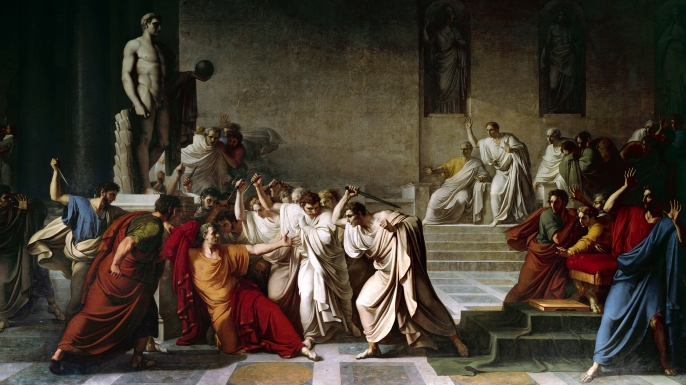
March 15, 2,063 years ago in 44 BCE (there was no 0 BCE and no 0 CE, so when counting from one era to the other, you have to subtract a year) Julius Caesar was murdered in the Roman Senate chambers by Brutus, Cassius and others


Why?

Supposedly, after twice turning down an offer to be named king (anathema in the Roman Republic since its founding, likely some few but not too many years after 509 BCE), he was going to be made the offer a third time, and accept. He had already been named perpetual dictator, going beyond the original Republican idea for a temporary emergency leader.

Shakespearean witch warnings to beware the Ides of March aside, as well as his wife's supposed fear, this is of course reality. And given the reality of Caesar's wife, it appears that both the plot, and the expectation that Caesar would again be offered, and would accept, the title were real as well.

So, what was this title?

Rex it was in Caesar's Latin. Derived cognates include rey in Spanish and roi in French.

Cognates from other Indo-European languages and language groups include raja or similar in Indian languages and shah or similar (picture raja losing the initial syllable, not uncommon if it started with a liquid consonant) in Iranian languages. It's in Irish and rígh in Scots Gaelic. (However, it's brenin or mrenin in Welsh. However, that could be related to the Latin regnum, which is of course related to rex.)

BUT!

The linguistic tail doesn't end there.

German knows no such kingly title. Rather, it's koenig there. Kong or similar in the Scandinavian languages.

But, the word is still there in German. Did Hitler not talk of a Third Reich, following that of the Hollenzollerns and the Holy Roman Empire? Indeed he did, and the word is cognate with our old friend rex.

What if we step further east? It's król in Polish, kralj in Slovenian and similar in other Slavic languages. It's karalius in Lithuanian, paralleling the Slavic. (Note the Finnish composer Sibelius' "Karelia Suite." I'm not sure if the name of the territory derives from the Balto-Slavic root or not.) 

But, that in turn seems connected to a similar word in English, and its cognates in German and Scandinavian languages.

That would be "earl." That, in turn is, yes, related to the name Karl, from the old German karal, which in turn gave the old English ceorl, which was simply the base level of freeman in medieval England. (The German freiherr is the English "baron," but is literalistically "free lord.") That is, in turn, behind the name of Charlemagne / Karl der Grosse / Carolus Magnus.

So, so far, we have cognate words, but a reordering of ranks.

Back to Germany's three empires.

The Romance languages borrowed from Latin imperium or similar for both "empire" and "emperor" while the Germanic languages all did takeoffs on the actual name of our would-be king for the word "emperor." Kaiser. etc.

The Slavic, and Baltic, languages follow the Germanic on on the same two words and differentiation of roots for "empire" and "emperor." Tsar. Etc. (Tsars after, IIRC, Peter the Great actually emphasized the Russian equivalent of imperator more than tsar.

Something that is quite different, at least among Indo-European languages with which I have a modicum of familiarity?

Greek.

There, it's βασιλέας for "king." Modern Greek has αυτοκράτορας for "emperor." But the Byzantines maintained Roman tradition.

Anyway, βασιλέας migrated north. Think of the common Russian name "Vasily." But, as an actual cognate word? Can't think of one in any Indo-European language to the west or north. Nor can I think of any cognates with the Welsh, though it also lists, on Google Translate, words like rhí and riau, obviously cognate with the many others above.

As for one other tragically great actual, not would-be, king of Shakespeare, Caesar was not Thane of Tibur. As for Macbeth's pre-kingly status, though Macbeth was in Scotland, he was, like most kings, a lowland Scot. Middle English, and pre-Norman Viking invasions, had affected Scots language. Thegn, in Old English, was a low-level knight-type person. Think "Sir" in modern British English. Or huskarl in Old Norse, where that Karl from Germanic names and Slavic regency pops back up! (So do witches, but, even within language groupings within the Indo-European family, the etymology on words for those creatures is all over the map.)

As for Caesar's last words? Shakespeare took huge poetic license. Suetonius and Plutarch both have him saying nothing, though Suetonius says that others claimed he said, in Greek, και συ τεκνoν?, which is "you too, child?" in English, to Brutus. (Brutus was just 15 years younger and not Caesar's spawn.)

In any case, he died as neither rex, nor imperator, nor, other than by personal name, as Caesar

Bonus etymology: If you're wondering about the word "ides," go here.

==

Update, March 16, 2023: Caesar was indeed killed for wanting to be proclaimed rex. But, it wasn't just his idea. This piece from JSTOR notes that Antony, among others, thought that he needed to be proclaimed king before battling the Parthians, among other things. I don't follow Antony's reasoning; Pompey had defeated kings in the eastern Mediterranean, already. But, it's a good read for the timing of Caesar's assassination and other motives the plotters had.

Friday, February 15, 2008

Tacitus: Accurate guide to early Roman Christianity, or not?

My short answer? Not.

Tacitus is a “go-to source” for many scholars of early Christianity, whether classicists, New Testament exegetes seeking a background for “Pauline” Rome, or early Christian period historians.

But, there’s some problems with Tacitus’ assertion that Claudius expelled the Jews from Rome over disturbances about “a certain Christ,” as he is normally translated.

First, Tacitus does NOT use Χριστος, the Greek word for Christ, but Χρήστος, a Greek epithet often translated as “noble” or similar, and used for Apollo. It is arguable that the Latin-first Tacitus confused two Greek words, but, perhaps he did not. In either case, it shows someone who, although familiar with classical Greek vocabulary was likely unfamiliar with Greek religious terms being used to represent yet other religious ideas coming from a non-Greek culture and language.

In other, shorter words, Tacitus had little familiarity with Judaism in general, let alone the idea of Messianism. Perhaps he meant to use Χρήστος about some esteemed rabbinic leader in Rome for all we know.

In any case, there’s nothing to indicate that, by “a certain Christ,” Tacitus actually meant ”this particular Christ,.” In other words, if Tacitus is talking about a historical incident, this could have been a Messianic disturbance with no connection to Yeshua bar-Iusuf of the village of Nazareth. As even the book of Acts makes clear, Messianic claimants were running all around Judea. And, as events in Alexandria show, Judea itself wasn’t the only locus of Jewish religious ferment.

Next, per evangelical Christian sociologist Rodney Stark, there were probably less than 1,500 Christians in the entire world at the time Claudius expelled the Jews from Rome, allegedly for a Christian disturbance.

Of those 1,500 Christians, reasonably, no more than 300, at best, would have been in Rome, out of a population of 1 million. It’s ridiculous to think that “Christians,” rather than “Jewish Messianism,” could have been the cause of either Claudius’ expulsion or Nero’s persecution.

And, if all the Jews were expelled, when did any of them come back? And, how many?

In short, leaning on Tacitus as an authority for either the historicity of Jesus of Nazareth, or the existence, let alone the strength, of pre-Pauline Christianity in Rome, is leaning on a mighty slim reed indeed.

==

Update, May 26, 2024: A person at r/AcademicBiblical, in chat with me about a main comment of hers there, where she claims that 1 Clement, stripped of legendary accretions, is about Peter and Paul being killed by fellow Christians, nonetheless, in response to me, claims that the Tacitus is not an interpolation. 

I offered as a sidebar the Option B, that, if genuine by Tacitus, it's still a double-bankshot smear, projecting back from his own interactions with Christians, of what was a non-event, so that he could smear Nero even more than Christians.

As for said person's claims rejecting the interpolation idea? They note that the Correspondence of Paul and Seneca mentions the Great Fire earlier. Two counterpoints: First, on a late dating, only about 20 years earlier. So, it's in the same milieu, even if earlier. Second, the 11th letter of said correspondence is generally believed to be by a second forger than most other letters. Severus himself?

Said person does reject an actual persecution, so they're solid there.