Showing posts with label Camus (Albert). Show all posts

Saturday, June 28, 2025

Missing: A fourth philosopher on grief

Big Think has a pretty good short piece on three philosophers as standard-bearers for approaches to grief.

After an initial hat tip to memento mori, it looks at each of the three: Kierkegaard, Heidegger and Camus. 

It's not bad as far as it goes, but it doesn't go far enough.

It needs a philosopher of pessimism, say Schopenhauer from the 19th century or Cioran from the 20th. Or maybe, if you strip off the religious veneer, an Unamuno. 

This is an issue where I part with Camus. "The Myth of Sisyphus," and above all its central message that "we must imagine Sisyphus happy," cited in the piece just before linking to the end of "Life of Brian" about looking on the bright side of life, has always struck me as a wrong move.

Let us quote the whole ending, in translation:

I leave Sisyphus at the foot of the mountain! One always finds one's burden again. But Sisyphus teaches the higher fidelity that negates the gods and raises rocks. He too concludes that all is well. This universe henceforth without a master seems to him neither sterile nor futile. Each atom of that stone, each mineral flake of that night filled mountain, in itself forms a world. The struggle itself toward the heights is enough to fill a man's heart. One must imagine Sisyphus happy."

OK, let's unpack.

I have no "necessity" (as in psychological, not logical) to imagine Sisyphus, or myself in similar circumstances, as happy. That might be a way of mocking god or the gods, but I'm pretty sure Camus is a good secularist, so, to me, not only should it be true that "You don't tug on Superman's cape," but "you don't spit into the wind [of fate]" and then laugh, or smile.


What in detail does that mean, beyond my riff on Croce, though? (Jim, not Benedetto!) 

First, was Camus as a womanizer in part talking about "the thrill of the chase," per an old Deep Purple song? If so, I think he was wrong on that, too, and I think it's a variation or subset of the above.

There's also a false dichotomy. I can see the universe as not sterile, and not futile, but at the same time, per Genesis 1, תֹהוּ וָבֹהוּ or tohu wәvohu in English transliteration — formless and void. Rejecting futility doesn't mean embracing happiness. Also, per Camus' words, he could be seen here, or accused here, of riffing on Nietzsche and postulating Sisyphus as beyond good and evil.

Next, what is the "higher fidelity"? Camus doesn't totally get into this.

The big issue is that we must look critically at Camus' framing. I've hinted at this with the Nietzsche comment, but we need to go further.

In the original myth, Sisyphus was an automaton. He was condemned to push this rock.

So, to riff on Camus, "We must first imagine Sisyphus with volition." An automaton can't really have emotion.

Or do we have to imagine that? For Camus, we do, I think, but do we have to for other interpretations? Can Sisyphus still have a consciousness, even if Zeus in some way controls all his motor neurons?

Anyway, I think Big Think gets it wrong. Sisyphus is certainly not fighting grief, or even generalized loss.

And, I think absurdist Camus is the wrong incarnation of Camus to be riffing on Sisyphus.

Rather, even if he can't physically revolt, Sisyphus imagining himself happy is man in revolt.

I was thinking of a long-ago read that I called "the best three-star book I've ever read," and that might still be true.

Pessimism: Philosophy, Ethic, Spirit

Pessimism: Philosophy, Ethic, Spirit by Joshua Foa Dienstag
My rating: 3 of 5 stars

A so-so to decent book that could have been so much better

Occasionally I'll penalize a book for having a good, even a great, concept and just not doing it full justice, and this is one of those occasions.

This book rates at least five stars for its rehabilitation of pessimism and for its excellence at connecting the dots between different philosophers without an established "school of pessimism."

It ranks less than five stars for not fulfilling its potential and overlooking three major areas.

Dienstag's project of rehabilitation for philosophical pessimism is done well. He begins by stating two core tenets of philosophical pessimism, that it is anti-systemic and anti-optimistic. He also, in his preface, indicates he will most focus on where pessimism plays out in the arena of political philosophy.

From this, he tackles specific philosophers who can be seen as having a pessimistic core, and groups them into cultural, metaphysical and existential pessimists

First, he shows that many philosophers in each of these three categories did not take pessimism to a world-denying, resigned conclusion. Here he contrasts the culturally engaged Leopardi to the withdrawing Rousseau, the metaphysically engaged Freud to the withdrawing Schopenhauer and the existentially engaged Camus to the withdrawn Cioran.

Dienstag then devoted a separate chapter to Nietzsche, followed by a second devoted to the central role of aphorism as a writing style within philosophical pessimism. He finishes with offering up some of his own aphoristic observations, which make several good points.

I found his outline of pessimism to be hugely thought-provoking. I would find myself connecting the dots on one particular line of thought, turn the page, and see him doing similar dot-connecting in print.

...

Now, the book's shortcomings:

The first is early philosophers. It's bad enough that Dienstag just gives a passing glance to the pre-Socratics, especially since he talks about Nietzsche's analysis of them. It's worse by far that he overlooks post-Socratic Cynicism. 

Other than it possibly (though Diogenes himself has little to say on the matter) still having a cyclical, not linear view of history, Cynicism meets all the benchmarks Dienstag establishes to define philosophical pessimism. Skepticism, beyond his brief mention of Pyrrhonic Skepticism, also deserves more mention and coverage.

The second big oversight was not to include 20th century discoveries in the natural science. Quantum theory, if not antioptimistic, at least puts definite limits on human knowledge. So does general relativity. And so, they push back against his claim that scientific positivism is used up.

The third oversight comes directly from philosophy. How Dienstag could not even have a word of mention for Gödel's Incompleteness Theorem, which is, at base, a wrecker of systems, totally escapes me.

Dienstag could have added to his three classes of political, metaphysical and existential pessimism a fourth field of logical pessimism. And he could have considered Wittgenstein here in addition to Gödel.

Now, it's true that Dienstag, in his preface, limits his focus to "pessimism (as) a philosophical sensibility from which political practice can be derived." That would rule out Gödel and Wittgenstein, to be sure, but not the Cynics.

Couple of other nitpicking points.

Here and in interviews, Dienstag calls cynicism (lowercase) a negative philosophy. First, cynicism as lowercased is a psychology, not a philosophy. Greek Cynicism is by no means a negative philosophy. For that matter, the same applies to skepticism the attitudinal state vs. Skepticism the philosophical school.

For someone new to the field of philosophy, let alone political philosophy, this book might be five-star worthy. But, to me, Dienstag falls short of that mark. And, the last observations were just about enough to three-star it for me.

I finally did so in the end precisely because this book could have been so much more.

View all my reviews

Or, beyond this book, the Big Think authors (and Camus) needed to read some Edward Arlington Robinson.  

Also, I just read Wikipedia's article about Camus' play "Caligula." Really? Trying to make Caligula himself, even if we discount the worst of the slurs against him, into Sisyphus 2.0? Ye gads.

Thursday, December 08, 2022

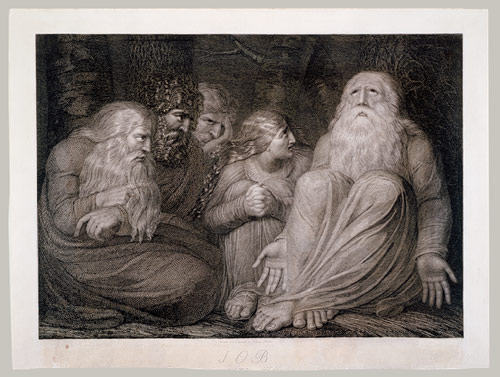
Did Job originally end at the end of chapter 41? What's existentialism got to do with it?

I doubt it; I hugely doubt it.

That's as, per the Blake painting, to riff on a biblical phrase, I wonder: "Who watches the comforters?"

I digress. Back to the main point.

Someone at one of the biblical subreddits made such a claim about the ending of the book of Job a while back. He based that claim by the comment just before the speeches of Yahweh starting, at the end of Job's last response to his "comforters" in Job 31:40, which ends:

The words of Job are ended.

This meant that chapter 42 had to be an addition. 

I first said, in essence, that no, that could mean, "Job is done speaking for now," not "done, period."

Then, the better answer hit me in the face, namely the start of Job 40:

40 The Lord said to Job:
2  “Will the one who contends with the Almighty correct him? Let him who accuses God answer him!”
3 Then Job answered the Lord:
4  “I am unworthy—how can I reply to you?  I put my hand over my mouth. 5  I spoke once, but I have no answer — twice, but I will say no more.”
6 Then the Lord spoke to Job out of the storm:
7  “Brace yourself like a man;  I will question you, and you shall answer me.

There you go. If you really believe Job 42 is a later addition because of 31:40, then you also have to believe Job 40:3-5 is, and for linguistic smoothness, you must also believe that either 40:1-2 or 40:6 is also an interpolation.

There's also the text-historical issue. We have a copy of Job at Qumran, and it ends pretty much the way today's does, and is dated to circa 100 BCE. Given the estimated compositional history of Job, it is just possible for a later redactional addition to have been made, but not likely. See discussion here; I agree with it that IF there were an earlier version, the "whirlwind speech" of 40-41 in general was likely not part of it. 

Mainly, though, I agree that, given the prose section is clearly older, there would have had to have been SOME prose conclusion. And, there's no way of knowing whether the current and original one was the same. We DO know that, by the time of scrolls being saved at Qumran, the current prose ending was where it ended.

The correspondent, who appears to be like me, a secularist with a graduate religious degree, seemed to be looking for an "existentialist" Job. Albert Camus is in the top rank of my philosophy pantheon. I've read a fair amount of Kierkegaard, some Sartre, and in even more modern times, lots of Walter Kaufmann. It's one thing to wish for that being true; it's another thing make unsustainable redaction-critical claims to that end.

As for one other claim there, I also don't believe David Clines' insinuation (page 7 of the PDF) that there was no wager between Yahweh and (the) Satan. (Here's the homepage to download the PDF if needed.)

Rather, as I said elsewhere on the thread, gods wagering with one another is a common enough thread in antiquity, and not just in the Ancient Near East, but in Greek myth, and also in the blinding of Baldur in Norse myth that it probably has its own subsection entry in Stith Thompson's encyclopedia of folklore motifs.

I think there was a bet, and as I said in my review of "God: An Anatomy," by Francesca Stravrakopoulou (saying she gets Job wrong, too), that, the wager may have been, if Satan won, he got to sit on Yahweh's throne a week or something. And, no, that's not being facetious. Then, when this thread started, I figured Yahweh's side of the wager would be that, if he won, Satan had to ONLY "wander the earth to and fro" for a while and couldn't sit in on the divine council. (Doorknob forgive me for sounding like David Heiser.)

The problem is, as I see it, is not only that the wager idea isn't spelled out completely, in the presumably older prose stratum, but that the shift to a monotheistic framework makes the whole divine wager more problematic when it's fused with the patient sufferer poetic narratives. (Clines is right, IMO, that Yahweh is the ultimate beneficiary of Job's suffering, but IMO, that doesn't make much sense if you're denying a wager was laid.)

And so, I stand by my comment to the correspondent that, even without Paul citing a mix of Isaiah and Job in his doxology at the end of Romans 15, Job is problematic at best. Reading the book either with or without Chapter 42, he looks like a capricious cad and you're in the middle of the problem of evil. Eliminating Chapter 42 is no answer otherwise. Rather, the correspondent's claim that Yahweh's monologue is "no answer" is wrong. Rhetorical questions at staccato tempo and high volume are indeed an answer.

With chapter 42, to put it in today's terms, Job as a whole reads to me like capriciousness being covered up with a success gospel conclusion.

The prose beginning, with the implied wager, is that Job is faithful precisely because, at least in modern dual-omni god terms, he doesn't have to fear god's capriciousness. In other words, the "natural evils" portion of "the problem of evil" is something that he doesn't have to worry about. That said, given the Chaldean raiders, Job faces both natural and human evils in chapter 1, but the ancient author probably wasn't thinking of the problem of evil.

The real problem, per the "see discussion here" is that Job is internally jumbled. By Chapter 10, Job himself is saying that he can't call Yahweh to account, but yet he hints at trying anyway, and later calls out for a "defense attorney" (NOT "redeemer"). And, of course, there's the problem of Elihu jumping in out of nowhere, without either being introduced earlier, OR without being listed in need of expiation in Job 42.

There's the option of going beyond C.L. Seow, Clines elsewhere and others, and postulating that Job originally ended at 31:40 with perhaps some brief speech by Yahweh, not Elihu's five chapters followed by Yahweh's four-chapter blast. That might satisfy my existentialist friend's ideas, but, if true, would have to be early indeed in the redactional history. And, it's not the theory he presented.

Otherwise, the archaicizing language? Assuming that it is an affectation, that makes sense as far as this being a post-exilic book. The (primary/original) author is trying to provide the idea of a sage of antiquity bringing wisdom to emerging Judaism. That "emerging Judaism" as well as looking for more orthodoxy could explain the addition of Elihu. Interestingly, C.L. Seow, cited by my correspondent as believing Job 42 is an addition, thinks the Elihu speeches are original. So does the author linked there, Ragnar Andersen, who doesn't explain why Elihu is missing at both beginning and end prose segments.

There's other problems. While Elihu's speeches do foreshadow Yahweh's in talking about divine power, they don't really offer anything different than the original three friends on the problem of evil and Job allegedly having a secret sin. It is possible that the foreshadowing is why Elihu's not seen in need of expiation, and just possible that this is why he's not mentioned with Job's other friends at the start. It's still awkward literarily.

That's more than enough.

The real puzzler is why, if under my idea, the "divine gamble" idea is at least halfway botched when moving it to a monotheistic deity, Job became "canonical" for Jews. For dual-omni Christians following in Paul's misinterpretation and misthinking tracks, it's a different story.

Also, as I said to a first-time questioner there asking about Ecclesiastes being "existential" or "nihilist" (after telling him the two are not the same) that I'm hesitant about using modern philosophy terms to describe the background or authorial mindset of biblical books, starting with the much different metaphysics. If you mean "existential" in a pop psychology sense, I get where you're coming from, but I'm then going to say that you need to treat the biblical book in question like pop psychology. (That's done plenty enough anyway.)

And, that's more than enough on Job.

Thursday, February 11, 2021

New insights on Camus

A Life Worth Living: Albert Camus and the Quest for MeaningA Life Worth Living: Albert Camus and the Quest for Meaning by Robert Zaretsky
My rating: 5 of 5 stars

Very, very insightful work on the life and thought of Albert Camus, which opened my eyes to several things.

First, as far as his life, other than knowing he was a pied-noir, that his father died when he was very young, that he was tuburcular, that he died young himself (but was NOT assassinated by the KGB!) and that he was a notorious womanizer, I knew nothing.

The details of his childhood explain that last element of his adulthood to some degree, perhaps, as well as one long-used intellectual tool of his.

Camus' father was called to the active duty at the start of World War I and killed in battle in 1914. Camus was a year old. At the time his dad was called up, his dad's mom took in Albert, his older brother, and their mom.

Camus' mom was deaf. Per Zaretsky, a few people said she could speak before her husband was killed and only went mute afterward; most say she was a life-long mute. Anyway, she was a mute. So was her uncle by marriage, her mother-in-law's brother, who also was in grandma Camus' house.

Meanwhile, grandma was illiterate. And, after Albert was old enough to read, Zaretsky says she took him to the movie theater in Algiers. In the 1920s, silent movies reigned, of course, and in France and possessions, as well as in the US, they usually had subtitles describing the action.

And, illiterate grandma told Albert to read them to her — ignoring, of course, all the other patrons in the theater telling him to shut up.

So, Camus grew up in a world of silence, either silent people or people calling for silence. And, that's the biographical backstory, I think, to his use of silence on the Algerian civil war.

Related to that, Zaretsky notes Camus was misquoted by Le Monde, deliberately, in his statement on his mother and justice.

He actually said:

"People are now planting bombs in the tramways of Algiers. My mother might be on one of those tramways. If THAT is justice, then I prefer my mother."

And, who could argue with that?

I also think this is where Camus' womanizing comes from. A mother deaf and silent to him, a grandmother seemingly using him and manipulating him, and him looking for connection. BUT ... when a woman got too close — and SOUNDED too close — off he went. Zaretsky doesn't make that connection, but it makes sense to me.

Zaretsky DOES divide Camus' literary output into two periods, plus implies the start of a third, before his death. And, he confines Camus' well-known absurdism to just the first period. (He's not alone in this framework, by any means; Wikipedia discusses it.)

That first period is exemplified by The Myth of Sisyphus and The Stranger. Sisyphus is of course the icon of absurdism.

Part two focuses on rebellion. The Rebel and various essays, most centered on the image of Prometheus, are key. Camus sees both Prometheus AND Zeus as having both innocent and sinful sides in their battle.

Looking at these two periods separately, Zaretsky says that Camus had moved beyond absurdism. He doesn't say Camus rejected it, unlike Hume rejecting the Treatise. It was nothing Camus was afraid of. He simply thought that rebellion, or beyond rebellion, the difference between rebellion and revolt, was "the issue" of the post-World War II world.

He does note that near the end of his first period through his second period, Camus read more on Nietzsche, though ultimately rejecting his nihilism. Apropos Camus, Zaretsky notes Nietzsche was silent after his 1889 horse-hugging then institutionalization.

While not claiming that Camus' last years, possibly represented by The Fall and the posthumously published The First Man, represent a third phase of Camus' thought, Zaretsky does leave that door open. He notes that the "mistress suicide" scene from The Fall is seen by many as quasi-autobiographical, and The First Man of course is.

That said, the book's not perfect. It could have used a bit more coverage about The Fall (The First Man gets more) and The Plague as well as The Rebel in Camus' second period.

But this is still a very good look at Camus and all in just 200 pages of paperback-sized body copy.

View all my reviews

Thursday, October 29, 2020

French pervert philosophers: Something new to me

Via a Boston Review piece about a new biography of Simone de Beauvoir, which notes, inter alia the hypocrisy in The Second Sex behind the various abusiveness she shared and spread along with Jean-Paul Sartre, I saw a link to a Wikipedia piece from a description that, in the 1970s, the two of them, along with many other leading lights of French philosophy, as in Jacques Derrida, Michel Foucault, Roland Barthes, Jean-François Lyotard, Gilles Deleuze and others, including intellectuals outside of the world of philosophy, had signed a petition asking the French government to ...

 Wait for it, wait for it ....

Abolish all aged-based laws of sexual consent.

No, really. Here's the petition, in Le Monde, and in English, with a link to a French blog post about it, and a similar one, two years later, in Liberation. Those, along with Figaro and Le Matin, would be two of France's top four daily newspapers by most accounts.

And, per some of the links off the Wikipedia page?

Atlantic describes a 2011 statutory rape of an 11-year-old. Except that it's not. It's technically not rape in France unless force is used, even on an 11-year-old. In other words, France has no statutory rape law. French law did allow original lesser sexual charges, but until a judge explicitly instated a rape charge (Continental jurisprudence allowing a judge to do that), that was it. But, France, as of the time of that case, and the 2018 story, still had no formal age of consent. (Atlantic had the actual petition links.)

The story notes that this all started with France's version of the summer of protest and summer of love in 1968. From there, France had, well, had NAMBLA type organizations form.

Not all Frenchmen at that time or now agreed. Many were horrified.

So, Sartre et al weren't even protesting statutory rape laws, since France doesn't even have THAT! They were protesting something lesser. Rather than decrying that the "something lesser" was all that was on the books.

And, it gets worse!

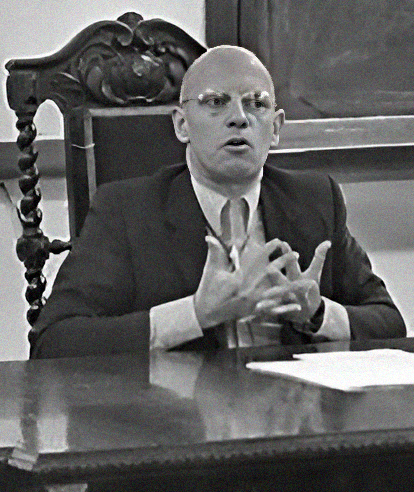
Also linked off Wiki is this interview with Foucault (at left) and others, about six months after the first petition in Le Monde.

One of the speakers says the push for a an age of consent, after some people were outraged by the petition to see that France didn't have one, is all about American puritan prudery crossing the ocean.

No, really. Guy Hocquenghem, one of the signers:

When someone says that child pornography is the most terrible of present scandals, one cannot but be struck by the disproportion between this -child pornography, which is not even prostitution - and everything that is happening in the world today- what the black population has to put up with in the United States, for instance.

What is there to say but what the fuck?

Well, there's more about why this is a what the fuck.

Yes, it's true that children understand something about what sexual organs are, etc. But, for Foucault to try to equalize a child's sexuality to an adult's is ridiculous. Part of what I see playing out is a continuing interest in Freudianism at this time among both the philosophers and psychologists who signed the petition. And, a veiled hint that an age of consent would be a societal version of Freudian repression. And, of course, from that, Hocquenghem says that the idea of a "pervert" is nothing but a social construct.

What's also "interesting" is that both Foucault and Hocquenghem died from AIDS. Foucault is identified as the first French public figure to do so. Whether either took any sexual precautions after the first AIDS alarms, I don't know. But, they had the opportunity. After all, Luc Montagnier is French, and he was first talking about it as a retrovirus back in 1983, and most of the basic issues had been worked out by 1985 or 1986.. It's also "interesting" that Hocquenghem started a sexually abusive (because it might fall under statutory rape age!) relationship with a high school philosophy teacher when he was 15.

Speaking of that, and per the interview, I'm actually surprised that none of the signees made a direct appeal to Athenian pederasty.

I would like to think that Camus, were he still alive at the time, would not only not have signed such a petition but would have called it out. But, of course, I don't know that.

And, no, this isn't "old Europe" in general. The Atlantic lists information on a number of European states that have explicit age of consent laws and what those ages are.

Thursday, April 16, 2020

The outrageous half-truths of Jacobin on Sartre

Jacobin, whose eclectic, editorially-unfocused (NOT a complement, editorial management) stable of contributors runs from Bernie Sanders DSAers to people stanning for the anniversary of the Revolution in November 2017, lauds "The Outrageous Optimism of Jean-Paul Sartre."

And, leads to my header.

The biggest half-truth is by omission. Even when Sartre did accept the truth about the USSR, after it crushed the 1956 Hungarian revolt, it was kind of grudging. And besides, he later shifted his worshipful devotion to Mao. That piece, by Jim Holt, is closer to the truth of who Sartre was.

The real issue is that Camus rejected violence after World War II, including rejecting the death penalty. Sartre never rejected the former, and given his praise for Mao and others, implicitly never rejected the latter. This was part of the reason for their split.

The Rebel somewhat disappointed me, but, nonetheless, Camus was light years ahead of Sartre here, even if his fallout with Sartre was not total and has sometimes been stereotyped.

Camus wasn't perfect on Algeria, but he was better than many Sartre-stanners portray him as being. Plus, he died in 1960, long before the civil war ended. And, his "federation" status might have worked. And, the idea that part of the backing of Algerian independence was an Egyptian version of colonialism? I don't think he was totally wrong there.

The real problem with Sartre? He was an absolutist. And, I think Heidegger did influence him on this. This is all part of what distinguishes Camus' absurdism from Sartre's existentialism. Per this very good CJR essay, Camus wasn't afraid of shades of gray and wasn't afraid to stand in the middle of them.

I'm too late to celebrate the 60th anniversary of Camus' death, vs. Sartre's 40th, but I can meditate on "The Plague" as a good substitute.

Beyond that, many of our best philosophers have been among the best writers, and Camus leads Sartre there, too.

Thursday, January 16, 2020

Schopenhauer, Camus, detachment,
maturity and midlife crises

A very interesting piece here, and one I largely agree with.

Kieran Setiya talks about how studying ideas of Arthur Schopenhauer can avert midlife crises.

The Buddhist influences on Schopenhauer shine through in the ideas from "Will and Representation" that represent this piece. And while Buddhism and Stoicism have some parallels, and some overlap, this is an area of difference. (Not to mention that the metaphysics behind the the two — metaphysics and a focus on them that make Buddhism a religion — are also different.)

Stop focusing on goals, Schopenhauer says. When you realize the goal, the goal itself is completed, and the pursuit is gone.

This is not just some academic philosophical or religious exercise.

Classic heavy metal rock band Deep Purple knew that in the song "Knocking at Your Back Door" (think about the title in a ZZ Top way) in chasing women, when they said:


"It's not the kill, it's the thrill of the chase."

That said, I think Schopenhauer (and Prince Gautama) go wrong where they say that "wanting what you don't have is suffering."

Animals with less complexity of thought and less complexity of emotions can (and do) still have wants beyond the basics of food, or per Deep Purple and Darwinian sexual selection, beyond the basics or non-basics of sex. But, they arguably don't have a level of consciousness to "suffer," at least not to suffer emotional pain.

A cow, per the old cliché, might see that the grass IS greener on the other side of a fence it can never cross (and might be lusting for freedom of choice rather than greener grass as better food). That doesn't mean that it "suffers" from being stuck in its own pasture. (A Buddhist might disagree; a Jain might disagree even more. That's why I'm neither one, and it's why I say both are religions.)

Setiya tries to spin Schopenhauer and I think fails. Activities that do not aim for completion are not ones with goals, even as he tries to split telic and atelic activity. But he then tells us not to abandon worthwhile goals, undermining himself. Nope; the worthiness of the goal may partially condition the failure to attain it or the emptiness after doing so. It doesn't wipe it out, though. So, in addition to failed hair-splitting, Setiya is wrong there.

So, is there something better, but on a broadly similar idea, that the world of philosophy can offer us? And preferably without the baggage of Buddhist metaphysics?

Why, yes!

I think Camus is better here. Accepting these wants, accepting that we might not get them, accepting that maybe we won't detach from them, and accepting the absurdity of all that is better.

To put it another way, which moves from Camus to neo-Cynicism, we must not imagine Schopenhauer or Sisyphus happy; rather, we should imagine Sisyphus raging against the machine, per Camus' call for authenticity in revolt.

That then said, to riff on another theme of Camus, he picked the wrong person from Greek myth. Sisyphus wasn't a rebel; Prometheus was.

I riffed on that when I said we should say "Mu" to Camus on meaninglessness.

Thursday, December 12, 2019

No, the KGB didn't kill Camus

That's despite a new book, based on old journal gleanings from Czech poet and translator Jan Zábrana, claiming exactly that.

Giovanni Catelli claims the KGB rigged the car of Camus' publisher to crash in 1960 because of his comments after the Hungarian uprising.

This ignores MULTIPLE countervailing items.

Start at the tail end. The accident wasn't really regarded as suspicious at the time, contra a 1978 biographer.

Go to the front end. Camus was openly anti-Communist in the writing of "The Rebel" way back in 1951. So, why would the KGB not be pissed off until 1957?

Now, insert meat in between.

Why would it take three years to kill Camus if the KGB were that upset? (Or nine years, in my counterblast?) Why would it target his publisher's car rather than going for something more direct, as the KGB then already had the expertise at doing? Or, pre-KGB, note the ice ax in Trotsky's skull.

And, indeed, wouldn't the KGB want something that, while not pinnable on it, might have a hint more of connection to it than the fatal car crash did? (Maybe the KGB paid the other driver in the James Dean crash?)

Monday, November 26, 2018

Attempt to normalize Marxism and Sartre's bromance fails

Retired Wayne State professor of the history of ideas Ronald Aronson, an expert philosophical commenter on Jean-Paul Sartre, including on his friendship with Albert Camus, attempts to rehabilitate both Marxism and Sartre's attempt to rehabilitate it in a new Boston  Review essay.

And fails.

In a nutshell, here's why.


-->
First, Sartre did find a weak point — rather, the weakest point — of Marxism 101, with all of its permutations through Lenin, Stalin, Mao and even revisers like the Frankfurt School.

It’s Hegelian dialectic.

Congrats to Sartre for seeing the main issue that makes Marxism even more a pseudoscience than most theories of economics, since Hegelian dialectic and its thesis-synthesis-antithesis is purely a philosophical idea, and totally unscientific.

BUT! Marxism is not Marxism without Hegelian dialectic. Pull that out, and you're engaging with non-Marxist Socialist theorizing of some sort.

Second, while comparing and contrasting Sartre to Camus, and intertwining them, and saying that Sartre tried to find a third way, Aronson ignores how late Sartre was to the table on criticizing both Stalin in particular and Soviet Communism in general.

Third, Marx ignored, or never thought through, larger economic consumptive problems of capitalism — resource exploitation problems that aren’t part of Marxism.

Peak Oil — temporarily offset by fracking — is one.

Climate change is a much bigger one, as this Boston Review essay notes in passing.

As far as Aronson's book on Sartre and Camus? Without staking absolutist positions on either side, Camus was in general right to reject the use of violence in social movements. And, per some critical reviews of his book (at that second link in the first paragraph), Aronson reportedly butters his bread clearly for Sartre, and for postmodernism that follows to some degree from him. You lost me there.

Sunday, May 29, 2016

Existentialism explained, and unexplained

I just got done reading "At the Existentialist Cafe," mentioned, if not recommended, by a friend on either Google Plus, Facebook or Twitter.

Well, I can tell you now, you probably don't need to read it.

At The Existentialist Café: Freedom, Being, and apricot cocktails with: Jean-Paul Sartre, Simone de Beauvoir, Albert Camus, Martin Heidegger, Edmund Husserl, Karl Jaspers, Maurice Merleau-Ponty and othersAt The Existentialist Café: Freedom, Being, and apricot cocktails with: Jean-Paul Sartre, Simone de Beauvoir, Albert Camus, Martin Heidegger, Edmund Husserl, Karl Jaspers, Maurice Merleau-Ponty and others by Sarah Bakewell
My rating: 3 of 5 stars

This book is overrated and mistitled and I'm going to explain why.

I wasn't sure exactly how to rate that book. This is another book that deserves a half-star rating, as in 3.5. Since so many others are overrating it, it thus gets the bump down to 3 stars. And, by the time I got done writing this, I wondered if even that were generous.

First, there's a typo/proofreading error on 11, that's tres funny, especially given that the book is primarily about Sartre. Instead of talking about him "exhorting" his readers, it actually mentions him "extorting his readers."

No radical freedom there!

There are one or two more serious errors of fact in the book, plus the fact that "glib" or whatever sometimes becomes disjointed.

A good example of this is when, in discussing Sartre's HUGE overwriting about Genet, she doesn't mention his amphetamine addiction. She only mentions it about 50 pages later, and then, it's never really called an addiction. But, that's part of a larger part — the book is a love affair with Sartre, papered over with the "Existentialist Cafe." It's a love affair with Sartre's cafe, then with Sartre and Beauvoir's. Camus (though I take his statement at face value that he was an absurdist, not an existentialist — something Bakewell never really explores), Levinas and Merleau-Ponty get short shrift. So, too, even in a popularizing account, do structuralists and deconstructionalist children or stepchildren of existentialism.

That points to a bigger problem. A David Edmonds of "Wittgenstein's Poker" or "Rousseau's Dog" fame would have focused on one or two fun issues (I've asked him to write a book about Koestler punching Camus), and written about 200 pages that we never expect to be a more serious history of Wittgenstein, Hume/Rousseau, etc.

However, Bakewell appears to fall between two stools in wanting to write something light, yet something serious, at the same time. And, to some degree, BOTH stools fall out from beneath her. If she wanted to be more serious, yet without giving a full analysis of existentialism, she could have analyzed why Sartre became an addict, or what was behind his existential dread (it was) of squishy, gooey things.

On to a few other issues.

On page 74, no, Germany's Social Democrats did NOT take power in Novemeber 1918 in "a kind of a coup." Instead, on Nov. 9, Prince Max of Baden, the Chancellor, announced that Wilhelm was abdicating as both German Kaiser and Prussian King. Max was forced to resign later the same day, when it became clear that only the Social Dems (to be precise, the majority Social Dems, not including the soon-to-be Communists) could hold the reigns of government and prevent an actual revolution. It's true that Friedrich Ebert demanded the chancellorship, but Max was likely recognizing already there was no alternative.

And, on page 75, in 1933, Hindenberg was head of state, not head of government, and therefore was not head of any coalition that gave power to Hitler. As president, he simply approved the coalition government that Hitler offered.

These are errors, especially the second, that shouldn't have been made. And, arguably, they may color how harsh Bakewell is, or is not, for Heidegger's early Nazism. I think they do.

Later, comes an error in biblical interpretation. On page 150, she says of Genesis 22, that Yahweh was "surprised" that Abraham went through with the offer of Isaac for sacrifice.

No, it doesn't, and in my read, it doesn't even hint that that is the mood of Yahweh. Ergo, she can't have a good grasp on either Kierkegaard's or Camus' writing about this episode. This probably ties with her giving short shrift to Camus.

On 152, she notes that Sartre attacked Camus for being too influenced by Hume. First, is this actually true, that Camus was more influenced by Hume? (The "too much," of course, is not true!) Second, why would Sartre feel that way? Bakewell never asks.

On 213, shockingly, she seems to misinterpret the end of "No Exit." She talks about the trio being "trapped" in hell — passive voice.

Not at all. The whole theme of the conclusion is that the trio have TRAPPED THEMSELVES! Yes, a demon placed them there, but they have the freedom to not only open the door, as they do, but leave — as they do not. Other parts of her interpretation of "Huis Clos" also seem incorrect.

Finally, on 257, and to no surprise to me, she misinterprets the Camus-Sartre split in a way most favorable to Sartre and in a way untrue to Camus and "The Rebel," in my opinion.

So, per some reviewers, this is an OK to good introduction **to Sartre and Beavoir.** To the whole of existentialism? No.


View all my reviews

Wednesday, January 21, 2015

Say "mu" to Camus on meaninglessness

Albert Camus famously or infamously said in "The Myth of Sisyphus" (summary and Wikipedia) that there is one ultimate issue in philosophy:
There is but one truly serious philosophical problem and that is suicide.
Of course, that relates to, and cornerstones, issues in his absurdist philosophy, and in the related existentialism of Jean-Paul Sartre and others.

Theists, especially Christian apologists, have used this as a cudgel, whacking secular existentialists over the head with the idea that they, or we, claim that life is "meaningless" and that there is therefore no recourse at end but suicide.

Well, a new essay at Massimo Pigliucci's Scientia Salon, by John G. Messerly, deals with this issue in part. And, it's stimulated me to yet further thought, reflected in part, and starting with, my second comment on the essay.

That said, let's unpack this issue a bit further. I'll then get to the second half of that second comment and go from there.

Camus, of course, said suicide was not the answer — revolt was. Which might be true. Revolt while accepting the modern absurdity of life.

Modern humanistic psychologists of a secularist mindset say that meaning is what we bring to the table.

But, beyond that, what if "meaningless(ness)" as traditionally defined in philosophy and psychology isn't exactly the issue?

And now, to that comment.
I think Camus was asking the wrong question. 
 Life is neither meaningful nor meaningless, if we take “meaningless” to be the opposite of “meaningful.”  
 If we instead, talk about “without meaning” or “meaning-less” (sic) we can hopefully understand this not as an opposition to “meaningful” but simply that the issue of “meaning” is, if not a category mistake, one of those issues about which we should be silent, or even more, per logical positivism, a question that is itself … without meaning!
 It’s true that, as part of our attempts to control our surroundings, we probably have “meaning seekers” as well as “pattern detectors” and “agency imputers” halfway hardwired into our brains. 
 But, per Hume’s is ≠ ought, that doesn’t mean that we have to follow them in falsely looking for agency — or falsely imputing meaning where it doesn’t exist, or falsely looking for it when it’s not part of the issue.
Let's go a bit further.

"Meaning" and "meaninglessness" also seems to be one of those polarities, like "free will" vs. "determinism," that's wrong in other ways.

First, it's presuming that a polarity should exist.

Second, it assumes that one should, in some degree at least, "reduce" to the other, rather than both be "unified" in a larger theory, just like general relativity and quantum theory will surely "unify" rather than having one reduce to the other.

Third, like the free will half of that first duality, a desire for meaning — or, a desire to frame ordering one's life around meaning, and trying to justify how to frame it without meaning — seems based in part on religion. I've said that this seems true to some degree of many secular defenders of classical free will, on religion and guilt connecting to free will.

Indeed, the Sparknotes summary, on the first link, puts this in is vs. ought terms, as far as how Camus treats Sisyphus:
As his starting point, Camus takes up the question of whether, on the one hand, we are free agents with souls and values, or if, on the other hand, we are just matter that moves about with mindless regularity. 
 Camus is interested in finding a third alternative. Can we acknowledge that life is meaningless without committing suicide? Do we have to at least hope that life has a meaning in order to live? Can we have values if we acknowledge that values are meaningless? Essentially, Camus is asking if the second of the two worldviews sketched above is livable.
But, just as I have repeatedly, most  notably here and in my own essay for Pigliucci, said that we should say “mu” to the traditional “free will versus determinism” polarity, I think we need to similarly “unask” Camus here.  (And Monty Python.)

So, per my pull quote from my comment at Massimo's, if life should not be viewed though a "meaning versus meaningless" filter, what should we then do?

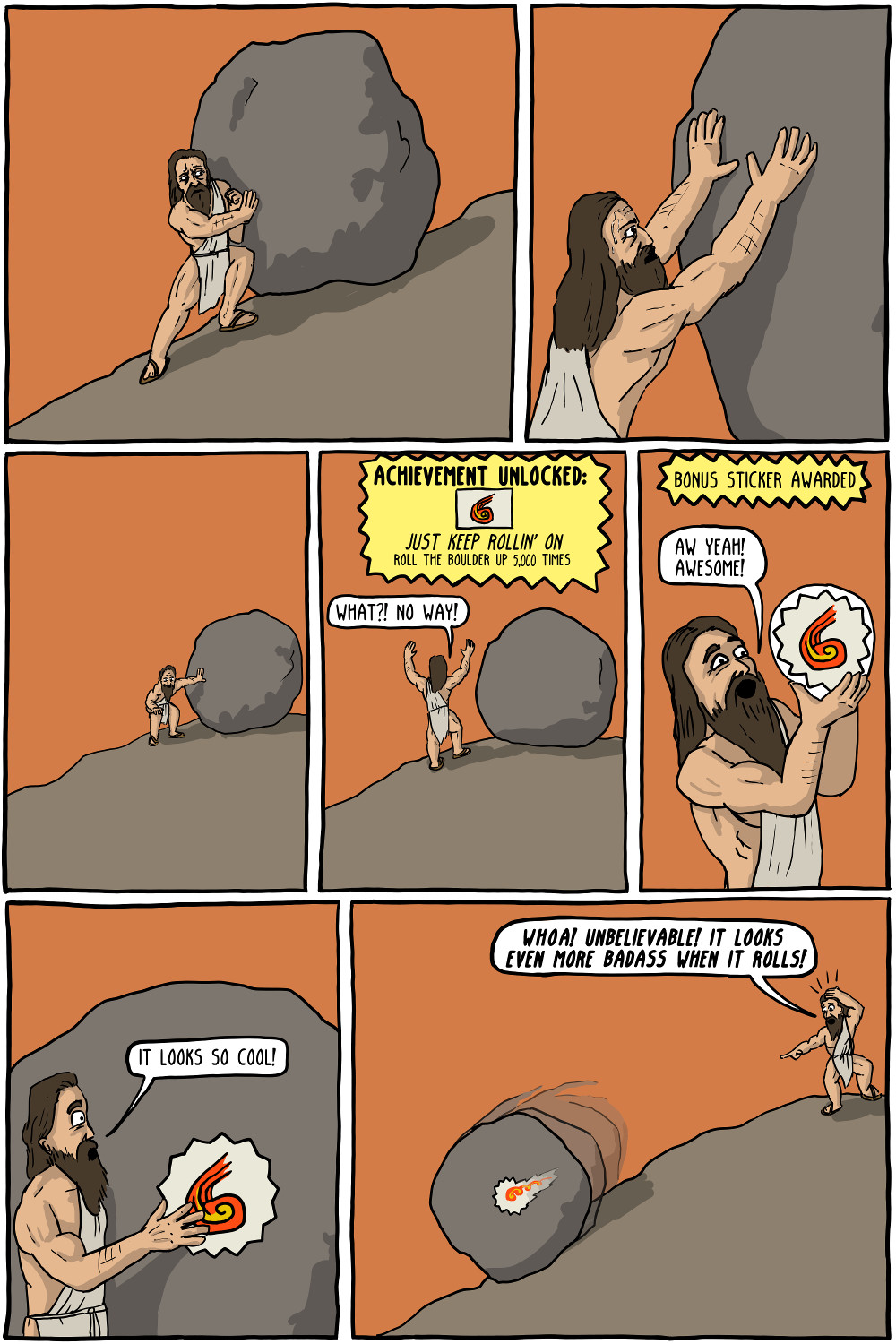
Well, the reference to Farmville, Candy Crush and other Facebook games aside, in this issue of Existentialist Comics, keeping an intelligent Sisyphus happy is probably harder than this. That's especially true for those like Camus and other professional and amateur philosophers who wrestle with these questions. We are "cursed" with intelligence, and speculative intelligence in general.

That said, where do we go from here, to find a better, more authentic contentment than Sisyphus?

To me, the original existentialism, or the Zen of the east from which I get my "mu" to Camus' question, is our starting point.

Recognizing that life simply "is," not in the scientific sense, but in a philosophical and a psychological sense, is the lodestar.

From there, finding contentment comes next. Contentment, to me, is both "deeper" psychologically and less ephemeral than "happiness." The likes of Daniel Kahnemann and other modern psychologists strongly agree.

And, it's not necessarily based on old ideas of how we "have to" find meaning, or create meaning, to be happy.

Second, per the essay that I linked that sparked these comments, as one other commenter noted, "progress" is usually defined in teleological terms. People often define meaning in the same way, which of course is another problem, and one recognized in part by existentialist and absurdist philosophers.

If your meaning is defined from achieving a goal, then you are doomed to frustration in never achieving it, or, like Sisyphus, having your "achievement clock" reset, or new layers added to it, or whatever.

And, what if you do achieve a goal of teleologically-based progress? What then? In the modern West, often, "emptiness," followed by chasing after some new goal.

"Revolt" might be one way of achieving this. But, I think it needs to be somewhat more comprehensive, maybe even somewhat more Cynical, as I discuss in calling for a neo-Cynicism, than Camus realized. The revolt has to include a revolt against teleology.

Even "authenticity" must be put under our Cynical microscope. Too often, "authenticity" is seen in a quasi-Platonic sense, as in "There's some ideal Me out there, and that's what I want to be."

Well, no there's not.

Each one of us is the result of massive contingency in a materialist universe. There's no way any ideal Me or You exists.

So, authenticity means rejecting the strictures of society that don't agree with deeper layers of our selves — before they become part of those deeper layers.

At the same time (heads up, Black Bloc!) it means questioning the idea of "revolt for revolt's sake" (sorry, any hyper-Camuseans) or any other "X for X's sake."

I'm not a process theologian, or anything close.

But, I will call myself a sort of "process psychologist."

As such, meaning is created, not found. And, it's created on an ongoing, not a static basis. It's part of a dialogue between a changing self, a current moment, and a current moment that is part of a larger stream of time.

And thus, meaning changes throughout life. Why wouldn't it?

Friday, November 08, 2013

Happy 100th to Albert Camus


Albert Camus/From Wikipedia
I missed the centennial birthday anniversary of Albert Camus yesterday, somehow.

But, it's never too late to commemorate a great philosopher and a great human being.

To talk about that latter part, while at the same time refuting recent rumors I've seen online that he was Jewish, please read this excellent piece, which talks about his Jewish friendships, his work in the French Resistance during WWII, and his support for the formation of the state of Israel.

Camus didn't always walk a perfect line between support for Israel and anti-Arab occasional sentiments. Even before the start of the Algerian civil war, his stance toward Arabs was surely part of his pied-noir Algerian native heritage.

But, in general? Per  Wikipedia's comment on his Nobel Prize award, his literature:
(W)ith clear-sighted earnestness illuminates the problems of the human conscience in our times."
Can't say it better myself.

And, speaking of:


The video is in French, but has English subtitles if you turn on the captions. It's from this tribute, which has selected quotes:
 For myself, I cannot live without my art. But I have never placed it above everything. If, on the other hand, I need it, it is because it cannot be separated from my fellow men, and it allows me to live, such as I am, on one level with them. It is a means of stirring the greatest number of people by offering them a privileged picture of common joys and sufferings. It obliges the artist not to keep himself apart; it subjects him to the most humble and the most universal truth.
The full speech, translated, is here. Camus' justification for why he wrote, and more, still speaks to us today:
Each generation doubtless feels called upon to reform the world. Mine knows that it will not reform it, but its task is perhaps even greater. It consists in preventing the world from destroying itself. Heir to a corrupt history, in which are mingled fallen revolutions, technology gone mad, dead gods, and worn-out ideologies, where mediocre powers can destroy all yet no longer know how to convince, where intelligence has debased itself to become the servant of hatred and oppression, this generation starting from its own negations has had to re-establish, both within and without, a little of that which constitutes the dignity of life and death.
That said, he and Sartre, who met during Resistance work, eventually became alienated when they didn't see eye to eye on how to address these issues. Why?

Camus "saw through" the reality of the Soviet Union early on, while Sartre remained, essentially, a "fellow traveler" all of his life. Sartre's blank-check support for the Munich Olympics kidnappers and Che Guevara only  further illustrate that.

That said, again per  Wiki, on Camus:
In the 1950s, Camus devoted his efforts to human rights. In 1952, he resigned from his work for UNESCO when the UN accepted Spain as a member under the leadership of General Franco. In 1953, he criticized Soviet methods to crush a workers' strike in East Berlin. In 1956, he protested against similar methods in Poland (protests in Poznań) and the Soviet repression of the Hungarian revolution in October.

Camus maintained his pacifism and resisted capital punishment anywhere in the world. He wrote an essay against capital punishment in collaboration with Arthur Koestler, the writer, intellectual and founder of the League Against Capital Punishment. He was consistent in his call for non-aggression in Algeria.
And, even if his birth might have left him a bit indisposed toward Arabs at times, it didn't do that much:
Although favouring greater Algerian autonomy or even federation, though not full-scale independence, he believed that the pied-noirs and Arabs could co-exist. During the war he advocated a civil truce that would spare the civilians, which was rejected by both sides, who regarded it as foolish. Behind the scenes, he began to work for imprisoned Algerians who faced the death penalty.
So, happy birthday, Mr. Absurdist. Speaking of that, here's some earlier blogging of mine about his absurdism, what he saw as philosophically separating him as an absurdist from existentialism and why, and more. (It's somewhat similar to why Stravinsky, and rightly, rejected the label of "neoclassicist" because that lumped him with Prokofiev. And, for more of my thoughts on THAT issue, and a level of a mix of jealousy and outright contempt that goes beyond Sartre on Camus, go here.)

I see in Camus, beyond philosopher and litterateur, a humanist, a man of and  for humanity.Add

Add to that this great piece from Columbia Journalism Review about how Albert Camus' career as a journalist, and his writing on real-life events, ties in with his work as a philosopher, especially on ethics and related issues.

As part of that, I see a person of integrity. By that, I mean far more than honesty, but someone "integrated" within himself. If we think about the idea of Aristotelian flourishing, Camus seemed to have exemplified this in many ways, and to have done so without being anywhere the rich slave-owning upper-class Athenian of Aristotle's day, to whom he limited the idea and possibility of such flourishing.

This idea of integrity, and an updated version of Aristotelian flourishing, is something I understand more, and aspire to more, as I get older. 

And, on Google Plus, a friend of mine talked about the desired Venn diagram overlap of atheism (in a non-Gnu Atheist way), true liberalism (with a humanist bent) and skepticism. I don't know how much of a science-type skeptic Camus was, but he certainly punched the ticket on the first and second.

American philosophy has certainly produced nothing exactly like Camus, in part because the true non-Communist leftist class in America generally has not produced such intellectuals, in part because it's so thin, and some have veered beyond that "non-Communist" part, or at least to a semi-reflex anti-American part. And,  even more, America hasn't produced a Camus because of the broader anti-intellectualism of much of America, per Richard Hofstadter.

That said, per his falling out with Sartre, Europe in some ways really hasn't produced anyone exactly like him.

Friday, November 30, 2012

Existentialist or absurdist? Understanding Camus


Albert Camus/From Wikipedia
Albert Camus consistently rejected the label of “existentialist” for himself, preferring that of “absurdist.”

I’ve always thought that, in part, there was a jealousy dynamic involved. He didn’t want to be under the “umbrella” of the same descriptive label as was Jean-Paul Sartre. This parallels why I see Igor Stravinsky not wanting to be called a “neoclassicist”; that label was already hung on Sergei Prokofiev; see here for more on that.

That said, it’s arguable that there are differences between Camus and Sartre, and that, as well, Camus knew his own writing better than anybody else, and should be allowed for his own labeling. (Exactly the same argument applies to Stravinsky vs. Prokofiev and, in fact, I have a similar blog post up.)

Fortunately, Wikipedia has a very good page on absurdism. The best part is that it offers a nice comparison chart of basic issues versus both secular existentialism (Sartre) and religious existentialism (Kierkegaard), as well as against nihilism.

I like absurdism because it sees more grays and fewer blacks-and-whites in life. But, it’s not nihilistic, which, well, sees all blacks!

Versus existentialism in general, absurdism says life may have meaning, not that it necessarily does. But, more “positively” than secular existentialism, it also says that the universe may have inherent meaning, but we can never know that.

That said, I’m not sure how much Camus believed that, and he wasn’t the only literary or philosophical absurdist, to be sure. Personally, I’d nuance that statement to say, “I don’t think the universe has inherent meaning, but I can’t prove it doesn’t.”

Also, versus both types of existentialism, absurdism says, don’t expect any guarantees, even on an individualized attempt to create personalized meaning out of life.

That, of course, was part of Camus’ “The Myth of Sisyphus.”

In turn, in that book, he first articulates the philosophy of revolting against the absurd, which finds its ultimate articulation in “The Rebel.”

Here is where Camus and Sartre parallel each other on the issue of “authenticity.”

For Sartre, it’s about being authentic by creating an authentic meaning for life. For Camus, it’s about the authenticity of one’s revolt.

And, as a result, Camus tells us that a life without hope is not necessarily a hopeless life.

And, along with Camus’ general terseness of writing, that’s part of why I admire him as an author in general and definitely hold him on a higher level than Sartre. A play like “No Exit” aside, Sartre simply doesn’t seem to have a visceral grasp of modern absurdity the way Camus does.

For additional thoughts on and interpretation of Camus, not necessarily agreeing with what I have written, see this site from Swarthmore. For some of Camus’ pithier insights, see this page of quotes.

And, go here for my thoughts on Camus' birth centennial.

Tuesday, December 18, 2007

John Haught straw-mans atheism in the name of progressive theology

I appreciate that Haught, the only theologian to testify at the Dover Intelligent Design school education trial, believes Darwin is good for theology to counter a literalist understanding of God, scriptures, etc.

I can halfway accept that Christopher Hitchens, et al, “cheat” in their “New Atheism” books by just talking about the worst of major religions.

But, Haught sets up a straw man by claiming, in essence that atheism is psychologically impossible or nearly so, per “old atheist” literati like Sartre and Camus.

First, he is right that the “old atheists,” Camus above all, did give a hat tip to the social justice of traditional religion. Nonetheless, in the same speech where Camus most directly did that, he told his Catholic religious audience that he wouldn’t be critiquing them on social justice issues if more people actually followed Christian social justice teachings.

On the social justice angle of Christianity, if literalist metaphysical verities are thrown out, that's all that's left. And Christian social justice improved in the modern world, post-Renaissance, precisely as the metaphysical verities faded away.

Second, in claiming atheism can’t justify any hope it does have in this world, he argues from an a priori, a logical equivalent of Aristotle’s Prime Mover. That is, after saying too many fundamentalists and new atheists alike have too much faith in science as being able to provide ultimate answers, he insists the world does have ultimate answers. That is the backdrop for his unspoken assumption that most, if not all psychological stances in this world, can be justified.

Third, Haught basically ignores evolutionary psychology, and the degree to which things like altruism are in our genetic make-up, by indicating one must be religious to hve a sense of social justice.

Fourth, after rejecting Stephen Jay Gould’s idea that science and religion are “separate magisterial,” he criticizes scientists for ever making comments about “purpose” in life, trying to reserve that for a religion-philosophy magisterial.

Here’s an example:
What intelligent design tries to do — and the great theologians have always resisted this idea — is to place the divine, the Creator, within the continuum of natural causes. And this amounts to an extreme demotion of the transcendence of God, by making God just one cause in a series of natural causes.

But, per Christian theology, historical errors of the Bible aside, the Christian God is one who intervenes in history, who makes plans for history, and who ultimately becomes immanent in Jesus.

Ttherefore, claims about God’s actions in this world have to be considered empirically reviewable, unless …

Fifth, and most importantly, after his high-faluting language, he pulls out one of the theologian’s oldest dodges in the book: Finitum non capax est infinitum, or, “The finite cannot comprehend the infinite”:
We have to refer to (transcendent reality) in the oblique and fuzzy but also the luxuriant and rich language of symbol and metaphor.

That didn’t fly when the author of Job put that on the lip of Yahweh, nor when Paul quoted that. And it doesn’t fly today. And, in fact, he gets called on it a bit later in the interview.

Haught does that again with resurrection stories:
If you had a camera in the upper room when the disciples came together after the death and Resurrection of Jesus, we would not see it. I'm not the only one to say this. Even conservative Catholic theologians say that.

I guess he is OK with ignoring what Paul said in 1 Corinthians about bodily resurrections, even if Paul hedges his bet by talking about “spiritual bodies.”

Sixth, Haught simply covers his eyes when scientific explanations run over his stances like a Mack truck. Haught can’t accept that modern neuroscience and related disciplines show “the mind is the brain,” no matter how that’s understood in terms of mind being an emergent property?

Dismiss it away. Say that cognitive science and neuroscience not only haven’t explained consciousness, but can’t.
Don't get me wrong. I want to push physical explanations as far as possible. I'm a man who loves science. I'm in awe of science. I don't ever want theology to put restraints upon science. I believe every thought we have has a physical correlate. But at the same time, I believe there's something about mind that does transcend, while at the same time fully dwelling incarnately in the physical universe. I see that as a microcosmic example of what's going on in the universe as a whole.

In other words, practice intellectual dishonesty.

Beyond that that, his claims to embrace science aside, he’s actually being antiscientific, not just nonscientific, with his a priori rejection of what cognitive science and neuroscience may well continue to discover about the nature of consciousness.

Finally, we have this howler:
That means we have to overcome literalism not just in the Christian or Jewish or Islamic interpretations of scripture but also in the scientific exploration of the universe.

Science admits its knowledge is provisional, but non-literal? This sounds like the intellectual relativists found in places like Stanley Fish lectures and the pages of New Social Review.

In other words beyond that, justify the Hitchenses and Dawkinses of the world for pointing out that people like you don’t necessarily have much more clothes than ayatollahs or hellfire preachers, or even than popes and dalai lamas.

That said, Haught’s theological mentor is the late Belgian Jesuit, Teilhard de Chardin. Chardin’s “Omega Point” is certainly out of the scientific realm of empirical study, and, in terms of religion, it’s essentially a Catholicized version of Whitehead’s process theology.

But, all of this skirts an even deeper point.

Haught refuses to look squarely at the fact that Darwinian evolution guts Christian ideas of divine perfection. In other words while Haught has read plenty of Camus, Sartre, Paul Tillich and de Chardin, he hasn’t read enough David Hume. In other words, Haught doesn't consider this world might be the product, even as a process, not literal creation, of a divinity immature, incompetant, immoral or all of the above.

The only way Darwinianism can be squared with theology is if one accepts a God who is “less than all,” unless Haught trots out the “incomprehensible” chestnut again. That’s true in spades of quantum theory.

But, Haught sure doesn’t seem willing to do that.

That said, I find it interesting that many theologians will talk readily about “dialoging” with Darwin or Einstein, with evolution and relativity, and their effects on religion, but you’ll never hear one talking about dialoging with Heisenberg and quantum indeterminancy.

Saturday, February 11, 2006

Existential thoughts on Camus

I’m rereading Camus – currently on "The Stranger." As I was out for a walk tonight in what is really “normal” temperature but felt briskly chilly compared to what we’ve been having this year, I remembered, nearly verbatim, his lines in Mersault’s mouth on the last pages:

“For the first time, in that night alive with signs and starts, I opened myself to the gentle indifference of the world.” The world cares not whether I am alive or dead and has no world-soul to care, anyway. That thought can be either depressing or gladdening, I realized, depending one what mindset I bring to that thought in advance, what feelings and beliefs I am seeking to be confirmed or denied, and so forth. I felt vaguely but reassuringly comforted by that fact.

And how had Camus reached this point?

“As if that blind rage had washed me clean, rid me of hope,” he says just before the words above. Raw emotion, when undenied, can get us to bedrock within ourselves. I take Camus as saying he has been rid of the hope of false delusions, such as the delusion that the world really gives a damn about Mersault.
And so we go on.

“Finding it so much like myself — so like a brother, really — I felt that I had been happy and was happy again.” Mersault is one with himself after getting stripped of his self-delusions. And so, in a nonmetaphysical way, he can experience a certain degree of oneness with the world at large, as a relative of some sort.

And that leads us to Mersault’s final lines, where Camus lets us know that the homo existentialis always remains in at least partial control of his own emotional fate, if not his physical fate.

“For everything to be consummated, for me to feel less alone, I only had to wish that there be a large crowd of spectators the day of my execution and that they greet me with cries of hate.”