Showing posts with label literature. Show all posts

Thursday, October 09, 2025

Novels, nostalgia and need

I grew up in Gallup, New Mexico, self-proclaimed "Indian Capital of the World."

Years and years ago, I read many, though not all, of murder mystery author Tony Hillerman's Chee and Leaphorn novels, about two Navajo Tribal Police officers, (I also read two non-Big Rez murder mysteries of his.)

Hillerman has long come off as sympathetic to Navajos in particular, and American Indians of the Southwest in general, as people. Going beyond oater dime novelist Louis L'Amour, who said more than once if he wrote about a place, "it was there," with Hillerman, not only was the place there, but so were the sociology and culture.

Well, recently, for various reasons, I started reading some of Hillerman again. But, after "Sacred Clowns," I may have hit a wall. An edited version of my Goodreads review will explain why.

Sacred Clowns (Leaphorn & Chee, #11)

Sacred Clowns by Tony Hillerman
My rating: 3 of 5 stars

On my "formula" for mid-level fiction reviews?
Characters 4.25-4.5
Plot 4.5
Dialogue 4-4.25

I'll take that to 4.5 or so overall but, round down due to an error.

Nope, it's "dropped" to 3 stars due to other issues listed at bottom. Some are specific to this book; others, the majority, apply to the Hillerman "canon" in general. I'm going to get to that after a condensed version of the first part.

On characters, Jim Chee as acting sergeant shows a first round of character development within the Chee-Leaphorn books, accepting enough of Lt. Joe Leaphorn's experience-developed wisdom to actually follow some rules. He also finds out that he may not be enough of a traditionalist to satisfy old-time hataałii (usually rendered by Hillerman as "shaman" or similar) to become one himself, complexifying his look at Janet Pete as too much of a "city Indian." One book later than Coyote Waits and two earlier than First Eagle, when you look at the series, you can see this "character plot line" developing. In addition to their hot-and-cold at times, the ethical playoff late in this story is good. As with widower Leaphorn's quasi?-romantic relationship with Prof. Bourebonette, this is Hillerman writing a generally internally consistent set of stories.
...

St. Bonaventure in Thoreau? It was there when I was growing up in Gallup eons ago. Not sure if it's the same church building today or not. Back then, it had a wood-plank floor that doubled as a roller skating rink, including being rented out; my church's youth group went out there more than once. I don't know if Gallup didn't have a roller rink then, or it was too big to rent to small groups, or what. (Or so I thought it was there. Teh Google lists skating in Gallup itself and not in Thoreau today, but Google Maps with "roller skating Thoreau NM" pointed to the Thoreau Community Center. Maybe skating moved there, or maybe that was the original church building.)

This all is why Hillerman is not dime-novelist Louis L'Amour, who used to brag that if a place was listed in one of his novels, it's there. With Hillerman, the people and culture are there, too.

But now, the problems start, beginning with smaller ones and working to bigger. 

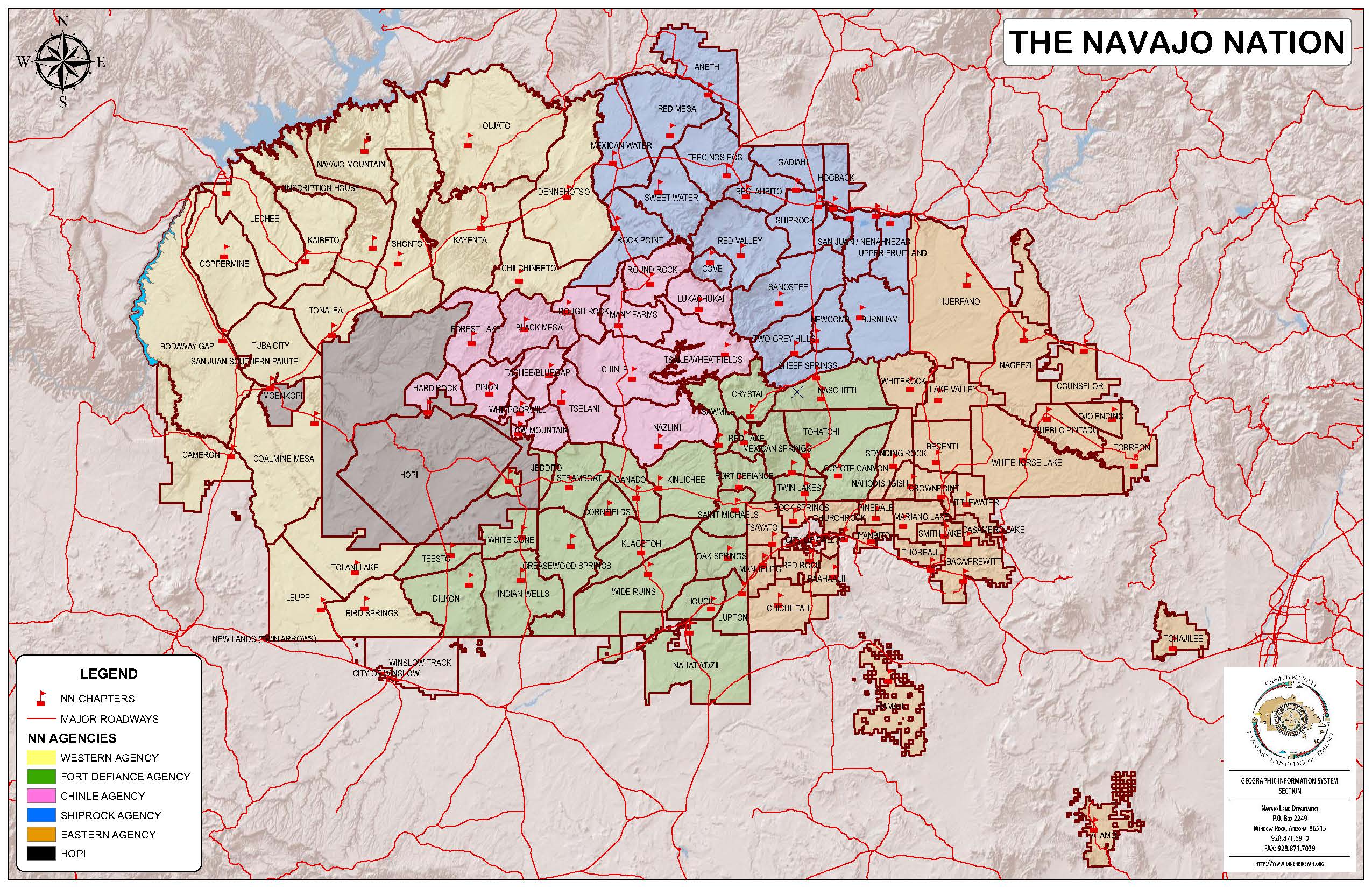
First, he mentions an Iyanbito and Iyanbito Chapter House south of Gallup [pg 121, hardcover], and the only one I am familiar with is the one to the east. Besides, the Red Rock Chapter House is to Gallup's south. See for yourself. I have driven past Iyanbito many, many times. It has an exit on I-40. This is why I double-taked.

Sorry, Tony, but you don't explain why you "moved" Iyanbito if deliberate. And, a basic error otherwise? On the border on ratings, that gets you bumped down on the Navajo authenticity issue. That said, in this Smithsonian piece he admits to "shuffling around" places to meet his needs, but? There was no need for this. Nor for calling the Zuni Drive-In the Gallup Drive-In. Was it going to sue? It closed in 1982, anyway, so it couldn't. (I saw "Star Wars" there as a kid.)

There's an issue or two in other Hillerman novels that generally hold him at four stars, not five. For instance, he talks about "the Tuba City type of Navajo," a description both sociological, in terms of demeanor, and physiologically, in terms of build, as if genes work that deterministically and there's no outbreeding into that small area. And, of course, none of that is true.

Now, to a bigger issue, expressed in this novel, and I think one or two others.

That is his take on the American Indian Movement . Yes, many people within Navajo leadership didn't like it. That's because it challenged their authority, just as on the Sioux reservations. Calling its leadership, like Dennis Banks and Russell Means, "city Indians," comes off as a bit, or more, condescending. And, it's a lie. Banks was born on a reservation in Minnesota. Means was born on a reservation in South Dakota. Both Bellencourts were born on reservations. Banks was forcefully removed to a BIA boarding school at age 5. Means' parents moved to San Francisco at age 3 to escape poverty; the Bellencourt family moved to Minneapolis when older brother Vernon was 16.

This comes off sounding like my dad. (I remember when AIM came to Gallup.) I've outgrown that, Tony. This review goes down to three stars, and I read you more skeptically on "flavor of the Southwest" in the future.

For a truly nuanced and insightful book on AIM, especially in the Siouxan heartland of its operations, read "The Unquiet Grave."

And, I realized I have now been "triggered," or if I accept that something like free will exists (I do, if you emphasize the "something like" and that it is not necessarily totally conscious), I have self-triggered.

First, the quasi-sneer about "city Indian" (also Blizzard, the "city Indian" Cheyenne from Chicago BIA agent in this novel) surely affects Hillerman's authorial stance toward Janet Pete throughout the entire series of his novels. He doesn't totally throw her under the bus when he has the final break-up between her and Chee, but he does entirely write her out of future books. Did his attitude toward "city Indians" in general harden as he grew older?

Related? As I think more skeptically, while Hillerman may not totally paint a romantic Rousselian noble savage view of reservation Navajo life, the toes of one of his two feet, at minimum, are in that swamp. And I use that word deliberately. In reality, not only is the poverty worse than he portrays, but bits of it are to some degree self-inflicted. Navajos overgrazed the land badly enough a century ago that, for this reason as well as price controls, Navajo sheep, like Iowa hogs, were "culled" as part of the Agricultural Adjustment Act in the 1930s. There's some degree of overgrazing again. Beyond that, as disagreements between chapters over Bears Ears have shown, there's not a "unified Navajo stance" on many things. In either case, on the land, as he has Chee drive by the pivot irrigation lands of what is today Navajo Agricultural Products Inc, and contrast them with a bit of ruefulness to the buttes and mesas, he overlooks the sheepherding.

In other words, to mash up Colbert and a cliche? "Truth is truthier than fiction."

Another issue? I think Hillerman has a generally bilagaana take on frybread, which is a flash point among many modern American Indians of many tribes. That's also not specific to this book, but, I never recall Chee, as an "authentic" Navajo, in any of my past Hillerman reading, saying it's not authentic Navajo food.

One other issue. One of Hillerman's novels is entirely on the Zuni reservation. Others have Hopi connections. But? Even though the Ute Mountain Ute reservation is directly north of the New Mexico portion of the Big Rez, I'm unaware of any Ute characters in any of his novels. Also not mentioned, IIRC? The Paiutes who actually live on the Utah strip portion of the Big Rez. (Indeed, some of these Paiutes have Navajo surnames like Begay or Yazzie.)

One OTHER other issue. Why, given Leaphorn's strident antipathy to alcohol, after his wife's death, does Hillerman name his new female interest Bourebonette? Yes, the initial "e" hides it, but really? Something like "bourbon"? Am I the first to notice this?

Anyway, beyond being self-triggered, I realized my nostalgia leading me to re-read Hillerman wasn't as much nostalgia as escapism — not the escapism of reading fiction, but real escapism, the desire to move out of Tex-ass, with the New Mexico of my childhood years a reasonable option financially — should I get a pre-retirement job there — among today's US Southwest and Western states. 

Expanding beyond my main blog, this probably isn't that likely. The sewer of U.S. job hunting sites gets worse and worse all the time. And, I'm not well-enough off to say that post-retirement moving will be easy.

Update: "The Wailing Wind" is even worse, especially given that Hillerman undermines his own schtick about painting a genuine Sitz im Leben about Navajos, Navajoland and things related.

View all my reviews

Thursday, October 19, 2023

Stacking the deck in 'A Canticle for Leibowitz'

A Canticle for Leibowitz (St. Leibowitz, #1)

This is an even more extended version of a Goodreads book review than normal. That’s because, in this case, while I overall still think the novel is a five-star on literary style, there are “issues” behind it. 

My original review doesn't have plot spoilers, so you may need to hit the Wiki page for "A Canticle for Leibowitz" to understand why, beyond saluting it as good novelistic writing, I started having a variety of concerns about the author, Walter M. Miller Jr., stacking the deck on the background, or "framing," of the novel.

And, I concluded by moving beyond those initial concerns to some degree of disquiet.

A Canticle for Leibowitz by Walter M. Miller Jr.
My rating: 5 of 5 stars

(That's the initial rating, before this in-depth review; I lowered it to 4 stars after that.)

A damned good book, or so I said in my initial review.

Almost as dystopian as Cormac McCarthy (until the final twists), but without his gratuitous violence in general and gratuitous bloodshed in particular. Possibly deeper in some ways, philosophically. And, per the Wiki pieces on this and Miller personally, reflecting his WWII service as being one of the US bombers that destroyed (probably, though not certainly, unnecessarily) Monte Cassino.

Plot and characters are both good. As are recurring themes. The wordplay in the second part (Fiat Lux), while not on the level of an Umberto Eco, hints in that direction. (I wonder if the name of Leibowitz was in fact such a play.) The "twists" that will later develop can usually be seen in a general way, but not specifically, until you're right there. (A good example of that is Ms. Grales' "second head" Rachel eventually becoming a new Virgin, which I recognized he was getting at right when we got there.)

My only complaint, or bit of perplexion, or something? And, that is that "Lazarus" (a character in both parts 1 and 2, and early in part 3, under various names in the three parts) doesn't make a final appearance somewhere near the end of Part 3. It could be that Miller couldn't figure out how to work him and Rachel both in at the end. (Personally, I would have loved to have seen him as a stowaway on the spaceship.) Or maybe it's a statement by Miller.

And, per Miller's word play, and one last aside on Lazarus? In Part 2, with the two Hebrew phrases, especially the specific way the second riffs on the Shema? I don't know whether Miller intended it or not, but he likely did, with the specific Hebrew word substituted in the Shema riff? Lazarus is also someone else (besides possibly Leibowitz), and that someone else also from the Christian New Testament.

==

A note for friends: If you're not religious in general, and haven't been, you may not even grasp at the meaning of the Latin, and if you don't know Hebrew at all? (The first of the two phrases is translated, the second not.) Have Google Translate ready as needed.

View all my reviews

==

Now, the critique of the backstory.

The biggie is that, if not outrightly stacking the deck, Miller clearly comes down on the side of religion vs. science, and makes it a two-sided battle of religion versus science. The term scientism may not been around in 1959, but that’s arguably what he’s critiquing. (And, by the time I finished this up, if not “stacking the deck,” I’m ready to say he’s putting one, at least, of his two thumbs on the scale.)

First of all, in Part 1, we don’t know enough (in the novel) about the actual Leibowitz to say what exactly he did with nuclear programs. But, that’s minor.

If we’re going to attack science, or even scientism, let us remember that absolutist religion has given us crusades, pogroms and holocausts. Plural. As in, in 1 Samuel, Yahweh telling Saul to commit a holocaust on the Amelekite people and even their livestock. And, it’s not just “western” religions. Think of Buddhism’s 969 Movement in Burma. Or the RSS and Hindutva thought in India.

Second, the miracle of Rachel the teratoma or whatever we shall call her arising from Mrs. Grales? Yet, Miller doesn’t have New Rome trying to move a colony of the Order of Leibowitz from Earth to Alpha Centauri by miracle. Nope, it’s a rocket launch — rockets like those that kicked off both nuclear Armageddons. And, for that matter, there’s no miraculous intervention in either Armageddon.

As for the Tua Voluntas Part 3 “showdown” between Abbot Zerchi and Doctor Cors over the issue of euthanasia? First of all, every religion will soften at the edges, at some point, on some major moral issue. Look at actual Catholicism today vs. times past on suicide. Or it will row its absolutist oar, if deemed necessary, when science challenges. Look at the actual church on abortion and reproduction.

And, in part two, giving the secular scholar Thon Taddeo the last name, auf Deutsch, of "plodding priest" only increases the deck-stacking.

In reality, per Walter Kaufmann, there is no such thing as absolute justice and morals must bend on that, despite Miller sympathetically having Zerchi punch Cors. And, the dying Zerchi thinking that “the battle” was not with pain, but with the fear of pain? His Wiki page notes that Miller committed suicide shortly after the death of his wife, and he reportedly suffered from depression for many years before that, and PTSD over the Monte Cassino bombing. (He had converted to Catholicism after the war, per his own Wiki page.)

There’s also datedness and/or Eurocentric issues. Why not have a “New Lhasa” with Tibetan Buddhism paralleling Catholic Christianity? The primary reason is obvious. "Canticle" is ultimately a paean to the eternal verities of Mother Church.

I will confess that I did not pick up on the Wanderer being “the wandering Jew.” (Wiki's link on the book indicates it is.) The Leibowitz name … “body joke” … may be a pun on that. One wonders, per the Wiki page, if Miller was influenced by Lew Wallace’s “The Prince of India,” where he is the protagonist. That said, that's "interesting" in itself and hold on to that thought.

Page 169, as numbered in the paperback I read, is interesting, with two phrases in Hebrew, but Miller only offering a translation of the first in the book. The second? A riff on the Shema, where I first thought a deliberately corrupted form of Adonai was being substituted for Yahweh, but not true. "Day" (די is Hebrew) for "enough," "sufficient" or "sufficiency," not a shortened Adonai. "Hear, O Israel, sufficiency is our god" ("qoph" used for "he," but Google Translate rendered it as "our god" still, and perhaps it is in modern Hebrew), and sufficiency alone." 

Update: Wikipedia, as seen by a piece on Easter vs Passover datings in The Atlantic, notes that "dayenu" is even a Passover song. And, in fact, Wiki also notes the song may have arisen as a response to the "Improperia" of the Christian Good Friday service. So, knowing Miller's pre-Vatican II Catholicism, surely this is all intentional.

A Buddhist riff, or a riff on what Paul was supposedly told, that "my grace is sufficient for you" when he asked for the thorn in the flesh to be removed? After all, the first phrase IS Tents Repaired Here and what did Paul do? 

I'm pretty sure it's not a Buddhist riff, and my update confirms. In that case, Paul, like Lazarus, is the wandering Jew? But why? I have no idea on Lazarus, but, with Paul, maybe it's to subordinate him to first pope Peter? Even though Peter was also a Jew? The "wandering Jew" reportedly taunted Jesus. This would fit pre-repentance Saul before he became Paul. But Lazarus never taunted him in the first place. 

All the other wordplay was easy enough to follow. But, the Paul and Lazarus angles are why I didn't think "Wandering Jew." With Leibowitz himself in Part 1, either the real, or the Wandering Jew, he could be seen as redeeming himself and annuling the curse of wandering by joining the Cistercians, etc. But Paul redeemed himself by repentance on the Damascus Road. And, Lazarus, again, never mocked. But, Miller portrays him as Christ's non-Christian follower, or words to that effect.

That said, there's one big issue here. "The Wandering Jew" is of itself not necessarily anti-Semitic per se; but with some modern writers like George Sylvester Vierick taking it that way, and with Miller writing after World War II but in the shadow of it, it's a literary trope that needs to be handled carefully. And, tying it to Leibowitz as a nuclear physicist sure treads closely to Hitler's "Jewish science" motif.

And, with that, I have my answer to the end of the novel, even if it wasn't Miller's answer. Blastoff is to a new Eden, at least potentially, and Ahasuerus can't be allowed to contaminate it.

Tuesday, April 28, 2020

Of tragedy and Hume

I didn't realize that David Hume wrote a treatise "On Tragedy." (As in, the tragedy of great plays and literature, and some music and plastic arts.) Walter Kaufmann referenced it in a quote cited in a new bio of him. It's from a Kaufmann work I hadn't read before.

Here's an abridged version. (The unabridged, linked off it, is about twice as long, and itself is less than, oh, 3,500 words?)

Hume reflects quasi-Aristotelian ideas in what makes good presentation of tragedy good. It needs nuance, counterbalance and framing, among other things.

He includes talk of the passions, which may be part of why good tragedy appealed to him. He then discusses what sets tragedy apart from if we saw a similar incident in real life. He says it's artistic eloquence, including but not limited to how it resolves the suffering and the issues behind it. In other words, he points to something similar to Aristotle's cathexis, though he doesn't use that language.

He also thinks that good tragedy, if based on real history, succeeds by having some distance from the historical time in question.

Hume also flips this on its head, as to why we weary of hypochondriachal and similar narratives in real life.

He also thinks it should not be too grotesque. Here, Kaufmann disagrees with him, referencing the Isenheim altarpiece approvingly.

Give it a read.

Tuesday, December 26, 2017

Tolkien no longer interests me

I first really noticed that a few weeks ago, when prowling the stacks at a nearby university library. Sorry, Kindle, it's not the same. Actually, I'm not sorry, it's just not the same. But I digress.

When in the P section, for literature, a tail end of one shelf caught my eye.

All Tolkien studies. J.R.R. Tolkien. John Ronald Reuel Tolkien. Lord of the Rings author Tolkien.

And, I then realized it's been at least, what, 7 years, if not nearly a full decade, since I read LOTR?

I may have read it once since Peter Jackson's third movie came out, but not too long since then. And, it's been at least 5, if not 7 or more, since the Hobbit. And surely 15 since the Silmarillion.

My background?

I read LOTR the first time about the time I started high school, which was a little over a decade after the first authoritative, copyrighted U.S. edition came out. In short, LOTR was riding the end of its first, hippie-era (which Tolkien was ambivalent about) era of popularity. I believe I then read the Silmarillion the first time when in college.

I remember the original Hobbit cartoon movie, the cartoon movie of the first half of LOTR, controversy over the second half, controversy over hearing Jackson would do a live-action version, seeing that "The Two Towers," at least, WAS produced as an action flick for 25-year-olds, nearly not going to "Return of the King" for fear he'd butcher it, and being pleasantly surprised at the ending.

I'm not a cultist, but, a decade ago, I was certainly an ardent devotee.

All told? I've read the LOTR cycle itself half a dozen times — as in read through, cover to cover. I've read the Hobbit that many times, though with less interest as I got older, even before the LOTR waned from my mind. I've read the Silmarillion through twice, if not three times. And, read most extraneous, Chris Tolkien-edited material up through Jackson's third movie in 2003, at least.

I don't know why it has lost its drawing power for me, but I know it has.

I've always read a lot more non-fiction than fiction, but my total ratio hasn't changed. Since last reading the LOTR, I've re-read Le Guin's Earthsea trilogy, as well as first-read other material by her, and that within the last 3-4 years. I've read Huxley's "Brave New World Revisited" in that time, and material from a couple of literature Nobelists who have died in recent years.

I think part of it is that, in the back of my mind, as I've become socially, politically and culturally generally more liberal, Tolkien's essential conservativism has been unconsciously apprehended more and more by me.

Second? At my current age, I'm not sure I want some of the quasi-depressive poignancy the book invokes. Let me check back with myself in five years. And, yes, I know that Earthsea had its own sadly poignant moments, too. Other than the "Final Endings" though, I think they're better handled. That's because Tolkien's other seeming poignancy, lamenting modernity, is about as stovepiped as Frank Capra's "It's a Wonderful Life" setup, which I've noted elsewhere.

I think another reason Tolkien interests me less is Chris Tolkien. The flood of post-Silmarillion material, especially after Jackson's movies, seems off-putting. It seems highly capitalist, even almost crassly commercial. And, the older I get, the more anti-capitalist I get, flat-out loathing its greatest excesses.

In that sense, part of JRR's semi-screed against modernity resonated.

At the same time, he seems partially hypocritical. First, re forests, trees, and the Ents of Middle Earth, in actual England, forests were cut for firewood, for catapults of war and many other things long before coal began to be mined, which in turn fueled the steam engines of the Industrial Revolution. Speaking of, Tolkien can have his dwarves mine gems and precious metals, but interestingly, there seems to be nary a coal miner among them.

(Update, 2020: I didn't even think about the hypocrisy of printing presses requiring massive amounts of trees, and with the traditional paper bleaching process being environmentally unfriendly, and other things.)

And, back to those Ents. Shepherds of the trees. Shepherds of actual sheep raise their sheep for eventual slaughter, and, of course, shearings before then, but eventual slaughter. The analogy he attempts to draw doesn't work quite so well.

Beyond that, it was modernity that let his family emigrate to South Africa relatively easily. And it ws modernity that let them come back to England after his dad died.

Meanwhile, Tolkien left something else out of calculations with his beloved Elves. Even with many of the Sindar eventually going over the sea, and some dying from war wounds and other injuries, being otherwise immortal, and propagating with multiple children, over several thousands of years, one would expect Middle Earth to be blanketed with them. The population explosion would certainly not be Edenic.

In other words, while I don't know about LeGuin and other fantasy writers, Tolkien seemed to believe that somewhere, at some time, in actual Earth, something like Middle Earth existed as a generally blessed realm.

I'm writing this over multiple sittings, in quasi-diary format. I'm going to take a break again, as I risk moving into territory too critically cynical. (Jan. 4, 2019: There may be a second round at some point.)

I will add that I just watched, for at least the third time at home as well as twice at the movies, "Cast Away." It of course has its own degree of pathos, and one in a real world, and pretty realistic, setting. So, it may be that fear of setting loose the black dog at a less than ideal time in life is not such a driver against LOTR as I have thought. It simply may be that it is a taste that I have moved beyond for now, and perhaps permanently outgrown.

Saturday, December 25, 2010

John Steinbeck - fabulist; maybe plain old liar

So, it turns out "Travels with Charley" isn't true. It's not even "true to life." Not even close. That said, because it's deliberate confabulation, it's not really a novel, either, is it? It's a lie. Should we then re-address the motive behind Steinbeck's actual novels? Did he actually sympathize with Joad-type characters, or did he just think it was a good storyline?

I mean, "Grapes of Wrath" and "Cannery Row" are powerful and stirring. But, reading just how much Steinbeck fabulized, or just made stuff up, in "Travels with Charley," seriously makes me wonder if he was writing them for the story line more than the message.

AND ... although the Nobel Literature committee, unlike the Downtown Athletic Club with a Heisman Trophy, doesn't seem like it would ever revoke an awarded prize, IF Steinbeck was writing his novels for story lines more than any "message," should we reconsider his place in the literary canon?

That said, per Leo on Facebook, The Harvest Gypsies (the series of articles about migrant workers Steinbeck wrote for the San Francisco News) was the nonfiction basis for "The Grapes of Wrath." As Leo notes, what if Steinbeck faked that, too?