Showing posts with label history. Show all posts

Wednesday, November 27, 2024

Nature's God: Apparent Gnu Atheist's bad history

Nature's God: The Heretical Origins of the American RepublicNature's God: The Heretical Origins of the American Republic by Matthew Stewart
My rating: 2 of 5 stars

This book caught my interest at the library, but at the same time, grokking the introduction made this secularist see enough for the skeptical antennae to go up. With that, let's dig in, on another extended version of my Goodreads review, to look at just what is wrong with this book

First, I knew most of the Ethan Allen story. Interestingly, Stewart does not relate the Allen deathbed anecdote, whether it's true or not. Supposedly, an "orthodox" minister told Allen that the angels were waiting for him, and he replied: "Waiting, are they? Well, goddammit, let them wait!"

I also knew a bit of Thomas Young's history, though I did learn more about him in this story. And, yes, "story" is a good name for this book. (Stewart, per another Goodreads reviewer, makes historical mistakes covering the pair of them and smallpox inoculation, too; that's another reason this is "story" and not "history" at bottom line.)

First of all, Stewart appears to be not just an atheist but quite possibly a Gnu Atheist, with all that entails. (I can't tell if he thinks this for sure, but his latest book, on U.S. slavery and emancipation? He may be one of those people who claims Lincoln was an atheist.) That gets you dinged right there, because it's totally not true. Second: His "The Truth About Everything" book makes me wonder how much of a scientism person he is. I think the first-in-order reviewer is themself.

Secondly, much of what I said about Epicurus and Epicureanism in my review of “The Swerve” deserves repeating.
First, the inventors of atomic theory, Democritus and Leucippus were pre-Epicurean and even pre-Socratic. Greenblatt never mentions this. Nor does he mention that Greek philosophers in general were anti-empirical, and therefore antiscientific, as we know science today. (Indeed, one could argue that Archimedes and Eratosthenes were the only two real scientists the Hellenistic world produced.)

Ergo, especially if we start "modernity" with the Enlightenment and not the Renaissance, Epicureanism was not "how the world became modern." Not even close.

Second, he cherry-picks who was influenced by Lucretius, and how much, and how much influence they had. The late Renaissance world didn't see a flowering of Giordano Brunos.
Extending on that? Epicureanism may be a very good moral philosophy. As some kind of philosophy of science? Bupkis. As a political philosophy, tohu w’vohu, as it just doesn’t really say anything. The Internet Encyclopedia of Philosophy offers more on how not just Spinoza, but 17th century philosophy in general, was still mired in the Socratic world on many issues, and yes, mired is correct, and hence, Whitehead's encomium to Plato is wrong.

The Stanford Encyclopedia of Philosophy, in its Epicurus page, further tackles the issue of "the swerve," which may or may not have originated with Epicurus; details of it are only discussed in Lucretius and Cicero. Related to that are larger issues with the atomism of Democritus and Leucippus, and why their ideas should in no way be conflated with today's atomic theory world. Basically, Epicurus, if one were to reference cosmology of the last century, was the Hellenistic version of steady-state Fred Hoyle or something kind of like that. Also per SEP, on its Democritus page, it should be remembered that whole atomism project was philosophical, not scientific.

Related? Stewart’s note that Bruno became so infatuated with Lucretius that he couldn’t explain Copernican theory correctly. Gassendi had that problem, too. See here.

AFAIK, Copernicus himself was uninfluenced by Lucretius and Epicurus. Besides, heliocentric theories existed back in ancient Greece. It wasn't until Ptolemy's version, which also through in epicycles to try to make planetary motion all based on perfect circles, that geocentrism took off, later boosted by the Christian church. (Copernicus' theory, as Kepler got more and more precise information on planetary motions, actually required MORE epicycles than Ptolemy. Then he had the light bulb moment to think of ellipses and poof.)

Also related? While Galileo’s discovery of Jupiter’s moons didn’t invent them into existence, nonetheless, it certainly offered the idea that Epicurean cosmology wasn’t the final answer. Even more so for Herschel's discovery of Uranus. I'm sure that if Napoleon had asked him about Epicurus, Laplace, whose nebular hypothesis of the solar system's origins put a wrap on Enlightenment-era science, would have said he had no need of that hypothesis, either.
 
All of this is important to note because the Enlightenment was about extending the world of science. The term "scientist" wasn't coined until post-Enlightenment 1833, but, the idea of a "natural philosopher" being called something that didn't have "philosophy" as part of the title extends into the 1700s. But, really, not into the 1600s. So, in that sense, Epicurus, Lucretius, Spinoza and Locke are all at least somewhat irrelevant to trying to scientifically ground what would eventually become political science. Ditto for Hobbes. Even today, 250 years later, you can have David Graeber and David Wengrow postulating a theory of everything that is largely wrong, and that also, per Stephanos Geroulanos in "The Invention of Prehistory" is also wrong on its "framing."

Next? The idea that Spinoza was more important of an influence on American deism, the revolution, etc., than, say, Locke? Laughable. He may have been an influence THROUGH Locke; different story. And, it doesn’t fit with his Epicurean thesis, anyway; Epicurus had no real influence on Spinoza. That’s per a place like the Stanford Encyclopedia of Philosophy, where Epicurus isn’t even mentioned in the entry on Spinoza.

Per Gilbert Ryle, I could say that Stewart is committing something kind of like a category mistake, but that’s too charitable. Rather, he’s committing something kind of like a category conflation, which entails much greater willfulness.

Side note? Spinoza's first name actually is neither "Benedict" nor "Baruch." It's "Bento," from the Ladino.

Related? The idea that Locke was a sekrut radical is laughable. To riff on Cervantes, it’s tilting at Gnu Atheist skyhooks. And, it's no wonder that Stewart has to repeatedly talk about how other academics disagree with him. Later on, Stewart accepts that most American deists were the “clockwork god” folks, the “Newtonians” (this sets aside that Adam Smith was a “clockwork god” deist at the time of the American Revolution, which not only undercuts Stewart but is also generally hated by classical liberal economists, no matter that it’s true.) But Stewart never extends that same courtesy, or whatever we should call it, to Locke. Why not? IMO, it’s because it upsets Stewart’s program. If Locke really was a Newtonian, that means American deists weren’t dissembling in their Newtonianism, nor that they "really" had some Spinozist semi-atheism as their Ultima Thule.

Somewhat related? The American Revolution, and Constitutional revolution, was a moderate, and politically focused, revolution. The Articles of Confederation took a pass on a federal state church, and the Constitutional finalized that. That’s it.

The French Revolution didn’t IMMEDIATELY attack and abolish religion in general. But? By the time of Robespierre and Danton, though, it did. 
To put it another way, as I repeatedly told a British Gnu Atheist who commented at some of Massimo Pigliucci's old philosophy sites? None of the American deist founders were interested in anything close to what became laïcité in France. (Oh, and contra some French intellectuals and Francophile intellectuals in the Anglosphere, laïcité is not hard to grasp. It's just something that I reject.)

With that?

To the degree I determine a thesis in an ill-focused book, it’s that the founders wanted to inculcate a Spinoza-like semi-atheist deism, not just the Newtonian mechanical clock type, of god winding up the universe. IF SOME of the founders (Jefferson, maybe Franklin) wanted this, let alone tried to get it, it was as private individuals, not as founders of the American state.  Even there, the all caps is deserved. There’s a second part to Stewart’s thesis, and that’s the insinuation they halfway succeeded. Anybody who’s read Antonin Scalia’s pronunciamentos from the Supreme Court bench about “civic religion” knows this is to laugh, as far as the American state. Anybody who knows most “Nones” are not atheists or agnostics knows this is to laugh in terms of private belief.

Related? Being long-listed for a book prize is nowhere near as big a deal as being short-listed. And, the use of the word "heretical" in the subhed is another — this time provocative or click-baity — instance of fluffery.

Per one other reviewer, who said this would make a great 300-page book or a great 800-page one? A la Paine, it might make a good but not great 150-page screed. And Stewart, IMO, could never write this into a great, quasi-academic 800-page book. That’s simply not his interest, and I doubt he would change that. He could have dropped his philosophical incorrectnesses, though, and perhaps written up a straight 300-page history of deism and the American Revolution.
 
Note: For quotes from Allen that may not be in this book, and references to the likes of Elihu Palmer who is not at all in this book, go to this piece from non-Gnu secularist Ed Buckner.

Anyway, despite me grokking around here and there, it's not a total meh, because it had me doing some philosophical mind-honing. That's the main reason it's not one star for me. And, it's not a disappointment, per what I said at the top of the review. I wasn't expecting five stars when I picked it up, and by the time I grokked the intro, I wasn't expecting much more than a high three stars. Getting Ethan Allen better known, and Thomas Young much better known makes this book worth more than one star for other readers, or it should.

==

And, per the editorial blurbs for "The Courtier and the Heretic," his calling Leibniz "foppish" and claiming late 1600s Amsterdam was "licentious" is enough reason right to pass on anything else he's written.

This, near the end of that blurb?
For Stewart, Leibniz's reaction to Spinoza and modernity set the tone for "the dominant form of modern philosophy"—a category that includes Kant, Hegel, Bergson, Heidegger and "the whole 'postmodern' project of deconstructing the phallogocentric tradition of western thought.
That one word, in case you're wondering? Invented by Derrida. Nuff ced.

Well, no. Unlike the scene of "Wittgenstein's Poker" or the ongoing action of "Rousseau's Dog" in the David Edmonds treatment, nobody knows what Leibniz and Spinoza said to each other, so this is historical fiction at best anyway in that book. And, the two one-star reviews of it make clear that Stewart is a "good" strawmanner.

View all my reviews

Saturday, January 08, 2022

Top blogging of October-December

Blogging no more than twice a week, I don't do enough here, versus my main blog, to do a monthly top 10 recap.

But quarterly? Earlier this year, I said yes.

So, here we go.

No. 1? My decade-ago calling out of the likes of Brian Dunning and Michael Shermer for engaging in libertarian pseudoscience pseudoskepticism.

No. 2? I pretty thoroughly deconstructed David Graeber's posthumously coauthored new book. (I even more thoroughly deconstructed its political angles at my main blog.)

No. 3? An oldie but a goodie — when I told Tim O'Neill of "History for Atheists" to go fuck off. Many Gnu Atheists have felt that, but from what I've seen, so have a number of other non-Gnus. He's an atheist who strikes me as a Samual Huntington "cultural Christianist," specifically, Catholic division. 

No. 4? What happens when biblical archaeology meets Zionism? Overblown claims that Edom existed, accompanied by hypocritical lies about the chief archaeologists alleged neutrality on historicity of biblical narratives.

No. 5? Something interesting to see trending from more than a decade ago. Is the question of whether or not we have free will (and calling determinism the only alternative is a false dilemma and a poor one to boot) even discussible?

No. 6? John Drinkwater's recent bio of Nero was highly touted for his revisionistic take. My take on Drinkwater is that his take is right ... up to the Great Fire, where he gets Tacitus, Nero vs. Christians, the presence or not of Christians in numbers in early Rome, and related issues massively wrong.

No. 7? This one started trending more after I posted it as a response to a Medium post, and then to Massimo Pigliucci. From 2019, I wondered if the seeming rise of the Nones (though, now, seemingly, that rise has been put on hold by COVID, and other factors show that Pew's religious demographics research seems to have some accuracy issues) said that America would take a path like that of post-WWII Europe.

No. 8? Speaking of? The Nones have slipped, too! My thoughts.

No. 9? A counter to "Tippling Philosopher" Jonathan M.S. Pearce, who seems to, more than once, extend himself too far on critical exegesis, enough to exhibit moderate, though not (yet?) huge, Dunning-Krueger tendencies. This was to counter his claims about Paul's 1 Corinthians resurrection body implying that Paul believed a physical body of Jesus was still in the ground, and related nonsensicalities. 

No. 10? My blunt destruction of the bullshit surrounding the so-called "Beethoven 10th."

Thursday, November 18, 2021

Drinkwater on Nero, Tacitus and early Christians: what he gets wrong

Nero: Emperor and Court

Nero: Emperor and Court by John F. Drinkwater
My rating: 3 of 5 stars

This book gets an overall three-star rating, which itself is a complex of three subratings and some downward rounding. (I was probably at 3.5 stars overall, but with every full review here on Goodreads going 5 stars and the total of all ratings at 4.5? Nope. Needed some evening out.)

 Update: This is why StoryGraph's fractional star ratings are good.

As promised in my review, I said I would address some parts of my review in more detail, as it was more than long enough for a Goodreads review as is. Per the header?

First, I give an easy 5 stars on his discussion of the Principate and imperial administration in the whole latter half of the Julio-Claudian dynasty. 

Second, what was actually part three of the review?

Part three is 3 1/2 stars.

I agree with much of Drinkwater’s revisionist history (which is not sui generis by any means on Nero but is part of a trend).

At some point, however, Drinkwater’s revisionist history becomes apologetics. In this, it becomes so after the Great Fire, and especially after the Pisonian conspiracy. 

Second in the review and the subject of the header? Something of close intellectual interest to me? Nero, the Great Fire, Tacitus’ chapter in the Annals, and just who may have been persecuted, or not. Drinkwater gets 3 stars here, and that may be generous. I agree with Drinkwater that the fire was an accident. I agree that Tacitus seems to have seen it that way. I disagree on who, if anybody, was scapegoated.

First, I had initial email discussions about this with Drinkwater after I got the book on interlibrary loan but before I started reading. It was clear then that we would disagree on some things, but I found more to disagree with after getting into the appropriate section of the book.

First, Drinkwater claims, riffing on the book of Acts, that “Christians” were first called such NOT at Antioch, but at Rome at this time. I strongly disagree, first on grounds that there probably were no more than 600 Christians in Rome at this time (Drinkwater seems to be in the general ballpark on numbers HE postulates, and offered no real argument when I mentioned this in an email) and so, out of a population of 600,000 could not even have been on Nero’s radar screen, and second on grounds that Christians weren’t separated from Jews at the time enough to be separately identified. Beyond that, he’s making an argument from silence, and not a good one, IMO, and he knows that it's an argument from silence, whether he thinks it's a justifiable one or not. I don’t accept that from Christian mythicists and I don’t accept it from him. Ergo, in 64 CE, there WERE NO "Christians" to be singled out by label.

Given what Tacitus writes, the word he uses for “Christ” being an itacism in Greek, and other things, plus what I mention above? There are two options besides Christians being persecuted. One is that Messianic Jewish rebels were blamed …. “a certain ChrEEstos” χρηστός (the itacism for Christos Χριστός) being “HaMosiach,” or Jewish Messianic rebels. Suetonius claims Claudius booted Jews because of this same person (CHREStus was also a name adopted by freedmen), and I find it laughable that, if there’s truth behind that, that Suetonius is referring to Christians, though Drinkwater appears to think he was. See paragraph above. (That said, the CHREStus name's backstory could be connected to the itacism by Suetonuis and Tacitus being deliberate. Under this idea of mine, they would be saying: "Look at these idiotic, disgusting Christians, making a god out of a freedman!")

There's yet more to suggest this first option is more likely than actual Christians.

First, beyond the likelihood that Christians were only 1/10 of a percent of Rome’s population at the time  Jews were probably around 3-5 percent. 

Second, both Josephus and Acts discuss Messianic pretenders at this general time. The Great Fire was two years after James was lynched by Ananus the High Priest, and just two years before the start of the Jewish Revolt.

Third, Suetonius claims Claudius booted the Jews from Rome, probably about 12-15 years earlier, if it happened. AND, he too uses the itacism CHREStos, which gets back to what I say Tacitus, that was writing about Jewish Messianic disturbances; Drinkwater still thinks they were Christians.

Fourth? Drinkwater argues for Tacitus' religious knowledge and scholarship. Sure, he knew Roman religion, both the Olympians and other things like the Vestals, household gods, etc. He knew his Greek religion. How well did he know Judaism? And, given that his "knowledge" of Christianity is largely the repetition of scurrilous rumor, his actual knowledge was probably almost nonexistent.

The second option more likely to me than actual Christians is that Tacitus is repeating another scurrilous story, like the ones he repeats about Christians in his own time, and figures he can “bank shot” a smear of Christians and a smear of Nero for his barbaric ALLEGED executions making them look sympathetic all at once. (Remember, if there was no separate identification of Christians, there was no execution of them as such.)

Really, there's several issues going on here.

I’m not absolutely sure of Drinkwater’s take on all of them, though between the book and the exchange of several emails, I think I’ve got pretty good guesses, and I offer a mix of summary of the above and expansion of some areas.

1. Did Tacitus think the fire was arson or accident? 

2. Regardless of what he thought, did he see this as a tool to scapegoat Nero, Christians or both? 

3. Did Tacitus (and Suetonius, with his claim Claudius expelled the Jews due to instigation of CHRESTus) really understand Judaism in general that much, let alone Messianic strains, let alone Xianity to the degree it was starting to separate by the time Tacitus and Suetonius wrote? 

4. What actually happened, both on fire and scapegoating? 

5. COULD there have been enough Xns to be on Nero’s radar screen AS CHRISTIANS to even have been scapegoated?

Drinkwater and I will disagree a fair amount on some of this. Let’s dig in. 

1. I am not sure, but I think Drinkwater thinks Tacitus may have thought it was. I think he considered it plausible, I’ll put it that way. 

2. I say yes to both. It’s funny, because Tacitus was “pulling the ladder up” 2,000 years ago, elevated to senatorial class by the Flavians. What if Nero had lived and had done that himself? On the second, yes, I think both he and Suetonius were projecting backward the rumors they heard about Xns in their own day, such as “ritual cannibalism” (the Euchariast) wrapped inside an orgy (the larger agape feast.) More on Tacitus: If you read the Annuals, ch 45 after the famous ch 44 in book 15, it’s clear that he thinks Xns were reprehensible but Nero even more so in how savagely he treated them.

3. Drinkwater explicitly, in exchange of emails, cites Tacitus as a religious scholar. Maybe of Roman religion. And certain aspects of Greek religion. Of Judaism, or Greek, or larger Hellenistic/eastern Mediterranean popular religion? Color me skeptical. The CHRESTus / ChristOS itacism is one reason why. Roman religion had little to do with anointing. That was more common in Greek religion, which is why Latin doesn’t even have the word commonly used. Yes, “unctus” leads to “Extreme Unction,” but seriously, that just wasn’t a word of use in Classical Latin. That relates to CHRESTus being a name taken by freedmen, but not Unctus.

In addition, Tacitus has been accused of bias against Eastern religions.

Related? Many scholars talk about Tacitus’ careful investigation. But, his large-scale copying from Pliny the Elder for his own Germania without ever crossing the borders, and without even updating Pliny’s political descriptions, puts paid to that. No less than Syme notes this. His repetition of ethnographic stereotypes (shades of Hume!) in the Germania also raises issues.

4. What actually happened? Drinkwater and I agree on the fire being accidental. We agree that Tacitus claims Nero scapegoated Xns. We disagree on who, if anybody, Nero actually DID scapegoat. Now we’re at point 5. 

5. First, I reject Drinkwater’s claim of the first use of “Christians.” I listed most of this above, but here's more. If Jews were 3-5 percent of the population of Rome, and that may be mildly conservative, enough of THEM might have been riled up (witness the Jewish quarter of Alexandria, the Kitos War and other things) it could have been an issue. So, without starting the Fire, could riotous Jews have been blamed by Nero? Yes. Could Tacitus, through a mix of anti-Xn stance and ignorance of Judaism, piggybacked on this? Yes. Is this guaranteed to be what happened? Not at all. There may have been no disturbances. See option two above.

Then, there's the issue of whether or not Tacitus wrote this.

Drinkwater rejects that it's an interpolation, but the case isn't ironclad. A religions wiki notes the problems: Not cited by Tertullian, who otherwise regularly cites Tacitus. Apparently not cited by Celsus, as Origen doesn’t fire back at any such thing. Not cited by Clement of Alexandria or Eusebius, the first two compilers of pagan stories about Christianity. Sulpicius Severus, ca 400 CE, appears to be the first Christian to write about it, but his account is hugely suspect. It also notes, contra Drinkwater, Tacitus’ overestimation of the numbers of Christians in this time. And, it states that death by burning wasn't a Roman punishment at this time. (I hadn't heard of claims that it was an interpolation before reading a review of this and other recent Nero revisionism, but ... it's plausible. I have more in a separate post.)

Brent Shaw, in an academic journal, extracted and summarized here by Charles Mercier, has the details on the possibility this is an interpolation. (Mercier then has a Part 2, which frames Catholic touting of Neronian martyrs within Reformation hagiography.) Shaw, per Mercier's Part 1, doesn't totally agree with the Religion Wiki take on why this is possibly an interpolation.

No, finally finally a second side note. Drinkwater’s an academic historian, yet uses “AD” rather than “CE” (and when needed, “BC” rather than “BCE.” I had noted it earlier, but given how wrong I think he is about Xns and the Great Fire, it may just have been the tipping point down to a third star, inasmuch as I now wonder if it’s something related to his thoughts on Tacitus. OTOH, Adrian Goldsworthy does the same; maybe it’s imperial hubris of older British historians?

(Update: Per my review of a Melvin Goodman book, this isn't the only bit of suspiciousness from Sulpicius Severus, either.)

View all my reviews

Thursday, July 22, 2021

Boo hoo for Catholic fundies crying over the Latin Mass

Per this AP piece, Francis the Talking Pope has reversed a papal action by Benedict XVI, aka Ratzi the Nazi, which had loosened the reins on the celebration of the Latin Mass.

First, Francis is right that it has been and is divisive. The reactions to his action show that; Tridentine Mass parishes, and even sub rosa ersatz bishoprics have become underground (or not so underground) centers of reaction to Francis' glasnost on divorced Catholics and other issues. The HATE in all-caps? It's on them, not on Francis.

Francis is also right that in many cases, it's a rallying ground against not so much him, but everything in the truncated (for many modern Catholics) reforms of Vatican 2:

For years, though, Francis has made known his distaste of the old liturgy, privately labeling its adherents self-referential naval-gazers who are out of touch with the needs of the church. He has cracked down on religious orders that celebrated the old Mass exclusively and frequently decried the “rigidity” of tradition-minded priests who prioritize rules over pastoral accompaniment.

Couldn't have said it better myself.

The Twitter reactions last week were hilarious.

One alleged former atheist said that the Latin Mass was an important part of his return to the faith. He probably forgot to capitalize The Faith.

As a good ex-Lutheran, I quote-Tweeted:

It's true.

And, it is sad. Besides, having been to more than one Orthodox service, one can chant the liturgy in a modern language, have the faithful know the sung, not spoken responses, and go all out with the lessons in Greek, not Latin. And, if the Latin Mass is considered "beautiful," the Divine Service makes Catholics look like Baptists. 

In addition, the "original language" is Aramaic, not Greek and certainly not Latin, anyway.

Then, to others, I Tweeted:

In a hugely Catholic small town with a Catholic K-12 school, I've been inside the parish for parts of a Mass or two. And, that's EXACTLY what the transubstantiation bell reminds me of.

If you're not familiar, the priest who converts, changes and transubstantiates nothing, starts Jesus' Words of Institution in Latin with "Hoc est corpus meum," then "hoc est sanguis meum," that is, "This is my body / blood." With the proliferation of Masses for the dead and other endowed Masses in the late Middle Ages, priests who were paid for such rushes through these Masses in 15 minutes, hence, "hocus pocus." As Luther discovered during his trip to Rome, either before, after, or even during, some priests would say "blood you are and blood you shall remain."

That said, per that link? A change for the good, for people in the pews, that came out of Vatican II was better preaching. It's not quite a Baptist or Lutheran sermon focus (albeit with different styles of those two), of course, but, it's a lot better than old priests who entered parishes pre-Vatican II.

====

Side note: Many post-Zwinglian Calvinist Reformed argue that Luther actually accept Calvin's spiritual presence, while noting Zwingli believed the same, but involved in direct disputations with Luther, focused on the "no bodily presence." See here, near the end. Yes, Melanchthon did, but ... IMO, Luther more ignored Calvin in silence than anything. He was focused on intra-Lutheran issues post-1530 more than anything else. And, this is itself a claim from silence. Sure, Luther accepted Calvin's "spiritual presence" — as far as it went. And condemned it for not going further. In reality, Calvin stood with Zwingli and against Luther on "local presence" vs "illocal presence," and on rejecting Luther and Rome on what's technically called "oral manducation" or similar. See here.

Indeed, until writing this post, I'd never heard of claims that Calvin and Luther agreed on the Eucharist. Tosh!

Thursday, March 12, 2020

Beware the Ides of March and Indo-European cognates


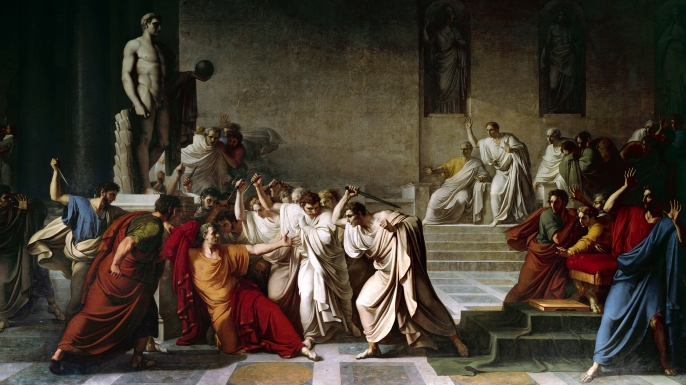
March 15, 2,063 years ago in 44 BCE (there was no 0 BCE and no 0 CE, so when counting from one era to the other, you have to subtract a year) Julius Caesar was murdered in the Roman Senate chambers by Brutus, Cassius and others


Why?

Supposedly, after twice turning down an offer to be named king (anathema in the Roman Republic since its founding, likely some few but not too many years after 509 BCE), he was going to be made the offer a third time, and accept. He had already been named perpetual dictator, going beyond the original Republican idea for a temporary emergency leader.

Shakespearean witch warnings to beware the Ides of March aside, as well as his wife's supposed fear, this is of course reality. And given the reality of Caesar's wife, it appears that both the plot, and the expectation that Caesar would again be offered, and would accept, the title were real as well.

So, what was this title?

Rex it was in Caesar's Latin. Derived cognates include rey in Spanish and roi in French.

Cognates from other Indo-European languages and language groups include raja or similar in Indian languages and shah or similar (picture raja losing the initial syllable, not uncommon if it started with a liquid consonant) in Iranian languages. It's in Irish and rígh in Scots Gaelic. (However, it's brenin or mrenin in Welsh. However, that could be related to the Latin regnum, which is of course related to rex.)

BUT!

The linguistic tail doesn't end there.

German knows no such kingly title. Rather, it's koenig there. Kong or similar in the Scandinavian languages.

But, the word is still there in German. Did Hitler not talk of a Third Reich, following that of the Hollenzollerns and the Holy Roman Empire? Indeed he did, and the word is cognate with our old friend rex.

What if we step further east? It's król in Polish, kralj in Slovenian and similar in other Slavic languages. It's karalius in Lithuanian, paralleling the Slavic. (Note the Finnish composer Sibelius' "Karelia Suite." I'm not sure if the name of the territory derives from the Balto-Slavic root or not.) 

But, that in turn seems connected to a similar word in English, and its cognates in German and Scandinavian languages.

That would be "earl." That, in turn is, yes, related to the name Karl, from the old German karal, which in turn gave the old English ceorl, which was simply the base level of freeman in medieval England. (The German freiherr is the English "baron," but is literalistically "free lord.") That is, in turn, behind the name of Charlemagne / Karl der Grosse / Carolus Magnus.

So, so far, we have cognate words, but a reordering of ranks.

Back to Germany's three empires.

The Romance languages borrowed from Latin imperium or similar for both "empire" and "emperor" while the Germanic languages all did takeoffs on the actual name of our would-be king for the word "emperor." Kaiser. etc.

The Slavic, and Baltic, languages follow the Germanic on on the same two words and differentiation of roots for "empire" and "emperor." Tsar. Etc. (Tsars after, IIRC, Peter the Great actually emphasized the Russian equivalent of imperator more than tsar.

Something that is quite different, at least among Indo-European languages with which I have a modicum of familiarity?

Greek.

There, it's βασιλέας for "king." Modern Greek has αυτοκράτορας for "emperor." But the Byzantines maintained Roman tradition.

Anyway, βασιλέας migrated north. Think of the common Russian name "Vasily." But, as an actual cognate word? Can't think of one in any Indo-European language to the west or north. Nor can I think of any cognates with the Welsh, though it also lists, on Google Translate, words like rhí and riau, obviously cognate with the many others above.

As for one other tragically great actual, not would-be, king of Shakespeare, Caesar was not Thane of Tibur. As for Macbeth's pre-kingly status, though Macbeth was in Scotland, he was, like most kings, a lowland Scot. Middle English, and pre-Norman Viking invasions, had affected Scots language. Thegn, in Old English, was a low-level knight-type person. Think "Sir" in modern British English. Or huskarl in Old Norse, where that Karl from Germanic names and Slavic regency pops back up! (So do witches, but, even within language groupings within the Indo-European family, the etymology on words for those creatures is all over the map.)

As for Caesar's last words? Shakespeare took huge poetic license. Suetonius and Plutarch both have him saying nothing, though Suetonius says that others claimed he said, in Greek, και συ τεκνoν?, which is "you too, child?" in English, to Brutus. (Brutus was just 15 years younger and not Caesar's spawn.)

In any case, he died as neither rex, nor imperator, nor, other than by personal name, as Caesar

Bonus etymology: If you're wondering about the word "ides," go here.

==

Update, March 16, 2023: Caesar was indeed killed for wanting to be proclaimed rex. But, it wasn't just his idea. This piece from JSTOR notes that Antony, among others, thought that he needed to be proclaimed king before battling the Parthians, among other things. I don't follow Antony's reasoning; Pompey had defeated kings in the eastern Mediterranean, already. But, it's a good read for the timing of Caesar's assassination and other motives the plotters had.

Monday, January 21, 2013

Are we seeing the end of a Fourth Great Awakening?

Per discussion with friends on Facebook, over the book "The Rocks Don't Lie," I'd say the answer is yes. (Partial review of the book below.)


The Rocks Don't Lie: A Geologist Investigates Noah's Flood
The Rocks Don't Lie: A Geologist Investigates Noah's Flood by David R. Montgomery

My rating: 4 of 5 stars


A genial refutation of young-earth creationism

Montgomery generally keeps this story about how the earth's geology refutes any version of a literal Noahic flood light on detailed scientific language. And, it is written as a story.

He takes the reader to various geological formations in the world thatr have been key to the development of geology as a science, while narrating how key figures from geology's history have studied and analyzed such formations. At the same time, he narrates the history of Christian theological thought on literal vs non-literal biblical interpretation in general, and specifically on the Noahic flood. He intertwines the two in discussing how different strands of Christian thought reacted to these scientific findings.

Basically, by the end of the 19th century, a literal or semi-literal young-earth creationism (if not 10,000 years or less, certainly no more than 100,000 years) had fallen out of favor with the great majority of theologians in most of the Western world.

With the exception of the United States.

Montgomery puts YEC developments in the historic context of:
1. Anti-evolutionism and the Scopes trial of the 1920s and
2. Anti-communism and the Cold War, etc., of the late 1940s and beyond.

As talk of "culture wars" continues, and as Montgomery stretches YEC roots back to the Second Great Awakening, this is good to remember.

View all my reviews

That said, unlike the First Great Awakening. the Second Great Awakening, or the Third Great Awakening, this "Fourth Great Awakening" has a much more political component.

The First one may have had some connection to the American Revolution; Wiki's entry claims that, but I think it overstates the case. The Second spawned the short-lived Anti-Masonic Party, but was not directly connected to abolitionism. The Third  (I partially accept there was one, but definite more narrowly in time than Wiki) had a bit of a political angle, more in the "Social Gospel" of mainline Protestantism, though, than in the rising Holiness Movement. was a bit more political, but not extremely so.

I also accept the idea of a Fourth Great Awakening, but while I disagree with Wiki that its timeframe for the Third is too long, I think it's too short for the Fourth.

Evidence for one starting includes that the National Council of Churches "peaked" in the late 50s/early 60s, mainline Protestantism had clergy/laity separating more at that time, and fundamentalism and conservative evangelicalism grew rapidly.

That said, previous "Great Awakenings" shot their Roman candle in 35-45 years, really. (Which is part of why I think Wiki is too long on the Third and too short on the Fourth.)  So ... W's two elections aside, is the Third Awakening pretty much dying? And, does that in part explain some of the vitriol? Angry death spasms?

We're at about the right time frame. Each previous Great Awakening died differently.

The First petered out, as much as anything. The fervor of the Second got a nurture in sects such as Mormonism, Adventism, etc. that got new life in the Third, which also faced American industrialization.

The Fourth had a start, if you will, and was almost stillborn, in the Scopes trial. Not all conservative Christians were young-earth creationists, and so, while they may not have been fully reconciled to Darwinian ideas aobut evolution, many probably could have halfway accepted a "tamer" version of evolution if combined with old-earth creationism.

But, the Second Red Scare ( the first being after World War I) changed everything. But not by itself. The Civil Rights Movement added a "second stage" to this rocket. (Although black megachurches have grown recently, the Fourth Great Awakening is much more a white Christian phenomenon.)

Because the Fourth Great Awakening tied with this, not just the Second Red Square, it naturally became more political. Non-Catholic parochial schools, battles over school prayer, tax exemptions and more, as well as political appeals, both open and coded, by both Democrats and Republicans, became part of this.

But, now, has it shot its bolt?

It may have. One sign? Per a new Wall Street Journal poll, almost 70 percent of Americans want to keep Roe v. Wade.

Wednesday, August 09, 2006

Redwoods — trees of living history

The analogy with which I start this poem struck me in the face when I saw a downed redwood in Muir Woods National Monument Sunday.


REDWOOD HISTORY LESSON

Like a phonograph
Awaiting a needle for playback,
The trunks of fallen redwoods
Have music to play.

Of course, the needle is already there,
Attached to the living tree
The playback only has live stereo sound
When played live, or alive.

Please don’t cut the redwoods.
Living history is more than just a figure of speech.

— August 8, 2006

Wednesday, November 02, 2005

Think back 5,000 years

As we live today’s American rat race, in jobs which even if largely fitting our skills and interests, still have stretches of boredom, frustration and tension; in lives which, even if relatively tranquil overall, also still have stretches and boredom, frustration and tension, we often look to how changing major parts of our lives — such as our jobs or even our career paths — might reinvigorate our very selves.

Then think back to, say, about 3000 BCE. Picture being a peasant farmer in the fields at the edge of at Ur or one of the other city-states of the Fertile Crescent. What can you change?

You were not born a royal or a priest — often of the same family — so possibilities of civic leadership are excluded.

Your ancestors have farmed for, say, nearly 1,000 years. Much old hunter-gatherer knowledge of edible wild plants outside of the edges of cultivated areas has long since been lost, as have hunting and stalking skills. To go back to that life would be risky indeed.

Brigandage? The current priest-king is renowned for having established a new level of order in his bounds, and stretching those bounds. The rewards may be great in the short term, but surely will have no long term.

As prosperity swells Ur, the lure of the city has grown for many peasants. But now, in your latter 30s, you fear that you are an old donkey unable to learn new tricks. Besides, a touch of arthritis in your hands restricts how much crafting skill you can develop, anyway.

Nothing remotely close to modern games exist. Ritual re-enactments of actions of the gods enliven some days and nights in Ur, but your small village has nothing of the sort.

Life is not nasty, brutish and short. Rather, it is mind-numbing, steam-rolling and interminable. Even a Zen-like detachment fails to offer relief, with so little to detach from in the first place.