Showing posts with label psychology of religion. Show all posts

Saturday, November 06, 2021

Top blogging of July-September

Data is of early October. Not all posts were written in the past three months.

First was my hard-hitting modern religion piece on the Lutheran Church-Missouri Synod and its multiple ethical failures and looming massive legal problems over the closure of Concordia University-Portland.

Second was my long-ago, but still relevant, libertarian pseudoskepticism pseudoscience piece about Brian Dunning and Michael Shermer.

Third was my not nearly so long ago, but even more still relevant, piece about Saint Anthony of Fauci and his telling of Platonic noble lie(s). (It eventually became plural, then Not.Even.Platonic.Or.Noble, to riff on Wolfgang Pauli.)

Fourth is from about 15 months ago, but getting new eyeballs when I retweeted it about the dreck that is this year's Dallas Symphony Orchestra schedule. I said the DSO had stepped backward in hiring Fabio Luisi as music director.

Fifth? Almost as old as my Dunning-Shermer piece, but also about classical music: Stravinsky vs. Prokofiev and what constitutes neoclassicism.

Sixth, a recent piece, about how Harvey Whitehouse seemed promising on new studies on the origin of religion, until he went way wrong on both that and a definition of what religion is.

Seventh? My burning take on the often laughable, usually conceited Mark Carrier thinking early Christians believed Jesus was a space alien.

Eighth, and also recent, my philosophical take on an ambulance-chasing journalist's experience with PTSD after his own car crash, and a psychologist discussing the issue with bad takes on free will and control.

Ninth and also nearly a decade old, like No. 2 and No. 5? My take on reviews of books by Dan Dennett and Douglas Hofstadter.

Tenth and trending probably due to a tweet by my to blogging friend Tales of Whoa? My poem about the death of friend Leo Lincourt, "Sitting Shtetl for the Living."

Thursday, August 20, 2020

The NYT and sheltered big media coverage of religion

On my primary blog, I recently discussed a New York Times story about President Donald Trump's continued support among the religious right, especially in rural heartland areas.

Here, I'm going to shift that focus more to the New York Times' coverage of religious issues, to the degree they're exemplified by this.

"Christianity will have power"? Yes, it's a nice phrase, but ... was one line in one speech in Iowa enough to elevate the speech into Donald Trump's version of a Cornerstone Speech vis-a-vis his relationship to the Religious Right? And, if so, why?

The New York Times would have you think so. But, I don't see it making the case, and its "marketing" efforts don't sell me any more than the story itself.

First, two of those marketing Tweets and my responses:
Uhh, no. I don't "need" anyone.
There you are, Mr. NYT National Editor Marc Lacey.

Then this:
Sorry, but no translator needed, Ms. Deputy National Editor Yang.

Here you are:
Just what did Dias leave off the table?

First, why Trump instead of Ted Cruz? That speech was in January 2016, before the Iowa caucus vote. On paper, Dominionist Ted Cruz and his Seven Mountains daddy were the ideal candidates for the Religious Right to back. So, why didn't they? (Pew notes that, in polling, the most devout among the evangelicals DID tilt Cruz, even though, overall, the Religious Right tilted Trump. Obvious deduction? Lots of these people may be sincere in their belief claims but don't go to church that often!)

If you're going to have someone with a graduate religious degree from Princeton work on this story for, I presume, several weeks, and you can't answer that? The story comes off as election-year pandering, in my book. True, you would still want the focus on Trump, but if you can't explain why him, not Cruz, then you can't fully explain "why still him" today, can you?

That said, assuming some of the lower-star ratings of a book that Dias edited are true, maybe that Princeton degree is not worth that much. A decade ago, I came across a friend of a good online friend who was in the graduate program at Harvard Divinity and who insisted that Plato's Euthyphro dilemma didn't apply to Christianity, so this isn't a "sour grapes" issue, it's a real observation. And, no, religious right idiots, claiming that good is good based on god's nature does NOT avoid the dilemma.

Second is Dias claiming that this is all new:
The Trump era has revealed the complete fusion of evangelical Christianity and conservative politics, even as white evangelical Christianity continues to decline as a share of the national population.
In reality, with data research sites like Pew having written about this for three or four years straight now, the "Rise of the Nones" (which is a broader issue than just the decline of conservative evangelical Xianity, and blogged about me three years ago, as well as last year) is yesterday's news. Indeed, the piece of mine three years ago noted that, by this year, per Pew estimates, "nones" would equal Catholics in the American population.

The problem is not just that the NYT is behind the curve on Nones. It's that a lot of people who might fall into "Nones" territory may not know this if they get much of their religious news from the Times, or from outfits following its lead. This ties to how politicians think their constituents are, overall, even more conservative than is true.  

As for the "complete fusion" issue? Forty years ago, the Religious Right backed for president a man who had expanded abortion access while governor of California, who never went to church and who consulted astrologers. (Ronnie turned Nancy on to that, not the other way around.)

Whether Dias personally believes this or not, I don't know. But, this is a common trope from the MSM, and from much of national Democratic leadership, and not just about religion. Trump is indeed an outlier on the vulgarity of expression of his stances. He may be a minor to moderate outlier on the degree of severity of some of his stances. But, no, nearly complete fusion within today's Republican Party on a lot of issues was around long before Trump.

Now, onto my original Twitter thread, with this blogpost being added to the end of it after being finished.

First:
See, that "bully" part is important. Per "The Rise of the Nones" issues, the Religious Right has been losing power for some time. Rather than sidle up to Hillary Clinton and her conservative DC prayer circle warrior background with The Fellowship, though, because she was pro-choice, and ignoring that Trump long had been so, they backed Trump.

This, too, was not really covered.  Nor were related issues. Looking from January 2016 to the fall general election, Dias appeared to ask none of the interviewees if they knew what Clinton's beliefs were, or even cared, which would itself be an issue. (That said, Clinton's lack of focus on Iowa allowed these folks to not even ask themselves what her beliefs and values might be.)

She does note that just 11 percent of people in Sioux Center caucused for him. But, she doesn't discuss why Trump instead of Clinton — or the option of not voting — was the choice in Novemer.

The bullying? Bullying and shaming people into expression of religious belief in small town America, even in blue states (Galloway vs Town of Greece) was and still is a real thing. Remember, most members of the Religious Right hate atheists even more than gays, and may hate non-Christians, especially Mooslims, almost as much.

The desire for bullying is far from new.

All one has to do is go back 1,800 years and read Tertullian's description of Christians in heaven rejoicing over the torments of the damned in hell. Maybe Princeton graduate divinity school grad Dias didn't want to look too much under that hood.

Anyway, again, when a lot of the most urban parts of blue America, or beyond, like Green or Socialist-red America, get a lot of religious news from sources like this, they get a skewed image.

They also get other skewed images. Even I did.

Did you know that Sioux Center isn't THAT small? More than 7,000 people and growing quite nicely since 2000, per City-Data. Did you know that, including the college students who claim residency there, it's still better-off than the Iowa average? Did you know it's less than an hour from Sioux City, Iowa, population 80,000 and metro area 180,000, and a flat hour from Sioux Falls, South Dakota, population 185,000 and metro 265K?

In other words, Sioux Center isn't the Idaho Panhandle or something.

Thursday, July 02, 2020

No, chimps aren't religious

I've seen shorter versions of this claim made before by James Harrod, but with a longer paper on Academia, wanted to take a few minutes to refute it.

First, my rough-and-ready definition of religion is:

"A communal focus on engagement with believed metaphysical personages or entities involving communal rituals and actions to align the community with believed personages or entities."

I've rephrased that elsewhere as

Religion is about:

Metaphysical matters of ultimate concern, within a social group setting; and 

How one orients oneself within that group to a better relationship to these metaphysical matters of ultimate concern.

First, note that "metaphysical" shows we're clearly into philosophy. It means something that "transcendence" does not.

First of all, this definition is written to include something like Theravada Buddhism, by noting "entities," not just "personages." Theravada believes in an incarnation of a metaphysical life force, even if it doesn't believe in a personal soul, let alone a personal deity. And it believes that laws of karma govern that reincarnation. I have discussed in detail before the fact that Buddhism is a religion, and had a follow-up. I have also noted karma is as offensive as original sin, and maybe worse in Theravada with its rejection of an individual soul. I've also noted how reincarnation and karma has other problems, mainly based in a "progress" mindset that's as wrong there as in misframings of evolutionary theory. OK, so with all that about Buddhism, we move on.

Second, religion is communal, and part of that alignment includes addressing things like "sin." In many religions, the focus is first on sins against a god or gods, but still includes communal sins as well. And, even sins against a god are only visible within the light of a community.

Third, the "rituals and actions" notes that all religions have elements of orthopraxis. They all also have elements of orthodoxy. I've covered this recently.

Now, let's dig in.

Do chimpanzees have compassion? Yes. And even, perhaps, something like compassion for the memory of dead fellow chimps? Yes, I think. So do elephants, cetaceans and a few other non-human animals.

Do chimps have metaphysics? Highly, highly unlikely. In other words, chimps, IMO, don't believe in chimp souls, chimp karma, or a chimp god. Nor do gorillas, neither in the 1970s nor this past decade:


Sorry, James.

And, unlike Caesar/Andy Serkis, chimpanzees, and other primates don't have the speech to organize a community to focus on abstract ideas. And, contra Harrod, who is letting other scholars and thinkers be his mouthpiece, it's tempting to overread what communication chimps have. Well, tempting to him and them, but not to me.

Cetaceans might. But, if they do, they don't have hands with opposable thumbs and can't really engage in metaphysically related actions.

A rich emotion life and symbolic play also prove nothing about chimpanzees possibly conceiving metaphysical concepts. Nor does it at all address the difficulty of communicating such concepts without language. The fact that chimps have neural substrate systems similar to something like Broca's in humans only proves that evolutionary biology is real and is a conservative workman.

And, a first-order theory of mind? Given the complexity of judging human actions that might be called sins against a community, that's not enough. But, let’s get to Harrod’s nutgrafs — his transspecific definition of religion. Here goes:
• Reverence (showing devotion, intense love, deep respect), which may involve a hush;
• Careful observance, which may involve a calling-out announcement or remark;
• Experiencing or expressing emotion of dread (awe in its terror or astonishment aspect) before that which overwhelms the subject by its magnitude, grandeur, beneficence, or lethality; mysterium tremendum
• Experiencing or expressing emotion of wonder (awe in its fascination, curiosity, or desire-to-know-more aspect) with respect to a phenomenon (especially a movement) which is surprising, non-ordinary, extraordinary, special, or ‘miraculous’; mysterium fascinans
• Binding individuals together or back together in empathic intimacy or communion with respect to experiences of aliveness and animacy, including other living beings or things that appear to be alive, which may secondarily involve the witnessing of this by a collective social group.

OK, first observation? He's clearly smoking some Rudolf Otto high-grade drugs. And the "mysterium tremendum" as a key to "religious experience" is by no means widely accepted. As the likes of Susan Blackmore note, psychadelic drugs or deep meditative experiences can induce this "mysterium" in the non-religious. Ditto for near-death experiences.

Harrod goes on to make clear that he is indeed adapting an Ottonian framework to animals.

He ignores entirely ideas of sin, guilt, and metaphysical entities.

As for his five actual points?
• I can love either a girlfriend or a bottle of whisky. I don't worship either one, even if I shout "oh my god" during sex.
• Careful observance? Chimps, like us, evolved to stay safe from snakes and predators, as well as to identify a variety of ripe foods. Careful observance is part of not being dead. It's also, in we humans, what's behind overuse of agency imputation and pattern detection in non-savannah civilized live.
• Mysterium tremendum? Since chimps don't have abstract language, no way I see for them to communicate that, let alone for us to see that they're trying to do so.
• Wonder? Many scientists still have great degrees of wonder for the facts of evolutionary biology, cosmology and many things in between, and they're not religious. Indeed, Aeon has a new piece about the role of awe in scientific work.
• Empathy for life? I have that, too, and again, I'm not religious.

What Harrod is missing is that, in reality, at some point in human CULTURAL evolution, some point AFTER the evolution of some degree of language in all likelihood, these five points were adapted for what developed into religion. Some of the adaptation, per my notes on point 2 above, may well have been non-conscious.

Should chimpanzees have an evolutionary twig that offshoots into a new species, that follows a similar bath, Harrod can contact me back in a couple of million years.

And with that, I've wasted enough time on him.

Thursday, May 21, 2020

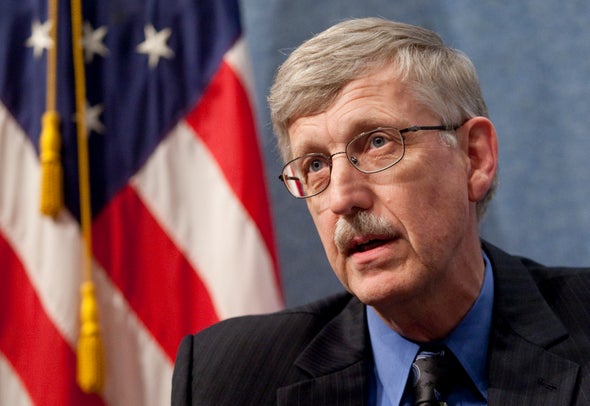
Francis Collins, the Templeton Prize,
and the Problem of Evil

Online and authorial friend John Horgan dusts off an old interview with Francis Collins of the National Institutes of Health on news that he's won this year's Templeton Prize.

Horgan notes that, at the end, where he asked Collins about the future of humanity, he showed lots of faith in god but little in homo sapiens. The questions were really about another issue — the role of suffering in religious belief.

The reality, per Logic 101 is that "suffering," however the word is defined, is not logically necessary for religion or a deity. (Remember: Folks like Theravada Buddhists have a religious belief system without a personal divinity.) Philosophy of Religion 101 will then add that suffering, or a belief in it, is not psychologically necessary, either.

The first is the old Problem of Evil. For believers in a god both omnipotent and omnibenevolent, it's an even bigger stumbling block than the Euthyphro Dilemma. The second often results from attempts by believers in a dual-omni god to avoid the Problem of Evil by citing their god's inscrutability. In the Judeo-Christian tradition, this usually involves an appeal to Job, with Christians doubling down by citing Paul referencing Job.

Doesn't work.

This is, as I have called it, the Psychological Problem of Evil.

Either said god is less than all-powerful if he can't make himself scrutable, or he's less than all-good if, other than "stop questioning me," he can't make his followers accept his inscrutability is for their good.

That said, what if there was some new way to get these people to accept his inscrutability? Still doesn't address the omnipotence and psychological evil issue.

There's also a bit of a petard lurking here.

IF ... we did accept that some suffering is necessary for human development as part of religion, how much is necessary and how much is too much? Usually this ends up again being hoist on the inscrutability of god in the Western "dueling-omnis" idea of god.

Otherwise, Collins himself, who famously once said, and included it in a book, that he had the idea of the Trinity be made understandable by a three-part waterfall, doesn't strike me as the deepest of thinkers on matters religious. It's almost as silly as the apple explanation that I heard as a kid — the peel, the pulp and core are all separate, but all connected, and all have "appleness," but there's still just one apple.

Nor does his taking a page from Augustine, on the idea that an omni-god is outside humanity's four-dimensional space-time, makes such a god inscrutable by logical necessity. Per Flatland, such a god could intervene into our four dimensions in a perfectly scrutable way.

I mean, if Collins did a riff on Whitehead's process theology into something even more creative, or invented his own religion, even more, I'd have more respect for him. But this is just plain bleah evangelical Christianity.

As far as what Collins misses in terms of psychology of religion? It was staring himself in his hiking face. The "trinitarian" waterfall is a dictionary exhibit of confirmation bias.

Monday, December 04, 2017

Ross Douthat and Tyler Cowen have mutual intellectual lightweight religious talk

Reading Ross Douthat and Tyler Cowen have a back and forth on religious belief that is laughable.

Among Cowen’s biggest hoots is deploring the lack of Bayesianism in most religious belief. I suppose he thinks Richard Carrier’s Bayesian book-cooking in the name of Jesus mythicism is spot on? Cowen also confirms that his libertarian bona fides are deep and thoroughgoing when he claims to be a Straussian on religious issues. Anyone who invokes Leo Strauss for THAT bears careful watching. (Note to Massimo Pigliucci: Remember, Cowen strongly blurbed Harry Frankfurt’s new book, which was the first reason I became highly skeptical of it.

Douthat responds by ignoring that both Blaise Pascal and C.S. Lewis stacked the deck with their wagers on, respectively, the existence of god and the divinity of Jesus.

Cowen then replies that he takes William James seriously. Wow. “Varieties” only shows how deep-seated are the human mental evolutions that have been “hijacked” by the development of religion. Nothing more.

Rusty then extends that to a “mystical ineffability means its true!” stance.

Surprisingly, near the end, Douthat lays out his own Bayesian take, and only 45 percent of his total of 100 percent is for classical theism.

That’s called “Cafeteria Catholic,” Rusty, next time you lay that label on the likes of John Kerry or any pro-choice Catholic.


-->
Douthat finishes by invoking Nicholas Taleb’s black swans and saying that, among religions, Christianity is the blackest of all. This is nothing more than a fancy new presentation of Tertullian’s “Credo quia absurdum.”

Saturday, August 16, 2014

#Buddhism is still a religion, folks

I've written a little bit about this before here. Specifically, I've talked about its metaphysical aspects and their religious overtones, in a way that shows what I think is a comfortable Western non-Buddhist's familiarity with it. I've discussed briefly the paradox involved at the core of making claims about ineffability. Related to that, I've written about how some of the Buddha's own observations lead to logical snares.

But, with a new post by Massimo Pigliucci bringing out all the first-generation converts who claim "Buddhism is just a philosophy" or even "Buddhism is just a psychology," I thought I'd jump into this in a bit more depth here. (Many of the same types of apparent first-generation converts to "secular Buddhism" as made statements on those blog posts above.)

First, for those trying to claim otherwise, or hold up Stephen Batchelor or the likes of him as having a direct illuminative pipeline back to 2,500 years ago? Wrong!

The idea of "Buddhism is just a philosophy" (along with similar claims about Hinduism) was cooked up by Victorian-era Europeans and Americans, in some degree of cahoots with "Westernizing" Indians.

The reality is that Buddhism deals with two matters of "ultimate concern," even "ultimate metaphysical concern," namely karma and reincarnation.

Second, a sociology of religion observation, and a snarky one, too.

I think that most of the "just a philosophy" claimants come from one of two previous backgrounds. They're either old Reform Jews who like being able to paste meditation and Zen-type inscrutable phrases that sound like updated, Easternized versions of comments by medieval rabbis, all from folks in saffron robes with a hipster angle, on top of their denatured Reform Judaism, or else they're liberal Unitarian Christians or post-Unitarian New Agers who wish they had been born as Reform Jews, etc.

And, yes, that's a snarky comment. But, isn't snark itself an updated word for the psychology in which Zen masters often presented their observations?

Yes.

And therefore, it's the best style of answer available to give to the "just a philosophy" folks. 

Third, in line with Massimo and contra his Buddhist friend who inspired his post, even if you trot out modal logic, multivalent logic or similar post-Aristotelean thought, Buddhism, if you try to sell it as a philosophy, is more illogical than anything that's come out of the West.

If you don't like that? Mu!

Yes, I know what the word means. I've used it here to "unask the question" or "unask the issue" of "free will versus determinism" to many people, including Massimo. That comes from my primary blog, where I've written with a bit more depth.

Today, though, I use it in Zen-snark mode to "unanswer the protests" by first-generation Buddhist converts. And, per one commenter on Massimo's post, and my observations above, that's exactly who you are. Aaron Shure observes:
The joke from the late ’60’s about the old Jewish lady who travels to the Buddhist monastery asking to speak the the Lama: after a long journey on donkey, finally talking her way into the inner sanctuary, she approaches the Lama, smacks him with her purse, and says, “Sheldon, come home.” Graham needs to Kimmen heim.

I don’t think it’s an accident that there are so many first generation Buddhists in America claiming it’s a philosophy and not a religion. Only if your parents aren’t Buddhists can you claim that Buddhism will do, unlike other religions, all that it promises. The first gen acolytes do all sorts of backbends to get around the obvious malarky of the dogma. Whether it’s the three card monty move of saying “there are many Buddhisms” so that any BS version of the doctrine you point out can be quickly pushed onto the wrong sect, or whether it’s the annoying “ineffable” dodge, or whether it’s the putting off until other lives the need for any sort of freaking evidence. 

Owan Flannagan did his best to come up with a naturalized Buddhism, and I find it unsatisfactory. Nagarjuna is no more a logician than Democritus and Leucippus were Physicists, which, with Massimo’s blessing, they were not. Still I’m going to read the book for the history of logic.
I agree with the joke. I also agree that Flanagan (correct) does a better job than Batchelor, at least in some ways, in trying to intellectually craft the idea of secular Buddhism, Buddhism is just a philosophy, etc. At least Flanagan, in the subtitle of his latest book, by saying "Buddhism Naturalized," seems to admit this is a conscious effort on his part. However, whether that's due to combatting what he sees as misinterpretations, or whether he's rewriting what he sees as the normal, historically-rooted understanding of Buddhism, I don't know.

And, also, I found this quote from him:
What they make of the hocus pocus about karma and rebirth is another matter.
In light of that quote, how many Buddhist arhats, etc., would accept him as a legitimate expostulator of Buddhism? I know it's primarily directed at Americans (many of them commenting on Massimo's blog?) who largely equate meditation with Buddhism, and putting thoughts into their heads, but what does he think of Buddhism's core doctrines — yes, doctrines — himself?

Anyway, folks, per Aaron and myself, I can make the same claim about Judaism. If I make the right readings of scriptures I choose versus ones I neglect and other things, hell, I can make the same claim about Christianity.

Which, after all, is what many Unitarians essentially do.

And, "back in the day"? First-generation Christian apologist Justin Martyr tried to sell Roman emperor Antoninus Pius and members of the Senate on the idea that Christianity was just a philosophy, after all!

So, to the degree anyone claims Buddhism is "just a philosophy," it's true, but not unique, and it is essentially trivial.

Back to the philosophy angle. If, as did someone on Massimo's blog, you make claims that because David Hume came up with observations about human psychology that parallel those of the Buddha, this is "proof" that either  Buddhism is just a philosophy, or worse, that metaphysical doctrines and all, Buddhism is still just a philosophy, you just kneecapped yourself in my court.

And, if prose for philosophical statements doesn't totally float your boat, well, this short poem of mine, and this other one, point out some of Buddhism's conundrums in verse.

Tuesday, May 31, 2011

How and why I became an atheist, Part 5

In part 1 of this series, I look at my conservative Lutheran childhood, above all my conservative Lutheran minister father's influences.

Part 2 gets into my high school and college years.

And Part 3 gets to my trying to follow in dad's footsteps at a Lutheran seminary, or divinity school.

In Part 4, I look at my "conversion" or transition period of my last year of school there, my first year of mixed part-time work after graduation, my moving to somewhere between Uniterianism and agnosticism, and an invitation from my dad to move back in with him.

So, it's up to Flint, Michigan.

Dad suggested that I might be able to get an adjunct teaching position at Baker College, which had an entire division called "Corporate Services," largely devoted to helping UAW workers using education benefits to get their degrees before the next automaker layoff.

He also said that that wouldn't pay a lot of money and might not offer a lot of hours. He said one of his members was the manager of a 7-Eleven and I could probably pick up a few hours there.

Well, between feeling depressed at "failing dad," feeling depressed at "having" to move back home, feeling depressed at having "fallen" to the level of 7-Eleven work, etc., I was depressed indeed. Add in the fact of feeling hypocritical by going to dad's church every Sunday and going through the motions, and that's serious depression.

So, I tried to kill myself. And nearly succeeded. I took half a bottle of over-the-counter sleeping pills while getting drunk, maybe more. And, was going to put a bag over my head to try to suffocate myself while sleeping, in the process.

Well, I didn't get the bag on tight enough. And the self-preservation powers of human physiology kicked in a few hours later, and I violently threw up the undigested portion of the sleeping pills.

As it was, I had double vision or worse 24 hours later, with very rubbery legs.

But, I'm here today.

Next?

I taught for a year, before the college said that, due to North Central Association accreditation changes, I could only teach religion classes, of which they had none open at the time. They also said that someone had filed a sexual harassment claim (unfounded) against me. And, three months after that, a 20-year-old, or so, held me up at the 7-Eleven with a 9mm automatic.

Dad was ready to get out of Michigan, so I moved with him to small-town Texas, fortunately not too far from Dallas. Meanwhile, I was becoming an ever-more-serious drinker, out of life-frustration, boredom, and PTSD (and trigger of past PTSD symptoms) over having a 9mm waved a foot in front of my nose.

All of the emotional reasons for questioning not just the existence of god, but the support value (other than purely human group support) of any metaphysically-based organization, were increasing ever more.

On the intellectual side, I had done further critical study of biblical texts plus more and more reading in comparative religion.

And, on the personal development side, probably more unconsciously than consciously, some growth was happening there.

I don't want to stereotype agnosticism, but, for many, I think it's more a halfway house than a permanent stop; a seminary acquaintance actually pushed me back then to "declare myself" as an atheist and stop hiding out in agnosticism world. For those for whom "positive agnosticism" is a valid stance, though, my hat is indeed off to you. That said, I was also reading my first books on philosophical atheism before leaving Michigan. I knew I was at least at the farther edge of agnosticism.

And, as this part and part 4 of my journey have shown, atheists (usually the P.Z. Myers type of "Gnu Atheists" who talk about religion as a psychological crutch don't get the time of day from me. I understand the desire for its comforts, still today.

Two years of living with my dad in Texas got me a start in newspaper journalism, with a boss who was (himself) an alcoholic drinker, I believe. But, I got out of there, got a job as editor of a weekly newspaper and ...

I'll tackle more in Part 6.

Tuesday, May 17, 2011

Billy Graham is master of the obvious — and the clueless

Actually, he's more the master of his interpretation of the obvious, when he says people are atheists because "they want to run their own lives." Actually, the fact of the matter is an acknowledgment of running our own lives.

Other than that, he repeats all the fundamentalist-type accusations about atheism — it allegedly can't explain why we exist/where we came from (try the Big Bang, and evolutionary biology, with details of abiogenesis between the two still being worked out); it allegedly leads to despair (a Religious Right wet dream of hell on earth for atheists); it imputes everything to chance (not true, evolutionary events lead to contingencies further down the line of development and chance vs. design is a false dichotomy); atheism allegedly can't tell right from wrong (nonsense, we see a common core of morals, with some moral relativity or situational moralism at the edges — just as fundies engage in relativistic or situational moral beliefs at times), etc., etc.

Of course, Billy Graham has never, I'm sure, had an honest, open dialogue with a real, live atheist.

Friday, September 17, 2010

Blackmore shows ignorance of both memes and religion

Susan Blackmore admits that religion isn’t a “virus of the mind.”
Are religions viruses of the mind? I would have replied with an unequivocal "yes" until a few days ago when some shocking data suggested I am wrong.

Why?
From a conference on “Explaining religion,” she cites the following reasons.

1. Religious activity correlates with more children.

And, no others.

Yep, that’s it.

First, despite her noting her previous mea culpa over believing in the reality of paranormal phenomena, it shows Blackmore might still lack intellectual rigor in some areas.

This is a prime example. She didn’t even look for additional information, like average lifespan of children from religious vs. nonreligious families.

Nor did she take a look at a single datum of cultural evolution that might be connected.

Nor did she acknowledge this might be an issue of cultural evolution trumping genetic evolution.

Shoddy, shoddy.

Beyond that, she didn’t even ask the most pertinent question:

Shouldn’t this put another nail in the coffin of “strong” theories of memes, at least?

Answer? Yes.

Meanwhile, I can't wait for the Christian version of a Pop Ev Psycher to actually cite this column.

Tuesday, April 06, 2010

Religion may just be irrational

AND linked with a continuum of other irrational beliefs, per a new study in Finland.

It sounds like a very interesting article. Now (and not to oversell MRIs) it would be interesting to take this to the next level. Are their brains functioning differently in some specific ways?

And, if at least "opennmindedness" to religious belief does pair with the other beliefs, who will tell New Atheist "guru" (not in MY book he ain't) Sam Harris, already on the record as accepting the possibility of psi phenomena?

Wednesday, September 30, 2009

Saturday, June 20, 2009

Neither Islam NOR Xianity NOR Judaism is ‘religion of peace’

Andrew Sullivan, whose internal and geo-politics must be called neo-Sulllivan, got that one wrong in his Iran live-blogging round-up.

Point is, Islam, Christianity and Judaism, all three are neither “religions of war” or “religions of peace.”

Beyond finding admonitions to both war and peace in the Quran, we can do the same in the other two world religions.

The Tanakh has Isaiah talking about “bending swords into plowshares,” but another prophet later talks about “bending plowshares into swords.” Per a quote by Jesus, the temple is allegedly a “house for all nations,” but, earlier, King Saul is told to till all the Amalekites — men, women, children and even livestock.

In the Christian New Testament, Jesus, in one Gospel, tells Peter to put his sword away at the Garden of Gethsemane, after he cut off the ear of a servant of the high priest. But, earlier in that same account, he asked his disciples how many swords they had.

Elsewhere, he tells his listeners, “I came not to bring peace but division.”

And, as Islam had its jihad, Christianity had its crusades and ancient Israel had its Ha’Aretz Yisrael.

Bottom line?

They simply are religions, the youngest of them 1,500 years old, all coming from tribalist roots whose values systems almost make Pop Evolutionary Psychology sound true.

And they, and their Kool-Aid drinkers, label them as “religions of peace” as needed for external public relations, while not-insignificant minorities in all three push the “religions of war” side externally against the other two, or internally about their own “crusades” for “religious corporate communications,” also as needed.

Thursday, January 22, 2009

Human brain not built for theistic evolution

Boy, this Live Science post just jumped out at me.

Using an fMRI to measure brain responses, and using either “gOd” or “science” as a priming word for subjects who first read information about the Big Bang, at the cosmology level, or “primal soup” at the Earth level, psychologist Jesse Preston of the University of Illinois at Urbana-Champaign and her colleague Nicholas Epley of the University of Chicago found statistical signs that people who know the basics of both cannot hold on to both the naturalistic focus of science and the transcendent metaphysic of theism at the same time:
“We can only believe in one explanation at a time,” Preston told LiveScience. “So although people can report explicitly, ‘Look, I’ve been a Christian all my life, and yes, I also believe in science and I am a practicing chemist,’ the question is, are these people really reconciling belief in God and science, or are they just believing in one thing at a time?”

But, the researcher’s thesis is being questioned.

In shades of Steven Jay Gould, Hampshire College science historian Salman Hameed says the conclusions depend on the “conflict” view of science and religion, vs. Gould’s non-oppositional magisteria or similar.

But, what Hameed overlooks is that among PhD scientists, especially top-tier post-doc PhDs, Gould’s two-domains theory is ignored even more than it is dismissed. Ditto among modern philosophers of science and non-science philosophers who aren’t explicit theists.

Saturday, October 11, 2008

Some conservatives really ARE really, really crazy

The latest proof the “secular apocalypse” is here? Parents believing the Fisher-Price Little Mommy Cuddle ‘n Coo doll says “Islam is the light.”

Other people claim it says “Satan is King.”

I think I’ll go to my nearest Target and see if one says: “Sarah Palin is smart.”

Then, I’ll KNOW it’s a plot.

This is just the aural equivalent of pareidolia.

Next: Face of Sarah Palin seen in a tortilla.

Saturday, October 27, 2007

Some further thoughts on defining religion

Based on my own readings in existentialism, and psychology of religion, I offer the following psychological definition of religion:

“Religion is an attempt to escape from the condition of being human in life. It is based on two facts. One is that there is something psychologically wrong with being human. The other point is philosophical — a belief that humans can be something besides being human.”

The only condition in which the second is true is with a .45 slug to the brain. Camus knew that when he said suicide was the ultimate question of philosophy. (He probably would have called existentialism, at least with the way he answered that question, as a psychology, not a philosophy.)

Psycho-philosophical escapism does sound a good way to define a religion, especially when he connect it with the sociology of religion observation that religions consist of certain defined rites, rituals, etc., such as prayer, worship, liturgy, etc. And, the psych-philosophical definition, of escapism, gets at the heart of what motivates religious people without even talking about whether a personal deity or not.

In other words, to riff on Paul Tillich, for the religious, escape from the human condition is the matter of ultimate concern.