Showing posts with label Religious Right. Show all posts

Thursday, September 21, 2023

Slate repeats old canards about church attendance

 It's a piece that is otherwise generally good, but nothing really new — it's about the closure of ever more "mainline" houses of religious worship in the face of the rise of the Nones, etc.

But, it then goes to a Gallup Poll that claims as late as just before COVID, just over one-third of Americans went to religious service weekly and it was still 40 percent in the early years of this century.

Tosh, as I told the story's author on Twitter. Time and motion studies have shown that self-reporting of church attendance (and perhaps the same for synagogues, mosques, temples, etc.) is somewhat to highly inflated. And, it's sad that these statistics still get trotted out, especially in the context of this story, and what individual congregations, parishes, minyim etc. face — whether or not to try to renovate a religious building, whether or not to move, whether or not to shut down. 

The actual number? Yes, 2020 was the first year of COVID, but it was down to 20 percent then. Even "every week" PLUS "almost every week" was just 30 percent, according to Statistia, and THAT may be high. It was down at about 25 percent at the turn of the century, and some evangelical orgs admit that, and THAT link is from 2007. But, this from 2018 concurs.

Having accurate information might help inform such decisions. (Or it might not; motivated reasoning is still real.)

The Gallup piece then gets worse with a section, a little over halfway down, about worship converting from in-person to virtual. That, too can be fudged. (Unless the congregation takes a roll call via Zoom!)

Nowhere near the first time Gallup's had idiotic polling about religiosity.

The header's central word, "canards," is not too harsh. Henry Graber had done more than a modicum of other research for the story, but then just accepted Gallup's words as gospel truth, literal pun intended.

Beyond the issue of whether individual groups of worshipers should shut down or not, such misreporting overstates the influence of churches on American life and culture, and allows religious right churches to run with that.

Thursday, August 24, 2023

Christianity is "weak," says Religious Right 2.0; Russell Moore may be hypocritical on call-out

That's per this Tumblr-length brief from The New Republic. (Sadly, it spoils itself by linking to a longer piece by Nat-Sec Nutsack Brynn Tannehill, who pivots into going off on the Russian Orthodox Church in typical #BlueAnon fashion, namely in being full of shit about a draft vs an all-volunteer army — an issue that #BlueAnon types are good at being full of shit about.)

Anyway, said editor is Russell Moore, well known for, overall, rightly bitching about his own (former it seems?) Southern Baptist Convention covering up its sex abuse scandals.

He notes, also in this Mediate piece, that the fundagelicals in general, to go beyond Moore's conservative evangelicals (which TNR gets wrong, as there ARE still, per the likes of Sojourners mag, librul evangelicals), to the Religious Right in general, on hearing about things like "turn the other cheek," will ask preachers "where did that come from"? Mediate references a longer interview that Moore had with NPR, in reference to a new book. Here's the full quote, re the "weak":

Well, it was the result of having multiple pastors tell me essentially the same story about quoting the Sermon on the Mount parenthetically in their preaching - turn the other cheek - to have someone come up after and to say, where did you get those liberal talking points? And what was alarming to me is that in most of these scenarios, when the pastor would say, I'm literally quoting Jesus Christ, the response would not be, I apologize. The response would be, yes, but that doesn't work anymore. That's weak. And when we get to the point where the teachings of Jesus himself are seen as subversive to us, then we're in a crisis.

How much of this is the Religious Right doing its own Overton Window? Surely a fair amount. But, how much of it is due to megachurches preaching prosperity gospel and other things, and not the actual bible? I mean, he's now running a nondenominational church as well as editing CT.

OTOH, on the issue of the Religious Right, for f?

First, this issue is more than a century old. Look at Teddy Roosevelt's "muscular Christianity." I don't know if McClure's or some other mag back then asked TR what he thought about "turn the other cheek"; the answer might have been interesting. No, no might; I'm sure. Let's not forget that TR himself did some tap-dancing on racial issues before showing his true colors over Brownsville 1906.

Second, Russell Moore? Russell Moore is over the age of 50, and grew up in Biloxi, Mississippi. Not real far from Neshoba County, Mississippi, home of Ronald Reagan's "affable" racism dogwhistles at the 1980 Neshoba County Fair. Neshoba County, where the bodies of Chaney, Goodman and Schwerner were found on Aug. 4, 1964. Russell Moore has known, or should have known, his former denomination's history long before 2013 or whenever.

Related to that? At Religion News, Tyler Huckabee notes that while Moore was calling out his former denomination a decade ago, he was always careful not to push too hard early on. OTOH, Tyler Huckabee says that to show his own ass while calling out librul Christians for allegedly doing the same by trying to normalize Moore.

Friday, April 12, 2019

Who's a Jew vis-a-vis Zionist claims?
History, culture-ethnos vs religion definitions
and many other demarcation problems

I had originally posted this on my main blog, vis-a-vis the Rep. Ilhan Omar contretemps, but it has serious issues tied to ancient history, history of religions, sociology and more that I am posting an edited version of the piece here.

First, what do you mean by "Jew"?

Do you mean a practitioner of the religion of Judaism? Then Whoopi Goldberg is one.

Do you mean an ethnic descendant from the one-time majority Semitic population of a small Eastern Mediterranean nation-state of antiquity?

Then Whoopi Goldberg is not.

This all may seem separate from the issue of anti-Zionism not being anti-Semitism. But it's really semi-separate and no more than that, and I'll hit on that at the bottom.

As friend Massimo Pigliucci would say: We have demarcation issues. One is separating a pracititioner of Judaism the religion from an ethnic Jew. Then, since "race" is not a scientific category in terms of a single standard of genetic demarcation of one group from another, "ethnicity" is definitely not. And, even to the degree we putatively, for argument's sake, try to talk about a particular ethnic group, we have other issues.

In that case, how Jewish are Jews? And, I'm going back far further than the Khazar hypothesis most notably promoted by Arthur Koestler and Raphael Patai, among others, which in any case only covered Ashkenazis.

I'm going back into the Torah to start. Even if half the nations listed in the Torah as living in Palestine promised to Abraham and Moses are fictitious, the other half aren't. Given the actualities of how Israel arose vs myth of the Torah and the Former Prophets in the Nivi'im, there is no pure Jewish bloodline. Because, of course, there was no "invasion" of some Semitic people who had been slaves in Egypt. Rather, Israel arose as an indigenous social-cultural development within Canaanite peoples. Probably a century or so after that, maybe two centuries, reading between the lines, there was an incursion of people from the land of Midian bringing the worship of their tribal god, Yahweh, with them.

Based on the trilateral consonantal root system of most Semitic languages, the name "Yahweh" derives MUCH more likely from the Old Midianite verb "to storm, blow or thunder," rather than the Hebrew verb "to be." In other words, Yahweh was an Old Midianite Zeus, ruling from a dormant but not dead volcano, Sinai; the Numbers version of the Exodus route puts Sinai in Midian (today's northwest Saudi Arabia) and NOT the Sinai Peninsula.

So, Israelites by alleged ethnicity or Israelites or Judahites by religion (religious scholarship doesn't use the word "Judaism" until the return from the Babylonian Exile and even then, many may speak of "proto-Judaism") weren't all "Israelite," in all likelihood. They intermarried with the Hittites, Girgashites, Amorites and others that Yahweh allegedly told them to drive out of the country, more clearly explicated as "wipe out" later, in Joshua 9. (And, yes, that would be another call for a holocaust, just like the one against the Amalekites, though that one was more explicit, in 1 Samuel 15. (Zionists claiming both an ethical high ground and a need to have a Zionist-based nation of Israel after the Holocaust thus — if they are religious Jews — are undercut by their own history. If they're non-religious, whether Israeli citizens or not, the idea that is is driven by the Holocaust is undercut by Chaim Weizmann talking about expropriating Palestinian land and more already in 1919. More here. The key quote: "Palestine is to become as Jewish as England is English." And, per the map at this Wiki page, Weizmann and fellow travelers wanted the alleged full promise of Biblical land by Yahweh. In other words, they wanted the arable portions of today's Jordan, too.)

I add in the number of post-Return Judahite males Ezra told to divorce. I presume that not all did and that many had kids.

Add in the Idumeans converted at Maccabean swordpoint. The house of Antipater and Herod weren't the only ethnic Idumeans intermarrying with ethnic Judahites. (Beyond that, the Maccabean wars were as much a civil war as a revolt against the Seleucids.)

None of this is to say that ancient Israel as a socio-cultural / "ethnic" group is any worse than any other group in history, on average. Nor was every portion of Israelite history unenlightened by standards of either then or today. It is to suggest that, on average, it's not necessarily better, though.

That said, we're now at about Khazar times. We know the Khazar Khan converted, and presumably along with his leading nobles, for political reasons, to balance between the Christians of the Byzantine Empire and the Muslims of the Abbasid Caliphate. That said, the khanate lasted long enough that surely a fair number of the Turkic Khazars also converted. There surely were other religious Jews of ethnically "Jewish" (per above) background in that area, too. We know the Crimea, which eventually became part of the khanate, had a large Jewish population. After all, the Crimean Karaites still exist. The genetics, per this note from Wiki, seem to rule out that Ashkenazi Jews are all Turkic, but allow for many of them being partly Turkic.

That said, the issue here is "who's an Ashkenazi"? A Rhinelander German and a Ukrainian in Odessa? A century ago, at least, both may have spoken Yiddish as their first language (well, maybe 200 years ago for unemancipated Rhinelanders) but that's about all they had in common. So, Jews from Odessa, Minsk or Vilnius may have a fair amount of Khazar background, and those from Baden or Köln not so much! So, defining an ethnic group in part by language is another demarcation issue. Ask Serbs and Croats about that one.

Schlomo Sand, in "The Invention of the Jewish People" (even published in Israel first, anti-anti-Zionists who may still pull out the "self-hating Jew" meme) goes into a lot more depth on this "who's an Ashkeazi" and many related issues.

As I noted above, the hypothesis applies only the Ashkenazis anyway. Time to move further west within Europe.

Besides the known-by-group-name Marranos of Spanish history, many a goy may not know their whole family history. Some goys (ahem) have at least guesses in that area. Also, especially from medieval Spain and conversions, that "sangre azul" cuts both ways. It does among Rhineland German Jews too. (If you're wondering, especially per the claim that Judaism is not an "evangelizing religion" [which also ignores the examples above]), in Spain, such conversions to Judaism from both Muslims and Christians are documented. They likely happened in the Rhineland. And in the Polish-Baltic pale of Askhenazim.

What this really shows, just as much as does the "one drop of blood" nonsense about blacks in America, is that "races" don't exist. Certainly, in that sense, "ethnicities" as pure blood don't exist either.

Besides, from the Mishnah on, Rabbinic Judaism has changed its definition of Jewish heritage. In the Tanakh, it was patrilineal, not matrilineal. And some Jews are still open to that today. Read more about the issue here.

In other words, Israelis claiming an ethnic right to ancient Canaan have no biological or socio-cultural leg to stand on. Jews of Israeli sympathy making similar claims to that land have no religious standing other than the law of the sword. It's no different from Crusades Christianity or Hindutva.

Likewise, the concept of a "Chosen People," the pernicious background of all of this, is not unique to Judaism. It's behind American exceptionalism (Reagan's "city on a hill" from John Winthrop), the Anglo-Israelite movement, to tie threads together, and even in the mind of many members of Alcoholics Anonymous. Especially in that last outlet — and likely as well as among some Zionists — it tends to promote a sense of psychological martyrdom. Like in Jehovah's Witnesses.

In turn, this halfway relates to a good idea inside a bad idea in Noah Yuval Hariri's "Homo Deus."

Religions are NOT, contra him, "-isms" or, even more, as he tried to claim, "-isms" are NOT religions.

But, metaphysics aside, fundamentalist versions of religions and more ardently held "-isms" (note the riff on fundamentalISM) do have similar mentalities and mindsets.
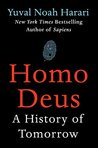
Homo Deus: A Brief History of TomorrowHomo Deus: A Brief History of Tomorrow by Yuval Noah Harari
My rating: 3 of 5 stars
Homo Deus, while decent, simply isn’t in the same league as the preceding Sapiens or the following 21 Questions book.

One reason is its niche, I think — futurism books will always be more open to second-guessing than historical interpretations of the past or analyses of the present.

But Hariri also makes some big errors in this book that he doesn’t in the other two.

The biggest is his entire chapter on religion and related issues. And, yes, I mean what I said — the whole chapter is problematic.

There are three “category error” type issues here, to wax philosophical.
One is claiming that ideologies are religions. No,. Marxism and Communism (and liberalism) are ideologies. And nothing more.
The second is trotting out the old “religion vs spirituality” trope. Can we put this tired cliché to rest?
The third is failure to wax philosophical, per my intro.

These are all compounded by, and contingent to, his poor definition of what religion is, but especially his failure to wax philosophical.

No, religion is NOT about things “superhuman.” Good philosophy in general, good philosophy of religion, and good psychology of evolutionary development from people like Scott Atran would all rectify that mistake.

Religion is about “matters metaphysical,” which is far different than “superhuman.” Alien life might be superhuman, but per the old Star Trek episode, many of us today, I would hope, would not worship it. For that matter, in straight power, the sun is “superhuman.”

No, religion is about “matters metaphysical,” as I define it. And, not just any matters metaphysical, but metaphysical matters of “ultimate concern.” I have to sound like a process theologian because atheist types of Buddhism are indeed religious, contra Robert Wright and other peddlers of bullshit.

But, it’s not just “about” metaphysical matters of ultimate concern. It’s about individuals, as individuals and as groups, conducting rituals and other actions to keep themselves “well aligned” with such metaphysical matters of ultimate concern.

This is why atheistic types of Buddhism are a religion and Confucianism is not.

With a proper definition of religion, one avoids calling ideologies religions. One also avoids trying to claim that “spirituality,” if it is metaphysical (some is, some isn’t) is automatically not religious. The third is bringing more critical thinking to this subject in general.

At this point, we’d lost a star right there. But, tentacles extending from the errors above were enough to drop this another star.

Philosophy is missing at a few other spots, too. That’s especially true on issues of free will, volition and consciousness. I agree with him that free will as traditionally conceived likely doesn’t exist. However, I HIGHLY disagree with him that this means determinism, or determinism plus randomness, is all that’s left.

First, we don’t act that way, and that should be taken into account more than he does. Second, per many modern philosophers, it’s possible that something kind of like free will, on a less than fully conscious level, does exist. Third, per the paragraph above, we need to say “mu” to the whole “free will vs. determinism” story.

And, I am sure Hariri knows what the word “mu” means and also knows what I am getting at in calling it a “story.”

And, there’s a bit too much techno-optimism.

I hate to bump two full stars, given that both other books are five-star, but … it’s what’s called for.


View all my reviews

Saturday, March 09, 2019

Bible autographing is a thing?

Everybody and their grandmother mentioned in the Biblical genealogy of Two Corinithians has by now heard of Trump autographing Bibles for Alabama tornado victims.

This:
is yet another reason this leftist, contra Arlie Russell Hochschild and fellow librulz, doesn't do "listening tours."

And actually, Trump autographing bibles (did he sign the first page of "Two Corinthians"? did he get his "cracker" [of the many crackers there]?) is only half as vulgar and one quarter as irreligious as the people who asked him for the autographs.

And, it's not just "the left" calling Trump out, contra fellow travelers at Red State:
That said, if Obama also did it, even for MLK's family, it's still theologically grotesque in my corner of the world.

But, that's Merikan Xianity, especially Southern style, in my corner of the world.

And, having grown up Lutheran, not Baptist or Church of Christ, even before becoming a secularist, it's not really "my corner of the world"; I just live here.

And, if the "Mammonof which Jesus warned includes fame as well as money, this secularist, looking from the outside, says it is un-christian. It's also halfway to being a success gospel.

I have little doubt that Episcopalians and Catholics, as well as Lutherans, north or south, would look askance.

Monday, January 21, 2013

Are we seeing the end of a Fourth Great Awakening?

Per discussion with friends on Facebook, over the book "The Rocks Don't Lie," I'd say the answer is yes. (Partial review of the book below.)


The Rocks Don't Lie: A Geologist Investigates Noah's Flood
The Rocks Don't Lie: A Geologist Investigates Noah's Flood by David R. Montgomery

My rating: 4 of 5 stars


A genial refutation of young-earth creationism

Montgomery generally keeps this story about how the earth's geology refutes any version of a literal Noahic flood light on detailed scientific language. And, it is written as a story.

He takes the reader to various geological formations in the world thatr have been key to the development of geology as a science, while narrating how key figures from geology's history have studied and analyzed such formations. At the same time, he narrates the history of Christian theological thought on literal vs non-literal biblical interpretation in general, and specifically on the Noahic flood. He intertwines the two in discussing how different strands of Christian thought reacted to these scientific findings.

Basically, by the end of the 19th century, a literal or semi-literal young-earth creationism (if not 10,000 years or less, certainly no more than 100,000 years) had fallen out of favor with the great majority of theologians in most of the Western world.

With the exception of the United States.

Montgomery puts YEC developments in the historic context of:
1. Anti-evolutionism and the Scopes trial of the 1920s and
2. Anti-communism and the Cold War, etc., of the late 1940s and beyond.

As talk of "culture wars" continues, and as Montgomery stretches YEC roots back to the Second Great Awakening, this is good to remember.

View all my reviews

That said, unlike the First Great Awakening. the Second Great Awakening, or the Third Great Awakening, this "Fourth Great Awakening" has a much more political component.

The First one may have had some connection to the American Revolution; Wiki's entry claims that, but I think it overstates the case. The Second spawned the short-lived Anti-Masonic Party, but was not directly connected to abolitionism. The Third  (I partially accept there was one, but definite more narrowly in time than Wiki) had a bit of a political angle, more in the "Social Gospel" of mainline Protestantism, though, than in the rising Holiness Movement. was a bit more political, but not extremely so.

I also accept the idea of a Fourth Great Awakening, but while I disagree with Wiki that its timeframe for the Third is too long, I think it's too short for the Fourth.

Evidence for one starting includes that the National Council of Churches "peaked" in the late 50s/early 60s, mainline Protestantism had clergy/laity separating more at that time, and fundamentalism and conservative evangelicalism grew rapidly.

That said, previous "Great Awakenings" shot their Roman candle in 35-45 years, really. (Which is part of why I think Wiki is too long on the Third and too short on the Fourth.)  So ... W's two elections aside, is the Third Awakening pretty much dying? And, does that in part explain some of the vitriol? Angry death spasms?

We're at about the right time frame. Each previous Great Awakening died differently.

The First petered out, as much as anything. The fervor of the Second got a nurture in sects such as Mormonism, Adventism, etc. that got new life in the Third, which also faced American industrialization.

The Fourth had a start, if you will, and was almost stillborn, in the Scopes trial. Not all conservative Christians were young-earth creationists, and so, while they may not have been fully reconciled to Darwinian ideas aobut evolution, many probably could have halfway accepted a "tamer" version of evolution if combined with old-earth creationism.

But, the Second Red Scare ( the first being after World War I) changed everything. But not by itself. The Civil Rights Movement added a "second stage" to this rocket. (Although black megachurches have grown recently, the Fourth Great Awakening is much more a white Christian phenomenon.)

Because the Fourth Great Awakening tied with this, not just the Second Red Square, it naturally became more political. Non-Catholic parochial schools, battles over school prayer, tax exemptions and more, as well as political appeals, both open and coded, by both Democrats and Republicans, became part of this.

But, now, has it shot its bolt?

It may have. One sign? Per a new Wall Street Journal poll, almost 70 percent of Americans want to keep Roe v. Wade.

Tuesday, May 17, 2011

Billy Graham is master of the obvious — and the clueless

Actually, he's more the master of his interpretation of the obvious, when he says people are atheists because "they want to run their own lives." Actually, the fact of the matter is an acknowledgment of running our own lives.

Other than that, he repeats all the fundamentalist-type accusations about atheism — it allegedly can't explain why we exist/where we came from (try the Big Bang, and evolutionary biology, with details of abiogenesis between the two still being worked out); it allegedly leads to despair (a Religious Right wet dream of hell on earth for atheists); it imputes everything to chance (not true, evolutionary events lead to contingencies further down the line of development and chance vs. design is a false dichotomy); atheism allegedly can't tell right from wrong (nonsense, we see a common core of morals, with some moral relativity or situational moralism at the edges — just as fundies engage in relativistic or situational moral beliefs at times), etc., etc.

Of course, Billy Graham has never, I'm sure, had an honest, open dialogue with a real, live atheist.

Friday, July 23, 2010

Relgious urban legend: 'Luck' does NOT come from 'Lucifer'

Ahh, a religion column freelancer out in Red State world fundy/conservative evangelical land. Ma'am, the word "luck" has nothing to do with "Lucifer" etymologically. Rather, it comes from the same root as today's modern German "Glueck."

Since this apparently goes back to known nutbar and Greed Gospel purveyor Kenneth Copeland, things like this deserve scorn, not "engagement," on the whole debate as to how much skeptics, or atheists, should "engage" religious people on certain issues.

See here for more on the fake etymology.

Saturday, October 11, 2008

Some conservatives really ARE really, really crazy

The latest proof the “secular apocalypse” is here? Parents believing the Fisher-Price Little Mommy Cuddle ‘n Coo doll says “Islam is the light.”

Other people claim it says “Satan is King.”

I think I’ll go to my nearest Target and see if one says: “Sarah Palin is smart.”

Then, I’ll KNOW it’s a plot.

This is just the aural equivalent of pareidolia.

Next: Face of Sarah Palin seen in a tortilla.

Friday, December 21, 2007

Religious Right numerology lunacy

Because Isaiah 35 says: “A highway shall be there,” a small group of churches is proclaiming I-35 the “Highway of Holiness” across the six states it traverses.

First, where’s U.S. 35? Or various state highways 35?

Second, this is the most stupid example of numerology since people kept pushing for U.S. 666 to be renumbered as 491, saying the number of deaths on the road showed it was “Satan’s highway.”

The nutbars neglected many hills, narrow shoulders, curves, and, above all, drunk Navajos, as being primary factors in all the vehicular deaths.