Showing posts with label problem of evil. Show all posts

Thursday, March 05, 2026

Bobby Kennedy, Edith Hamilton and Aeschylus — wrongness compounded

Bobby Kennedy's quotation of Aeschylus on the night of Martin Luther King Jr.'s death is probably one of his greatest known moments. It has flickered in and out of my mind through the years, and came to my starker attention recently. On the divine? It's bullshit, really, whether classical Greece's panoply or Aeschylus going henotheistic, on one hand, or Kennedy's Christian god on the other. 

Anyway, here it is:

"In our sleep, pain which cannot forget falls drop by drop upon the heart until, in our own despair, against our will, comes wisdom through the awful grace of God."

First, per several sites, the Edith Hamilton translation is "despite," not "despair." Aeschylus is slightly less bullshitting than RFK with "despite." The original idea doubles down on "against our will." Bobby's sounds more poignant.

But, neither is true. In the Christian dual-omni god world of Bobby, this runs straight on into the problem of evil, Aeschylus' original or his misremembered version equally so. A god who can't teach wisdom outside of suicides or homicides is either less than omnipotent or less than omnibenevolent. If one wants to go Calvinist and call this part of double predestination, which RFK wouldn't, of course, that is only more hideous yet.

That said, of course, Hamilton herself mistranslated the last word. In Aeschylus, it's, to give the whole phrase, "the awful grace of the gods." 

On that, yes, the Olympians were capricious, and while Aeschylus is treating them (and the Fates and others as well, surely) as a group, they were individually capricious, battling each other, even.

For more on that, and other problems with Hamilton's translation, go here. I quote author Tara Wanda Milligan:

Even more than this, it is perhaps Hamilton’s reconstruction of Athenian tragedy, Americanized to focus on individual “poetically transmuted pain,” that appealed to Robert F. Kennedy. Hallett says that tragedy as conceived by Hamilton, a school headmistress with a master’s degree in classics but no further training, “focused intensely on individual suffering, democratic to the extent that it equalizes, and minimizes differences among, individuals who suffer and exult in their suffering.” A man of forty-two who had witnessed both his elder brothers die unexpectedly (Joe Jr. died while fighting in World War II), Kennedy needed solace and founded it in Hamilton’s writing. “Reading the Greeks was Jackie’s idea but something Bobby was ready for,” writes biographer Evan Thomas, adding that Aeschylus’s words “seemed to be speaking directly to Bobby.”

Going past that, the author notes that Hamilton misconstrues Hellenic Greek tragedy in general. Indeed, the Americanization is tragedy as individualized pathos.  

While that's not "the problem of evil," per se, and it's not "theodicy," it is A problem of evil of sorts.

Go back to World War II, where African-American combat deaths, or service short of death, received less valourous recognition than that of Whites. Or look at "Drunken" Ira Hayes. 

That then said, going beyond Milligan, Aeschylus appears to be talking about what is at the heart of Greek tragedy: hubris. The "despite" plus "against our will" is basically about stiff-necked humans getting taught a divine lesson through pain and tragedy.

Of course, that ties back to something like the book of Job, where Yahweh eventually says, in essence: "I'm the boss and you're not. Shut up and stop second-guessing me." 

Often, though, it goes beyond that to something deeper. 

I mean, this is the heart of many multigenerational, familial Greek legends such as the fall of the house of Atreus, tainted, tainted, tainted. (And, none of that is worse than what you'll find in portions of Genesis and Judges.) Usually, this hubris is about offending the gods, violating divinely-backed social or cultural precepts and so forth. In many cases, it's compounded when one precept collides with another, or a precept collides with humaneness.

In this case, it's how original familial sin, slightly parallel to original sin of Augustine, or more parallel to the "third and fourth generation" of the Ten Divarim, puts people in "damned if you do, damned if you don't" situations. 

In other words, from a secularist point of view, Aeschylus is still wrong, but not in the way Edith Hamilton and Robert F. Kennedy make him to be. 

Thursday, December 14, 2023

Intercessory prayer DOES NOT WORK

 This is not against the U.S. Religious Right, mainly Christian, but with a few Orthodox Jews along for the ride, and even, for political reasons, a few Muslims.

This is against the Religious Center and Left, as well as Right, of all religious traditions that believe in praying to a god(dess) to get him/her to change their minds.

Via Tales of Whoa, who says (rightfully) that even within the world of religiosity, with the Western dual-omni god, at least, this is one that doesn't make ANY sense, we have this in-depth research test.

It checks all the scientific boxes:

Remote

Random

Double-blinded.

People were asked to pray for COVID patients' recoveries. And it made no difference.

Zip. Zilch. Nada.

Summary details:

The objective of this study was to evaluate the effect of intercessory prayer performed by a group of spiritual leaders on the health outcomes of hospitalized patients with Novel Coronavirus (COVID-19) infection, specifically focusing on mortality and hospitalization rates. Design: This was a double-blinded, controlled, and randomized trial conducted at a private hospital in São Paulo, Brazil. Interventions: Both groups continued to receive their usual medical care in accordance with HCor Hospital's institutional patient care protocol for COVID-19 patients. Intervention: Both groups received their regular medical care according to HCor's institutional patient care protocol for COVID-19 patients. The intervention group, in addition to standard treatment, received intercessory prayers performed by a group of spiritual leaders. Main outcome measures: The primary endpoint was in-hospital mortality. Secondary endpoints included the need for mechanical ventilation during hospitalization, duration of mechanical ventilation, length of ICU stay, and length of hospital stay. Results: A total of 199 participants were randomly assigned to the groups. The primary outcome, in-hospital mortality, occurred in 8 out of 100 (8.0 %) patients in the intercessory prayer group and 8 out of 99 (8.1 %) patients in the control group (HR 0.86 [0.32 to 2.31]; p = 0.76). Additionally, there were no significant differences between the groups in terms of secondary outcomes. Conclusion: The study found no evidence of an effect of intercessory prayer on the primary outcome of mortality or on the secondary outcomes of hospitalization time, ICU time, and mechanical ventilation time.

A total of 199 patients is relatively robust, too, at least partially undercutting "small sample size" claims.

As for the theology, philosophy of religion and related?

This issue hits home hardest with the classical Western monotheisms, post-early Jewish contact with Greek philosophy. In other words, the "dual-omni" god, as I call him, both omnipotent and omnibenevolent.

But, this critter doesn't even have to be omnibenevolent. Only the first omni is really in play, as long as omniscience is understood as a subset of omnipotence.

So, you have a deity who already knows what is going to happen because, and in addition to he (she, it) having already created things to happen and play out that way. And yet, you're praying for him to change his mind.

After all, the Torah records Moses himself as saying, in Numbers 23:19:

God is not human, that he should lie, not a human being, that he should change his mind.

There you go.

BUT?!

After the Great Flood, when Yahweh smells Noah's burnt offering, although Genesis 8:21 doesn't use the actual word, he is said to have "repented" of what he did. Of course, before that, in Genesis 6:6, he "repented" of having created human beings in the first place, and there, the Hebrew word is used.

Beyond that, in Genesis 8, Yahweh is just as much quasi-human as Zeus, as he "repents" precisely because he SMELLS Noah's burnt offering.

Fact is, of course, as this illustrates, there is no theology of the Bible, or of the Tanakh or New Testament. Nor even of individual books that have gone through multiple writing and editorial hands.

Of course, there is, in Isaiah, the passage, II Kings 20, when Hezekiah is told that his illness will kill him and he prays and gets 15 more years of life.

I guess believers in an omnipotent god could say this was his own plan all along and he just didn't make that clear. In other words, per Job as filtered through Paul in Romans, this is god's inscrutability and y'all on earth just need to shut up.

Well, as I have called it, that's the psychological division of the problem of evil, so you just opened a bigger can of worms. And, per what started us off? The more liberally religious, at least in Christianity, as well as the wingnuts, ultimately go there.

Or, also among the semi-liberal theologically, but something also used by religious fundamentalists there's C.S. Lewis, whose essay "Does Prayer Work" Tales of Whoa cites. Lewis says, in essence, that in a scientific test mode, this isn't real prayer. Gee, don't we have psi phenomena people claim exactly the same when telekinesis, etc., are subjected to scientific testing?

But, Lewis and the wingnuts are wrong anyway, as the study allowed for exactly that:

The intercessors consisted of Protestant religious leaders who were selected based on their faith, availability, and commitment to daily prayers for a specific period. They were volunteers from Protestant congregations across various cities and denominations. The theological knowledge of each intercessor could not be objectively evaluated, but their voluntary participation and shared belief in the efficacy of prayer for the sick were significant factors in their selection.

Your last door is closed.

Thursday, December 08, 2022

Did Job originally end at the end of chapter 41? What's existentialism got to do with it?

I doubt it; I hugely doubt it.

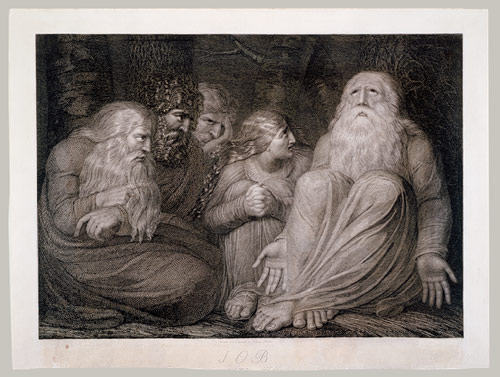
That's as, per the Blake painting, to riff on a biblical phrase, I wonder: "Who watches the comforters?"

I digress. Back to the main point.

Someone at one of the biblical subreddits made such a claim about the ending of the book of Job a while back. He based that claim by the comment just before the speeches of Yahweh starting, at the end of Job's last response to his "comforters" in Job 31:40, which ends:

The words of Job are ended.

This meant that chapter 42 had to be an addition. 

I first said, in essence, that no, that could mean, "Job is done speaking for now," not "done, period."

Then, the better answer hit me in the face, namely the start of Job 40:

40 The Lord said to Job:
2  “Will the one who contends with the Almighty correct him? Let him who accuses God answer him!”
3 Then Job answered the Lord:
4  “I am unworthy—how can I reply to you?  I put my hand over my mouth. 5  I spoke once, but I have no answer — twice, but I will say no more.”
6 Then the Lord spoke to Job out of the storm:
7  “Brace yourself like a man;  I will question you, and you shall answer me.

There you go. If you really believe Job 42 is a later addition because of 31:40, then you also have to believe Job 40:3-5 is, and for linguistic smoothness, you must also believe that either 40:1-2 or 40:6 is also an interpolation.

There's also the text-historical issue. We have a copy of Job at Qumran, and it ends pretty much the way today's does, and is dated to circa 100 BCE. Given the estimated compositional history of Job, it is just possible for a later redactional addition to have been made, but not likely. See discussion here; I agree with it that IF there were an earlier version, the "whirlwind speech" of 40-41 in general was likely not part of it. 

Mainly, though, I agree that, given the prose section is clearly older, there would have had to have been SOME prose conclusion. And, there's no way of knowing whether the current and original one was the same. We DO know that, by the time of scrolls being saved at Qumran, the current prose ending was where it ended.

The correspondent, who appears to be like me, a secularist with a graduate religious degree, seemed to be looking for an "existentialist" Job. Albert Camus is in the top rank of my philosophy pantheon. I've read a fair amount of Kierkegaard, some Sartre, and in even more modern times, lots of Walter Kaufmann. It's one thing to wish for that being true; it's another thing make unsustainable redaction-critical claims to that end.

As for one other claim there, I also don't believe David Clines' insinuation (page 7 of the PDF) that there was no wager between Yahweh and (the) Satan. (Here's the homepage to download the PDF if needed.)

Rather, as I said elsewhere on the thread, gods wagering with one another is a common enough thread in antiquity, and not just in the Ancient Near East, but in Greek myth, and also in the blinding of Baldur in Norse myth that it probably has its own subsection entry in Stith Thompson's encyclopedia of folklore motifs.

I think there was a bet, and as I said in my review of "God: An Anatomy," by Francesca Stravrakopoulou (saying she gets Job wrong, too), that, the wager may have been, if Satan won, he got to sit on Yahweh's throne a week or something. And, no, that's not being facetious. Then, when this thread started, I figured Yahweh's side of the wager would be that, if he won, Satan had to ONLY "wander the earth to and fro" for a while and couldn't sit in on the divine council. (Doorknob forgive me for sounding like David Heiser.)

The problem is, as I see it, is not only that the wager idea isn't spelled out completely, in the presumably older prose stratum, but that the shift to a monotheistic framework makes the whole divine wager more problematic when it's fused with the patient sufferer poetic narratives. (Clines is right, IMO, that Yahweh is the ultimate beneficiary of Job's suffering, but IMO, that doesn't make much sense if you're denying a wager was laid.)

And so, I stand by my comment to the correspondent that, even without Paul citing a mix of Isaiah and Job in his doxology at the end of Romans 15, Job is problematic at best. Reading the book either with or without Chapter 42, he looks like a capricious cad and you're in the middle of the problem of evil. Eliminating Chapter 42 is no answer otherwise. Rather, the correspondent's claim that Yahweh's monologue is "no answer" is wrong. Rhetorical questions at staccato tempo and high volume are indeed an answer.

With chapter 42, to put it in today's terms, Job as a whole reads to me like capriciousness being covered up with a success gospel conclusion.

The prose beginning, with the implied wager, is that Job is faithful precisely because, at least in modern dual-omni god terms, he doesn't have to fear god's capriciousness. In other words, the "natural evils" portion of "the problem of evil" is something that he doesn't have to worry about. That said, given the Chaldean raiders, Job faces both natural and human evils in chapter 1, but the ancient author probably wasn't thinking of the problem of evil.

The real problem, per the "see discussion here" is that Job is internally jumbled. By Chapter 10, Job himself is saying that he can't call Yahweh to account, but yet he hints at trying anyway, and later calls out for a "defense attorney" (NOT "redeemer"). And, of course, there's the problem of Elihu jumping in out of nowhere, without either being introduced earlier, OR without being listed in need of expiation in Job 42.

There's the option of going beyond C.L. Seow, Clines elsewhere and others, and postulating that Job originally ended at 31:40 with perhaps some brief speech by Yahweh, not Elihu's five chapters followed by Yahweh's four-chapter blast. That might satisfy my existentialist friend's ideas, but, if true, would have to be early indeed in the redactional history. And, it's not the theory he presented.

Otherwise, the archaicizing language? Assuming that it is an affectation, that makes sense as far as this being a post-exilic book. The (primary/original) author is trying to provide the idea of a sage of antiquity bringing wisdom to emerging Judaism. That "emerging Judaism" as well as looking for more orthodoxy could explain the addition of Elihu. Interestingly, C.L. Seow, cited by my correspondent as believing Job 42 is an addition, thinks the Elihu speeches are original. So does the author linked there, Ragnar Andersen, who doesn't explain why Elihu is missing at both beginning and end prose segments.

There's other problems. While Elihu's speeches do foreshadow Yahweh's in talking about divine power, they don't really offer anything different than the original three friends on the problem of evil and Job allegedly having a secret sin. It is possible that the foreshadowing is why Elihu's not seen in need of expiation, and just possible that this is why he's not mentioned with Job's other friends at the start. It's still awkward literarily.

That's more than enough.

The real puzzler is why, if under my idea, the "divine gamble" idea is at least halfway botched when moving it to a monotheistic deity, Job became "canonical" for Jews. For dual-omni Christians following in Paul's misinterpretation and misthinking tracks, it's a different story.

Also, as I said to a first-time questioner there asking about Ecclesiastes being "existential" or "nihilist" (after telling him the two are not the same) that I'm hesitant about using modern philosophy terms to describe the background or authorial mindset of biblical books, starting with the much different metaphysics. If you mean "existential" in a pop psychology sense, I get where you're coming from, but I'm then going to say that you need to treat the biblical book in question like pop psychology. (That's done plenty enough anyway.)

And, that's more than enough on Job.

Thursday, May 21, 2020

Francis Collins, the Templeton Prize,
and the Problem of Evil

Online and authorial friend John Horgan dusts off an old interview with Francis Collins of the National Institutes of Health on news that he's won this year's Templeton Prize.

Horgan notes that, at the end, where he asked Collins about the future of humanity, he showed lots of faith in god but little in homo sapiens. The questions were really about another issue — the role of suffering in religious belief.

The reality, per Logic 101 is that "suffering," however the word is defined, is not logically necessary for religion or a deity. (Remember: Folks like Theravada Buddhists have a religious belief system without a personal divinity.) Philosophy of Religion 101 will then add that suffering, or a belief in it, is not psychologically necessary, either.

The first is the old Problem of Evil. For believers in a god both omnipotent and omnibenevolent, it's an even bigger stumbling block than the Euthyphro Dilemma. The second often results from attempts by believers in a dual-omni god to avoid the Problem of Evil by citing their god's inscrutability. In the Judeo-Christian tradition, this usually involves an appeal to Job, with Christians doubling down by citing Paul referencing Job.

Doesn't work.

This is, as I have called it, the Psychological Problem of Evil.

Either said god is less than all-powerful if he can't make himself scrutable, or he's less than all-good if, other than "stop questioning me," he can't make his followers accept his inscrutability is for their good.

That said, what if there was some new way to get these people to accept his inscrutability? Still doesn't address the omnipotence and psychological evil issue.

There's also a bit of a petard lurking here.

IF ... we did accept that some suffering is necessary for human development as part of religion, how much is necessary and how much is too much? Usually this ends up again being hoist on the inscrutability of god in the Western "dueling-omnis" idea of god.

Otherwise, Collins himself, who famously once said, and included it in a book, that he had the idea of the Trinity be made understandable by a three-part waterfall, doesn't strike me as the deepest of thinkers on matters religious. It's almost as silly as the apple explanation that I heard as a kid — the peel, the pulp and core are all separate, but all connected, and all have "appleness," but there's still just one apple.

Nor does his taking a page from Augustine, on the idea that an omni-god is outside humanity's four-dimensional space-time, makes such a god inscrutable by logical necessity. Per Flatland, such a god could intervene into our four dimensions in a perfectly scrutable way.

I mean, if Collins did a riff on Whitehead's process theology into something even more creative, or invented his own religion, even more, I'd have more respect for him. But this is just plain bleah evangelical Christianity.

As far as what Collins misses in terms of psychology of religion? It was staring himself in his hiking face. The "trinitarian" waterfall is a dictionary exhibit of confirmation bias.

Wednesday, August 08, 2012

A failed attempt at theodicy

Rev. Timothy Keller makes a nice try, when he says that if one uses the existence of suffering or natural evil, and its seeming unfairness, as part of rejecting the existence of god, it doesn't work, because the suffering remains senseless without a deity.

Not true; that's a framing mistake. It's really similar to Gilbert Ryle's idea of category mistakes.

"Sense" and "senseless" are both related, in general, to the issue of agency. And obviously, nature (unless one is a New Ager) isn't a personal being with powers of agency. A good existentialist could do more to straighten out Keller.

That's just the first of four straw men that Keller sets up to knock down.

The second is that this means that any god who exists is less than omnipotent.
But that kind of God doesn’t really fit our definition of “God.” So that thinking hardly helps us with reconciling God and suffering.
Well, maybe your definition is wrong. Isn't it arrogant to assume it isn't? And, that's a problem I have with theologically liberal Christians. It's for similar reasons I unfriended on Facebook, and eventually blocked there, a Harvard Divinity student who claimed Plato's famous Euthyphro dilemma (is "good" what it is because god orders it? then god can be capricious; is "good" what it is by its own nature? then "good" has moral standing independent of god) didn't apply to the god of Christianity.

(Honest grasping of the dilemma, perhaps through distinguishing between contingent and necessary moral truths, while ultimately a failure, would still be an effort, at least, not a craven dismissal. The "false dilemma" claims of some Christian Fathers, as listed on Wikipedia, aren't very good, either; they're halfway on the road to the ontological argument for god's existence, and it's no wonder Anselm is among those making this claim.)

The third one is that some people suffer because they're more evil. Well, about no nontheist claims that. Many of us do claim that, within a monotheistic theodicy, it sure looks that way, though, even if we're not Gnu Atheist knife-twisters.

Fourth is what he says is a half-answer; it's the will of god, we have to but accept.

He spins on this to go to us needing to be like children before god.

Not true. In fact, a god who creates sentient, curious, thinking beings, but then says "hey, wait a minute" and hides behind inscrutability is ultimately guilty of inflicting psychological evil on those creatures, thereby making the "problem of evil" worse, if anything.

Now Keller is just a parish pastor, not a theologian. Nonetheless, he's a pastor in New York City for a mainline, vaguely liberal Protestant denomination. And, he can't do better than this?


Friday, March 23, 2012

Gary Gutting whiffs on 'problem of evil'

For theists, atheists, and philosophers of religion and beyond, the "problem of evil" is at the core of stumbling blocks of western monotheism.

How can a deity be both omnipotent, or all-powerful, AND omnibenevolent, or all-good?

Theistic apologists often appeal to god's inscrutability. In a nutshell, they claim that what appears to be evil now is for our ultimate good, or similar.

Gary Gutting says we need more than an appeal to ignorance, if we don't want to have a blind faith.

But, he misses what apologists also miss.

That such an all-powerful, all-good god, even if he or she must allow local evils, or allow short-term evils for long-term good, could still explain himself/herself better to sentient created beings, and *has chosen* not to do so.

That, as I have repeatedly identified it, is the "problem of psychological evil." And, I've yet to see a theistic apologist adequately answer it.

Saturday, September 17, 2011

‘Critical’ Xns not any more rational than fundys?


Or at the least, they can be just as determined in their habits and depth of motivated reasoning, perhaps.
In one particular case, I know that’s true.

In an extended debate on Google Plus with a new Harvard Divinity School student, I wound up learning a number of things along that line.

I started the thread with this post:
If God wants us to be unselfish and think of others first, then why does he want us to think above him above everyone else?
I explained that this was influenced by an actual religion column by a conservative, mainline Protestant (Lutheran) but nonfundamentalist minister.

Eventually, Mr. Harvard Div responded:
When you base your joke on an if that presumes the Christian God, you leave the question of whether God exists behind. You enter a world that assumes such a God exists.
So, thing No. 1 I learned?

This person thinks a rhetorical device use of “if” thinks that I’m actually committed to the propositional statement that follows the “if.” Either he’s clueless about use of rhetoric, or he’s willing to distort my rhetorical stance that much that he’s willing to engage in intellectual dishonesty. Or a bit of both.

Anyway, he then goes on to make a claim I expected more from a conservative, non-critical-scholarship Christian.
So you seriously think that, granting a creator of everything, literally an author of everything, that one could effectively do good without loving the author?-- and further you believe that so strongly that you think it's not even a passably good argument?
I responded in two ways, saying, basically, I and many other secularists feel that way, and we have nearly 2,500 years of philosophical history behind us.
Plato raised this issue 2500 years ago in the Euthyphro are things good because god(s) say(s) so, or is/are god(s) good because they follow an order of goodness outside it/them? Plato saw way back then that one cannot logically anchor morality on the existence of adivinity. I know many Christian apologists claim he presents a false dilemma, but their counterarguments are weak. … The answer to your question, not just from me, but from many secularists of all sorts of nametags ... is YES. Yes, I believe one can do good without loving a creator, and that logically, claiming a creator is necessary is horribly illogical.
By this point, I wasn’t expecting him to accept Plato’s argument. And he didn’t, with this response:
Plato's gods in the Euthyphro are not all that similar to the Christian God which you were here critiquing, and Christian thinkers have described their God largely in terms that avoid the Euthyphro dilemma.
To which, and other things, I said, basically, “that’s your perception.” It wasn’t the first time in the thread where he made a statement of his opinion, IMO, assuming it was right. 

Beyond that, the Wiki article on the Euthyphro dilemma, linked above, directly addresses his absurd claim that Plato’s thought can’t apply to the Christian god.
The dilemma can be modified to apply to philosophical theism, where it is still the object of theological and philosophical discussion, largely within the Christian, Jewish, and Islamic traditions. As Leibniz presents this version of the dilemma: "It is generally agreed that whatever God wills is good and just. But there remains the question whether it is good and just because God wills it or whether God wills it because it is good and just; in other words, whether justice and goodness are arbitrary or whether they belong to the necessary and eternal truths about the nature of things."
The fact that hordes of Christian, Jewish and Islamic philosophers worried about it shows they damn well knew just how much it applies.

And, the disingenuousness of their response shows that, too. Still from the Wiki article:
Anselm scholar Katherin A. Rogers observes, many contemporary philosophers of religion suppose that there are true propositions which exist as platonic abstracta independently of God. Among these are propositions constituting a moral order, to which God must conform in order to be good. Classical Judaeo-Christian theism, however, rejects such a view as inconsistent with God's omnipotence, which requires that all that there is is God and what he has made. "The classical tradition," Rogers notes, "also steers clear of the other horn of the Euthyphro dilemma, divine command theory." From a classical theistic perspective, therefore, the Euthyphro dilemma is false. As Rogers puts it, "Anselm, like Augustine before him and Aquinas later, rejects both horns of the Euthyphro dilemma. God neither conforms to nor invents the moral order. Rather His very nature is the standard for value.”
The last two sentences, per the analytic philosophy that said Harvard Div student showed elsewhere he (for good reasons, I guess, from his point of view) doesn’t like, are basically meaningless. The last sentence, if anything, accepts the first “horn” of the dilemma, that things are good only because (a) god says they are. 

The second-last sentence, combined with it, if it came out of Paul Tillich’s mouth, would be calling God the “ground of moral being.” But, wordplay can’t escape logic.

He follows with this:
Now, you may find such a God logically impossible, but it is still a mis-representation to say that if this logically impossible God exists, then he couldn't do X because it is logically impossible (ha ha, let's all have a laugh because of how these people didn't think of this). They did think of this. Their answer is fully consistent with the nature of God that they point out; if God's nature is the embodiment of moral value, as in Christian thought, then it follows that to love him is to love what is good.
I realize how wedded he is to Tillich-type thought with that statement. In fact, in an earlier thread, on Facebook, he more directly referenced Tillich, in the same comment as saying how he rejected analytic philosophy.

Yep, and we know why.

Well, sir, Paul Tillich is as dead as god, and so is Tillich’s theology. Really, if that’s the best a supposedly broad-minded student can bring to Harvard (it’s his first semester, so, I won’t blame it ON Harvard yet). In fact, I’m surprised the Wiki article on the Euthyphro dilemma didn’t bring Tillich into the discussion. After all, his theology is largely based on ontology, and, as I’ve blogged before about Anselm’s ontological argument for the existence of god, it fails because …

Here’s that damned analytic philosophy again …

Because it commits a category mistake. “Existence” is NOT an attribute.

And, that said, I know where Mr. Harvard Div’s claim that Platonic gods are not like the Xn god comes from. They’re not “the ground of being.” And, that’s why people like this don’t like analytic theology – because it cuts through the attempted word play to get at actual meaning and content.

Anyway, lesson learned. Any time I should again get in a discussion of morals, ethics or related issues, let alone the “problem of evil,” with a “critical scholar” Christian, I’ll ask questions first. Starting with what they think about Tillich in particular and modern “ontological theology” in general.

That said, and again, it’s meant to be snarky … what if a Hindu claimed Krishna was the “ground of being”? I suspect that at least some “enlightened, tolerant” critical-thinking Christian scholars would first laugh, then go on the critical-philosophical attack.

UPDATE: Speaking of, a Western academic Buddhist, on a FB thread, says "Karma and reincarnation aren't falsifiable claims." So, this isn't even a liberal-vs-conservative Christianity deal, with them being the two sides of the same coin, it's really a religion vs. naturalism claim.

I of course responded that David Hume first pointed out, even if not using Carl Sagan's words, that "extraordinary claims require extraordinary evidence." I also, riffing on Ben Johnson's comment about patriotism, politely said the claim "metaphysical stance X isn't falsifiable" was the last refuge of the religious, without adding the word "scoundrel."

For both conservative and liberal Christians, not only is Yahweh jealous – so are his followers. That's the second lesson learned.

Tuesday, March 29, 2011

Michael Ruse, Dawkins fail to understand philosophical necessity

It's ironic to say that about a famed Ph.d. philosopher, and an atheist and skeptic of sorts to boot, as well as about a famous evolutionary biologist, if this is the case.

But, here, Ruse defends Richard Dawkins in advancing a secularist defense of natural evil in particular and, in relation to natural selection rather than a creator god, of the problem of evil in general.
But supposing that God did (and had to) create through law, then Richard Dawkins of all people offers a piece of candy to the Christian. Dawkins argues that the only physical way to get organic adaptation -- the design-like nature of living beings -- is through natural selection, that very painful mechanism that worried Darwin! Other mechanisms are either false (such as Lamarckism, the inheritance of acquired characteristics) or inadequate (such as saltationism, change by sudden jumps). In other words, although Darwinism does not speak to all cases of physical evil -- the earthquakes -- it does speak to the physical evil that it itself is supposed to bring on. It is Darwinism with suffering, or nothing.
So, Ruse seems to be claiming that Dawkins says a certain amount of "nature bloody red in tooth and claw" was necessary for evolution. And, as a philosopher, Ruse appears to be giving this the imprimatur that it was philosophically necessary.

But, just as there's no philosophical necessity for the amount of evil in the world for God to do good, there's no necessity for a certain amount of evil, in terms of natural evil, for natural selection to operate.

Dawkins isn't a philosopher, not even a real amateur one, so he can be partially forgiven. But, this is a BIG #fail for Ruse.

Sunday, March 20, 2011

Karma — as offensive as hell

This extended CNN blog, with broadly multifaith comments on "why suffering" in the wake of the Fukushima nuclear worries, following the Japanese tsunami and eaerthquake, makes the case well for me.

Is it any worse for a fundamentalist Christian to say:
1. God is inscrutable;
2. Original sin brought on this disaster for you;
3. It's God's prerogative to damn some people to hell.

Or a hardcore Buddhist to say:
1. Karma is inscrutable;
2. Your past life that you can't even remember brought on this disaster for you;
3. It's a cyclical universe's "prerogative" to damn some people to recurring rounds of bad karma.

I know of people who are skeptics, and atheists, even, in the sense of not believing in a western monotheist divinity, that still believe in the metaphysics of karma. Well, sorry, but, karma's as offensive as the heaven-hell of western monotheism. (The Buddhist version is more offensive than the Hindu version because it claims that not even a person or personality, but just a "life force" is reincarnated and the "self" [nonexistent as it allegedly is] is STILL punished in a new life.)

Beyond that, both western and eastern religion offer the same pablum when confronted with the problem of evil.

And, a "shout out" to "it's not a religion" Buddhist Sam Harris — what say you now?

And, speaking of that, I give a kudo to Chris Hitchens, the one "name" New Atheist to look at eastern religions just as toughly as those of the west.

Monday, January 25, 2010

Even Obama over uses "civic religion"

Obama can't even be totally blame-free on this.

Very interesting, noting that civic religion often invokes what really is pure, dumb luck, but noting that nobody wants to actually put it that way.

In talking about theodicy and this issue, James Wood notes:
Either God is punitive and interventionist (the Robertson view), or as capricious as nature and so absent as to be effectively nonexistent (the Obama view). Unfortunately, the Bible, which frequently uses God’s power over earth and seas as the sign of his majesty and intervening power, supports the first view; and the history of humanity’s lonely suffering decisively suggests the second.

Or god, at least as many people see him, doesn't exist.

The emotional power of how theodicy undermines the Western Judeo-Islamo-Christian all-powerful deity was as powerful for me, if not more so, than intellectual arguments.

Unfortunately, somebody as smart as Barack Obama doesn't think that through.

Rightly did Hume say, in light of things like this, that reason is the slave of the passions.

Wednesday, April 30, 2008

Ayala to IDers – ‘God is the greatest abortionist’

Francisco Ayala, one of the world’s greatest evolutionary biologists, AND one of the most renowned biological scientists openly defending the compatibility of evolution and religious belief, has been a busy man with the controversy over “Expelled.”

And, he’s not afraid to be as blunt with IDers as Richard Dawkins:
In fact, he said, evolution “is more consistent with belief in a personal god than intelligent design. If God has designed organisms, he has a lot to account for.”

Consider, he said, that at least 20 percent of pregnancies are known to end in spontaneous abortion. If that results from divinely inspired anatomy, Dr. Ayala said, “God is the greatest abortionist of them all.”

Or consider, he said, the “sadism” in parasites that live by devouring their hosts, or the mating habits of insects like female midges, tiny flies that fertilize their eggs by consuming their mates’ genitals, along with all their other parts.

For the midges, Dr. Ayala said, “it makes evolutionary sense. If you are a male and you have mated, the best thing you can do for your genes is to be eaten.” But if God or some other intelligent agent made things this way on purpose, he said, “then he is a sadist, he certainly does odd things and he is a lousy engineer.”

That is also the message of his latest book, “Darwin’s Gift to Science and Religion.”
Ayala also offers his take on the “teach the controversy,” or similar statements, espoused by many evolution doubters from President Bush on down, as well as evolution denialists:
He dismisses the argument that it is only fair to teach both sides of the evolution/creationism controversy. “We don’t teach alchemy along with chemistry,” he said. “We don’t teach witchcraft along with medicine. We don’t teach astrology with astronomy.”
Ayala’s work on behalf of evolutionary biology is greatly appreciated.

But, his comments also underscore part of why I became an atheist.

If you accept the idea that God, in the Western monotheistic version, cannot be “all,” how much of a “less than all” do you accept and still find worthy of the label “God,” as far as powers or skills of design?

Or, second question – how much below “less than all” do you get until you recognize that your “God” is nothing but a “god of the gaps” and that these gaps have been being closed by both science and philosophy for 300 years or more?

Or transferring this issue beyond what philosophers call “natural evil” to “moral evil,” how much “inhumanity” (the older Mark Twain would say it’s quite human) do you accept as the production, whether active or passive, of a “morally less than all” divinity before junking the idea entirely?

And, that said, at the end of the NYT story, Ayala himself refuses to discuss whether he is still a religious believer or not.

Thursday, December 08, 2005

The problem of evil bites monotheism with a vengeance

It’s far worse than the basic omnipotence vs. omnibenevolence dichotomy would have it seem.

The bare-bones, cut-to-the-chase definition of the problem of evil is that a Western monotheistic God, as normally defined, is impossible, because you can’t square a god who is both omnipotent and omnibenevolent with the existence of evil. That, of course, goes in spades for the existence of natural evil. (No time is being taken here to refute the arguments of theists who claim otherwise; there’s plenty of books and compendiums by professional philosophers who have already shot down the Alvin Plantingas of theistic apologetics.)

I, though, charge that this fissure the problem of evil exposes in classical monotheism is only the opening view of a far deeper crevasse, which I will quickly show by means of an informal sorites. (No need to write it out, it’s that simple.) In short, omnipotence and omnibenevolence are even more at war than it appears.

Knowledge is mental power, therefore a god who is less than omnipotent must be less than omniscient. Truly being able to care for another person, as empathy vs. sympathy exemplies, means knowing their needs. A god less than omniscient therefore cannot be omnibenevolent.

Ergo, a god less than omnipotent cannot be omnibenevolent. Throwing out the bathwater, a la Rabbi Kushner, won’t save any sort of recognizable baby.

(Kushner is the author of “When Bad Things Happen to Good People,” which [reading between the lines] faces the problem of evil by admitting that the God of Rabbi Kushner is not omnipotent but really is omnibenevolent.)