Showing posts with label absurdism. Show all posts

Thursday, February 11, 2021

New insights on Camus

A Life Worth Living: Albert Camus and the Quest for MeaningA Life Worth Living: Albert Camus and the Quest for Meaning by Robert Zaretsky
My rating: 5 of 5 stars

Very, very insightful work on the life and thought of Albert Camus, which opened my eyes to several things.

First, as far as his life, other than knowing he was a pied-noir, that his father died when he was very young, that he was tuburcular, that he died young himself (but was NOT assassinated by the KGB!) and that he was a notorious womanizer, I knew nothing.

The details of his childhood explain that last element of his adulthood to some degree, perhaps, as well as one long-used intellectual tool of his.

Camus' father was called to the active duty at the start of World War I and killed in battle in 1914. Camus was a year old. At the time his dad was called up, his dad's mom took in Albert, his older brother, and their mom.

Camus' mom was deaf. Per Zaretsky, a few people said she could speak before her husband was killed and only went mute afterward; most say she was a life-long mute. Anyway, she was a mute. So was her uncle by marriage, her mother-in-law's brother, who also was in grandma Camus' house.

Meanwhile, grandma was illiterate. And, after Albert was old enough to read, Zaretsky says she took him to the movie theater in Algiers. In the 1920s, silent movies reigned, of course, and in France and possessions, as well as in the US, they usually had subtitles describing the action.

And, illiterate grandma told Albert to read them to her — ignoring, of course, all the other patrons in the theater telling him to shut up.

So, Camus grew up in a world of silence, either silent people or people calling for silence. And, that's the biographical backstory, I think, to his use of silence on the Algerian civil war.

Related to that, Zaretsky notes Camus was misquoted by Le Monde, deliberately, in his statement on his mother and justice.

He actually said:

"People are now planting bombs in the tramways of Algiers. My mother might be on one of those tramways. If THAT is justice, then I prefer my mother."

And, who could argue with that?

I also think this is where Camus' womanizing comes from. A mother deaf and silent to him, a grandmother seemingly using him and manipulating him, and him looking for connection. BUT ... when a woman got too close — and SOUNDED too close — off he went. Zaretsky doesn't make that connection, but it makes sense to me.

Zaretsky DOES divide Camus' literary output into two periods, plus implies the start of a third, before his death. And, he confines Camus' well-known absurdism to just the first period. (He's not alone in this framework, by any means; Wikipedia discusses it.)

That first period is exemplified by The Myth of Sisyphus and The Stranger. Sisyphus is of course the icon of absurdism.

Part two focuses on rebellion. The Rebel and various essays, most centered on the image of Prometheus, are key. Camus sees both Prometheus AND Zeus as having both innocent and sinful sides in their battle.

Looking at these two periods separately, Zaretsky says that Camus had moved beyond absurdism. He doesn't say Camus rejected it, unlike Hume rejecting the Treatise. It was nothing Camus was afraid of. He simply thought that rebellion, or beyond rebellion, the difference between rebellion and revolt, was "the issue" of the post-World War II world.

He does note that near the end of his first period through his second period, Camus read more on Nietzsche, though ultimately rejecting his nihilism. Apropos Camus, Zaretsky notes Nietzsche was silent after his 1889 horse-hugging then institutionalization.

While not claiming that Camus' last years, possibly represented by The Fall and the posthumously published The First Man, represent a third phase of Camus' thought, Zaretsky does leave that door open. He notes that the "mistress suicide" scene from The Fall is seen by many as quasi-autobiographical, and The First Man of course is.

That said, the book's not perfect. It could have used a bit more coverage about The Fall (The First Man gets more) and The Plague as well as The Rebel in Camus' second period.

But this is still a very good look at Camus and all in just 200 pages of paperback-sized body copy.

View all my reviews

Thursday, April 16, 2020

The outrageous half-truths of Jacobin on Sartre

Jacobin, whose eclectic, editorially-unfocused (NOT a complement, editorial management) stable of contributors runs from Bernie Sanders DSAers to people stanning for the anniversary of the Revolution in November 2017, lauds "The Outrageous Optimism of Jean-Paul Sartre."

And, leads to my header.

The biggest half-truth is by omission. Even when Sartre did accept the truth about the USSR, after it crushed the 1956 Hungarian revolt, it was kind of grudging. And besides, he later shifted his worshipful devotion to Mao. That piece, by Jim Holt, is closer to the truth of who Sartre was.

The real issue is that Camus rejected violence after World War II, including rejecting the death penalty. Sartre never rejected the former, and given his praise for Mao and others, implicitly never rejected the latter. This was part of the reason for their split.

The Rebel somewhat disappointed me, but, nonetheless, Camus was light years ahead of Sartre here, even if his fallout with Sartre was not total and has sometimes been stereotyped.

Camus wasn't perfect on Algeria, but he was better than many Sartre-stanners portray him as being. Plus, he died in 1960, long before the civil war ended. And, his "federation" status might have worked. And, the idea that part of the backing of Algerian independence was an Egyptian version of colonialism? I don't think he was totally wrong there.

The real problem with Sartre? He was an absolutist. And, I think Heidegger did influence him on this. This is all part of what distinguishes Camus' absurdism from Sartre's existentialism. Per this very good CJR essay, Camus wasn't afraid of shades of gray and wasn't afraid to stand in the middle of them.

I'm too late to celebrate the 60th anniversary of Camus' death, vs. Sartre's 40th, but I can meditate on "The Plague" as a good substitute.

Beyond that, many of our best philosophers have been among the best writers, and Camus leads Sartre there, too.

Wednesday, January 21, 2015

Say "mu" to Camus on meaninglessness

Albert Camus famously or infamously said in "The Myth of Sisyphus" (summary and Wikipedia) that there is one ultimate issue in philosophy:
There is but one truly serious philosophical problem and that is suicide.
Of course, that relates to, and cornerstones, issues in his absurdist philosophy, and in the related existentialism of Jean-Paul Sartre and others.

Theists, especially Christian apologists, have used this as a cudgel, whacking secular existentialists over the head with the idea that they, or we, claim that life is "meaningless" and that there is therefore no recourse at end but suicide.

Well, a new essay at Massimo Pigliucci's Scientia Salon, by John G. Messerly, deals with this issue in part. And, it's stimulated me to yet further thought, reflected in part, and starting with, my second comment on the essay.

That said, let's unpack this issue a bit further. I'll then get to the second half of that second comment and go from there.

Camus, of course, said suicide was not the answer — revolt was. Which might be true. Revolt while accepting the modern absurdity of life.

Modern humanistic psychologists of a secularist mindset say that meaning is what we bring to the table.

But, beyond that, what if "meaningless(ness)" as traditionally defined in philosophy and psychology isn't exactly the issue?

And now, to that comment.
I think Camus was asking the wrong question. 
 Life is neither meaningful nor meaningless, if we take “meaningless” to be the opposite of “meaningful.”  
 If we instead, talk about “without meaning” or “meaning-less” (sic) we can hopefully understand this not as an opposition to “meaningful” but simply that the issue of “meaning” is, if not a category mistake, one of those issues about which we should be silent, or even more, per logical positivism, a question that is itself … without meaning!
 It’s true that, as part of our attempts to control our surroundings, we probably have “meaning seekers” as well as “pattern detectors” and “agency imputers” halfway hardwired into our brains. 
 But, per Hume’s is ≠ ought, that doesn’t mean that we have to follow them in falsely looking for agency — or falsely imputing meaning where it doesn’t exist, or falsely looking for it when it’s not part of the issue.
Let's go a bit further.

"Meaning" and "meaninglessness" also seems to be one of those polarities, like "free will" vs. "determinism," that's wrong in other ways.

First, it's presuming that a polarity should exist.

Second, it assumes that one should, in some degree at least, "reduce" to the other, rather than both be "unified" in a larger theory, just like general relativity and quantum theory will surely "unify" rather than having one reduce to the other.

Third, like the free will half of that first duality, a desire for meaning — or, a desire to frame ordering one's life around meaning, and trying to justify how to frame it without meaning — seems based in part on religion. I've said that this seems true to some degree of many secular defenders of classical free will, on religion and guilt connecting to free will.

Indeed, the Sparknotes summary, on the first link, puts this in is vs. ought terms, as far as how Camus treats Sisyphus:
As his starting point, Camus takes up the question of whether, on the one hand, we are free agents with souls and values, or if, on the other hand, we are just matter that moves about with mindless regularity. 
 Camus is interested in finding a third alternative. Can we acknowledge that life is meaningless without committing suicide? Do we have to at least hope that life has a meaning in order to live? Can we have values if we acknowledge that values are meaningless? Essentially, Camus is asking if the second of the two worldviews sketched above is livable.
But, just as I have repeatedly, most  notably here and in my own essay for Pigliucci, said that we should say “mu” to the traditional “free will versus determinism” polarity, I think we need to similarly “unask” Camus here.  (And Monty Python.)

So, per my pull quote from my comment at Massimo's, if life should not be viewed though a "meaning versus meaningless" filter, what should we then do?

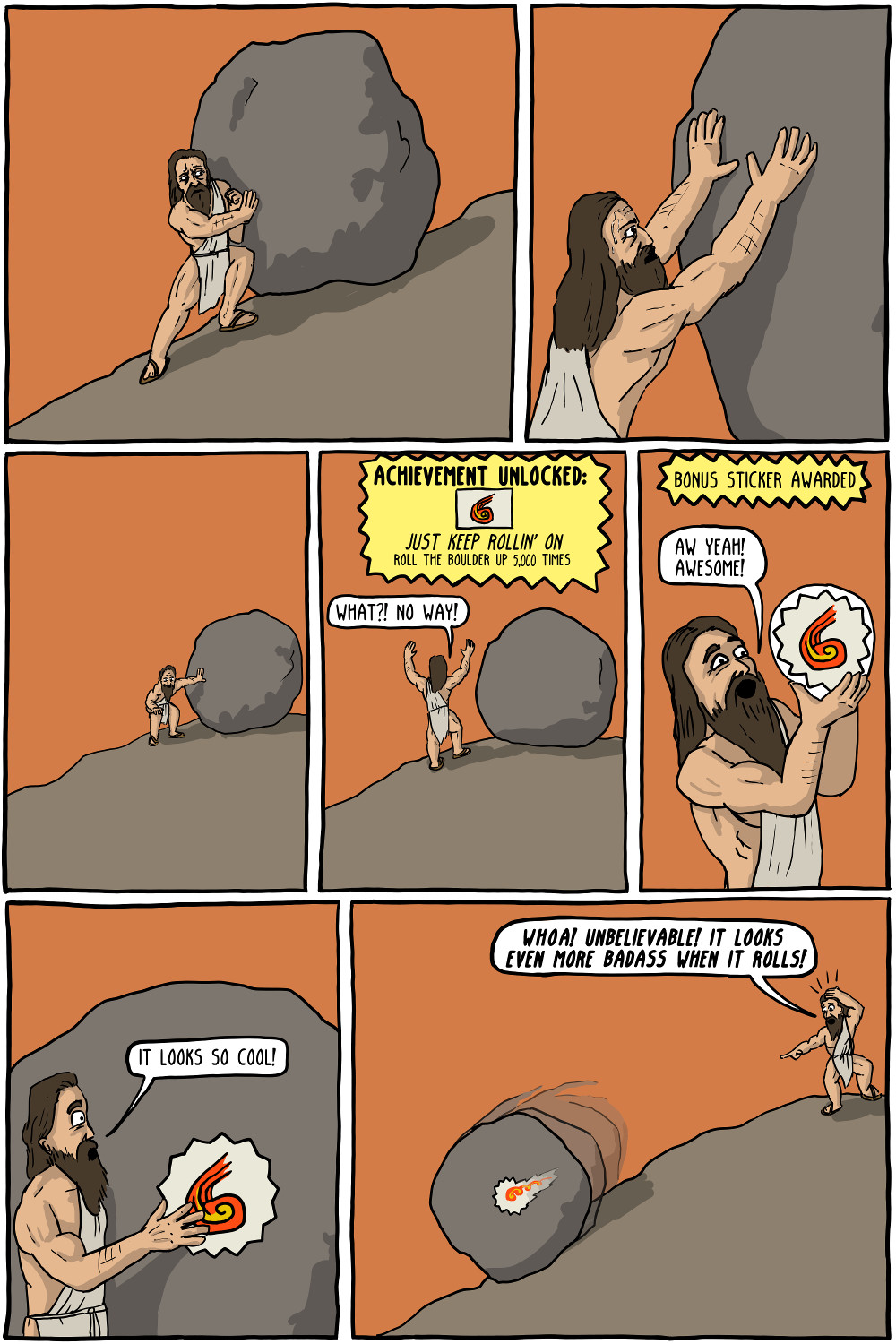
Well, the reference to Farmville, Candy Crush and other Facebook games aside, in this issue of Existentialist Comics, keeping an intelligent Sisyphus happy is probably harder than this. That's especially true for those like Camus and other professional and amateur philosophers who wrestle with these questions. We are "cursed" with intelligence, and speculative intelligence in general.

That said, where do we go from here, to find a better, more authentic contentment than Sisyphus?

To me, the original existentialism, or the Zen of the east from which I get my "mu" to Camus' question, is our starting point.

Recognizing that life simply "is," not in the scientific sense, but in a philosophical and a psychological sense, is the lodestar.

From there, finding contentment comes next. Contentment, to me, is both "deeper" psychologically and less ephemeral than "happiness." The likes of Daniel Kahnemann and other modern psychologists strongly agree.

And, it's not necessarily based on old ideas of how we "have to" find meaning, or create meaning, to be happy.

Second, per the essay that I linked that sparked these comments, as one other commenter noted, "progress" is usually defined in teleological terms. People often define meaning in the same way, which of course is another problem, and one recognized in part by existentialist and absurdist philosophers.

If your meaning is defined from achieving a goal, then you are doomed to frustration in never achieving it, or, like Sisyphus, having your "achievement clock" reset, or new layers added to it, or whatever.

And, what if you do achieve a goal of teleologically-based progress? What then? In the modern West, often, "emptiness," followed by chasing after some new goal.

"Revolt" might be one way of achieving this. But, I think it needs to be somewhat more comprehensive, maybe even somewhat more Cynical, as I discuss in calling for a neo-Cynicism, than Camus realized. The revolt has to include a revolt against teleology.

Even "authenticity" must be put under our Cynical microscope. Too often, "authenticity" is seen in a quasi-Platonic sense, as in "There's some ideal Me out there, and that's what I want to be."

Well, no there's not.

Each one of us is the result of massive contingency in a materialist universe. There's no way any ideal Me or You exists.

So, authenticity means rejecting the strictures of society that don't agree with deeper layers of our selves — before they become part of those deeper layers.

At the same time (heads up, Black Bloc!) it means questioning the idea of "revolt for revolt's sake" (sorry, any hyper-Camuseans) or any other "X for X's sake."

I'm not a process theologian, or anything close.

But, I will call myself a sort of "process psychologist."

As such, meaning is created, not found. And, it's created on an ongoing, not a static basis. It's part of a dialogue between a changing self, a current moment, and a current moment that is part of a larger stream of time.

And thus, meaning changes throughout life. Why wouldn't it?

Friday, November 30, 2012

Existentialist or absurdist? Understanding Camus


Albert Camus/From Wikipedia
Albert Camus consistently rejected the label of “existentialist” for himself, preferring that of “absurdist.”

I’ve always thought that, in part, there was a jealousy dynamic involved. He didn’t want to be under the “umbrella” of the same descriptive label as was Jean-Paul Sartre. This parallels why I see Igor Stravinsky not wanting to be called a “neoclassicist”; that label was already hung on Sergei Prokofiev; see here for more on that.

That said, it’s arguable that there are differences between Camus and Sartre, and that, as well, Camus knew his own writing better than anybody else, and should be allowed for his own labeling. (Exactly the same argument applies to Stravinsky vs. Prokofiev and, in fact, I have a similar blog post up.)

Fortunately, Wikipedia has a very good page on absurdism. The best part is that it offers a nice comparison chart of basic issues versus both secular existentialism (Sartre) and religious existentialism (Kierkegaard), as well as against nihilism.

I like absurdism because it sees more grays and fewer blacks-and-whites in life. But, it’s not nihilistic, which, well, sees all blacks!

Versus existentialism in general, absurdism says life may have meaning, not that it necessarily does. But, more “positively” than secular existentialism, it also says that the universe may have inherent meaning, but we can never know that.

That said, I’m not sure how much Camus believed that, and he wasn’t the only literary or philosophical absurdist, to be sure. Personally, I’d nuance that statement to say, “I don’t think the universe has inherent meaning, but I can’t prove it doesn’t.”

Also, versus both types of existentialism, absurdism says, don’t expect any guarantees, even on an individualized attempt to create personalized meaning out of life.

That, of course, was part of Camus’ “The Myth of Sisyphus.”

In turn, in that book, he first articulates the philosophy of revolting against the absurd, which finds its ultimate articulation in “The Rebel.”

Here is where Camus and Sartre parallel each other on the issue of “authenticity.”

For Sartre, it’s about being authentic by creating an authentic meaning for life. For Camus, it’s about the authenticity of one’s revolt.

And, as a result, Camus tells us that a life without hope is not necessarily a hopeless life.

And, along with Camus’ general terseness of writing, that’s part of why I admire him as an author in general and definitely hold him on a higher level than Sartre. A play like “No Exit” aside, Sartre simply doesn’t seem to have a visceral grasp of modern absurdity the way Camus does.

For additional thoughts on and interpretation of Camus, not necessarily agreeing with what I have written, see this site from Swarthmore. For some of Camus’ pithier insights, see this page of quotes.

And, go here for my thoughts on Camus' birth centennial.