Showing posts with label religion. Show all posts

Thursday, September 19, 2024

Utah no longer Mormon majority

 The LSD Church continues to claim it is, but religious sociology surveys, per the Religious News Service, paint a massively different picture, with the gap between Mormons' own claims and social response surveys having doubled, by percentage points of difference, over the last 30 or so years.

Even more interesting? Utah has dropped to just No. 3, if that, per the RNS piece, in fertility rate. Mormons not making more! The Dakotas are highest, it says (but no link). Guess without any search? American Indian fertility.

Wiki has South Dakota No. 1 as of 2022. Then, Alaska, Nebraska, Louisiana, Utah, North Dakota. Alaska, North Dakota, and probably Nebraska also American Indian births. World Population Review has the two Dakotas, then Alaska and Nebraska, then Utah for 2024. Of note? New Mexico, despite its large American Indian population, is in the bottom one-third of states.

Add to that massive in-migration of non-Mormons and hence the current state of the state.

Thursday, May 11, 2023

A religiously sympathetic look at Waco and Koresh

But, is it TOO sympathetic, both in the author's treatment of two religious leaders who attempted to negotiate with David Koresh at the time, and the stance of those two religious leaders themselves? Let's dig in on this extended version of a Goodreads review.

Waco: David Koresh, the Branch Davidians, and A Legacy of RageWaco: David Koresh, the Branch Davidians, and A Legacy of Rage by Jeff Guinn
My rating: 4 of 5 stars

This is good to very good but not quite great as pop history, and OK-plus but not quite very good as semi-academic history. It’s also one of those books whose possible rating changed in my mind while writing up this review. (It's really a 4.25, which is what it got at StoryGraph.)

The good? First, Guinn gives a detailed, and accurate, history of Branch Davidian’s history, starting with the foundation of Adventism, then through Davidian’s start as an offshoot of traditional Adventism. Connecting Cyrus Teed to Koresh via Lois Roden getting his one book sent to the Waco-McLennan County Library. (I know Sean Sutcliffe from days of living in Marlin, Texas. I also from days of living in the Metroplex, know Carlton Stowers.) His idiomatic interpretation of “Messiah” as someone chosen by god for a specific purpose is also good, and probably assisted by biblical scholars who helped him. In all this, it's generally a good work.

His description of how ATF’s surprise was blown, not by ATF itself, nor by the Waco Trib’s start of a story series, but by a clueless KWTX cameraman who should have been fired if he wasn’t, is also good. So, too, is the backstory on why ATF pushed to go through with the raid even after local leaders knew cover had been blown. Later in the book, the description of differences between ATF and FBI in hierarchy, organization and lower-level autonomy is important.

Getting ATF people to talk, whether on the record or on background, is also good. That said, with two other new books out for the 30th anniversary, I don’t know if Guinn was any more successful on that than the other two authors.

Really good? His alternative 4 on how the fire started — neither FBI-deliberate (I reject that as he also seems to do), nor Branch Davidian-deliberate (the compound was too disorganized) nor accidental, but Koresh-deliberate, based on a literalistic interpretation of a “wall of fire” from Zechariah. OTOH, that assumes that under that much stress, that Koresh could have popped up such an idea is perhaps questionable.

Issues? And, this is where we extend off the Goodreads review. 

James Tabor is arguably but NOT UNarguably an “esteemed religious scholar.” I would be OK with using "recognized" in an academia sense but wouldn't go further.  J. Philip Arnold isn’t even that.

Tabor believes in a quasi-DaVinci Code David family dynasty theory of a Jesus movement, and also believes that the James ossuary, and others where he has gotten even more scorned, are “real” burial sites of Jesus’ family and disciples. Even where he's better, in talking about Paul vs James, Tabor holds on to old ideas about Pauline thought development. And, in a lot of this, despite the DaVinci Code type angle, he draws support of a lot of people who follow theologically conservative critical scholars, even if he is not one himsel.

Arnold seems to be some sort of quasi-Restorationist Xn. He was also flat wrong in the insinuation I infer behind his statement that Branch Davidian was entitled to First Amendment protection. Said protection does not include violating state child sex abuse or federal gun control law. This is clear in a variety of court rulings up to SCOTUS level. 

Both were probably overly sympathetic to Koresh at the time they were entering negotations. Guinn doesn’t address that, nor does he address the issue of whether Tabor and Arnold might have been not just sympathetic but so overly sympathetic that they thought they really could have gotten Koresh to surrender. 

I personally doubt that could have happened; Tabor seems like he might have been close to gullible on the issue and Arnold might even have inadvertently egged Koresh on, if allowed more contact. Guinn definitely doesn't address that issue. Nor does he address the possibility that not everybody on the FBI team was an urban yokel about these issues.

Nor does Guinn address the likelihood that FBI people were right and the promised exegesis of all seven seals would have become a stall tactic around seal 6 with Koresh saying, “God won’t give me more revelation.” I think this is not only possible but likely.

Also, even though he’s written a book about Jonestown, Guinn doesn’t try to draw parallels. Personally, by the end of the book, I was more reminded of Heaven’s Gate, though it, unlike Jonestown and Mount Carmel, did not end in a battle with government forces. Jonestown, though, had a number of people starting to become disillusioned before the denouement, whereas Heaven’s Gate, like Mount Carmel or even more, had all true believers.

That said, the epilogue, “Clive Doyle is Waiting” was good, illustrating him as the truest of surviving true believers. And it ends with him dying.

As did some people 2,000 years ago, after the "one person" died 30, 40 or 50 years earlier.

And, that's the final missed parallel. Beyond not comparing Mount Carmel to Heaven's Gate, Guinn in general doesn't "play it forward."
 
Update: Correct the previous paragraph, as in an A&E interview, Guinn specifically says that First Amendment religious freedoms have to be placed in societal context, especially when the potentiality of violence is an issue.
 
==

Update: As recently retired NPR religion reporter Jeff Burnett (originally from here in Tex-ass, in Sherman, and for whom the standoff was one of his first big pieces) tells the Texas Observer, David Koresh was also another in a long line of skirt-chasing, money-grifting evangelists.

Saturday, March 04, 2023

Pastors worried about ChatGPT doth protest too much

Yeah, religious leaders are freaking their heads out, per the AP, about ChatGPT writing AI sermons.

In part, maybe they're worried it's better than them:

Todd Brewer, a New Testament scholar and managing editor of the Christian website Mockingbird, wrote in December about an experiment of his own -- asking ChatGPT to write a Christmas sermon for him. 
He was specific, requesting a sermon “based upon Luke’s birth narrative, with quotations from Karl Barth, Martin Luther, Irenaeus of Lyon, and Barack Obama.” 
Brewer wrote that he was “not prepared” when ChatGPT responded with a creation that met his criteria and “is better than several Christmas sermons I’ve heard over the years.” 
“The A.I. even seems to understand what makes the birth of Jesus genuinely good news,” Brewer added.

There you go.

On the other hand, Brewer went on to voice what many other people claimed in the piece:

Yet the ChatGPT sermon “lacks any human warmth,” he wrote. “The preaching of Artificial Intelligence can’t convincingly sympathize with the human plight.”

Problem?

Yes, and not with ChatGPT.

This is social science 101 problem; There's no double-blinded study on the AI sermons lacking a heart, soul, emotions or whatever.

Riffing on Tales of Whoa, who I saw post this a couple of weeks ago (and from whence the idea for last Saturday's post came), this is exactly NOT a Turing test, for exactly that reason.

Let's go next to Mike Glenn:

In Brentwood, Tennessee, Mike Glenn, senior pastor for 32 years at Brentwood Baptist Church, wrote a blog post in January after a computer-savvy assistant joked that Glenn could be replaced by an AI machine. “I’m not buying it,” Glenn wrote. “AI will never be able to preach a decent sermon. Why? Because the gospel is more than words. It’s the evidence of a changed life.”

And, the well-known Russell Moore:

Also weighing in with an online essay was the Rev. Russell Moore, formerly head of the Southern Baptist Convention’s public policy division and now editor-in-chief of the evangelical magazine Christianity Today. He confided to his readers that his first sermon, delivered at age 12, was a well-intentioned mess. 
“Preaching needs someone who knows the text and can convey that to the people — but it’s not just about transmitting information,” Moore wrote. “When we listen to the Word preached, we are hearing not just a word about God but a word from God.” 
“Such life-altering news needs to be delivered by a human, in person,” he added. “A chatbot can research. A chatbot can write. Perhaps a chatbot can even orate. But a chatbot can’t preach.”

Well, a chatbot can't preach, but a humanoid robot could, especially with a megachurch with satellite campuses seeing a video sermon.

As I told Tales, first of all, pastors, priests and rabbis have been preaching out of sermon books for decades if not centuries. And, whether canned sermons or their own, despite homiletic delivery training, many of them can't preach that well, either. Per Moore, they either write or deliver well-intentioned messes at 52. Beyond that, per Brewer, if I heard a pastor cite Irenaeus in a sermon outside a collegiate or divinity school campus chapel, I'd think him clueless for other reasons.

What I really see this worry covering is a follow-on to COVID slashing church attendance. With the rise of the "nones" being accelerated by that, these pastors are worried that, instead of the old time cable channels like Trinity Broadcasting, per what I said above about video sermons, you're going to get chatbot-robot sermons streaming on YouTube.

Beyond that, metaphysics aside, if you're worried enough to claim a ChatGPT doesn't have "soul," maybe your own sermons don't? And, besides, sermons aren't the only part of pastoral ministry. Maybe you're not doing good counseling? Not making hospital and homebound visits? Of course, at megachurches, the grifting chief pastor doesn't do that anyway.

Thursday, June 23, 2022

Belief in God plunges

 This is NOT the rise of the "Nones," which seems to have plateaued during COVID, anyway.

And, this is just a Gallup poll, not a full Pew Research study. 

BUT?

It's definitely interesting to see that belief in god in America has reportedly PLUNGED in the last few years, down to just 81 percent.

And, as noted, this isn't about the Nones, who aren't necessarily disbelievers in god. They're just people who reject organized religion and related religious sociology ideas.

And, that's not all.

Interestingly, the drop in belief in god, by percentage points, is twice as great among women as among men. Whites are still more likely to be non-believers than non-Whites. The drop is much bigger among Democrats than Republicans. The "independents" is surely almost all people who think Democrats are leftists; it's not Libertarians, Constitutionalists, Greens, Socialists, etc.

The other facet I find interesting is that unbelief is statistically at the same level in central cities, suburban areas, and independent small towns and rural areas.

Belief in an interventionist theistic god is not high, even among believers in a god in general. This:

A follow-up question in the survey probed further into what Americans' belief in God entails. Specifically, the question asked whether God hears prayers and whether God intervenes when people pray. 
About half of those who believe in God -- equal to 42% of all Americans -- say God hears prayers and can intervene on a person's behalf. Meanwhile, 28% of all Americans say God hears prayers but cannot intervene, while 11% think God does neither.

Is also quite interesting.

The more religious, as well as the more Republican, are more likely among believers to believe in an interventionist god. No surprise there. Liberal Protestantism has long believed in a "mush god," so to speak, and as a metaphysical atheist as well as a sociological secularist, I get to say that.

This will surely have longer-term political ramifications, but not exactly as everybody may think. Not all atheists are secular humanists, to riff further on the distinctions at the end of the above paragraph. Many are libertarian not only on social issues but economic ones. In short, they could support an even more economically cruel America in decades ahead.

Saturday, April 17, 2021

Nones continue to rise; there IS no "god-shaped hole"

The rise of the "Nones" in America doesn't mean a decline in belief, per this from the Atlantic:
"(W)hat was once religious belief has now been channeled into political belief."
That said, there is no "god-shaped hole." That's Augustinian bullshit, to put it bluntly. There IS, rather, a "god-belief-shaped hole."

The "nones" may indeed, per the SJW division of liberals (who are NOT leftists) may act in ways the second link states. But, with people acting like there is one, that may happen.

On the right, as the Religious Right had made the church politics in a way that the Black church really had not (and, in some ways, was forced to), with tied with the rise of Trumpism. So, they're already prepared for that.

Thursday, September 24, 2020

Zoroastrianism has its myths too

Via Pocket, this piece from The Guardian illustrates.

First, yes, it is likely that IF Zoroaster existed, he probably lived closer to 1500 BCE than 600 BCE. However, per that IF? It's more likely yet that ... he's much more mythical than Jesus of Jesus mythicism or Buddha of Buddha mythicism. (Wikipedia's piece claims that some scholars put him back as long ago as 6000 BCE, which would only confirm that he didn't exist.)

Second, it's omitted that Zoroastrian scriptures didn't become written until Sassanid times. Just as we probably should speak of Vedic religion, not Hinduism, in the oral period of its transmission (and probably should speak of Brahmanism or something during the period from the writing of the Indian epics to the Gupta Empire and the triumph of what became Hinduism over Buddhism and Janism), so we need another term for pre-Sassanid Zoroastrianism, like Magism, or Mazdaism. (Before Ezra, scholars speak of Israelitism or Yahwism, not Judaism, so this is not unique to one or two religions. In Christianity, we have the term pre-Nicene Christianity. Chalcedon is a better cutoff, and a separate term would be better. It's a catch-all, and it's already used for a "heresy," but calling the whole earlier belief system "Arianism" would be accurate.)

Third and on to the Parsees of India, the focus of the piece. Did they really promise not to proselytize? Given that the first history of the Parsees was written 600 years after the first move to Gujarat, hard to say, isn't it? (This is similar to other insular religious minorities, such as Jews and Alawites, making similar claims. They usually have a degree of truth, but they're not 100 percent true.)

Fourth, the author claiming that Parsees were intransigent? Actually, they ditched much of their Zoroastrian caste system after moving to India. (Side note: Shows that maybe Zoroastrianism wasn't so enlightened after all, to have a caste system.)

The likely reality is that:
A. Zoroaster never existed.
B. The Gathas probably aren't as old as claimed, given that the Vedic Sanskrit which is the uncle of old Avestan lasted into the first century BCE.
C. One or more Mazdakite priests, parallel to Ezra, codified a mix of writings and oral poetic traditions, and the mythic personage of Zoroaster, in the early Achaemenid Empire. Darius or Xerxes would be likely target periods, and could then be inspiration for Ezra approximately a century later.
D. This religion then underwent a reform during Sassanid times. The reform was driven in two ways: the royal house saw a priesthood too independent and too powerful, parallel to how in Parthian times, often, the king was like a Holy Roman Emperor with unruly nobles; and, by internal cleansing.

Tuesday, November 12, 2019

Is post-Great Recession America going to be
like post-World War II Europe
on religious participation?

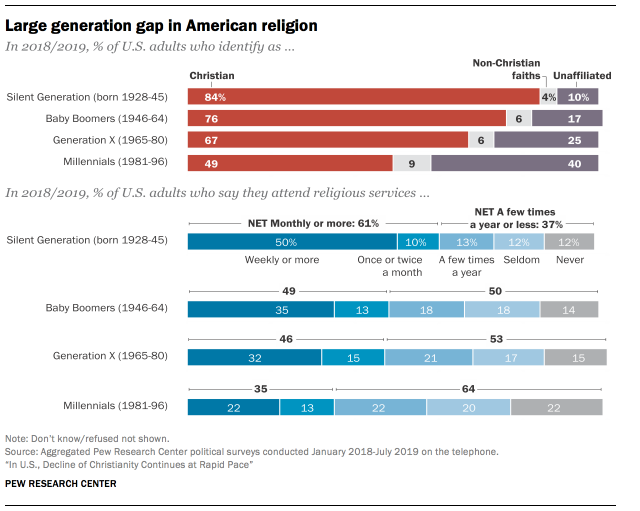
Per the latest Pew Research Center data on religion and American life, it sure looks that way.

The biggest takeaway from all this latest data? Millennials (yeah, those slackers, despite adults calling the younger generation slackers as far back as Aristotle) are a LOT less religious than their parents. A LOT less.

"Nones," the common word for those with no religious affiliation or identity, plus non-Christians, have as great an identity among Millennials as all Christian groups combined. No, really.


Now, this is a lot broader group than atheists or agnostics, despite Gnu Atheists talk of an "atheist surge," which has been going on for a decade or more now. (The talk, not any surge.) That said, self-identified atheists and agnostics have more than doubled over the 12-year range of the data, from 4 percent in 2007 to 9 percent in 2019.

It should be noted that "nones" may well have metaphysical beliefs. That's another reason for Gnus to stop poaching and crowing. Looking back 15 years or so, a woman on Match.com who originally wanted to meet me said "no" when she found out that "atheist" meant just that and NOT "spiritual but not religious" or Wiccan light or whatever. (It should also be noted, which Gnus don't, that millions of Buddhists around the world, mainly in the Theravada tradition, are both atheist and religious — and believe in metaphysical ideas, just not a personal god.)

That said, Nones are voting with their feet, not just their brains. In 2014, people who attend religious services just a few times a year first exceeded those who worship monthly or more. Among Millennials, it's just one-third who go to services once a month or more.

Among Americans overall, that growth is driven by a surge in those who NEVER attend, by self reporting. That's up to 17 percent.

Yes, one-sixth of Americans, even if they have some metaphysical beliefs (astrology, luck, Kabbalah or whatever) lurking somewhere, say they NEVER attend religious services. Related? Among those who say they attend once a month or more, the most ardent, the weekly attenders (or more) lost six percentage points, down to 31 percent. (If even that is correct; time and motion studies have shown that decades-old self-reported religious attendance surveys were consistently too high.)

Pew notes that the National Opinion Research Center, with different questions and framing, shows a similar number of Nones. It's at 22 percent for all ages vs 26 percent from Pew, even with somewhat different framing and questioning.

At the same time, Christian denominations seemed to have plugged the gap among the self-identified faithful. Worship rates among them have held pretty much steady over the past decade. But, with more and more of this being among the older generation, not just the Baby Boomers but the Silent Generation behind it, absolute numbers of Christians are declining due to death if nothing else.

That said, there are other takeaways. Despite the "give me that old time Christianity" (which type? Catholic? Lutheran? Reformed? Arminian? Anabaptist? Eastern Orthodox? Jacobite/Nestorian?) claim that it's those liberal Protestants (and cafeteria Catholics) who are all running away.

Not really.


Conservative mainline Protestants and conservative newer-line denominational Protestants (Southern Baptists, Disciples of Christ, etc.) are declining at almost the same rate as mainline Protestants (UMC, PCA, ELCA, Episcopaleans, UCC). I have theories on why.

They relate to the header.

It's true that the decline started before the Great Recession. It started with the slow recovery after the tech bubble burst in the early years of the George W. Bush presidency. But that recovery was anemic by historic standards, and the recovery from it and the post-9/11 slump (along with late-Clinton era and Bush era deliberately blind regulatory eyes) directly lead to the Great Recession.

Paul, in 1 Corinthians 15:19, said:
If we have put our hope in Christ for this life only, we should be pitied more than anyone.

But I think the flip side holds true.

If you tell Millennials, just like Southern massas told slaves who weren't in a position to challenge them, that their hope should only be in and for the next life, they'll laugh at you.

And, it's not just today. It's like the claim in Isaiah 7:14, the famously mistranslated almah passage:
Therefore Yahweh Himself shall give you a sign: behold, the young woman shall conceive, and bear a son, and shall call his name Immanuel.

No "virgin" was involved, of course, nor was any metaphysically divine Messiah being predicted. King Ahaz of Judah, worried about being invaded by Rezim of Syria and Pekah of Judah, would take cold comfort in being told to wait 700 years for a Metatron or whomever.

Instead, Isaiah was proclaiming in all likelihood that the new wife of Ahaz's son Hezekiah was going to give birth within a year, and per the rest of Isalah 7, before the child got much past the terrible twos, Rezin and Pekah would be smashed. Ironically, that baby would be King Manasseh, deemed the worst of Judah's rulers by biblical chroniclers.

I digressed a bit, but for a point. Contra Christians proof-texting the Old Testament, proclamations ("prophecies") were made for the people to whom they were directed.

So, today, with Millennials almost certain to have it worse off than not just smug Baby Boomers, but also Gen X, any church that can't address the here and now will get tuned out.

And, that's more than a soup kitchen or food bank. It's a job bank. It's sobriety support that may not be explicitly AA. It's church-based yoga and other exercise programs and more. Also, as America gets more ethnically diverse and it hits more than 50 percent non-white babies being born now, if that old church not only doesn't offer this support network, it's a bunch of old white people, the Millennials will tune out. Related to that? Unless they're conservative white Millennials, if they don't see social justice being addressed at that church (or synagogue, Orthodox and Conservative Jews), they'll tune out. 

And obviously already are.

And, given that they're young and debt-burdened in an era where income inequality continues to grow, they won't even be at success Gospel churches.


After all, per what I said about warning Christians about proof-texting the Tanakh, the preachers ("prophets") of the prophetic books were about preaching social justice, not "making predictions." And much of that social justice preaching was about wealth that was unearned, unshared, or both.

The situation is not directly parallel to World War II in Europe (and maybe in Japan?) where destruction was massive, and where deprivation lasted more deeply, not to mention pre-war and wartime political fissures that make America's look mild. But I think there are parallels.

For fundamentalist-type Christians who consider Europeans who aren't godless Communists to be mostly godless mostly Socialist, you're wrong to a degree today on belief (and way wrong on politics) and of short time sensibility.

European religious involvement closely tracked America's until the Great Depression started. It diverged some degree during then and the rearmament period, stayed about the same degree of difference during the war, then diverged more yet after World War II. But that shows it was a process. Jews lost god in the camps. Many Protestant and Catholic young German males, and their anxious families, lost god in Russian prison camps. Yet others on the Western side of the Iron Curtain lost god in postwar capitalism. (OK, the parallel fails there.)

But, it is happening, and unlikely to change. That's my analytical notes, including to my conservative Lutheran family.

Beyond that? I welcome it.

It's probably kind of like cigarette smoking. If the Nones who truly don't go to church at all continue that through age 30, they'll likely never be there. And, with that, contra the fakery of Supreme Court backtracking in rulings like Town of Greece, at some point, the First Amendment's freedom of religion meaning true freedom from government propping up religion in any way will maybe start to be realized. Beyond totally banning pre-meetings prayers, etc., I'm talking about things like churches not getting any tax breaks beyond those extended to nonprofit entities in general and things like that.

==

Update, with some related stats? In 2019, 23 percent of Americans went to church every week. Sounds fairly devoted, right, every week? But 29 percent never went once. Texas, Bible Belt stereotypes aside, is no exception. This site says that it was less than 20 percent, and they're a religious website.

Monday, December 17, 2018

Andrew Sullivan hits a new pseudointellectual low

In what I see as possibly his greatest feat of anti-intellectualism since denoting an entire issue of The New Republic to touting the pseudoscientific insights of The Bell Curve, Sully is now hoisting high the old canard that atheists are really religious, too.

I have myself said that Gnu Atheists, in some sociology-type ways, show a mindset similar to fundamentalist-type Christians, and have thus called them atheist fundamentalists. But, I've never claimed that they, let alone non-Gnus, are religious.

He then followed with teh stupidz of claiming religion is in our genes.

Neither one is close to true, in reality. The fact that Sully is arguably a very good representative of the Peter Principle in mainstream media, especially thought and opinion media, on the other hand, is almost ironclad as an argument now.

But, I couldn't let such arrogant, arrant nonsense go unchecked.

Here's a few thoughts I posted on Twitter, with interspersed comment:
In short, per his Bell Curve love, on B, Sully seems to be doubling down on the pseudoscience of Ev Psych. A Scott Atran or Pascal Boyer will easily steer clear of this while offering much more plausible theories about the origins of what eventually became religious belief mindsets.
From there, it's off to the land of false analogies, refuted by this:
The real problem is Sully's willful ignorance on a fair amount of philosophy. I note that here
and here:
Finally, Sullivan shows his misunderstanding of the political movement he claims to represent.
Tosh. Both here and in Europe (and the Anglosphere across the world), many politicians and political thinkers are both classical liberals and irreligious.

Saturday, August 16, 2014

#Buddhism is still a religion, folks

I've written a little bit about this before here. Specifically, I've talked about its metaphysical aspects and their religious overtones, in a way that shows what I think is a comfortable Western non-Buddhist's familiarity with it. I've discussed briefly the paradox involved at the core of making claims about ineffability. Related to that, I've written about how some of the Buddha's own observations lead to logical snares.

But, with a new post by Massimo Pigliucci bringing out all the first-generation converts who claim "Buddhism is just a philosophy" or even "Buddhism is just a psychology," I thought I'd jump into this in a bit more depth here. (Many of the same types of apparent first-generation converts to "secular Buddhism" as made statements on those blog posts above.)

First, for those trying to claim otherwise, or hold up Stephen Batchelor or the likes of him as having a direct illuminative pipeline back to 2,500 years ago? Wrong!

The idea of "Buddhism is just a philosophy" (along with similar claims about Hinduism) was cooked up by Victorian-era Europeans and Americans, in some degree of cahoots with "Westernizing" Indians.

The reality is that Buddhism deals with two matters of "ultimate concern," even "ultimate metaphysical concern," namely karma and reincarnation.

Second, a sociology of religion observation, and a snarky one, too.

I think that most of the "just a philosophy" claimants come from one of two previous backgrounds. They're either old Reform Jews who like being able to paste meditation and Zen-type inscrutable phrases that sound like updated, Easternized versions of comments by medieval rabbis, all from folks in saffron robes with a hipster angle, on top of their denatured Reform Judaism, or else they're liberal Unitarian Christians or post-Unitarian New Agers who wish they had been born as Reform Jews, etc.

And, yes, that's a snarky comment. But, isn't snark itself an updated word for the psychology in which Zen masters often presented their observations?

Yes.

And therefore, it's the best style of answer available to give to the "just a philosophy" folks. 

Third, in line with Massimo and contra his Buddhist friend who inspired his post, even if you trot out modal logic, multivalent logic or similar post-Aristotelean thought, Buddhism, if you try to sell it as a philosophy, is more illogical than anything that's come out of the West.

If you don't like that? Mu!

Yes, I know what the word means. I've used it here to "unask the question" or "unask the issue" of "free will versus determinism" to many people, including Massimo. That comes from my primary blog, where I've written with a bit more depth.

Today, though, I use it in Zen-snark mode to "unanswer the protests" by first-generation Buddhist converts. And, per one commenter on Massimo's post, and my observations above, that's exactly who you are. Aaron Shure observes:
The joke from the late ’60’s about the old Jewish lady who travels to the Buddhist monastery asking to speak the the Lama: after a long journey on donkey, finally talking her way into the inner sanctuary, she approaches the Lama, smacks him with her purse, and says, “Sheldon, come home.” Graham needs to Kimmen heim.

I don’t think it’s an accident that there are so many first generation Buddhists in America claiming it’s a philosophy and not a religion. Only if your parents aren’t Buddhists can you claim that Buddhism will do, unlike other religions, all that it promises. The first gen acolytes do all sorts of backbends to get around the obvious malarky of the dogma. Whether it’s the three card monty move of saying “there are many Buddhisms” so that any BS version of the doctrine you point out can be quickly pushed onto the wrong sect, or whether it’s the annoying “ineffable” dodge, or whether it’s the putting off until other lives the need for any sort of freaking evidence. 

Owan Flannagan did his best to come up with a naturalized Buddhism, and I find it unsatisfactory. Nagarjuna is no more a logician than Democritus and Leucippus were Physicists, which, with Massimo’s blessing, they were not. Still I’m going to read the book for the history of logic.
I agree with the joke. I also agree that Flanagan (correct) does a better job than Batchelor, at least in some ways, in trying to intellectually craft the idea of secular Buddhism, Buddhism is just a philosophy, etc. At least Flanagan, in the subtitle of his latest book, by saying "Buddhism Naturalized," seems to admit this is a conscious effort on his part. However, whether that's due to combatting what he sees as misinterpretations, or whether he's rewriting what he sees as the normal, historically-rooted understanding of Buddhism, I don't know.

And, also, I found this quote from him:
What they make of the hocus pocus about karma and rebirth is another matter.
In light of that quote, how many Buddhist arhats, etc., would accept him as a legitimate expostulator of Buddhism? I know it's primarily directed at Americans (many of them commenting on Massimo's blog?) who largely equate meditation with Buddhism, and putting thoughts into their heads, but what does he think of Buddhism's core doctrines — yes, doctrines — himself?

Anyway, folks, per Aaron and myself, I can make the same claim about Judaism. If I make the right readings of scriptures I choose versus ones I neglect and other things, hell, I can make the same claim about Christianity.

Which, after all, is what many Unitarians essentially do.

And, "back in the day"? First-generation Christian apologist Justin Martyr tried to sell Roman emperor Antoninus Pius and members of the Senate on the idea that Christianity was just a philosophy, after all!

So, to the degree anyone claims Buddhism is "just a philosophy," it's true, but not unique, and it is essentially trivial.

Back to the philosophy angle. If, as did someone on Massimo's blog, you make claims that because David Hume came up with observations about human psychology that parallel those of the Buddha, this is "proof" that either  Buddhism is just a philosophy, or worse, that metaphysical doctrines and all, Buddhism is still just a philosophy, you just kneecapped yourself in my court.

And, if prose for philosophical statements doesn't totally float your boat, well, this short poem of mine, and this other one, point out some of Buddhism's conundrums in verse.

Monday, January 21, 2013

Are we seeing the end of a Fourth Great Awakening?

Per discussion with friends on Facebook, over the book "The Rocks Don't Lie," I'd say the answer is yes. (Partial review of the book below.)


The Rocks Don't Lie: A Geologist Investigates Noah's Flood
The Rocks Don't Lie: A Geologist Investigates Noah's Flood by David R. Montgomery

My rating: 4 of 5 stars


A genial refutation of young-earth creationism

Montgomery generally keeps this story about how the earth's geology refutes any version of a literal Noahic flood light on detailed scientific language. And, it is written as a story.

He takes the reader to various geological formations in the world thatr have been key to the development of geology as a science, while narrating how key figures from geology's history have studied and analyzed such formations. At the same time, he narrates the history of Christian theological thought on literal vs non-literal biblical interpretation in general, and specifically on the Noahic flood. He intertwines the two in discussing how different strands of Christian thought reacted to these scientific findings.

Basically, by the end of the 19th century, a literal or semi-literal young-earth creationism (if not 10,000 years or less, certainly no more than 100,000 years) had fallen out of favor with the great majority of theologians in most of the Western world.

With the exception of the United States.

Montgomery puts YEC developments in the historic context of:
1. Anti-evolutionism and the Scopes trial of the 1920s and
2. Anti-communism and the Cold War, etc., of the late 1940s and beyond.

As talk of "culture wars" continues, and as Montgomery stretches YEC roots back to the Second Great Awakening, this is good to remember.

View all my reviews

That said, unlike the First Great Awakening. the Second Great Awakening, or the Third Great Awakening, this "Fourth Great Awakening" has a much more political component.

The First one may have had some connection to the American Revolution; Wiki's entry claims that, but I think it overstates the case. The Second spawned the short-lived Anti-Masonic Party, but was not directly connected to abolitionism. The Third  (I partially accept there was one, but definite more narrowly in time than Wiki) had a bit of a political angle, more in the "Social Gospel" of mainline Protestantism, though, than in the rising Holiness Movement. was a bit more political, but not extremely so.

I also accept the idea of a Fourth Great Awakening, but while I disagree with Wiki that its timeframe for the Third is too long, I think it's too short for the Fourth.

Evidence for one starting includes that the National Council of Churches "peaked" in the late 50s/early 60s, mainline Protestantism had clergy/laity separating more at that time, and fundamentalism and conservative evangelicalism grew rapidly.

That said, previous "Great Awakenings" shot their Roman candle in 35-45 years, really. (Which is part of why I think Wiki is too long on the Third and too short on the Fourth.)  So ... W's two elections aside, is the Third Awakening pretty much dying? And, does that in part explain some of the vitriol? Angry death spasms?

We're at about the right time frame. Each previous Great Awakening died differently.

The First petered out, as much as anything. The fervor of the Second got a nurture in sects such as Mormonism, Adventism, etc. that got new life in the Third, which also faced American industrialization.

The Fourth had a start, if you will, and was almost stillborn, in the Scopes trial. Not all conservative Christians were young-earth creationists, and so, while they may not have been fully reconciled to Darwinian ideas aobut evolution, many probably could have halfway accepted a "tamer" version of evolution if combined with old-earth creationism.

But, the Second Red Scare ( the first being after World War I) changed everything. But not by itself. The Civil Rights Movement added a "second stage" to this rocket. (Although black megachurches have grown recently, the Fourth Great Awakening is much more a white Christian phenomenon.)

Because the Fourth Great Awakening tied with this, not just the Second Red Square, it naturally became more political. Non-Catholic parochial schools, battles over school prayer, tax exemptions and more, as well as political appeals, both open and coded, by both Democrats and Republicans, became part of this.

But, now, has it shot its bolt?

It may have. One sign? Per a new Wall Street Journal poll, almost 70 percent of Americans want to keep Roe v. Wade.

Thursday, March 01, 2012

What about God and the first tornado. ma'am?

I'm no Gnu Atheist, and I know at bottom line people in general are creatures of emotion, and desire for psychological comfort first, then rationality second.


Nonetheless, I can't help but point out this line from a survivor of the Harrisburg, Ill., tornado, in light of the possibility that a new round of severe weather could bring more twisters to the area:
"You just keep thinking, 'God, please don't let there be another tornado.'"
Sorry, Ms. Wise, but the god you believe in, under your belief system, already let one happen there. Why not another?

IF religious people were willing to drop either omnipotence or omnibenevolence from belief systems, then non-Gnu Atheists like me would dialogue more on more issues. And, this is primarily an  issue of western monotheisms.

But ...  


Or course,. as I've said before, karma is in some ways  worse than hell, so I'm not letting Buddhism or Hinduism off the hook.

Saturday, December 10, 2011

One "None" doesn't speak for all "apatheists"

An apatheist is the semi-technical term for someone too apathetic to care about atheism or theism.

A common nontechnical phrase is "nones" in vernacular sociological discourse.

Not being a Gnu Atheist, I therefore looked forward to a New York Times column written by a None.

However, to put it bluntly, Eric Weiner is NOT a "None." Selections from the column clearly show that:
We Nones may not believe in God, but we hope to one day. We have a dog in this hunt. 
Really? Who's the "we" you claim to represent by such a blanket statement.
Nones don’t get hung up on whether a religion is “true” or not, and instead subscribe to William James’s maxim that “truth is what works.” 
Again, since Nones by definition have no religion, many of them don't even have that much focus on religion.
God is not an exclamation point, though. He is, at his best, a semicolon, connecting people, and generating what Aldous Huxley called “human grace.” 
So, you're actually a theist of sorts, of the Paul Tillich "ground of being" school of Protestant theology that still has antirational, anti-analytic-philosophy, anti-linguistic roots at places like Harvard Divinity School.

And, if those snippets aren't stupid and barf-inducing enough, the closing paragraph certainly is:
We need a Steve Jobs of religion. Someone (or ones) who can invent not a new religion but, rather, a new way of being religious. Like Mr. Jobs’s creations, this new way would be straightforward and unencumbered and absolutely intuitive. Most important, it would be highly interactive. I imagine a religious space that celebrates doubt, encourages experimentation and allows one to utter the word God without embarrassment. A religious operating system for the Nones among us. And for all of us. 
No, honest religious seekers don't need a capitalist mass marketer as the person to lead them down the road of "wherever." That said, I don't think Eric Weiner would know intellectual honesty if it bit him in the ass.

But, knowing what he's written and reported before, he exemplifies the Peter Principle in action at public radio's Nice Polite Republicans.

And, at times like this, the anger that Gnus have at people who claim to be intellectuals is understandable.

Saturday, November 26, 2011

Are atheists more charitable? Maybe, maybe not

I was kind of sorry to see Skeptic's Dictionary author/editor Bob Carroll to post a link to a site that made that claim on less-than-rigorous evidence.
Atheists, non-believers, secular humanists, skeptics—the whole gamut of the godless have emerged in recent years as inarguably the most generous benefactors on the globe. 
Inarguable, eh? It would be one thing, and possibly bad enough, to say that was an arguable claim. But, to say it's inarguable is even worse. The site goes on.
The current most charitable individuals in the United States, based on “Estimated Lifetime Giving,” are:
1) Warren Buffett (atheist, donated $40.785 billion to “health, education, humanitarian causes”) 2) Bill & Melinda Gates (atheists, donated $27.602 billion to “global health and development, education”) 3) George Soros (atheist, donated $6.936 billion to “open and democratic societies”)
A century ago, one of the USA’s leading philanthropists was Andrew Carnegie, atheist.
Sorry, but, this sounds like cherry-picking. Picking out the top couple of individuals, and noting their religious belief, is different than general research polling. Gates and Buffett are the two richest people in America, as well as being atheists. (If they are. Many "famous atheist" websites either don't have them or list them as agnostic.) Beyond that, and also per the post, there are relatively few "secular" aid charities, so a place like Kiva will likely attract a higher concentration of secularists. It's no big deal for secularists to outraise Christians there. Similar might be true at a place like The Heifer Project.


Arthur Brooks, at Hoover, claims the religious are more charitable even to non-religious charities. However, Ilya Somin at the Volokh Conspiracy shoots down his methodology.

Some people like Brooks claim that the religious invest more time in charities, too. Well, religious, or non-religious but moral-based charities (like pro-life groups) expect that. Certainly, explicitly religious groups do.

This all said, the little I can find on this question to "settle" it one way or the other.

Of course, that gets back to the link Bob Carroll posted. Since there is little evidence one way or the other, it's an unsupported claim.

Saturday, November 19, 2011

Atheism: What I lost

A while back, on Facebook, or some blog, or something, there was a discussion thread, for those of us who weren't "born atheist," about what we lost.

Well, news from my sister underscored that today. My brother-in-law is going to a new congregation, as interim pastor with likely move to permanent. She said his total compensation package will be around $100K. I assume that includes salary, denominational pension, health care, parsonage or housing allowance, car allowance and probably a few other things. With allowances for all of that, it's still got to be a base salary of more than $50K in a "flyover" part of Texas, a large town/small city place. (And, this is a mainline Protestant denomination, not a stand-alone church.)

As a divinity school grad myself who just couldn't do it, that's what I lost, compared to my lower-paying, lower-perking by far newspaper reporter/editor's salary.

Envious? Yes, a bit. But more angry at other things.

I'm angry at the dad who pushed all of his kids to some degree toward church-work careers. I'm angry at the mom who said that's why she was divorcing him, but didn't fight for primary physical custody of me. I'm angry at the career interest neglect by both parents, Ward/June Cleaver stereotypes aside. I'm angry at parts ignorant of, or ignoring of, sexual abuse under their roof. I'm angry at the emotional and physical abuse of a dad and the emotional neglect and sexual manipulation of a mom. I'm angry at how "passive" this all left me as an adolescent and young adult.

That's why, as I've blogged before, I reject "no regrets about life" claims as bordering on pop psychology.  But, I made my decision, as I blogged about in a series of posts, starting here. (To me, regrets are like old scars. I try not to pick at them, but I know that if they're deep enough, while they fade, they will never disappear. And, they have value for reminding me of the physical wounds that caused them, perhaps, just as it is with regrets.)

That said, there are many hypocrites in pulpits, whether atheist or otherwise. Even if they're not making $100K a year as a total package, they're still making decent money. Even if they're from a Baptist sort of hire-and-hire denomination or tradition, they still have pretty good job security. If, for whatever reasons, whether philosophical/metaphysical, more narrowly doctrinal or other reasons, if they're clinging to a job for job's sake when it's supposed to be more than a job, they're hypocrites.

They not only lose some self-respect, as they hang on to their jobs for money, they lose some of their self-image. If you're a hypocritical minister in a more conservative denomination, how do you counsel someone coming out of the closet? What do you say when someone asks you about gay issues? It was that, not just my changing belief/philosophy system, that led me to reject a guaranteed job (the Lutheran structure is similar to Catholics, not Baptists, in terms of job security) and more.

That said, philosophical/metaphysical issues can be hypocrisy producers. What do you say to the would-be mother who miscarried a three-month-old fetus if you don't believe in traditional ideas of "souls"? Ditto, as to what do you say to the son or daughter of a late-stage Alzheimer's parent? How do you tackle assisted suicide in general?

Tuesday, May 31, 2011

How and why I became an atheist, part 4

In part 1 of this series, I look at my conservative Lutheran childhood, above all my conservative Lutheran minister father's influences.

Part 2 gets into my high school and college years.

And Part 3 gets to my trying to follow in dad's footsteps at a Lutheran seminary, or divinity school, up to the point of realizing that psychologically, I didn't want to be a minister and that, at the same time, intellectually and emotionally, I had problems with what I had been raised to believe.

So, here I am after two years of classes and a year of internship similar to a medical residency (we ought to make would-be lawyers do one of those, too), back for a final, wrap-up year of classes and realizing that this is NOT where I wanted to be going. I had enough money from scholarships and part-time work at a Lutheran publishing house that I didn't have to borrow much money to finish getting the degree while trying to figure out what I did want to do. (I've not totally figured that, 19 years later.)

On the academic side, I started doing "intellectual judo" on what I had been taught to believe. We'd been taught the bare bones of historical-critical theology with the idea that, as one professor put it, when Time or U.S. News comes out with its usual Christmas or Easter story, we could explain to church parisioners in a semi-fundamentalist denomination what was wrong with the story.

Well, being near the top of my class academically, and interested in the study of the texts and their exegesis, I took to this like a duck to water. Soon enough, before the year was out, I realized the more liberal wing of Lutheranism, just like liberal mainline Protestantism in general, wasn't a viable stopping point or landing point for my spiritual development. I was going to be some type of Unitarian, or beyond.

Related to that, I was reading more about psychology of religion and related issues. With my dad a minister, my oldest brother in the same graduating class as me, my sister having married a minister from the class ahead of me and getting her own master of arts in religion degree, my dad's sister being a Lutheran parochial school teacher, there were these larger issues.

I was losing, or cutting myself away from, some existential moorings. So I had emotional and psychological issues to face.

At the same time, I was bringing emotions, and philosophy, to bear on other religious issues, religious problems not just Christian in nature.

Big-ticket problems like the "problem of evil."

And, though I knew the basics about Buddhism, already then I was realizing that it wasn't necessarily just Western religions that have problems with this issue.

(The problem of evil is this, for the three Western monotheistic religions: How can an all-powerful god also claim to be all-loving while there's still evil in the world? For theologians who blame human sin, the quickest "counter" is with "natural evil" like hurricanes, etc.

Eastern religions? With more and more years of thought, karma, as an all-powerful law of reincarnation, becomes as evil, in a sense, as an all-powerful god for this failure. And, in some sense, the Buddhism that holds to karma is to me more perverse than the Christianity/Islam/Judaism that at least attributes this to a personal deity. But, I digress.)

On the academic side, tender young mid-20s Lutheran minds of mush were apparently too sensitive to stand up to such ideas. The dean of students eventually told me, after he'd been approached by several other students, that the only way he'd let me stay in school and graduate was if I observed a gag order. No, seriously.

So, I felt more isolated. And, as a divinity school has just one objective for its graduates (and my Lutheran undergraduate college had declined due to lack of enrollment), I had other angst on my hands, increasing - employment issues and lack of support.

Well, I graduated, continued to work part time at the Lutheran publishing house for a year after that while doing other PT work, and working on figuring out whether I was a Unitarian, an agnostic or an atheist.

A year after graduation, I realized I was at least quasi-agnostic. I knew then that Unitarianism the denomination was broad enough to accept agnostics, but ... was halfway ready to abandon religion as an organization.

Anyway, this wasn't an overnight process. My apartment complex where I lived the year after graduation was next to a small suburban St. Louis city park. I would pace out there late at night, praying/talking, or "praying"/talking to Jesus, Buddha, Yahweh, Allah, the Tao and more, venting my psyche, running through emotions and more.

This is part of why atheists (usually the P.Z. Myers type of "Gnu Atheists" who talk about religion as a psychological crutch don't get the time of day from me. I understand the desire for its comforts, still today. Ditto for those who treat "conversion" to atheism as a relatively pristine, highly intellectual process.

Then, my dad offered to let me move back home ... with the hope of me teaching on an adjunct basis at a college there. Well, it was better than what I was doing ....

And, that will continue in Part 5.

Tuesday, March 22, 2011

Can science predict the decline of religion?

According to one topic at the American Physical Society's annual meeting, the answer is yes. The study uses modeling similar to that used to predict the decline of languages.

I'll give it m ore credence if similar modeling can also predict the rise of religion, or explain the anomalous outlier of religion in the U.S. vs. western Europe.

Sunday, March 20, 2011

Karma — as offensive as hell

This extended CNN blog, with broadly multifaith comments on "why suffering" in the wake of the Fukushima nuclear worries, following the Japanese tsunami and eaerthquake, makes the case well for me.

Is it any worse for a fundamentalist Christian to say:
1. God is inscrutable;
2. Original sin brought on this disaster for you;
3. It's God's prerogative to damn some people to hell.

Or a hardcore Buddhist to say:
1. Karma is inscrutable;
2. Your past life that you can't even remember brought on this disaster for you;
3. It's a cyclical universe's "prerogative" to damn some people to recurring rounds of bad karma.

I know of people who are skeptics, and atheists, even, in the sense of not believing in a western monotheist divinity, that still believe in the metaphysics of karma. Well, sorry, but, karma's as offensive as the heaven-hell of western monotheism. (The Buddhist version is more offensive than the Hindu version because it claims that not even a person or personality, but just a "life force" is reincarnated and the "self" [nonexistent as it allegedly is] is STILL punished in a new life.)

Beyond that, both western and eastern religion offer the same pablum when confronted with the problem of evil.

And, a "shout out" to "it's not a religion" Buddhist Sam Harris — what say you now?

And, speaking of that, I give a kudo to Chris Hitchens, the one "name" New Atheist to look at eastern religions just as toughly as those of the west.

Friday, January 07, 2011

Atheists are religious? Who'd have thunk?

A flawed poll indeed, from Gallup.

How can atheists be very religious, moderately religious or nonreligious? But, that's what Gallup claims. Gallup says:
Americans' degree of religiousness, as defined in this analysis, is based on responses to two questions asking about the importance of religion and church attendance, yielding the "very religious," "moderately religious," and "nonreligious" groups. (See page 2 for details of this classification procedure.)

Gallup does say that the effect is probably based on contact with others in a group.

Beyond that, this poll has other "issues."

The main one is, what is "wellbeing"? In the story about the poll, that's not really explained. Even if it is, that's a subjective issue. For some, it might be more a good partner relationship. For others, it might be a Maslow-type actualization. For others, it might be a $100,000-a-year job.

But, beyond that, what's with the nearly 3 percent of atheists/agnostics supposedly strongly religious?

In this case, it's bad linguistics. I guarantee.

After I wrote a newspaper column, years ago, about my non-metaphysical stances, I was asked to speak at a philosopher's club in Dallas. And, a philosophy professor at a community college told me he prayed regularly. (I had the good grace not to ask him directly, "To whom?")

Another, also illustrative anecdote. I started making a connection with a woman on Match.com several years ago who said she was an atheist. But, as she learned from me what that really meant, well, she "ran like hell." As vest I could figure from hindsight, to her, "atheist" meant something like "spiritual but not religious."

And, that's the problem with polls of his nature by somebody like Gallup — terms aren't clearly identified and nailed down.

Friday, December 24, 2010

An 'aha' moment from 'It's a Wonderful Life'

At the end of George's extended vision, when he goes back to the bridge and discovers he's still alive? I believe the music at that point is a major-key variation on the medieval Dies Irae melody. (Doubt the average watcher would even pick up on that.)

That said, what if Capra had ended the movie with George jumping? Or, had run it out another 30 minutes after the tear-jerker ending?

If you want to get more thought on that line, go here; is it "the most terrifying movie ever"?

Thursday, December 23, 2010

Gallup: Very religious are healthier

Gallup notes, in a new research poll:
Very religious Americans are less likely to report that they smoke and are more likely to say they eat well and exercise regularly than those who are moderately religious or nonreligious. Nonreligious Americans have the worst health habits of the three groups.

Fortunately, Gallup recognizes that a statistical correlation is not necessarily a causal one:
There are a number of factors that could contribute to very religious Americans' healthier lifestyle choices. Some of these factors are likely overt products of religious doctrine itself, including rules related to smoking and substance abuse. Seventh-Day Adventists, for example, strictly adhere to vegetarian lifestyles free of alcohol and smoking, while orthodox Mormons and Muslims do not drink alcohol. In some Christian denominations, gluttony and sloth are considered two of the seven deadly sins, and many evangelical faiths frown on drinking and smoking. The Bible indicates that one's body is the "temple of God," which could in turn help explain the relationship between religious orthodoxy and exercise and certain types of food consumption. It is possible, of course, that the noted relationship between health and religiosity could go in the other direction -- that people who are healthier are the most likely to make the decision to be religious. This could be particularly relevant in terms of church attendance, one of the constituent components of Gallup's definition of religiousness. Healthier people may be more likely and able to attend religious services than those who are less healthy.

It also notes that, if there is a causal correlation, it could go in the other direction than fundamentalist types will claim?
It may also be possible that certain types of individuals are more likely to make healthy lifestyle choices and more likely to choose to be highly religious. The most parsimonious explanation, however, may be the most intuitive: Those who capitalize on the social and moral outcomes of religious norms and acts are more likely to lead lives filled with healthier choices.

That said, besides allowing for Mormons and Adventists, how much of this is age-specific? I'll bet that once we get past the age of 40 or so, the gap narrows a fair degree.