Showing posts with label Evolutionary Psychology. Show all posts

Saturday, October 09, 2021

Harvey Whitehouse: Right on defining what religion is, until he went way wrong

Via Pocket, I saw this Nautilus piece, written by Steve Paulson, that at first looked very interesting.

British anthropologist Whitehouse, who has been to hunter-gatherer or mixed subsistence cultures in places like New Guinea, talked about how the power of rituals, especially initiation rituals, and their creation of social bonds, are a key item to the development of religion.

Sounded interesting. That's definitely the case as he further discussed the sociological aspects of this.

Until ... he went wrong.

He first went wrong with the word "transcendence," which he seemed to use even more loosely than Rudolf Otto's "numinous," and which, like the word "ineffable," comes off in his account as "anything that seems unexplainable." So, at that point, we've moved kind of New Agey. (Hold on to that thought.)

That was bad enough, until he went really wrong.

He claimed that footy (football, in the UK) fandom was itself a religion. Oh, wrong, wrong, Not.Even.Wrong. And, not just about footy, but US football or any other sport.

And, I suppose we're at the point of needing to offer my definition of religion.

First, I agree that religion is a group, sociological and social psychology function.

Second, rituals in general and initiation rituals in particular, may be part of religion's coherence. (Etymologists still debate whether or not the word comes from the Latin "religere," which means "to tie together.")

But, that's where we part company.

My definition of religious starts in the world of philosophy, where he seems not to visit, per the story:

Whitehouse directs the Institute of Cognitive and Evolutionary Anthropology at Oxford University. For years he’s been collaborating with scholars around the world to build a massive body of data that grounds the study of religion in science. Whitehouse draws on an array of disciplines—archeology, ethnography, history, evolutionary psychology, cognitive science—to construct a profile of religious practices.

And, that means that right there, he's going to be lacking, IMO. (I also wonder if, or fear that, "evolutionary anthropology" could wind up coming off like some of the current worst of "evolutionary psychology," but that will be a blog post or three for another time, if necessary. OTOH, it may be something like Scott Atran, who Wiki says, on its Whitehouse page, helped found another institute at Oxford with him. I digress.)

My definition, which I think I've uttered here before, is something like this.

Religion is about:

Metaphysical matters of ultimate concern, within a social group setting; and 

How one orients oneself within that group to a better relationship to these metaphysical matters of ultimate concern.

First, note that "metaphysical" shows we're clearly into philosophy. It means something that "transcendence" does not.

Second, note that "of ultimate concern" shows we're not talking about footy fandom. UK fans who would believe that they can conduct magic rituals to revive the career of a current player, let alone actually revive a dead star of the past, would be considered mentally ill by psychologists, and ministers, and presumably by Whitehouse.

Third, note that I did NOT say "god," or "deity/-ies" or "divinity/-ies." 

This means that Theravada Buddhists who do not believe in a personal deity are still part of a religion. They ARE, Stephen Batchelor, Robert Wright, and Buddhism flirter John Horgan. I also did NOT say "soul." Western monotheisms, and generally Hinduism, believe in some sort of personal soul, as in "your immortal soul," in the Western tradition, but Theravada claims to believe only in a "life force."

And, "karma."

To put it another way, Tottenham fans have not devised a god called "Spurs," have not devised a karma about relegation, have not recruited a community to believe this, and have not developed a cultus of worship, prayers, etc.

Rabid fandom is an "-ism," like Nazism or Communism. Neither of those is a religion, either.

And, that leads us to point the second, of the two main parts of my definition.

Karma is itself a metaphysical entity throughout Hindu and Buddhist belief, and basically similar among Jains, from what I know. Given that these religions claim one can be reincarnated as a piece of shit, or more literally, a dung beetle eating that shit, without knowing what one did wrong in a past life, or, per Theravada, even having a personal soul from a past life that COULD remember, is why I've said that karma is more offensive than original sin, following on an earlier post. But I digress.

Anyway, ethical actions, and beliefs and doctrines, are, as defined by the religious-sociological group (that's how religion is not individual) are how one "orients oneself to a better relationship" with these metaphysical entities, whatever they are in that religion. (Buddhism and Judaism have doctrines as well as ethical practice, as I said before, let's not pretend otherwise, it's called "orthodoxy" vs "orthopraxis" in philosophy of religion and critical religion, and refusal to accept that is stereotyping.) Speaking of that, Whitehouse himself, per this "modes of religiosity" Wiki page, differentiates between what he calls "imagistic" vs "doctrinal" systems. Frankly, seeing that he's also missing scholars of religion and philosophers of religion from that institute, I think this is poor language usage. It's also not good division, per a follow-up to my "as I said before"; for many a Catholic, the ringing of the transubstantiation bell is NOT Pavlov's dog, which IS what it reminds me of, nor just doctrinal, but is "imagistic," aural division. The elevation of the host certainly is imagistic. I could also mention Catholic Penitentes, Protestant "holy rollers" and "speaking in tongues," Shi'ite flagellators and more. 

Wiki then mentions a "cognitive science of religion," which has Whitehouse and another, like Atran, long-ago read, Pascal Boyer, mentioned. Cognitive science has in the past offered some insight for philosophy and probably can for religion, but its devotees often overrate it, too. That's especially true if, per Wiki, these ideas originate in ev psych. And, thus, my original worries about Whitehouse's evolutionary anthropology gain more foothold.

Yes, human psychology evolved; as a scientific and philosophical naturalist, I totally accept that. But, modern ev psych as a discipline, with its pseudoscience, sexist ideas and more? I reject.

And, with that, I'm more than done with Whitehouse.

Final sidebar note. If you claim to be "spiritual but not religious," but still follow religious leaders on social media, though not going to a church or temple, you're religious. If you claim to be "spiritual but not religious," but attend a Wiccan coven or a neo-Druid gathering? You're religious.

Actually, second sidebar note: Whitehouse reminds me a lot of James Harrod and his claim that chimps are religious, debunked by me here.

==

Update, May 10, 2024: Per a piece by Ed Buckner on Substack, where I posted a link to this, no, I do not at all think secular humanism is religious. Nor atheism in general. 

That said, certain types of Gnu Atheism that approach Camus' "antitheism" of "The Rebel"? They're close, to be honest. It's an "antibelief," or belief against, but it is a belief against metaphysical entities of ultimate concern, generally with all the communal aspects etc also listed above.

Thursday, November 05, 2020

Maybe the "dopamine" theory of addiction isn't ALL wrong; ditto on serotonin and depression

 Sometimes, science is exciting indeed.

 For years, starting about the turn of the century, dopamine as "the addiction neurotransmitter" became an ever more peddled idea among simplistic and reductionist ideas of neuroscience — both professional as well as lay.

Given the number of brain receptors for dopamine, that alone made it simplistic. Dopamine does a lot more than trigger desire, or even trigger memories of desire.

Indeed.

It turns out both it and serotonin are ALSO involved in epigenetic controls.

As the author of this Quanta piece notes, reflecting on a recent piece in Science magazine and other things, this would explain, or partially explain, a LOT.

On serotonin, if part of its antidepressant effects are epigenetic, not straight neurotransmitter work, that would explain why SSRIs, and antidepressants in general, take weeks to have effect. This also would probably explain why different SSRIs affect people differently.

Finally, it would add new backdrops to the heritability of depression.

On dopamine, it might further add to why addiction "triggers" can be potent years later. And, as with serotonin and depression, it would add material to the heritability of addiction.

The bigger picture, on evolutionary biology and the extended evolutionary synthesis? This could be a further wedge undercutting evolutionary psychology, as well as deterministic thoughts on volition.

Finally, it would probably add more food for thought for evolutionary development of these and other neurotransmitters, or now, neurotransmitters/epigenetic tags.

Monday, October 05, 2020

Is intelligence really about being a better bullshitter?

Or, more politely, about learning to be a better motivated reasoner?

So says Diana Fleischman in the pages of of Nautilus. 

Two caveats.

One, she's an ev psycher.

Two, she's working in part off work by Richard Dawkins.

Nonetheless, this delayed nutgraf:

Intelligence is associated with coming up with more convincing bullshit and with being a better liar, but not associated with a better ability to recognize one’s own bias.

Rings largely true in my book. (With caveats!)

First, one cannot say that intelligence, long before the syllogisms of Hellenic Greek philosophy, evolved "for" human rationality.

Second and related, per Kahneman and Tversky, "slow" thinking has high evolutionary cost, so intelligence wouldn't have evolved for that.

Third, per anecdotes, partially related to Julian Jaynes' book, intelligence probably did evolve in part for us to talk to ourselves better. Including couching our lies better.

So, there you are.

Sadly, sociopaths will read this as a huge self-justification.

That said, Fleitman is missing a page. Or two or three.

The first missing page? That is Goleman's varieties of intelligence. Especially when we get to the whole nine types idea, shown in one form here, emotional intelligence and interpersonal intelligence both offer the ability, even if not evolved for that, to detect others' bullshit.

Second, of course, as I've written many times, much of ev psych is pseudoscience. If Fleitman's ideas about why intelligence evolved are based on things like the Era of Evolutionary Adaptation, well, then they're also pseudoscience.

Finally, of course, we're NOT an ev psycher in this corner, nor are we Aristotelian final causers. Human intelligence did NOT evolve "for" better bullshitting, or "for" anything else. It was adapted "for" certain things after it evolved, and that adaptation was part of cultural evolution.

(Doorknob help us if the Ev Psychers try to trump this with a full-on ev psych based version of cultural evolution. Not that that's not already half their program.)

I will give Fleischman credit for not overstating her case, mainly through using the phrase "associated with."

For my take on Jaynes?


The Origin of Consciousness in the Breakdown of the Bicameral MindThe Origin of Consciousness in the Breakdown of the Bicameral Mind by Julian Jaynes
My rating: 4 of 5 stars

It's been what, a decade or nearly so, since I last read this, so this review (I thought I had done one, but guess not) is from memory.

That said, I first read it in the early 1990s, when finishing up a graduate divinity degree and transitioning into a secularist.

Academics largely savaged the book at the time, but it's made somewhat of a comeback with them as well as the general public since then. In the world of philosophy, Jaynes' ideas somewhat parallel Dennett's subselves. Similar ideas have taken further root in psychology.

But, the biggie? Jaynes remains less than fully convincing in the when and why of how consciousness originated, both on general anthropology and on philosophy of religion.

The idea that god(s) might originally have been inner voices? Yes, not a totally unreasonable hypothesis.

But, why did these voices become "god(s)" when, as more and more cave paintings showed, some sort of religious experience may well have paralleled, not followed, the development of human language? Not really answered.

Also not really answered is why they STOPPED being internalized and instead became externalized.

Finally, although Jaynes doesn't go heavily into New Agey left brain/right brain stuff, he does drift a bit that way.

At the same time, the book remains provocative enough to get four stars, not three.

View all my reviews

Per Jaynes, and per Fleischman, to the degree she's on to something? Many people often tell themselves the best bullshit. And, per Goleman et al, they are highly lacking in intrapersonal intelligence. As a result, they can often get themselves wrapped around their own axle by someone who is transparent and guileless. Some of the greatest short stories in literature and parables in philosophy are about exactly this. 

Thursday, July 02, 2020

No, chimps aren't religious

I've seen shorter versions of this claim made before by James Harrod, but with a longer paper on Academia, wanted to take a few minutes to refute it.

First, my rough-and-ready definition of religion is:

"A communal focus on engagement with believed metaphysical personages or entities involving communal rituals and actions to align the community with believed personages or entities."

I've rephrased that elsewhere as

Religion is about:

Metaphysical matters of ultimate concern, within a social group setting; and 

How one orients oneself within that group to a better relationship to these metaphysical matters of ultimate concern.

First, note that "metaphysical" shows we're clearly into philosophy. It means something that "transcendence" does not.

First of all, this definition is written to include something like Theravada Buddhism, by noting "entities," not just "personages." Theravada believes in an incarnation of a metaphysical life force, even if it doesn't believe in a personal soul, let alone a personal deity. And it believes that laws of karma govern that reincarnation. I have discussed in detail before the fact that Buddhism is a religion, and had a follow-up. I have also noted karma is as offensive as original sin, and maybe worse in Theravada with its rejection of an individual soul. I've also noted how reincarnation and karma has other problems, mainly based in a "progress" mindset that's as wrong there as in misframings of evolutionary theory. OK, so with all that about Buddhism, we move on.

Second, religion is communal, and part of that alignment includes addressing things like "sin." In many religions, the focus is first on sins against a god or gods, but still includes communal sins as well. And, even sins against a god are only visible within the light of a community.

Third, the "rituals and actions" notes that all religions have elements of orthopraxis. They all also have elements of orthodoxy. I've covered this recently.

Now, let's dig in.

Do chimpanzees have compassion? Yes. And even, perhaps, something like compassion for the memory of dead fellow chimps? Yes, I think. So do elephants, cetaceans and a few other non-human animals.

Do chimps have metaphysics? Highly, highly unlikely. In other words, chimps, IMO, don't believe in chimp souls, chimp karma, or a chimp god. Nor do gorillas, neither in the 1970s nor this past decade:


Sorry, James.

And, unlike Caesar/Andy Serkis, chimpanzees, and other primates don't have the speech to organize a community to focus on abstract ideas. And, contra Harrod, who is letting other scholars and thinkers be his mouthpiece, it's tempting to overread what communication chimps have. Well, tempting to him and them, but not to me.

Cetaceans might. But, if they do, they don't have hands with opposable thumbs and can't really engage in metaphysically related actions.

A rich emotion life and symbolic play also prove nothing about chimpanzees possibly conceiving metaphysical concepts. Nor does it at all address the difficulty of communicating such concepts without language. The fact that chimps have neural substrate systems similar to something like Broca's in humans only proves that evolutionary biology is real and is a conservative workman.

And, a first-order theory of mind? Given the complexity of judging human actions that might be called sins against a community, that's not enough. But, let’s get to Harrod’s nutgrafs — his transspecific definition of religion. Here goes:
• Reverence (showing devotion, intense love, deep respect), which may involve a hush;
• Careful observance, which may involve a calling-out announcement or remark;
• Experiencing or expressing emotion of dread (awe in its terror or astonishment aspect) before that which overwhelms the subject by its magnitude, grandeur, beneficence, or lethality; mysterium tremendum
• Experiencing or expressing emotion of wonder (awe in its fascination, curiosity, or desire-to-know-more aspect) with respect to a phenomenon (especially a movement) which is surprising, non-ordinary, extraordinary, special, or ‘miraculous’; mysterium fascinans
• Binding individuals together or back together in empathic intimacy or communion with respect to experiences of aliveness and animacy, including other living beings or things that appear to be alive, which may secondarily involve the witnessing of this by a collective social group.

OK, first observation? He's clearly smoking some Rudolf Otto high-grade drugs. And the "mysterium tremendum" as a key to "religious experience" is by no means widely accepted. As the likes of Susan Blackmore note, psychadelic drugs or deep meditative experiences can induce this "mysterium" in the non-religious. Ditto for near-death experiences.

Harrod goes on to make clear that he is indeed adapting an Ottonian framework to animals.

He ignores entirely ideas of sin, guilt, and metaphysical entities.

As for his five actual points?
• I can love either a girlfriend or a bottle of whisky. I don't worship either one, even if I shout "oh my god" during sex.
• Careful observance? Chimps, like us, evolved to stay safe from snakes and predators, as well as to identify a variety of ripe foods. Careful observance is part of not being dead. It's also, in we humans, what's behind overuse of agency imputation and pattern detection in non-savannah civilized live.
• Mysterium tremendum? Since chimps don't have abstract language, no way I see for them to communicate that, let alone for us to see that they're trying to do so.
• Wonder? Many scientists still have great degrees of wonder for the facts of evolutionary biology, cosmology and many things in between, and they're not religious. Indeed, Aeon has a new piece about the role of awe in scientific work.
• Empathy for life? I have that, too, and again, I'm not religious.

What Harrod is missing is that, in reality, at some point in human CULTURAL evolution, some point AFTER the evolution of some degree of language in all likelihood, these five points were adapted for what developed into religion. Some of the adaptation, per my notes on point 2 above, may well have been non-conscious.

Should chimpanzees have an evolutionary twig that offshoots into a new species, that follows a similar bath, Harrod can contact me back in a couple of million years.

And with that, I've wasted enough time on him.

Friday, June 21, 2019

D.S. Wilson tries to extend group selection to cultural evolution

This looks to be a howler.

Wilson, who along with non-relative E.O. Wilson, tried to turd-polish group selection in evolutionary biology by linking it with traditional genetic selection under the moniker of multi-level selection, is now trying to apply it to cultural evolution.

The biological evolution of individual humans itself is less a driver of cultural evolution than are non-biological changes in human societies. To the degree that group selection on the biological side has some small bit of reality, it obviously would be a small bit of the minority half of biological influences on cultural evolution.

But, apparently DS has a new book to sell. That's all about this.

At least, that appears to be the case in a recent exchange of online letters between him and Massimo Pigliucci, which starts with Massimo's response to Wilson's original, which is above it. Massimo politely torpedoes him.

And I snarkily piled on, on Massimo's Facebook page.
 I didn't know that D.S. Wilson had been trying to apply group selection aka multi-level selection to cultural evolution. And, of COURSE there's a new book attached to it. 
Second snarky comment. Is putting "evolutionary" in front of all sorts of ideas and fields kind of like doing the same with "neuro-"? 
And I smell a blog post coming on ... :) 
I think it's going to be about multi-level evolutionary neurobiology. 
And, does Wilson have any algorithms for this?
(Had to throw Dennett under the bus, too.)

More seriously, Wilson does sound like the neuro-faddists.

Wilson is a kind of odd duck in other ways. He rejects most of the Tooby-Cosmides central theorums of evolutionary psychology while still apparently believing in something like it.

That said, OTOH, I think I accept that evolutionary biology has more influence on average human psychological traits than Massimo does, albeit less than Wilson does.

Because of this, and contra his hint that Tooby-Cosmides might be a minority view, while I'll use the more clunky "evolutionary-biology based psychological development" or something like that, the phrase "evolutionary psychology" is poisoned fruit. So is "sociobiology," again contra D.S. — and E.O.

As for Wilson touting his ideas of the evolutionary development of religion? No soap. I'll take Pascal Boyer and Scott Atran ahead of you any day.

And, that leads us back to the original.

Pace Massimo, the claim that one can find different group levels to study in exegesis of history is laughable.

Or tohu wevohu, per Genesis 1.

Or empty and cognitively meaningless, per logical positivism.

I mean, there are different schools of history, like Great Man, economic, etc., but ...

BUT ...

First, most of them aren't that exclusive; they cross-pollinate and aren't separately selected for.

Second, Wilson doesn't even explain what group selection would be like in cultural evolution, at least not from what he writes Massimo. That's the cognitively meaningless part.

Third, as Massimo points out, Wilson offers no explanatory power, nor testable hypotheses.

Wednesday, April 11, 2018

Saplosky's 'Behave' doesn't fully do so

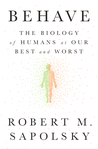
Behave: The Biology of Humans at Our Best and WorstBehave: The Biology of Humans at Our Best and Worst by Robert M. Sapolsky
My rating: 3 of 5 stars

A 3.5 star "magnum opus" needs some philosophy in general and Hume in particular

The book is not horrible, but it's not all that it could be or that some reviewers crack it up to be. Content, lack of content, and lack of editorial connectivity are all problems.

One biggie on the good side is about dopamine. Sapolsky, with all the latest on that, shows just how much dopamine can NOT be the "addiction neurotransmitter." (There are still plenty of the uninformed who think it is.)

1. On dopamine, at one point it becomes about rewarding anticipation of an actuality, not the actuality
2. Neurons have at least 5 dopamine receptors. D4 is the most studied … the DRD4 gene controlling for it has at least 10 different variants. The 7R form, with seven repeats of one stretch of the gene, is associated w/novelty seeking, addiction, promiscuity, risk taking etc. BUT the risk taking can be for good causes.
3. A particular variant has at most 3-4 percent effect on novelty seeking.
4. What constitutes ‘novelty seeking’ still varies from person to person.
5. In addition, the DAT (dopamine reuptake) gene also comes in different varieties.
6. Even an anticipation of a lessening of an electric shock of a Pavlovian operant conditioning type will raise dopamine

Then, I love this footnote:

Footnote, page 66: Dopaminergic responses to sexually arousing visual stimuli are greater in men than in women. Remarkably, this difference isn’t specific to humans. Male rhesus monkeys will forgo the chance to drink water when thirsty in order to see pictures of — I’m not quite sure how else to say this — crotch shots of female rhesus monkeys (while not being interested in other rhesus-y pictures).

Sapolsky has a fair amount to say about cultural evolution. No blinding light info, but generally solid.

He pretty much crushes Steve Pinker's "Better Angels" claims about our mega-violent past. (Pinker isn't totally alone in such claims, and he and fellow travelers like creating straw people out of anthropologists.) The reality, Sapolsky notes, and with which many anthropologists agree, is that primitive hunter-gatherers weren't violence-free, but they weren't totally Hobbsian. That said, Sapolsky only briefly references controversy over whether or not Pinker et al cheat by not counting internal violence by the modern state against its own citizens.

Surprisingly, after that kicking of Pinker, Sapolsky is generally accepting of sociobiology and its offspring, ev psych. He's also surprisingly at least halfway accepting of D.S. Wilson's neo-version of group selection. And, with that, for now, the book goes back to 4 stars.

Chapter on morals gets dicey. Gets close to scientism. Says he’ll talk more about virtue ethics later, but doesn’t, not in that chapter. Doesn’t recognize that many serious philosophers don’t consider the trolley problem to be serious philosophy.

And, speaking of, his last chapter, on the justice system, could use a lot of philosophy. And has none. Philosophy is missing elsewhere, too.

He uses Hume to introduce Damasio's idea of "emotional reasoning," which includes modeling hypothetical situations to feel potential emotional affect. But, he doesn't reference Damasio that much after that and doesn't mention Hume at all. Of course, Hume's famous "Is ≠ ought" is VERY pertinent in the justice system chapter, if no place else. The whole emphasis on "neuro-" in this last chapter comes close to scientism, and Sapolsky could use some help on matters of volition, which, rather than "free will," is the preferred terminology among many philosophers.

Then there's an occasional WTF. Here's the biggest, on 486:
In one such study, Michael Tomasello (a frequent critic of de Waal — stay tuned) ....

Stay tuned for WHAT? Per the index, and my reading, that's the only reference to Tomasello (who IS an insightful person) in the whole book.

Similarly, after promising, in the first few pages after that Hume reference, to talk more about Damasio later on, he really doesn't. There's only two brief references to him after the first 100 pages.

In short, although it's been several years since Sapolsky has had a tome, and I've liked his previous work this baby came off in some ways as looking like a rush job which needed a better editor as well as a philosopher to be among its readers.

I'd heard good stuff about it, but, because it's at 4.5 stars, my 3.5 star rating and the non-allowance of half-stars mean I bump it downward.


View all my reviews

Thursday, March 01, 2018

Moral realism, moral non-realism, moral naturalism

In this post at Footnotes to Plato, Massimo Pigliucci talks about morals and not participating in the "Big Four" of Apple, Google, Facebook and Amazon ever more dominating large chunks of the online world. The post is based on a new book about that.

A back-and-forth about moral framing issues between Massimo and Dan Kaufman in comments, with me largely agreeing with Massimo, led to me hinting that Dan is strawmanning Massimo on this issue (I still think he is, despite his denial), led to this last comment by Massimo:

“Massimo is also a moral anti-realist, as you know, as he’s said so here” 
It would be more correct to say that I’m a moral naturalist, as I think morality is a human invention (thus not “real”), but constrained by human nature, desires, and limitations (thus partially factual).
(His quote is of a previous comment by me.)

I told him in an email that with that explanation, I agree, and that it's why I think something like "ev psych done right," or a relabeled, start-from-scratch, the "evolutionary biology of psychology and sociology" is real — as long as said field includes gene-culture co-evolution.

That said, let me note a comment of mine there, not too much earlier, the one from which Massimo quoted:

Dan, you choose not to see any type of argument, especially if you don’t see “specialness” in something like trashing the entire planet’s climate. To further riff on Isaiah, I don’t try to reason forever where and when it’s a waste of time. 
Massimo is also a moral anti-realist, as you know, as he’s said so here. I’m a semi-anti-realist. Being a moral anti-realist is irrelevant here, other than the issue of language, and you choosing to make your division of where the word “moral” falls …
And others disagreeing
 
IF one wants to fully go down that road, and also be a moral anti-realist, every person in the universe can hive off by one’s moral self. If one takes it far enough, we can introduce Mr. Wittgenstein to Mr. Hobbes. 
That said, this is why I’m only a semi-anti-realist. Per the evolutionary development of human nature, I think we can find some moral values partially influenced by our human backgrounds. 
And, as for Mr. Wittgenstein meeting Mr. Hobbes? Based on the paragraph above, homey can either not play that game, or else play it in deliberately contrarian way, usually based on Cynic ideas.
I can do exactly that. I can call a person like Dan immoral, if I think he or she is for willfully narrowing their "moral arc," per Martin Luther King.

And I do think exactly that. Per the Markan explainer (reduplicated by Q with the Parable of the Talents) of the moral of certain parables, that, "to him who has much, more will be given," and even more, per the Lukan different explainer on a different parable cycle, that, "From everyone who has been given much, much will be demanded," and that virtue ethics morals, based on Massimo's moral naturalism, is somewhat of a sociological project (Massimo talks about writing and exemplifying) I think it is realistic to say that we as a society should expect a broader moral arc from people with higher intellectual gifts, especially if they have a more prominent social standing with it.

That said, whether it's "don't want to" or "can't," at times, Dan's psychological arc isn't highly expanded. He's said more than once that he just doesn't "get" families with less than a fairly high degree of cohesion, let alone families where blood is certainly not thicker than water. Taking it charitably as "can't" within his current psyche, and knowing of some of his gifts, I hope that both on that in particular and moral arcs in general, his arc does expand in the future.

Do I think Dan is as immoral as a person who drowns cats, let alone a suicide bomber? Of course not.

But, yes, and seriously — not just to play Wittgensteinian linguistic schadenfreude — I do think it's a moral failing of a small degree to not expand one's arc further, especially if part of that is willfully wanting to not expand one's arc.

Tuesday, May 31, 2011

How and why I became an atheist, part 4

In part 1 of this series, I look at my conservative Lutheran childhood, above all my conservative Lutheran minister father's influences.

Part 2 gets into my high school and college years.

And Part 3 gets to my trying to follow in dad's footsteps at a Lutheran seminary, or divinity school, up to the point of realizing that psychologically, I didn't want to be a minister and that, at the same time, intellectually and emotionally, I had problems with what I had been raised to believe.

So, here I am after two years of classes and a year of internship similar to a medical residency (we ought to make would-be lawyers do one of those, too), back for a final, wrap-up year of classes and realizing that this is NOT where I wanted to be going. I had enough money from scholarships and part-time work at a Lutheran publishing house that I didn't have to borrow much money to finish getting the degree while trying to figure out what I did want to do. (I've not totally figured that, 19 years later.)

On the academic side, I started doing "intellectual judo" on what I had been taught to believe. We'd been taught the bare bones of historical-critical theology with the idea that, as one professor put it, when Time or U.S. News comes out with its usual Christmas or Easter story, we could explain to church parisioners in a semi-fundamentalist denomination what was wrong with the story.

Well, being near the top of my class academically, and interested in the study of the texts and their exegesis, I took to this like a duck to water. Soon enough, before the year was out, I realized the more liberal wing of Lutheranism, just like liberal mainline Protestantism in general, wasn't a viable stopping point or landing point for my spiritual development. I was going to be some type of Unitarian, or beyond.

Related to that, I was reading more about psychology of religion and related issues. With my dad a minister, my oldest brother in the same graduating class as me, my sister having married a minister from the class ahead of me and getting her own master of arts in religion degree, my dad's sister being a Lutheran parochial school teacher, there were these larger issues.

I was losing, or cutting myself away from, some existential moorings. So I had emotional and psychological issues to face.

At the same time, I was bringing emotions, and philosophy, to bear on other religious issues, religious problems not just Christian in nature.

Big-ticket problems like the "problem of evil."

And, though I knew the basics about Buddhism, already then I was realizing that it wasn't necessarily just Western religions that have problems with this issue.

(The problem of evil is this, for the three Western monotheistic religions: How can an all-powerful god also claim to be all-loving while there's still evil in the world? For theologians who blame human sin, the quickest "counter" is with "natural evil" like hurricanes, etc.

Eastern religions? With more and more years of thought, karma, as an all-powerful law of reincarnation, becomes as evil, in a sense, as an all-powerful god for this failure. And, in some sense, the Buddhism that holds to karma is to me more perverse than the Christianity/Islam/Judaism that at least attributes this to a personal deity. But, I digress.)

On the academic side, tender young mid-20s Lutheran minds of mush were apparently too sensitive to stand up to such ideas. The dean of students eventually told me, after he'd been approached by several other students, that the only way he'd let me stay in school and graduate was if I observed a gag order. No, seriously.

So, I felt more isolated. And, as a divinity school has just one objective for its graduates (and my Lutheran undergraduate college had declined due to lack of enrollment), I had other angst on my hands, increasing - employment issues and lack of support.

Well, I graduated, continued to work part time at the Lutheran publishing house for a year after that while doing other PT work, and working on figuring out whether I was a Unitarian, an agnostic or an atheist.

A year after graduation, I realized I was at least quasi-agnostic. I knew then that Unitarianism the denomination was broad enough to accept agnostics, but ... was halfway ready to abandon religion as an organization.

Anyway, this wasn't an overnight process. My apartment complex where I lived the year after graduation was next to a small suburban St. Louis city park. I would pace out there late at night, praying/talking, or "praying"/talking to Jesus, Buddha, Yahweh, Allah, the Tao and more, venting my psyche, running through emotions and more.

This is part of why atheists (usually the P.Z. Myers type of "Gnu Atheists" who talk about religion as a psychological crutch don't get the time of day from me. I understand the desire for its comforts, still today. Ditto for those who treat "conversion" to atheism as a relatively pristine, highly intellectual process.

Then, my dad offered to let me move back home ... with the hope of me teaching on an adjunct basis at a college there. Well, it was better than what I was doing ....

And, that will continue in Part 5.

Monday, April 25, 2011

Just how irrational are we? Very?

Very, or potentially very irrational, defining "irrational" and "rational" in terms of the great project of Descartes and followers, it seems.

In a blog post at Discover, in follow-up to his column last week at Mother Jones, Chris Mooney notes that the journal Behavioral and Brain Sciences has devoted an entire issue to what he covered at Mojo, with links to summaries of key content.

Here's a couple of key outtakes:

First:
Reasoning is generally seen as a means to improve knowledge and make better decisions. However, much evidence shows that reasoning often leads to epistemic distortions and poor decisions. This suggests that the function of reasoning should be rethought. Our hypothesis is that the function of reasoning is argumentative. It is to devise and evaluate arguments intended to persuade. Reasoning so conceived is adaptive given the exceptional dependence of humans on communication and their vulnerability to misinformation. A wide range of evidence in the psychology of reasoning and decision making can be reinterpreted and better explained in the light of this hypothesis. Poor performance in standard reasoning tasks is explained by the lack of argumentative context. When the same problems are placed in a proper argumentative setting, people turn out to be skilled arguers. Skilled arguers, however, are not after the truth but after arguments supporting their views. This explains the notorious confirmation bias. This bias is apparent not only when people are actually arguing, but also when they are reasoning proactively from the perspective of having to defend their opinions.
And more, from a response to some of the issues:
When people reason alone, there will often be nothing to hold their confirmation bias in check. This might lead to distortions of their beliefs. As mentioned above, this is very much the case. When people reason alone, they are prone to all sorts of biases.

In short, as Mooney notes, classical Cartesianism appears m ore and more dead in the water. First, Dan Dennett (and others) said there is no little man, no Cartesian homunculus, making magic rationality decisions inside us.

Now, BBS et al say that, even if there were such a critter, he wouldn't be a disinterested rationalist anyway.

But, not all commenters on Mooney's post want to accept that, it seems.

I responded to one:
Nullius, (you seem to present) a great defense of the “traditional” view of reasoning or whatever …

BUT, I’m going to argue with you.

First, the “reasoning as argumentation” model I think explicitly says this is NOT, NOT, NOT, a “human failing.” Rather, it is, if I may, “human ISness.”

I won’t propose abandoning “rationalism,” but I will say that it is even more unnatural than you may want to admit.

And, that IS a conflict with Cartesianism, which postulates rationality is a cornerstone of homo sapiens.

Sorry, but, either you don’t get the degree of implications this involves, or …
You DO, unconsciously, understand precisely what is up and by your conscious argumentation, actually support the fact at hand.
Of course, maybe I have reasons for my argumentation.

Meanwhile, this SciAm blog explains some of the reasons for our irrationality, in terms of motivators.

Friday, September 17, 2010

Blackmore shows ignorance of both memes and religion

Susan Blackmore admits that religion isn’t a “virus of the mind.”
Are religions viruses of the mind? I would have replied with an unequivocal "yes" until a few days ago when some shocking data suggested I am wrong.

Why?
From a conference on “Explaining religion,” she cites the following reasons.

1. Religious activity correlates with more children.

And, no others.

Yep, that’s it.

First, despite her noting her previous mea culpa over believing in the reality of paranormal phenomena, it shows Blackmore might still lack intellectual rigor in some areas.

This is a prime example. She didn’t even look for additional information, like average lifespan of children from religious vs. nonreligious families.

Nor did she take a look at a single datum of cultural evolution that might be connected.

Nor did she acknowledge this might be an issue of cultural evolution trumping genetic evolution.

Shoddy, shoddy.

Beyond that, she didn’t even ask the most pertinent question:

Shouldn’t this put another nail in the coffin of “strong” theories of memes, at least?

Answer? Yes.

Meanwhile, I can't wait for the Christian version of a Pop Ev Psycher to actually cite this column.

Monday, August 31, 2009

It ain’t just men who are serial monogamists

In the latest blow, of many, to Pop Evolutionary Psychology, it turns out that some women marry multiple husbands serially. That’s in societies with fairly equitable power distribution.

Sunday, October 19, 2008

Liberal ignorance about ev psych raises its political head

Well, I haven’t had to shoot down any right-wing eugenicists or sexists in a while. No, now it’s a mainstream liberal wanting to refight Richard Lewontin’s political ax-grinding against E.O. Wilson 30-plus years ago. Hilzoy, co-host of Washington Monthly these days, bemoans, and Atlantic Monthly putting Wilson’s “The Biological Basis of Morality” online. (Thanks, Atlantic — it’s bookmarked!) And, it’s right here for you.

First, comes the snideness, hinting that Wilson is little more than an Alan Sokol with his spoof on PC lit crit. I never did tackle that in my back-and-forth with her, but to me, that was sign No. 1 we were going to get a political discussion of Wilson, not a scientific one, or even a philosophical one.

Next, comes the politically driven non-skeptical liberal approach of putting John Rawls and his ideas of “justice as fairness” and “distributive justice” on a pedestal, clueless that Walter Kaufmann blew Rawls out of the water 40 years ago, before Wilson ever tackled him scientifically. (Hilzoy rejects the idea, but she’s not read Walter Kaufmann’s “Without Guilt and Justice,” which does just that.)

Third is the omission of the fact that Wilson was the target of a politically-inspired, not scientifically-motivated, vendetta after publishing “Sociobiology” in 1976.

So, here’s selected passages from the long earful I gave her:
First, I don't KNOW if this is the case with Hilz in person, and I've distinguished that sociobiology, while in some sense a godfather to ev psych, is not exactly the same....

BUT, BUT, BUT...

I get the feeling that for many here, Wilson is all about "what's wrong with 'reductionistic science.' "

First, read Dan Dennett and distinguish between reductionism and greedy reductionism.

Second, given that Wilson started writing about this 30 years or so ago, Hilz, I assumed you had an ax to grind. I looked at what I saw was the most logical ax.

Third, many non-skeptical liberals put Rawls on a pedestal. That's why I pointed out Rawls has been shot down from within the world of philosophy. Based on this post, I'm also inferring you're one of those non-skeptical liberals.

Kaufmann does an excellent job of showing that distributive justice, a horse ridden hard by Rawls, actually isn't just.

He then goes beyond that, in "Without Guilt and Justice," and notes that justice is NOT some Platonic ideal but very much a socially based convention. And, on that grounds, Rawls IS a transcendentalist, so you got that part of your critique wrong. (And, I've read Rawls as well as Kaufmann, and Kaufmann's right. From a somewhat different angle, Dennett also pokes holes in Rawls.)

Third, you opened the snideness door yourself, with the Sokol crack, Hilz, and I'm just firing back.

More seriously,though, try reading more of Rawls, more skeptically, as well as some critiques of him.

(So), Rawls was wrong, justice is not fairness. He was a transcendentalist for offering that claim without empirical evidence. (One need not be religious to be a transcendentalist.)

From this, it is arguable that there is no such thing as a just society. Some societies may be more just, others less just. But, to claim justice as perfection is another transcendentalist claim from where I sit.

Next, just because I reject Rawls as a political philosopher on ethics doesn’t mean I have to accept Nozick, and I don’t.

But, on Wilson at this point…

If there are no transcendent principles which we can label “justice” then we had better find some empirical underpinnings lest we enter a Hobbsian world.

From here, sociobiology says, evolutionary biology is the logical place to start looking for empirical underpinnings, along with empirical causes, etc.

That said, Wilson has himself pulled back from stronger statements of later Ev Psychers and even some ev psycher. He is definitely NOT a “œnature = destiny”� person.

Next, let’s look at the “other side of the street.”

It’s not as if Gould and Lewontin were free from bias in their critiques of Wilson. (And a s left-liberal Green voter, don’t try to claim I’m politically biased from the right.

Next, if you’ll Wiki, the word ‘sociobiology’ was around 30 years before Wilson’s book of that name.

And, as Wiki also notes on the article of that name, Wilson himself has been a noted liberal, and visible one, on many issues.

OK, more on what Wilson actually says.

First, “contrivance of the mind” does not necessarily mean “conscious contrivance.”� In the case of ev psych, or its sociobiology godparent, it explicitly does NOT mean that.

Second, as for the “naturalistic mind,”� what’s wrong with that? Although I disagree with Steve Pinker on a lot, to the degree the human mind is not only from the brain, but has been influenced by the evolution of the brain, he’s right — deal with it. Live with it.

Finally, an aside … I didn’t start reopening one side of a 30 Years War, Hilz, which is what your post seems like from here; if my inferences on any of your reasons for this post are wrong, maybe you should articulate them. Maybe you should have done so in the first place.

As for the “dumping water” incident, it was stupid, childish and reinforcing of the “liberal academia” �stereotypes of many conservatives, many of whom themselves didn’t like Wilson’s ideas.

And, that war was politicized from the start. John Maynard Smith, a dean of evolutionary biology at the time Wilson’s book came out, expected them:
“It was also absolutely obvious to me--I cannot believe Wilson didn't know--that this was going to provoke great hostility from American Marxists, and Marxists everywhere.”

But, it apparently has no problem finding resources and agents to investigation ACORN.

Of course, it’s not all the FBI’s fault. It’s been asking for more money to investigate financial crime since 2004, but our MBA president just hasn’t been forthcoming. According to former law enforcement officials, that would be anti-business and “overdeterrence.”

In fact, Hilz said she considered her post the equivalent of the water dumping, so I know that I can’t go anywhere with her on scientific grounds, and given the starry eyes for Rawls, not far on philosophical grounds.

As I also told her, I don’t care if Rawls is the most influential political philosopher (in the U.S., or the western democracies) of the last 50 years. Karl Marx was the most influential single political philospher for the world as a whole for most the 20th century, so appeals to the crowd don’t fly.

Beyond that, I think Hilzoy has another assumption that lies behind her post.

And, that is?

That only conservatives can politicize science.

And that just ain't so.

Tuesday, October 14, 2008

Bonobos busted making war as well as love

Many researchers (Frans de Waal comes immediately to mind) have long suspected that frequent bonobo copulation in zoos was a stress response as much as anything else. Well, bonobos making war — even females certainly provides indirect confirmation to that idea.

Now, I don’t doubt that bonobos are nonetheless, more peaceful than common chimpanzees, on whom they were found hunting. But, the “free love primate” is dead.

And, thank doorknob for that. From where I sit, this idea was a cross-species version of psychological projectionism.

And, in terms of evolutionary psychology, it was probably a dangerous idea, too.

Saturday, July 26, 2008

Is Evolutionary Psychology the new sexism, or the new Social Darwinism?

Note – per a blog post earlier this week, I once again have clearly explained the difference between Evolutionary Psychology and scientifically investigatable evolutionary psychology.

Here’s the link to my evolutionary psychology label; a few of the more illustrative individual posts. Several of these are especially illustrative of how Ev Psych approaches, if not goes beyond sexism … and no, you Ev Psychers, not just beyond a social construct called sexism, but, beyond sexism.
Women’s improvement in gaming refutes Ev Psych;
Ev Psych claims for sarcasm are “stretched” (mainly by ignoring cultural evolution);
The stereotypical male-female math gap can be reversed;
Susan Pinker plays wrongly plays down workplace sex discrimination;
Definitional questions EvPsych, and, to a lesser degree, ev psych, leave undefined;
The core of the differences between Ev Psych and ev psych.
Some serious snark about Ev Psych riffing on Leibnitz’s “best of all possible adaptationist worlds”;

And,finally, David Buller’s seminal article on the subject at Scientific American. (To you Ev Psychers who dismiss him as “just a philosopher, what do you do with Dan Dennett, then?)

Read his book, too.

Or, a decent but not really good read is Richard Francis’ “Why Men Won’t Ask for Directions.”

On the flip side, in this post about behavioral economics, among several posts, you’ll see how I praise evolutionary psychology. Just not Evolutionary Psychology.

Do NOT e-mail me, or comment to this post, that I am against evolutionary psychology, lowercase, until you’re read that post, at least, and perhaps others on my blog in general.

That said, I do propose that capital-letter Evolutionary Psychology does threaten to become the new Social Darwinism, and with a political bias to it, too, at least in some cases.

Steve Pinker admitted as much, near the end of “The Blank Slate.”

He told political liberals that they needed to accept the reality of what he said was “evolutionary psychology” (and what I say is Evolutionary Psychology), deal with it as best they could, and adjust their political prescriptions accordingly. Pretty political to me.

The other reason I think that threatens to be Social Darwinism is its focus on sexual differences. By arguing that men have dominated societies in the past (not true, as far as I can see, before the invention of agriculture), capital-letter Ev Psychers give the appearance, at least, of telling women today to accept the glass ceiling, accept secondary status in society, and deal with it – because it’s all normal.

And, if you’re not prepare to describe why you personally, if you do, focus so much of your ev psych discussion, or especially, your Ev Psych discussion, on sexual selection issues, move on. Because that WILL be part of the dialog and investigation from my end.

A book with a few thoughts on that is Robert Sapolsky’s “Monkeyluv: And Other Essays on Our Lives as Animals.”

In fact, let me excerpt a few sex-specific comments from my Amazon review of Sapolsky, by page number:
63. In a study with ducks, with attractive males, it actually appears that the female invests more energy in the egg, laying a larger egg when impregnated by an attractive male. (The egg size is under female control.)
Both of these should put some question to old stereotypes about peacock tails being signs of fitness and so increasing mating, etc. At the least, they should caution us to look for more nuanced explanations.

177. In many species, females in some way manipulate alpha-male type males into fighting over them, to go off and mate with more "nice guy" types.

Some more food for thought.

And, I’m not going to even bother linking to the recent story showing girls do as well on math as boys, which undercuts one of Ev Psychers’ favorite male-female difference talking points.

Beyond that, with true, lower-case ev psych, there’s plenty of things to talk about in the evolution of the human mind, not the “male” or “female” mind.

I mean, look at Scott Atran’s “In Gods We Trust.”

There’s books on behavioral economics; the effect of evolutionary psychology on Homo economics is certainly not small. (Don’t forget to allow for cultural evolution here, too, though.)

Enough said.

Monday, June 02, 2008

Larry Summers and Steve Pinker listen up!

That male-female math gap?

It appears to be reversible. The quasi-metaphysical Evolutionary Psychology, as opposed to the actually scientific evolutionary psychology, takes another body blow.

Here’s the details of the latest research:
• Girls are as good at math as boys given the proper environment.
• Males may have an edge in spatial thinking abilities, which are useful in math — and this advantage may be very ancient, evolutionarily speaking.
• Deep-rooted though this difference may be, females can surmount it with just a little work.

More proof of this gap being at least in fair part environmentally based?
“The gap doesn’t exist in countries in which men and women have access to similar resources and opportunities,” said Paola Sapienza of The Kellogg School of Management at Northwestern University in Illinois, summarizing the results of a new study published in the May 30 issue of the research journal Science.

And, another study notes that the spatial cognition differences, to the degree they have a real gender basis, can also be surmounted. (In other words, Pinker, Summer, et al, environment trumps “raw genes” again. Try reading somebody like Matt Ridley.)

Tuesday, April 22, 2008

Language can shape our perception of the world

This has been a back-and-forth in both philosophy and psychology ever since Benjamin Whorf mythically claimed the Eskimos had 100 different words for snow. (He didn’t, actually.) For a long time, in relatively recent years, well, ever since the discovery of DNA and the crumbling of Skinnerian behavioralism, Whorf’s ideas were cast by the wayside.

But now, a Cornell researcher has partially resurrected them.

At least with color discrimination, Gary Lupyan says a specific language background does make a difference:
Language helps us learn novel categories, and it licenses our unusual ability to operate on an abstract plane, Lupyan said. The problem is that after a category has been learned, it can distort the memory of specific objects, getting between us and the rest of the nonabstract world.

This fits well with the general idea of “man the category-making creature.”

But, not everybody is ready to buy into even a limited version of Whorfian linguistics redivivus.

On the contrary side? Evolutionary Psychologist (yes, with the double capital letters, see my tages) Steve Pinker. (That, of course, means there’s a good chance the theorizing is right and he’s wrong.)
This separation of language and thought is emphasized in a recent book by Steven Pinker, at Harvard University, a skeptic of “neo-whorfianism.” In “The Stuff of Thought: Language as a Window Into Human Nature,” Pinker explores the complicated ways that language and thought relate to each other. He cautions against confusing the “many ways in which language connects to thought.” “Language surely affects thought,” he writes, but he argues that there is little evidence for the claims that language can force people to have particular thoughts or make it impossible for them to think in certain ways. With numbers, the importance of language evidence is much clearer. It appears that the ability to count is necessary to deal with large, specific numbers. And the only way to count past a certain point is with language.

He’s overstating the case. Lupyan didn’t say anything about forcing. Rather, as with human genes, we might say that in certain categories of reasoning, one language may create a predisposition (and perhaps no more than a mild one) toward reasoning in one way rather than another.

Sunday, March 23, 2008

Nice guys win while clueless guys remain clueless

Two interesting, but not exactly earthshaking, studies on human psychology out there, one about “guys” as humans in general, and how being nice does “win” in the game of life, while the other quantifies what most women have long said, that guys are clueless about “reading” them.

First, the “nice guys” story. Researchers found that, after a while, the negative reinforcement of punishment loses its psychological reinforcement. The research involved multiple rounds of the prisoners’ dilemma game, with a higher-than-normal punishment level.

The reason I say this one isn’t totally earthshaking is the some part of the principle behind this has long been exemplified in the “good cop, bad cop” scheme. However, this goes beyond “good cop, bad cop” in cooperation vs. punishment between equals.

Perhaps semi-equals who run free-world situations, like tyrannical bosses, will sit up and take notice.

The second study?

Researchers found that men misread women’s friendliness as sexual signals.

Well, that’s the “no duh” insight of the year, right?

But, it also found that men misread women’s sexual signals as not being about sex but just friendship.

In other words, men misreading women isn’t related to male libido and sex focus, just to men not being so observant.

Saturday, March 08, 2008

Pinkers – like brother like sister in quasi-junk science

It appears Susan Pinker is just as much a died-in-the-wool “naturist” on evolutionary psychology issues as is her better-known brother, Steven.

Specifically, in a new book, it’s the difference between boys and girls at school, followed by men and women at work, that gets her research psychologist’s explanation of being all about hormonal-generated differences in male and female brains.

The facts of difference are unarguable today. In school, boys are truant more, cause more disciplinary problems, perform lower on standardized tests, etc. But, they’re still the leaders in the business world. And, glass ceilings aside, women in the business world generally indicate higher degrees of job satisfaction, Emily Bazelon notes.

Pinker rejects the idea that much of this is due to the “glass ceiling” effect in the business world. She does admit there is some sexual bias, but says its effect is minuscule:
To support this, Pinker quotes a female Ivy League law professor: “I am very skeptical of the notion that society discourages talented women from becoming scientists,” the professor writes. “My experience, at least from the educational phase of my life, is that the very opposite is true.” If women aren’t racing to the upper echelons of science, government and the corporate world despite decades of efforts to woo them, Pinker argues, then it must be because they are wired to resist the demands at the top of those fields.

Now, Clarence Thomas would claim that society doesn’t hold black men down, either, and would cite his own academic experience, without talking 5 seconds about how much he benefited from affirmative action. So, without knowing who this professor is and how she got to where she is, I can’t even begin to dissect her statement.

Beyond that, Bazelon does her own takedown on Pinker and that pesky “glass ceiling”:
Pinker also skips past an answer to the book’s central question that may have more explanatory power than her other arguments, even if it’s more prosaic and familiar to many a parent. Boys lag dramatically behind girls in terms of psychological development and physical resilience and then start to catch up as teenagers, as a long-running and well-known study Pinker cites documented. Maybe after a few years as girls’ developmental equals, boys are ready to compete in the work force — and then zoom ahead as cultural norms and discrimination push women back. After all, why would girls’ hard-wired predilection against competition stay on ice while they blithely sweep all the academic honors and then kick in only at work?

I don’t reject sexual dimorphism in the human brain, at all. But, as Matt Ridley put it in his excellent book by that title, I affirm the reality of “nature via nurture” and it is obvious neither Pinker sibling does.

Fortunately, the pendulum of scientific study, even in molecular biology and genetics, as we learn more about how much “junk DNA” is actually regulatory sequences which control the expression of codons, regulatory sequences affected by cellular environment.

Let me take this opportunity to remind readers of the difference between evolutionary psychology and Evolutionary Psychology, too.

Wednesday, December 19, 2007

Evolution’s acceleration and the evolution of religious belief

Recent news that the pace of human evolution may have accelerated in the last 40,000 years, and accelerated a lot in the last 10,000, seems like it would fit both with books I’ve read on cognitive science and evolutionary psychology’s connection with religion by others such as Scott Atran and Pascal Boyer, but also with the dating of cave paintings in sites such as Lascaux.

Thursday, November 29, 2007

Aggressive woman gets the guy

At least in the antelope world. I wonder how some of the more sexist practitioners of Evolutionary Psychology (vs. real proponents of evolutionary psychology), such as Randy Thornhill and Craig Palmer, will spin this challenge to their metaphysical beliefs.