Thursday, November 02, 2023

Standing Josiah and Deuteronomy on their heads

We start with a recent study by Paul Davidson, author of the "Is that in the Bible?" website.
"The 'Fire from Heshbon' and a censored King of Judah" proposes that seeming problems in the text of Numbers 21, a song about Mosaic-wandering Israel's battle with Sihon, king of Og, and Balaam's refusal to curse Israel on Sihon's behalf reflect something deeper. That's his Problem 1.

Namely, he ties them to seeming problems in 2 Kings with the regnal dates and heritage of Josiah. This is his Problem 2.

Davidson first notes, as do many lay and academic biblical scholars, that the total of Judahite regnal years vs the actual time span based on external calendrical anchors leaves a surplus. In Davidson's calculations, it's 8 years.

Second, Josiah is made king "by act of the people." And, other than the populace pushing Samuel to give them their first king (but even then, it was Samuel's act after consulting with Yahweh), nothing else like that is in the Bible.

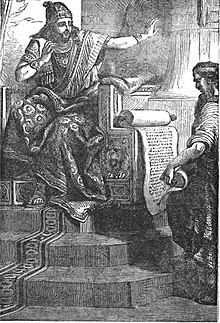
Image: Josiah receiving the book of the law, something that, as we shall see below, almost certainly never happened.

It gets worse, with Josiah's own birth and progeny.

Furthermore, math dictates that Josiah was conceived when his father was only 15. Again, not a biological impossibility, but still quite unlikely.2 The problem is even worse for Josiah’s two oldest sons, who are conceived when Josiah is 13 and 15 years old! (Jehoiakim is 25 when he takes the throne in the same year as Josiah’s death. Josiah died at age 39, meaning Jehoiakim was born when Josiah was 14. By biological necessity, he would have been conceived 10 months earlier.) 
There is also significant confusion about who Josiah’s sons were. According to 1 Chronicles 3:15, he had a son Johanan who was born even earlier than Jehoiakim (!), while Jehoahaz (his second-born in 2 Kings) is nowhere to be found. Meanwhile, 1 Esdras 1:32 (v. 34 in some versions) refers to Josiah’s second-born son as Jeconiah, and Jeremiah 22:11 gives his name as Shallum, which is the name of Josiah’s fourth-born son according to Chronicles.

Oy vey indeed!

Problem 3 is the Tower of Hananel.

His solution is the "censored king of Judah," building on previous scholarship.

In 2005, the late Orientalist historian Giovanni Garbini made the remarkable proposition that Judah was briefly ruled by an otherwise unknown Ammonite king named Hananel during the mid-600s BCE, and it was he who built the eponymous Tower of Hananel.

Innnteresting. Garbini goes on to propose that King Amon (note the similarity to Ammon) was that foreign king, eventually booted in a coup, and replaced by Josiah. 

Davidson says that still leaves unanswered for certain details of Josiah's death, but it's a good idea.

OK? 

I take off from there, courtesy Idan Dershowitz, an up-and-coming Tanakh scholar.

Years before, I had read, and reviewed, "The Lost Book of Moses," about Moses Wilhelm Shapira's 1880s reception of a possibly antique Hebrew scroll, referred to as the Shapira Scroll, covered with bits of bitumen and other things. If this had happened after 1947, or enough after 1947 for the Dead Sea Scrolls to have their antiquity and authenticity established and accepted, Shapira's find would have been glommed onto by scholars. Instead, he was accused of forgery, allegedly proven by cursory examination, and a few years later, committed suicide. Being a converted Jew from eastern Europe probably didn't help him.

But, hold on, says Dershowitz, who in a monograph called "The Valediction of Moses" (PDF) says that Shapira probably found either a direct or indirect predecessor of the canonical Deuteronomy, one that includes only the narrative, not the "book of the law" of modern Deuteronomy 12-26. (Wiki's piece on the scroll references Dershowitz; on Shapira itself, it does not.)

Hold on to that thought.

Relevant to Davidson, Dershowitz notes that "V," as he calls this scroll in shorthand (having done a strong attempt at reconstructing the now-lost original from Shapira's notes) has a different version of the battle with Sihon than canonical Deuteronomy 2. (To tie back to the top of this piece, Deuteronomy's version of the battle with Og king of Bashan, no Balaam, is in the next chapter.)  In it, Yahweh has Moses provoke Sihon into war; in V, it's a straight-on attack by Israel. Note: Dershowitz says "Elohim"; in canonical Deuteronomy, it's "Yahweh." This is not "stickyness" over the divine name by Dershowitz, as he uses the consonants YHWH of the Tetragrammaton himself; rather, in passages that are directly parallel, Shapira doesn't have Yahweh. The bigger issue is that Yahweh, not Elohim, is who is the actor throughout canonical Deuteronomy.

As I see it, there are four possibilities, off the top of my head:

  1. V is indeed a precursor, whether direct or indirectly, to canonical Deuteronomy and Elohim is who it is.
  2. Shapira, as a converted Jew, wouldn't write out the Tetragrammaton in his notes to a legit book.
  3. Shapira or whomever, as forger, wouldn't write out the Tetragrammaton.
  4. This is indeed ancient, but it's not a precursor to Deuteronomy. Contra Dershowitz, call it a targum or whatever, written by a Jew to clear up confusions in Deuteronomy before that text became too finalized, maybe.

How likely are each of these?

I'll dismiss 3 right away. Writing out the name is not a problem on Torah scrolls, and besides, a forger wouldn't have scruples.

No. 2? I don't know enough about Shapira's religiosity to offer any "Bayesian probability." Take that, Richard Carrier. I don't think that's highly likely, though, especially given further background, in the following paragraph.

So 1 vs. 4 is where we're at. Without explaining why V uses Elohim, Dershowitz does say that, in canonical Deuteronomy, the insertion of the law code would have meant rewriting Deuteronomy 2 into current form so that Moses doesn't violate the laws of war in Deuteronomy 20. Otherwise, on the name, he says that "V" shows no use of P or P-like material.

How likely is Dershowitz's claim, by the way? At academia-lite, Biblical Archaeology Review, Jonathan Klawans, without calling Shapira the forger, says it's possible he was, and if not, somebody else, indicates that "V" is too Christianizing, and thus can't be authentic. BAR's founder, lawyer and James Ossuary grifter Hershel Shanks, stated this more firmly, jumping with both feet 20 years ago, long before Dershowitz. (Being a converted Jew probably didn't help Shapira again.)

Dershowitz goes on from the Sihon pericope to note that the incipit V has of Dt. 1, far shorter than canonical Deuteronomy, reflects a reconstructed proto-Deuteronomy broached by other scholars, but not in today's version until decades after Shapira got the scrolls and not at all until a few years later.

Next, he directly addresses Klawans' and Shanks' complaints about V's version of the Decalogue, the Divarim. He notes that there are several places with "intertexts" of the Commandments that parallel at least in part V's version. The closest is Leviticus 19, and it totally blows up the objections.

So, as a working hypothesis, let us assume Dershowitz is correct.

This ties back to Davidson. 

Under this theory, the narrative sections, Deuteronomy 1-11 and 27-32, are the original, and the priestly-like law code of Dt. 12-26, a later, and intrusive, insertion. (It interrupts the Ebal and Gerizim narrative.)

For traditional critical scholarship, per this piece,* this means that Dt 12-26 almost certainly could not have been "the book of the law" magically uncovered soon after "an act of the people" put Josiah on the throne. Under the Dershowitz timeline, Dt 12-26 is certainly exilic and possibly to probably post-exilic. (He promises a future book on Dt's composition.)

He wraps up with comparing V and canonical Dt on the Ebal-Gerizim narrative and finds a few interesting differences.

This does leave one item up in the air. And, that is, why does Shapira's proto-Dt. end with Deuteronomy 11 and not the second half of the narrative material, the Former Prophets material if you will. I hope it's something he tackles in his promised book on Deuteronomy.

==

* Piece at this link is cited only for illustrative purposes. I think Russell Gmirkin's idea that the Greek LXX and Hebrew Torah in the current form were written simultaneously in Alexandria, with a core of history behind Aristeas' letter, is laughable. It's based on a strawmanning version of the documentary hypothesis, first, and second, even if Gmirkin IS right on that, his solution is not one. A whole series at Vridar devoted to Gmirkin leaves me no more convinced. Some of his ideas are easily dealt with. 

Why is their no attestation earlier in Greek sources of the Torah? No Jewish diaspora, for starters. And, as a JTS review of his book notes, he simply ignores apparent references in Isaiah and elsewhere to the Torah. Weirdly, per this savaging Amazon review, Gmirkin at the same time, via Manetho etc., seems to believe there was a literal Exodus. Another 1-star review suggests an earlier translation into Greek of an earlier extant Torah addresses many of Gnirkin's claims.

And,  this may expand into a separate post.

Thursday, October 26, 2023

Sapolsky all wet on "No free will means Yes determinism"

And, thoughts and claims like what Robert Sapolsky is apparently putting into a new book show why, scientism-peddling scientists aside, science still needs philosophy.

I've long said "mu" to the issue of "free will VERSUS determinism," and have gone beyond even that with the wonderful insights of the late psychologist Daniel Wegner, on "The Illusion of Conscious Will."

Just because conscious will is an illusion doesn't mean that determinism is the only counter-answer. That's why I said mu so many times years ago, and also why, per Idries Shah (a philosopher!) this is clearly an issue with more than two sides.

And, specifically, what Sapolsky is talking about is what I've called psychological constraint. It's no more deterministic than our genes are, and an evolutionary biologist knows our genes aren't determinist. Yes, bad childhoods on average, per sociological survey, means that the average person with a bad childhood is more likely to become an addict or whatever. It doesn't at all mean they're predestined for that. It also ignores, as I discuss here, just what words like "agency" and "intentionality" mean.

I have read Sapolsky's most recent book before "Determined," "Behave," and noted that it exhibited muddied and muddled thinking, and I have no doubt this is more of the same, and not worth reading. In fact, on that linked review of "Behave," I said then that Sapolsky needed some philosophy. I also said he was getting close to scientism in general and ev psych in particular. I wouldn't be surprised if "Determined" is yet more that way.

To put it another way? As I said long ago on my main blog, "determinism is often simplistic."

Or, and as Sapolsky demonstrates in this Nautilus interview, determinism is often nothing more than a tautology for methodological naturalism, or more, philosophical naturalism or monism (monism in a non-duopoly, materialist-only sense, and not suggesting anything like Leibniz's monads). This alone, contra a Sapolsky or a Stephen Hawking, shows why philosophy is not dead and why scientists need to stop saying that and stop believing that.

It is interesting that, in that piece, both Sapolsky and neuroscience professor, and free willian, Kevin Mitchell, refer to the Libet experiments. See my most recent thoughts on them here. Mitchell also appears to have not read Wegner. And, shock me that Sabine Hossenfelder, who has plenty of "incoherence" herself, attacks free will as being incoherent. Yet more reason to be glad I deblogrolled her on my main site.

Finally, I reject Sapolsky's idea that determinism is something that, essentially, we need to believe in even if it isn't true, for political science and human sociology reasons.

And thus, I continue to say mu on free will vs. determinism.

Thursday, October 19, 2023

Stacking the deck in 'A Canticle for Leibowitz'

A Canticle for Leibowitz (St. Leibowitz, #1)

This is an even more extended version of a Goodreads book review than normal. That’s because, in this case, while I overall still think the novel is a five-star on literary style, there are “issues” behind it. 

My original review doesn't have plot spoilers, so you may need to hit the Wiki page for "A Canticle for Leibowitz" to understand why, beyond saluting it as good novelistic writing, I started having a variety of concerns about the author, Walter M. Miller Jr., stacking the deck on the background, or "framing," of the novel.

And, I concluded by moving beyond those initial concerns to some degree of disquiet.

A Canticle for Leibowitz by Walter M. Miller Jr.
My rating: 5 of 5 stars

(That's the initial rating, before this in-depth review; I lowered it to 4 stars after that.)

A damned good book, or so I said in my initial review.

Almost as dystopian as Cormac McCarthy (until the final twists), but without his gratuitous violence in general and gratuitous bloodshed in particular. Possibly deeper in some ways, philosophically. And, per the Wiki pieces on this and Miller personally, reflecting his WWII service as being one of the US bombers that destroyed (probably, though not certainly, unnecessarily) Monte Cassino.

Plot and characters are both good. As are recurring themes. The wordplay in the second part (Fiat Lux), while not on the level of an Umberto Eco, hints in that direction. (I wonder if the name of Leibowitz was in fact such a play.) The "twists" that will later develop can usually be seen in a general way, but not specifically, until you're right there. (A good example of that is Ms. Grales' "second head" Rachel eventually becoming a new Virgin, which I recognized he was getting at right when we got there.)

My only complaint, or bit of perplexion, or something? And, that is that "Lazarus" (a character in both parts 1 and 2, and early in part 3, under various names in the three parts) doesn't make a final appearance somewhere near the end of Part 3. It could be that Miller couldn't figure out how to work him and Rachel both in at the end. (Personally, I would have loved to have seen him as a stowaway on the spaceship.) Or maybe it's a statement by Miller.

And, per Miller's word play, and one last aside on Lazarus? In Part 2, with the two Hebrew phrases, especially the specific way the second riffs on the Shema? I don't know whether Miller intended it or not, but he likely did, with the specific Hebrew word substituted in the Shema riff? Lazarus is also someone else (besides possibly Leibowitz), and that someone else also from the Christian New Testament.

==

A note for friends: If you're not religious in general, and haven't been, you may not even grasp at the meaning of the Latin, and if you don't know Hebrew at all? (The first of the two phrases is translated, the second not.) Have Google Translate ready as needed.

View all my reviews

==

Now, the critique of the backstory.

The biggie is that, if not outrightly stacking the deck, Miller clearly comes down on the side of religion vs. science, and makes it a two-sided battle of religion versus science. The term scientism may not been around in 1959, but that’s arguably what he’s critiquing. (And, by the time I finished this up, if not “stacking the deck,” I’m ready to say he’s putting one, at least, of his two thumbs on the scale.)

First of all, in Part 1, we don’t know enough (in the novel) about the actual Leibowitz to say what exactly he did with nuclear programs. But, that’s minor.

If we’re going to attack science, or even scientism, let us remember that absolutist religion has given us crusades, pogroms and holocausts. Plural. As in, in 1 Samuel, Yahweh telling Saul to commit a holocaust on the Amelekite people and even their livestock. And, it’s not just “western” religions. Think of Buddhism’s 969 Movement in Burma. Or the RSS and Hindutva thought in India.

Second, the miracle of Rachel the teratoma or whatever we shall call her arising from Mrs. Grales? Yet, Miller doesn’t have New Rome trying to move a colony of the Order of Leibowitz from Earth to Alpha Centauri by miracle. Nope, it’s a rocket launch — rockets like those that kicked off both nuclear Armageddons. And, for that matter, there’s no miraculous intervention in either Armageddon.

As for the Tua Voluntas Part 3 “showdown” between Abbot Zerchi and Doctor Cors over the issue of euthanasia? First of all, every religion will soften at the edges, at some point, on some major moral issue. Look at actual Catholicism today vs. times past on suicide. Or it will row its absolutist oar, if deemed necessary, when science challenges. Look at the actual church on abortion and reproduction.

And, in part two, giving the secular scholar Thon Taddeo the last name, auf Deutsch, of "plodding priest" only increases the deck-stacking.

In reality, per Walter Kaufmann, there is no such thing as absolute justice and morals must bend on that, despite Miller sympathetically having Zerchi punch Cors. And, the dying Zerchi thinking that “the battle” was not with pain, but with the fear of pain? His Wiki page notes that Miller committed suicide shortly after the death of his wife, and he reportedly suffered from depression for many years before that, and PTSD over the Monte Cassino bombing. (He had converted to Catholicism after the war, per his own Wiki page.)

There’s also datedness and/or Eurocentric issues. Why not have a “New Lhasa” with Tibetan Buddhism paralleling Catholic Christianity? The primary reason is obvious. "Canticle" is ultimately a paean to the eternal verities of Mother Church.

I will confess that I did not pick up on the Wanderer being “the wandering Jew.” (Wiki's link on the book indicates it is.) The Leibowitz name … “body joke” … may be a pun on that. One wonders, per the Wiki page, if Miller was influenced by Lew Wallace’s “The Prince of India,” where he is the protagonist. That said, that's "interesting" in itself and hold on to that thought.

Page 169, as numbered in the paperback I read, is interesting, with two phrases in Hebrew, but Miller only offering a translation of the first in the book. The second? A riff on the Shema, where I first thought a deliberately corrupted form of Adonai was being substituted for Yahweh, but not true. "Day" (די is Hebrew) for "enough," "sufficient" or "sufficiency," not a shortened Adonai. "Hear, O Israel, sufficiency is our god" ("qoph" used for "he," but Google Translate rendered it as "our god" still, and perhaps it is in modern Hebrew), and sufficiency alone." 

Update: Wikipedia, as seen by a piece on Easter vs Passover datings in The Atlantic, notes that "dayenu" is even a Passover song. And, in fact, Wiki also notes the song may have arisen as a response to the "Improperia" of the Christian Good Friday service. So, knowing Miller's pre-Vatican II Catholicism, surely this is all intentional.

A Buddhist riff, or a riff on what Paul was supposedly told, that "my grace is sufficient for you" when he asked for the thorn in the flesh to be removed? After all, the first phrase IS Tents Repaired Here and what did Paul do? 

I'm pretty sure it's not a Buddhist riff, and my update confirms. In that case, Paul, like Lazarus, is the wandering Jew? But why? I have no idea on Lazarus, but, with Paul, maybe it's to subordinate him to first pope Peter? Even though Peter was also a Jew? The "wandering Jew" reportedly taunted Jesus. This would fit pre-repentance Saul before he became Paul. But Lazarus never taunted him in the first place. 

All the other wordplay was easy enough to follow. But, the Paul and Lazarus angles are why I didn't think "Wandering Jew." With Leibowitz himself in Part 1, either the real, or the Wandering Jew, he could be seen as redeeming himself and annuling the curse of wandering by joining the Cistercians, etc. But Paul redeemed himself by repentance on the Damascus Road. And, Lazarus, again, never mocked. But, Miller portrays him as Christ's non-Christian follower, or words to that effect.

That said, there's one big issue here. "The Wandering Jew" is of itself not necessarily anti-Semitic per se; but with some modern writers like George Sylvester Vierick taking it that way, and with Miller writing after World War II but in the shadow of it, it's a literary trope that needs to be handled carefully. And, tying it to Leibowitz as a nuclear physicist sure treads closely to Hitler's "Jewish science" motif.

And, with that, I have my answer to the end of the novel, even if it wasn't Miller's answer. Blastoff is to a new Eden, at least potentially, and Ahasuerus can't be allowed to contaminate it.

Saturday, October 14, 2023

Top blogging for the third quarter of 2023

As with my main blog, where I do a monthly top 10, not all of these are from the last three months. I'll note there they are not. And most, in fact, are not.

No 10 is from 2021, about Lutheran Church-Missouri Synod President Matt Harrison's underhanded closure of Concordia University Portland.

No. 9 is from recently, though: it's about a high-grift tour of the US of the fraudulent, bogus, bullshit "James Ossuary." Actually, the tour is only here in Tex-ass right now.

No. 8? My 2019 review of Lyndal Roper's Luther bio. (It is near Reformation Day, where conservative Lutherans turn into pumpkins if they see a shadow of Luther legend refuted.)

Speaking of? At No. 7, my 2017 roundup of Luther legend.

If an underhanded closure of a university wasn't enough, at No. 6 Matty Harrison earlier this year had to worry about one of his ministers being among Fani Willis' Dirty 19.

At No. 5? I take down "The Smart Fool," one of the overly self-inflated commenters at the r/AcademicBiblical subreddit.

At No. 4? An oldie but a goodie from 2020, getting new traction because I posted it for Democratic tribalists on r/politics. That's about St. Anthony of Fauci's various Platonic noble, then more ignoble, lies about COVID.

No. 3? Even older, but, it's never too late to keep kicking and saying good-bye to Tim O'Neill, the papal apologist of History for Atheists.

No. 2? From this quarter, more wrongness at r/AcademicBiblical, namely "The Woman Taken in Adultery" pericope of John 7:53-8:11.

Drumroll .....

And No. 1? Anal-retentive backdoor liars at r/religion.

Thursday, October 12, 2023

Bart Ehrman goes from JW to Marcionite

Ye gads.

First? For you Bart Ehrman geeks out there? Just stop reading him and stop geeking on him. Period. He's forfeited the right to even be grokked by anybody with a serious interest in biblical criticism, per his latest book. (I didn't even know he had one, and now I don't care, and I also wonder how much of this is "him" and how much is grad students doing the ground level work.)

Armageddon: What the Bible Really Says about the EndArmageddon: What the Bible Really Says about the End by Bart D. Ehrman
My rating: 1 of 5 stars

Per a review I just read (so sue me for not reading this book yet, and likely not at all), this sounds almost as bad as his previous "Jehovah's Witnesses" book and as bad as his book before that on early Christian origins, which had whopper-level untruths/misframings/oversights in both history and comparative religion.

This one, per that review and another 1-star reviewer here? The New Testament "god of love" vs Tanakh "god of wrath"?

1. At worst, comes off as anti-Judaism, and leaving the door open to larger anti-Semitism.
2. At second-worst, given Bart's academic background, comes off as Marcionite.
3. At third-worst, ignores plenty of NT "god of wrath" pericopes. You know, like the Matthew 25 that Bart tried to explain away in his JW book.

(That said, contra to a 2-star reviewer and what I'm inferring Bart says about the Beast, while Nero was not the Antichrist, he in all likelihood WAS the Beast, especially if the core of Revelation has a pre-Christian origin. See here for more. Oh, while I'm here? There was NO persecution of Christians by Nero after the Great Fire. See here and here for more.

View all my reviews

Saturday, October 07, 2023

A bigger r/AcademicBiblical Nazi than Naugrith now blocked

 That would be ...

BobbyBobbie, now blocked.

He, she or it, as of the new mods (before or after I was banned I'm not sure) claims that the rule on "cite your academic sources" was made applicable to lower-level comments more than a year ago. News to me. The poster says, "delete it then," and BobbyBobbie the mod says: "That's the neat part; I already did." A junior Naugrith and another Nazi.

And, on AskAChristian, about justifying her morals, after accusing an agnostic or atheist of circular reasoning, this circular reasoning of his, hers or its: 

How do I justify their existence? I thought it would have been pretty obvious: they are expressions of God's will and binding upon all moral creatures as the inheritors of a system, not the creator of it. 
Whether or not this creates any supposed dilemma is besides the point. The mere existence of them is supported by theism, and imo unable to be grounded under atheism.

got a rebuke and a block (along with an accusation of being more a Nazi than Naugrith, calling her a 1930s partisan of a Central European state). It's also "interesting" that the atheist to whom she was responding, their comment is now deleted. Such TOLERANCE!

Thursday, October 05, 2023

1 Thessalonians 2:13-16 as interpolation? Yes, but mixed with some more questionable ideas from Birger Pearson

Interesting stuff by Birger Pearson, link originally seen via r/AcademicBiblical, in one of the occasional truly good things there.

First, per why the link was posted there? I'd never closely read 1 Thessalonians 2 before, but yeah, 1 Thessalonians 2:13-16 is CLEARLY an interpolation. Most likely, referencing the Jewish Revolt and its defeat. Was it inserted by the author of 2 Thessalonians, or someone different? (The preview has it as the last section of pages. Within that chapter from his book, a page here and there is dropped, as are the last few pages, but there's plenty still to look at. Sadly, I don't know if he offers any more specific thoughts on just how long after the Revolt it was inserted, or why.

Second, early on? Pearson's just wrong on claiming Baptism and the Eucharist have Jewish roots. I haven't thought a lot about Baptism, but it could be influenced by both Qumran, and non-Qumran, Judaism alike, but also the Greek mysteries. The Eucharist, though? Nope. Greek guild dinners honoring their patron gods, the one and only good thing I learned from a Jesus Seminar book. Beyond that, Pearson ignores the apparent Gnosticizing background of Paul's creation (sic) of the Eucharist, something he also likely wouldn't have gotten from Judaism at this time.

Next page after that? Claiming Zoroaster is the "historical founder" of Zoroastrianism? The man no more actually existed, in all likelihood, than did Moses, given a 500-year range in his florovit for those who claim he was historical. The date of writing of the Avestas and other things is HUGELY debated.

After that? Pearson has a fairly high view of the historicity of Acts in general, and on the origins of "Christian" and "Christianity," way too high on the last one-quarter of Acts.

His claims about Mark 7 wrongly mix Jesus' response to the Pharisees (about hand-washing) and his later response to the disciples, which transitions to clean and unclean foods, or so it seems.

He is totally right, though, about a callout of the Jesus Seminar's Scholars Press translation of the four canonical Gospels plus Thomas. In addition to what he says, I said at the time that it was wooden as hell.

Anyway, because the preview drops enough pages within chapters, and because of the amount of stuff Pearson gets wrong, I didn't bookmark it in my browser.