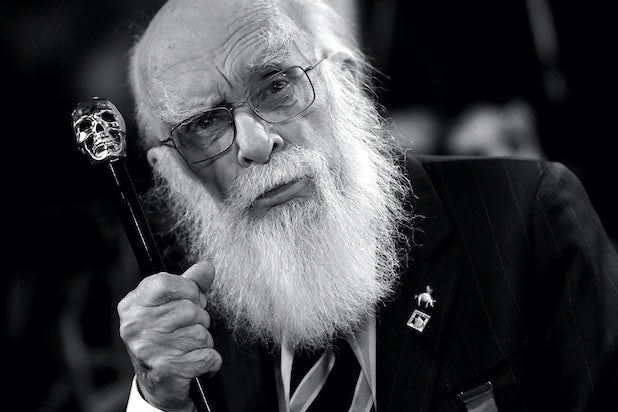
What follows is a reworking of a sort of "takedown" obiturary about the death of the so-called Amazing Randi, done on my main blog shortly after his death.
I posted that link in comments when a Hucksterman Village friend of a friend extolled a new YouTube channel talking about how many hits it had gotten, and from there, talking about essentially how valuable he still was.
The "capture" for the video at Susan Gerbic's post talks about "the magician who exposed fakes, frauds and charlatans."
Did that include himself? The (Not so) Amazing Randi, aka, The Amazing (Deceiver) Randi, as I called him.
From lesser to greater?
There's his libertarianism that enabled the likes of Penn and Teller to be denialist about secondhand smoke as a carcinogen, and to still be denialist about things like climate change. That's too common in movement skepticism; Michael Shermer is yet another prominent member, at least partially influenced by Randi, who has conflated some version of modern movement (it's NOT "scientific," per the above, so I don't call it that) skepticism with philosophical and political libertarianism.
Yes, it's true per the Hucksterman friend, that Randi repented of that one himself, and admitted (to some degree at least) that anthropogenic climate change is real.
But, that's the lesser.
Next, there's his condoning of #MeToo related problems in movement skepticism. (And, allegedly, Shermer was part of those problems, too.)
Finally, Randi almost certainly knew that his long-time lover, Devyi Peña, was an identity thief. Hiring him at JREF, the nepotism wouldn't look good even without the above. That, of course, makes it worse. Even if Randi didn't know that Peña had engaged in willful criminality, the hiring made it look like he did know and was trying to protect him. That's the greater, or greatest.
All the information two paragraphs up, plus Shermer's history, is documented here. More on Shermer here. That documentation notes that this goes back to the time of Paul Kurtz as founder of CFI. (Randi as founder of JREF, as much as Kurtz at CFI, also fell willing victim to founders syndrome.)
Related? Randi started sniffing his own press clippings too much later in life. The claims that Peña magically (I see what I did there) skeptically enlightened most of Australia have been put paid to by many people, for example.
But, many in the movement skeptic world still believe that Peña was magic. They also believe Randi knew nothing about Peña's background. Etc. In short? Enablers to some degree. Beyond Randi sniffing his own press clippings too much in later life, on #MeToo, and on Peña I think, and on founder's syndrome in general, he had too many enablers. He should have been nudged out of leading JREF at least half a decade before he actually was.
Now, to the "fossilized" and related matters.
I next shared this on MeWe, and tagged a friend who has, like me, long left both movement skepticism and organized atheism behind. Like me, he was never in the "hierarchy," but at one time was a much more interested follower, as was I.
He mentioned the word "fossilized."
That's like founder's syndrome on steroids? Or frozen founder's thought or something?
I do agree.
I think that, per discussion on one social media site, "fossilized" is a good word to describe JREF, and other orgs, whether "movement skepticism" or Gnu Atheism like the Freedom from Religion Foundation, aka the folks who once tried to claim that Abraham Lincoln was an atheist.
I don't know as much about their fundraising psychology as I do, say, major environmental organizations, but I suspect there's a certain amount of crisis-mongering, which mingles with a certain amount of tar-babying off the Religious Right.
In addition, founders syndrome is semi-cultic, something that any good skeptic should steer clear of, of course. And, yes, that "good" is deliberate.
But, if you're part of the movement? There's all the behavioral psychology issues at play, like "sunk costs" and "loss aversion." These and related issues don't just play out capitalistically.
Indeed, I think that prompted a back-and-forth with a non-friend to me of the Hucksterman friend of a friend, who I web-searched after that conversation played out.
And, in turn, that leads to the question of sunk costs versus the flip side of that coin: a rise in the hierarchy.
Phil Stilwell made, I believe, a comment on Gerbic's post that said, in essence, "don't make it about the person." Since she deleted the entire thread that started with my comment, as I had that page open, I couldn't see it when I got notified that he had commented. Clicking the notification bubble led to a non-existent thread. But, as he is a skeptic insider himself, and nowhere else in that 24-hour time span had I commented on someone else's post other than in a nature group that wasn't about people, that's what it had to be.
Editorial clarification from when I was still blogging on this, after my initial write-up but before I posted this. (I've noted both here and on my primary blog, even more, how I'll spend weeks writing serious, in-depth posts to let them percolate. It will be interlaced, in italics, with the original.
Well, I posted "thank god for screengrabs" then tagged him in my first comment to that. In a back and forth of comments, I may have been less than totally clear originally, but at some point, I believe he moved beyond mildly puzzled at my train of thought to trying to gaslight me.
It WASN'T Stilwell. In cleaning up my computer desktop, I actually looked at the screengrab.
It was David Glück, a Facebook friend.

I did the right thing on Hucksterman Central. Apologized to Stilwell, with tagging him.
AND, at the same time, asked if he'd care to share what he DID say.
As for Glück? Since he agrees with me more than disagrees on Elizabeth Loftus, about whom I've blogged a bit here and a lot at my main blog, he should know if one is looking at a person's ethics, it can't be anything but personal in that sense. I don't know what follows the ellipsis points. But, the basic issue is, that when the whole idea is that another person's character needs, in one person's opinion, re-examining, then it's going to be re-examined!
That said, I did search up Stilwell on the Net. He wasn't gaslighting me, obviously, but whatever he did say, I'm sure it wasn't favorable. And with that, back to the original.
And, from his perspective, why not?
Seeing as how he got lucky enough to get played up by the likes of Jonathan M.S. Pearce, for whom I have less and less respect, as a deconversion success story, and you've been a regular commenter on the major skeptatheism sites, I'm sure of what you said, even if it's now gone. His being an apparent Islamophobe doesn't help his cause.
Re movement skepticism, I've long said that it could stand to learn some philosophical Skepticism. Re the Gnu Atheist orgs, since the "nones" are growing fast — but aren't really atheist, contra Gnus — there's definite tar-babyism as far as how American religious demographics are changing. On the secular humanist world, per said friend, it should be focusing on things like the dehumanization factors of the "always on" world, or the future of the precariat (the word I first heard from the late Leo Lincourt) and other socio-economic issues.
Lots of Gnus don't like to admit that the concept of antitheism is in any way true. That's even though Camus mentions it in "The Rebel" before getting to his true modern original sin — blind allegiance to communism.
But, to riff on Voltaire? If god didn't exist, antitheist-type atheists would have to invent the concept of him to have someone to rebel against. (Camus, in "The Rebel," explicitly says antitheists enjoy having the concept of a god to rebel against.
Back to the "fossilization." And the fundraising. Even though Nones (not necessary atheist, or agnostic, or even non-theist, but at least not conventionally religious, either fundamentalist or non-fundmentalist) are growing faster in the US than members of any Western monotheism and certainly faster than any main division within Christianity, movement atheist groups aren't going to tell you that.
And, anything is a "hook" for this. Like Freedom from Religion Foundation, per my main blog, trying to claim eight years ago that Lincoln was really an atheist. I believe that was for the visibility level first, yes, but for the fundraising angle second.
On the secular humanist world, per said friend, it should be focusing on things like the dehumanization factors of the "always on" world, or the future of the precariat (the word I first heard from the late Leo Lincourt) and other socio-economic issues. (Said friend mentioned Paul Kurtz and the Council for Secular Humanism et al as also being among the fossilized.)
Movement skepticism groups haven't pivoted from things like evolution to climate change — not only denied by too many Republicans but minimized by too many Democrats. And, while they may look at things like antivaxxerism, they're likely to point first at New Agey type leftist woomeisters long before they point at libertarians. (Antivaxxerism in SoCal, for example, is just as much a problem among both libertarian and Religious Right types in Orange County as among woos in Hollywood.)
Also in regard to movement skepticism, I've long said that it could stand to learn some philosophical Skepticism. I've mentioned that to "movement" insiders, even mid-level majordomos. No real bites on that. And, there's been some, like Barbara Drescher, who have even been openly anti-philosophy.

Finally, to tie this back to Gerbic. Deleting comment that is NOT "hateful," but is real, albeit strongly put? Skeptics censoring dissent? I had already let my actual Hucksterman friend have the last word. Then Stilwell weighed in, and when I tried to respond to him, she had deleted the "hateful" comment and thread.
As for Glück? I did not unfriend him. I did remove him from my "skeptical friends" list ... and I did add him to my "acquaintances" list. That could be changed back in the future, but, for now, that's the way it is.
Next? Orac. Until I searched my main blog, I forgot about my history of past issues with him.
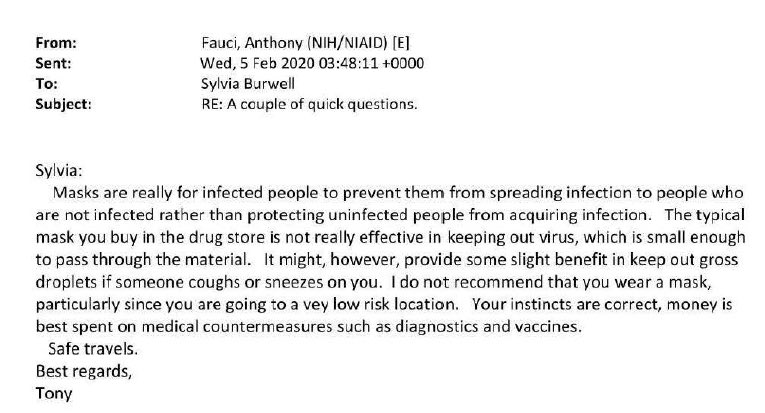
Having tangled with Orac twice now over issues related to St. Anthony of Fauci, and knowing that Movement Skeptics / Skeptics™ are their own set of tribalists, I've looked back further at his paean to Randi.
First, I'm sure that Orac is more than a micro-celebrity, and certainly more than a nano-celebrity, within Skeptics™. Such modesty!
Second, to get to some meat? Orac ignores Peña. Flat-out ignores him. Never discusses him. Not just the ID theft, but the allegations of shammery in Australia. If that's not intellectual dishonesty?
Third, he doesn't tackle the issue of founder's syndrome. Since Paul Kurtz had shown it several years prior, and to some degree, like Randi, on #MeToo issues, this wasn't good, either. I mean, Orac even commented, as I blogged about, a non-MeToo problem with Kurtz.
Fourth, he (and fellow travelers at NECSS) have evidenced tribalism and twosiderism before! I forgot about John Horgan calling him out, and them, five years ago, and that I blogged about that. What Orac in his insolence really hated was getting called out by someone at his pay and fame grade. (I also wonder how much both Orac and Steve Novella, per that link, disliked Horgan's comments not on skepticism, but on fee-for-service medicine. Orac strikes me as a mainstream neolib Democrat type who at a minimum isn't highly favorable to single-payer national health care.)
Fourth, part 2: Per Horgan, and contra Orac, the asshole wasn't Horgan. Besides Orac and Novella, it was first Jamy Ian Swiss. That said, for not having a single word of praise, Orac and Novella are assholes themselves. I might wind up writing something just about Orac at some point!
Fourth, part 3: The likes of Orac, though not a lot himself personally (rather, Shermer, Randi, philosophy-hating Barbara Drescher and philosophy-minimalizing mild Daniel Loxton) are part of why I don't call myself a skeptic any more, and haven't for five years, like Massimo — at least not without the word "philosophy" or "philosophical" attached. (I suspect that Orac's probably not big on philosophy, either.)
Fifth? Beyond "fossilized," per Horgan, tribalist and twosiderist are major problems.