Thursday, June 25, 2020

Museum of the Bible's Auguean stables:
Have fun on cleanup, old classmate Jeff Kloha

I blogged a few months ago about the breaking of the Dead Sea Scrolls scandal at Hobby Lobby-owned Museum of the Bible, and how the man dealing with the fallout is old seminary classmate Jeff Kloha, who now prefers the full Jeffrey.

Update, July 27, 2021: The Gilgamesh Dream Tablet has Hobby Lobby back in the news. See my update at the bottom of the piece, including noting that Hobby Lobby is far from the only villain in the drama.)

Said blogging included disagreements between this now-secularist myself and the still-fundamentalist wing of Lutheranism Kloha about whether or not the DSS confirm a pristine transmission of the text of the Old Testament or Tanakh (they don't, Jeff) and whether or not they're "inarguably" the most important biblical discovery of the last century (they're arguably not, and if we focus on Christian development and diversity, Nag Hammadi is arguably MORE important).

But I digress.

NPR has a new piece about all the cleanup work that Kloha, the museum's chief curator, has on his hands.

He said it's looking at returning a bunch of items to Iraq, some of which likely came from its national musuem. That said, he doesn't know for sure:
"All we have is paperwork, and very vague paperwork," says Kloha, a former professor of the New Testament at Concordia Seminary in St. Louis. "Obviously, there are multiple sources for items from Iraq over the past 30 years. So we have no way of knowing where these came from." 
Part one of the fun.

Part two? The Green family bought 5-10 percent fakes among the 8,000 items up for return. Schadenfreude is a bitch.

Part three? Items it has already promised to return are still in the U.S., because the Greens are too cheap to pay insurance. They're hoping to send them back on an Iraqi embassy plane.

Part four? Schadenfreude can spread wide, like diarrhea. Christie's sold a Gilgamesh to the Museum of the Bible, and didn't adequately check provenance. An Afghani Jewish prayer book was likely trafficked by the Taliban.

Kloha told NPR the "few bad apples" story.
"It seems to have been just one or two individuals who were acting as agents and purchasing things for what was, at that point, just the idea of a museum," he says. "It was a handful of advisers who would literally travel the world, make contacts, find things, and then bring them to the Greens for acquisition."
 Not quite, sir.

Part five? Schadenfreude sometimes degenerates into fuck-you privilege. Steve Green, Hobby Lobby patriarch, was flagged by Customs in 2010 for importing an ancient manuscript Bible without documentation. Read the story for details.

And, per this site, let us not forget the Green family's dirty hands on Dirk Obbink's apparent papyrus stealing.

I don't think Jeff is lying. But, it sounds like he needs to get more up to speed on the Green family.

===

Update, July 27, 2021: With the DOJ getting a court ruling today that Hobby Lobby must forfeit the Gilgamesh Dream Tablet, sounds like Jeff Kloha has more Cleanup on Aisle 6 to do. Details? The tablet was shipped to the US in 2003 by Jordanian Antiquities Authority, without proper paperwork but with the claim it was found in miscellaneous rubble in 1981. In reality, like much other stuff the Green family got its mitts on, it was apparently looted from Iraq. There is no honor among thieves, and we'll see how much remorse there is.

Now, some of this is not new, and some of this on the political side is a #BlueAnon dogpile on the Green family. Hobby Lobby surrendered it a nearly a year ago, after federal authorities ruled to that end. Let's ALSO note that Hobby Lobby supports its return to Iraq. The actual court ruling is more icing on the cake than anything, though it gives the feds leverage if there's anything Hobby Lobby tries to keep its hands on.

In fact, it's arguable that Christie's (yes, THAT Christie's) is at least as big a villain as Hobby Lobby.
Christie's, the international auction house from which Hobby Lobby bought the item, previously told CNN that "any suggestion that Christie's had knowledge of the original fraud or illegal importation is unsubstantiated."
Christie's can use the weasel word "unsubstantiated" all it wants. And, yes, "weasel word" it is.

Re Hobby Lobby, Christie's and looted Iraq, there may be plenty of people who aren't hard-right conservative Christians who willingly bought larger or smaller sums of ill-gotten booty pilfered from Iraq, and some of it may have sifted through Christie's hands.

Related to that? I want to hear NOTHING from American do-gooders claiming we should hold on to it because ISIS will just destroy it. First, that would be yet another form of thievery. Second, that's why much of the rest of the world hates American do-gooders. Third, destruction of antiquities has been happening since the rise of civilization. Fourth, Christians have done this in hte past. The Iconoclastic Controversy. Worshipers, led by ex-priest pastors such as Karlstadt, shattering stained glass in the early Reformation. Some "Mark of the Beast" types (generally ignorant) destroying things related to that alleged mark today.

So, the idea, from one apparent BlueAnon do-gooder on Twitter, that it would have been better had it been stolen on the QT, is laughable.

No, really! The "HL" in his Tweet, part of a thread from a now-muted person, goes exactly down that rabbit hole. 
Besides, quis custodiet ipsos custodes? That's true on everything from antiquities to importing exotic plants and animals to a new country or continent. I tweeted back to the guy exactly on that line:
Twitter's non-literalists claimed that the words above were inciting self-harm and locked my account until I deleted that. I of course did a screenshot.


And yes, IMO, that's what it boils down to. I thought of Juvenal's maxim shortly after that. And, see what I said above about Christie's. They may have sold Iraq antiquities to other buyers who made exactly that argument. Or, Christie's senior staff, with their attempt at plausible deniability, may have internally made that argument themselves, that selling these items got them out of Iraq.

No, per the Wiki link, the phrase doesn't come from Plato's "Republic," though the idea behind it is raised indirectly. Plato's answer on how to guard them? The heart of the fascism behind the "Republic" — mind control through the Platonic Noble Lie. No thanks, as I've said about St. Anthony of Fauci, on masks and herd immunity. I don't even consider his "gain of function" a Platonic noble lie. More like a Jesuitical one, or just a plain old grubby one.

As for the value of Gilgamesh? It's at least partly behind the tales of Moses' birth and similar birth stories around the ancient Near East, as well as some documents from Qumran (which tie back to Hobby Lobby's larceniousness as well as to why Kloha was hired) and to the Iliad and Odyssey. Arguably, it's connected indirectly to just about any later epic tale in the ancient Near East and eastern Mediterranean.
 
Update, Nov. 26, 2024: I don't know whether he left on his own, or got kicked to the curb, but Kloha is no longer at the Museum of the Bible, per his LinkedIn. In a post, he says it was his decision, but, nonetheless, that could be a decision that was constrained or nudged in some way. Per this post from his new freelance life? It's interesting. Maybe he's less argumentative than in the past. That said, does his enlightenment about political discourse also apply to political discourse?

Monday, June 15, 2020

Arise, O Lord, against this Luther

This is another in a serious of posts examining facts, legends and more related to Martin Luther and early Lutheranism on the 500th anniversary of the Lutheran Reformation.

So, Luther had forced Johann Eck to admit that popes could err, and that good works could only "act" after faith — a sola fide faith — had enlightened and sanctified a person.

So, we got?

A committee.

Why not.

The papal curia was, and still is, a bureaucracy like any secular state.

So a committee of about 40 sat down to fine-tooth comb Luther's writings. Among the group was not only Eck but Cardinal Cajetan, rebuffed by Luther the year before Eck was refuted.

The committee eventually led to Pope Leo X "calling bull" on Luther, with the papal bull Exsurge Domine, translated at the start of the header.

Cajetan wanted to take a nuanced approach of ranges of possible church discipline to different writings and comments of Luther's while Eck, more openly humiliated, wanted to bulldoze over him.

Result? Eck won.

The committee, similar to how Hus was treated a century earlier, just drew up a laundry list of what was wrong without saying why it was biblically wrong or how wrong it was.

Just as Rome and Constantinople were asunder long before their mutual anathemas of 1054 (he Slavic missionary competition in the 700s shows that, and the crowning of Charlemagne as emperor [NOT "western emperor"] in 800 in the secular side backs that up), so were Luther and Rome officially asunder when the bull was received by him, months before his excommunication and two years before the imperial pressure cooker of the Diet of Worms.

For Luther, the lack of imperial action — related to imperial succession issues — only emboldened him.

Thursday, June 04, 2020

Richard John Neuhaus: A Lutheran con, like
Lutheran Church-Missouri Synod on abortion

Richard John Neuhaus was a rising theologian within the late 1960s and early 1970s Lutheran Church-Missouri Synod, at a time when the denomination was "schizophrenic" by its own standards.

In 1969, the body elected J.A.O. Preus, perceived as a conservative, as its new president, and him defeating an incumbent perceived as a bit more moderate. But, at the same time, it entered full "altar and pulpit" fellowship with the moderate-conservative, but not full conservative, American Lutheran Church. That was modified four years later into "fellowship under protest" even as the LCMS worried about "liberalism" in theology taking over its main seminary in St. Louis. That ended with the "Seminex" walkout, which failed to oust Preus from the presidency. (Bringing things to a full boil in the 1973-74 academic year, AFTER Preus had been re-elected to a second term and the "fellowship under protest" had been adopted, was the height of bad politics.  And, yes, churches are all about politics.)

Neuhaus supported Seminex, but at the same time, moved more conservative politically because of Roe v. Wade.

I came across this via the "Slacktivist" blog on Patheos. The writer, a liberal evangelical, was refuting David French in his claim that before the 1980s, the rising Religious Right didn't care about abortion. And, contra mythos of my LCMS days, teh Google to its own website tells me Lutherans for Life wasn't officially founded until 1979, and only claims some activity starting 1976. (That said, contra pro-life Catholic mythos, it's arguable that pre-Roe, abortion wasn't big on the Catholic radar screen either, contra Humanae Vitae.)

Anyway, Neuhaus was a sort of a neocon. He was also a paleocon, even more at times, per his affiliation with the Rockford Institute.

And, per Slacktivist, he is kind of full of it on other things.

If one truly does believe in historical-critical methodology, first, then "Jesus is Lord," with which he starts his blast, is always subject to human trimming.

Second, Christianity is compatible with non-democratic governments, human rights abuses, slavery and more. For the first, read Romans 13. For the second? More Romans 13 isn't bad. Nor is 2 Corinthians 11:24-25. For the third? Galatians 3:28. For all of the above? Any good Lutheran (or Catholic, for other reasons, perhaps) theologian would know of this book called "The City of God."

Third, any good non-Catholic would look at least a bit askance at going too far down the road of natural law for human rights. A good secularist would look hugely askance.

Fourth, despite his dipping one foot into theological liberalism or what passed for that at the LCMS of his salad days, it's laughable to be like National Affairs and paint him as a liberal. What he really was, was a neocon. (That's probably part of why Rockford booted him.) First Things magazine itself, in its encomium obituary, tells the truth.

I will say that, when he came by Concordia Publishing House in the early 1990s, he was well received among staff, even by the ordained minister who oversaw copyediting there and was more theologically conservative.

He struck me as a bit erudite and urbane. In hindsight, that probably comes from him being born in Canada.

Thursday, May 28, 2020

Fabio Luisi at the DSO? I think I'll pass

Dallas Morning News classical music critic Scott Cantrell recently offered praise for the Dallas Symphony Orchestra's new music director, Fabio Luisi, who will officially start this fall after a two-year hiatus to replace Jaap van Zweden.

Among the praise was, even with him not having a full hand in the 2020-21 season, booking more 20th century music than van Zweden or Andrew Litton before him.

But, of the pieces Cantrell listed, none are from the warhorses of 20th century atonality.

No serialist Schoenberg, or disciples Berg or Webern.

No late-life serialist Stravinsky.

No second-gen serialism pioneer Ernst Krenek, either from his serialism or his non-serial atonality.

No atonal (or tonal) Penderecki. No Ligeti. No Schnittke.

Lemme know when something from THAT, or similar, is on the playlist.

That said, speaking of warhorses?

I found part of Luisi's premier concert with the DSO on YouTube, which sadly had commenting turned off.

It's Beethoven's Seventh. To me, one of the acid tests is if you play the Allegretto second movement as marked, with the metronome at 76 or thereabouts, you have failed. You're not "HIP," if you're not conducting a period instruments orchestra.

And, while Luisi does get some nice texture out of the movement, it's too slow. Clocking at almost 45 minutes, the whole symphony is too slow. But the second movement, at more than 10 minutes, is WAY too slow. Listen, starting at 13:22 for the second movement.


No, DSO concertgoers, that did not deserve applause at the end of the second movement. Third movement is by the modern book, so good there. In fact, if anything ... it's almost rushed, and has a feeling of that after the slow second movement. Fourth movement, again, crisp, and again, even to the fast end. But ... that second movement ... no. And again, it's not just that it's slow; it stands out like a sore thumb against the third and fourth movements.

Listening to that again, in 2024, there's one other problem. The "attacca" between first and second movements, with no pause. You'll note there is a normal pause after the second movement, even before the unwarranted inter-movement applause. Listen further. The third movement in general is too slow. But, within that, the last major tempo change in the recapitulation area is too fast, and with the earlier portion of the movement too slow, it sounds rushed.

Speaking of, especially with all that behind him, the fourth movement's opening sounds rushed. In fact it IS rushed even if we ignored the slowness of the previous. It's barely 8 minutes. And that only emphasizes how the second and third sound too slow. And are too slow.

Compare all of that to the master in the period instruments (when appropriate) groups, John Eliot Gardiner and the Orchestre Revolutionnaire et Romantique.


Hear the difference? Compare and contrast the finales, too. Gardiner actually starts slower, but that gives him more room to play.

Or David Zinman with the Tonhalle, whose Beethoven cycle I bought immediately after hearing him with the new urtext on Eroica. YouTube has his 7th separate by movement.


Again, hear the difference?

Or, one more. Kleiber, among the old masters. 12:15 8:04 for the second movement. (The scratched-out was the first movement clocking.) And he takes the whole schmeer even faster than Gardiner or Zinman.


Much above 80 can be rushed.

But anything below 68 can seem slow, and anything below about 64, especially with poor nuancing, can seem draggy. An even 8 minutes, as the three gents above indicate, is about right. Not a full 10 minutes. (Cantrell DID ding him for this.)

And, contra unnamed critics cited by D Magazine, Luisi's predecessor van Zweden didn't lash this piece, at least, too fast. YouTube shows him also at 38 and change. It also shows him with a 14-minute first movement and a second movement that's not exactly fast.

OK, more questionable Beethoven.

A nearly-55 minute Eroica?


Too slow all around. The biggest offender seems to be a 15-minute finale; second biggest is Funeral March nearly 16 minutes long.

Zinman comes in at an even 46 overall. The opening is about 2 minutes quicker. The funeral march about 2:40 quicker. The finale is almost 4 minutes shorter. Listen:


Zinman isn't alone. Erich Kleiber has the finale at 11 minutes in a 45 minute recording. Ditto Gardiner. Again, listen:


If Luisi either can't "get" Beethoven, or, on a piece like Eroica, thinks that sounding like Daniel Barenboim is good (it ain't), then no, this is not a fantastic hire.

Next, a warhorse from just about exactly a century later.

I found Luisi doing the finale of the Mahler Sixth with the Suisse Romande. Before even clicking, I noted a above-35 play time. Antennae up. Listen:


Not totally draggy, and he does get some nice nuances out of texture. But, when not totally draggy, even for Mahler, there seems to be too much rubato in tempo changes. Portions seemed rushed. And, per the Beethoven Seventh above, he likes to play with tempos a lot, as far as pushing composers' plans to the extreme both fast and slow.

A decade-plus older Italian contemporary of Luisi then came to mind — Guiseppe Sinopoli. I bought his M6 in the early 1990s, shortly after he'd started moving beyond opera, and started getting raves for his psychological interpretations. The opener of the M6 (where I'm a tough critic, and was halfway so even then) wasn't bad. Each subsequent movement got worse, and he pushed 35 with the finale. But even he didn't have that much rubato, IIRC.

Listen to somebody hugely uptempo with the M6, Kondrashin:


Big difference.

Or, someone somewhat more conventional, and with a lighter touch, but not delayed, Ivan Fischer, who comes in at just over 28 minutes:


Again, a difference that you would notice, even without Kondrashin as a peg.

Cantrell may have gotten it right before Luisi was named. "YouTube performances suggest consummate professionalism, but something less than a compelling musical personality."

And, speaking of M6? Cantrell (with whom I exchanged emails in the 2000-aughts when I was a DSO season ticket holder at Thursday night concerts, the nights he'd be attending for his preview write-ups) praises this by Jaap.


I'll pass on this, too. The second movement (not here, as this is first movement only, after the original YouTube video is gone due to being from a now-canned account) is lyrical and nuanced, but the first movement is by the book, and almost all conductors' books are wrong on this. This is part of why I so like Kondrashin; the opening BRISTLES with him.

Having never talking post-Litton Mahler with Scott, maybe we'd disagree on interpreting him in general? And, (April 5, 2024) going beyond earlier thoughts on this, while Cantrell was right that van Zweden brought the technique of DSO players, as individuals, as sections, and as a whole, to new levels, I don't think he brought as much new as an interpreter as Scott may have thought of him in van Zweden's first years in Dallas.

I do know that we agreed that the DSO, especially under Litton but also in my brief time there at the start of van Zweden's tenure, needed to broaden its rep in the 20th century. Per my suggested playlist, vs Cantrell's, I'm trying to figure out . He does like him some Walter Piston, who did at least some toe-dipping into serialism, and Elliott Carter, though.

Frankly, though he's older than Luisi, I wish they'd made a run at Salonen. But I forgot myself and forgot that this is Dallas.

And, 18 months later, having heard (via online clips) Luisi actually play with Dallas, my impression went further downhill.

Update, April 4, 2024: Yet more reason to take a pass on Luisi? Per this great New Yorker piece about a sad recent trend in the classical world, he's spread too thin:

Fabio Luisi is spread across three continents, maintaining roles at the Dallas Symphony, the Danish National Symphony, and the NHK Symphony, in Japan.

Per the piece, it's not quite as bad as its focal point, Klaus Mäkelä, who not only currently runs the Concertgebouw but is tapped to help Chicago in 2027 — while (at least until he says he's leaving) staying in Amsterdam as well. And, while neither Dallas nor the NHK (dunno about the Danish National) are top-tier, they're both solidly enough in the second tier that they shouldn't be sharing a music director. A Luisi could do one or the other of the two, plus the Danish. And, even be principal guest conductor at a third, smaller orchestra if the ego or tightening corporate symphonic sponsorships demanded. But, that's it.

That said, there's more.

That is snarkily topped by this:

American orchestra subscribers have become resigned to a phony civic ritual: a foreign-accented maestro flies in a few times a season for two or three weeks, stays in a hotel or a furnished apartment, attends a flurry of donor dinners, and dons the appropriate cap when the local baseball team makes the playoffs.

Oof. When Jaap van Zweden was in Dallas, he seemed reasonably involved. But, it was the only orchestra where he was the music director. Speaking of, the piece notes that he and the NY Phil have parted ways. For the Seoul Philharmonic and the French Radio Philharmonic, to style it in English? Wow, what a tumble.

Wiki's page on Luisi adds this, which fits perfectly with the New Yorker snark:

Outside of music, his hobbies include the production of his line of perfumes.

Oy.

Bottom line? It's like the reading of books. Ars longa, vita brevior. I have only so much time to read, or to listen.

Thursday, May 21, 2020

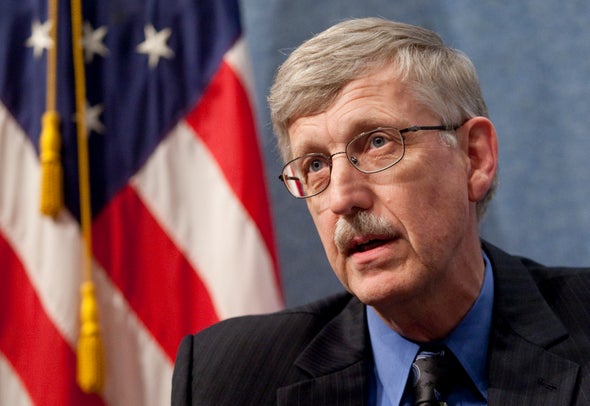
Francis Collins, the Templeton Prize,
and the Problem of Evil

Online and authorial friend John Horgan dusts off an old interview with Francis Collins of the National Institutes of Health on news that he's won this year's Templeton Prize.

Horgan notes that, at the end, where he asked Collins about the future of humanity, he showed lots of faith in god but little in homo sapiens. The questions were really about another issue — the role of suffering in religious belief.

The reality, per Logic 101 is that "suffering," however the word is defined, is not logically necessary for religion or a deity. (Remember: Folks like Theravada Buddhists have a religious belief system without a personal divinity.) Philosophy of Religion 101 will then add that suffering, or a belief in it, is not psychologically necessary, either.

The first is the old Problem of Evil. For believers in a god both omnipotent and omnibenevolent, it's an even bigger stumbling block than the Euthyphro Dilemma. The second often results from attempts by believers in a dual-omni god to avoid the Problem of Evil by citing their god's inscrutability. In the Judeo-Christian tradition, this usually involves an appeal to Job, with Christians doubling down by citing Paul referencing Job.

Doesn't work.

This is, as I have called it, the Psychological Problem of Evil.

Either said god is less than all-powerful if he can't make himself scrutable, or he's less than all-good if, other than "stop questioning me," he can't make his followers accept his inscrutability is for their good.

That said, what if there was some new way to get these people to accept his inscrutability? Still doesn't address the omnipotence and psychological evil issue.

There's also a bit of a petard lurking here.

IF ... we did accept that some suffering is necessary for human development as part of religion, how much is necessary and how much is too much? Usually this ends up again being hoist on the inscrutability of god in the Western "dueling-omnis" idea of god.

Otherwise, Collins himself, who famously once said, and included it in a book, that he had the idea of the Trinity be made understandable by a three-part waterfall, doesn't strike me as the deepest of thinkers on matters religious. It's almost as silly as the apple explanation that I heard as a kid — the peel, the pulp and core are all separate, but all connected, and all have "appleness," but there's still just one apple.

Nor does his taking a page from Augustine, on the idea that an omni-god is outside humanity's four-dimensional space-time, makes such a god inscrutable by logical necessity. Per Flatland, such a god could intervene into our four dimensions in a perfectly scrutable way.

I mean, if Collins did a riff on Whitehead's process theology into something even more creative, or invented his own religion, even more, I'd have more respect for him. But this is just plain bleah evangelical Christianity.

As far as what Collins misses in terms of psychology of religion? It was staring himself in his hiking face. The "trinitarian" waterfall is a dictionary exhibit of confirmation bias.

Thursday, May 14, 2020

Walter Kaufmann: Skeptic, heretic, antichrist
and a whole lot less

Walter Kaufmann: Philosopher, Humanist, HereticWalter Kaufmann: Philosopher, Humanist, Heretic by Stanley Corngold

My rating: 5 of 5 stars


FANTASTIC book. Five stars for it, while my rating of Kaufmann falls from a high 4 stars to a flat 3.


This is a greatly extended version of my book review, which was written so as to not be too long and not avoid spoilers. It was written to also be a book review first and foremost, whereas this will be a Kaufmann review as much as a book review.


As someone who owns and has re-read “Without Guilt and Justice,” “Existentialism from Dostoyevsky to Sartre” and “Critique of Religion and Philosophy,” and has read Kaufmann’s translation and explication of Nietzsche in “The Portable Nietzsche,” and also has read “Faith of a Heretic” and “From Shakespeare to Existentialsm,” I was definitely looking forward to this bio when I heard about it.

Corngold didn’t disappoint. But he did lead me to see how I’ve overrated Kaufmann in the past, especially because I had not read, or heard of, one book and one trilogy after “Without Guilt and Justice.”

“Religions in Four Dimensions” puts Kaufmann’s special pleading for Judaism as a special religion on full display, and it’s pretty bad. He simply rejected what was already in place on modern biblical criticism at that time, going beyond earlier claims that the traditional documentary hypothesis was antisemitic. More below, as the bio goes chronologically and this was a late book of his.

“Discovering the Mind” shows the poverty of his not looking at British philosophy, and I’m talking about empiricism, then utilitarianism, not modern analytical philosophy. Basically, it is the culmination of his lifelong stance of an uncritical, HUGELY uncritical, love for Freud.

I’m agreeing still with Kaufmann as a demythologizer of Nietzsche, namely stripping away the anti-Semitic and Nazi-related past his sister put on him. The post-Epilogue chapter of “Contra Nietzsche” (interesting to have a chapter after the Epilogue) reinforces this.

I don’t totally agree with Kaufmann that Nietzsche’s biggest focus on will to power was mastery of one’s self, though that could come from the Greek antiquity.

Disagree even more with Kaufmann on Nietzsche and sublimation. I think Nietzsche did promote some version of that, but Kaufmann is a big Freudian and he is seemingly specifically referencing that. But, per that trilogy, I didn’t realize Kaufmann was THAT big of a Freudian. Corngold, by looking at his whole opus, lays this out  QUITE clearly, though. It’s why he accepts Nietzsche’s claim to be the first philosopher to be a psychologist. (And, this is wrong; that would be Hume. Hume, of course, was not a depth psychologist. Thank doorknobs for that.)

Disagree even more that there’s an overall large unity to Nietzsche.

Now, on Existentialism from …

I think critics are at least partially right to call out Kaufmann for not including religious existentialists other than Kierkegaard. I know he savages Bultmann especially in his next book, Critique of Religion and Philosophy. More on book in a minute. He still could have included somebody besides Kierkegaard, or else left him out.

And why put Dostoyevsky before him? If he believes Nietzsche was the root of 20th century existentialism, why not start with HIM?

Now, to Critique. I think Kaufmann does a disservice to British philosophy. Not so much to the 20th century version, although Russell the pacifist being arrested in WWI shows that even in modernity, it was not so ivory-towered as K claims. I think his disliking its anti-mysticism led to all other dislikes he had. But it’s simply wrong in other ways, one in particular.

I’ve said many, many times that Hume was, in my estimation, the world’s first modern psychologist. And for K., who calls N. a psychologist in the title of his book about him, to ignore Hume, and to claim that this man who was know first, in his own day, as a historian, second as a befriender of Smith and his economics-oriented moral philosophy, and third, more than Descartes, as a reviver of Greek Skepticism, to claim that he’s really not worth study as a philosopher or in general? K. impoverished himself.

That said, Kaufmann also misreads Judaism here. I had noted this in my copy of Critique, which I’ve not read for more than half a decade. It’s simply wrong, and Qumran’s library, with many apocalyptic books in Hebrew, was proof. Tho he didn’t preach hellfire, Ezra DID preach exclusiveness. Daniel 12 talks about “everlasting contempt.” Qumran has scrolls that talk about everlasting damnation. And, on “dogma”? No, it doesn’t have nearly that of Christianity, but a Buddhist or Hindu might well call the Shema “dogma.” Or the Orthodox idea of 613 mitzvoth, and how to fulfill them.

Kaufmann also tries to look at Judaism while ignoring the Mishna and Talmud. And this is despite studying under renowned rabbi Leo Baeck.

Couldn’t we call him a modern Karaite? Well, Karaism’s attempt to reject Mishna and Talmud and get back to “authentic Judaism” seems to me, per Husserl, a failure to fully “bracket” the “later testaments” of Judaism. It’s a lesser-degree parallel of Campbellite type Christians of the “primitive Christianity” movement to get back to allegedly “Jesus Christianity” while ignoring the 1,900 years (at that time) of Christian doctrine filters they were using to define “primitive Christianity.”

More on dogma and exclusiveness. Even if we grant Kaufmann is partially correct, much of the Torah itself is priestly pronouncements. That’s where those 613 mitzvoth are. And, while the Lutheran idea (held in some ways by many other Xns) of distinguishing between moral, ceremonial and civil commands doesn’t fully wash (and certainly not in terms of Xn exemptions, contra Paul), nonetheless, many commands are about ritual purity that is specific to that religion.

More on dogma. Spinoza was, to use a normally Xn term, excommunicated.

And, Kaufmann knew much of this. And, by the time of his untimely death, had opportunity to know enough of the early study of the Dead Sea Scrolls and how it too undercut his Xn-Judaism bifurcations.

Kaufmann also hadn’t read Jewish or Christian NT criticism closely if he thought Jessu claiming to be the Messiah (if he did) was blasphemous. He also, despite studying with Baeck, had not made h imself familiar with Tannaitic Jewish history, namely, Akiva proclaiming bar Kokhba to be the Messiah.

Kaufmann also thought the documentary hypothesis on formation of the Torah was antisemitic. To reference above, Spinoza was one of the first people to question Mosaic authorship, even if he didn’t formulate a replacement theory. (I personally believe in a modified documentary hypothesis, moved back a century or two and reliant on issues of development and fragments, without going full Copenhagen.)

And, this speaks to a conceit that Kaufmann seems to have had about himself, that he was widely read in every area where he made major commentary. He wasn’t.

The author was good for provoking these thoughts in me. But, I’m going way beyond him in my critique of Kaufmann.

Page 306, Kaufman is quoted as claiming the Greek gods as presented in the Iliad were only poetic fictions. They may have been viewed as such at the time of Plato, per his comments elsewhere, but in its original oral formation, and presumably its earlier written forms, no, I think it’s more likely the gods were viewed as real.

The chapter on what is my favorite Kaufmann book, “Without Guilt and Justice,” is very good. Corngold notes the dual Latin etymology of “decido” behind Kaufmann’s “Decidophobia” (though it’s not clear Kaufmann was invoking that). It can either mean “to decide,” or to “fall away/off/down.” In other words, to stumble or to err. And this failure, whether it causes personal physical consequences, or social ones like embarrassment or loss of face, is a real human worry.

That said, Corngold also has me questioning Kaufmann even here. Since Kaufmann rejects the poles of both moral rationalism and moral irrationalism, could we not, per friend Massimo Pigliucci saying, “I’m a moral naturalist, as I think morality is a human invention (thus not “real”), but constrained by human nature, desires, and limitations (thus partially factual),” find a middle ground on distributive justice, which I think, contra Kaufmann, has advanced. And, on retributive justice, to cite the Nivi’im and Plato as “advances” for developing a natural law? No.

Corngold, by quoting Kaufmann, reminds me of other failings here. No. 2 of his six reasons to retain punishment despite retributive justice being a fail, “to inculcate a moral sense,” strikes me as self-referentially defeating. I think many people intuit something like what K. has said on both retributive and distributive justice; ergo, the punishments of the criminal system can inculcate no moral sense, but only more questioning of the idea of retributive justice.

No. 8 is also self-referentially defeating. If we punish a person to offer a psychological benefit to their victim, isn’t this a concession that distributive justice is not illusory after all?

If we agree with Kaufmann that trying to apply distributive justice as a moral calculus is a refuge of the decidophobe, I’m in agreement. But if, from that, we extrapolate to rejecting attempts to produce better versions of them, and instead, on the retributive side, still try to justify punishment on dubious grounds, I’m gone.

I’m even more gone on his rejection of guilt in light of what he says above. If there is no guilt, then punishment cannot inculcate a moral sense. And one can retain the idea of guilt while still rejecting the idea of desert.

What’s really missing is Kaufmann seeming to be ill-informed by non-Freudian humanistic psychology that was available to him at his time, let alone what is available today.

Corngold does note that others criticize him and also for the hypocrisy of pointing out how the Hebrew prophets gave the world … a call for JUSTICE.

Corngold does note that Kaufmann is very readable in this book and comes off li ke the best attributes of a journalist.

That leads to the next chapter, about a book of Kaufmann’s I had not heard about, about world religions, the “Religion in Four Dimensions.” It too sounds problematic. The issue of religion may still be the most important issue of human discussion. Or it may not. It certainly was in the past. That doesn’t mean it will be so forever, contra a quasi-essentialist stance like Kaufmann’s.

He again gets his Judaism wrong. It was influenced by Zoroastrianism more than he’ll admit, especially on heaven and hell and ethical dualism. Daniel talks about this, and the intertestamental books thatTannaitic rabbis rejected after the Second Revolt. Kaufmann doesn’t get into this at all. Corngold rightly notes that he ignores the unjust and unseemly parts of the Tanakh, like Yahweh’s call for genocide against the Amorites. He also ignores that much of the call for social justice was only with Israel. As for ancient Hebrew having the same word for servant and slave? Please, Walter. It’s not the only ancient language to be like that. As for his seeing indications that Israel intended to end slavery? No. He also, Corngold shows, repeats the old myth that Judaism was not an evangelistic religion, though he has to allow for the Khazars. He ignores the conversion by the sword of the Hasmoneans. And, conversions by medieval Spanish rabbis in three-way disputes with Christians and Muslims. He ignores that the growth of Rhineland Judaism pre-First Crusade was in part due to conversions. He ignores Chrysostom warning Christians in Constantinople to stop going to synagoges, which implies that rabbis were welcoming them.

He also ignores that the intertestamental books, the apocalyptic ones like I and II Enoch, etc., were shown, by being at Qumran, to be more popular in Judaism at the turn of the eras than Kaufmann will admit. Ditto, of course, on at least some people there being celibate, it seems. But yet, Kaufmann can attack

Basically, to use a word, Kaufmann is tendentious. To use another word or two, about a philosopher and philosophy he disliked? He’s trying to employ the “bracketing” of Husserl’s phenomenology or something similar, with the claims that non-rabbinic Judaism vs the emerging proto-rabbinic Judaism isn’t “normative.” Of course not; the rabbis, especially when we get to the Amoritic era, “bracket out” Messianism as much as possible. (Kaufmann also overlooks that Akiba proclaimed bar Kokhba to be the Messiah.)

In his next chapter, Corngold shows Kaufmann stumbling again, this time in his final book, “Discovering the Mind,” actually a triology of books, each devoted to philosophers. The stumble is based in working off an ejaculation by Nietzsche: “Who among philosophers was a psychologist at all before me?”

The answer is: “David Hume.” And Kaufmann’s previous semi-neglect of Hume becomes total here by not having him as any of his nine philosophers of mind in the three volumes.

The trio is worsened only by Kaufmann’s love, via Nietzsche, for depth psychology in general and Freud in particular. Indeed, Freud, in Kaufmann’s eyes, it seems can even more do no wrong than Nietzsche. His pseudoscientific propositions and his lack of scientific rigor in testing his ideas all get swept under the rug.

To summarize? Kaufmann was out of his league from the start on biblical criticism comments. He was out of bounds, though not out of his league, on his ideas on psychology. Ditto on some philosophical thoughts.


View all my reviews

Thursday, May 07, 2020

Gustavo Dudamel is hugely overrated

The first time I heard him, I think it was on Shostakovich's Tenth. Pretty decent on the second movement. Playing it too slow gets you fired from my list of good conductors.

I actually blogged about it, in fact. Anyway, here's the clip.

The Simon Bolivar Youth Symphony under Gustavo Dudamel (who I heard live in Dallas several years ago):


Man, that just bristles!

But, since then? Plenty to not like.

I mentioned in that previous blog post that, hearing him on the Mahler 2, he just doesn't get it. I thought maybe it was just Mahler, and him being too young.

But no.

Listen to this Bolero. You'd think a Latino conductor like Dudamel wouldn't have a semi-somnolent (and semi may be being generous) take, but he does.


Blech. Two full minutes or more longer than many takes.

Or, from the older repertoire, heard recently on Dallas classical station WRR? Eroica, at least the funeral march from it.

I'm not sure if this is the performance played on WRR, and this is only a snippet.


And, it can't all be the Simon Bolivar Youth Orchestra. Look at the good take he did on Shosty. That was with it. And his craptacularness on Bolero was with the Vienna Phil.

And it can't all be callow youth. He's nearly 40 now.

It's Dudamel. Why he couldn't bring even 60 percent of the Shostakovich energy to Bolero???? (And yet, he can have a reasonably interpreted 66-minute Beethoven Ninth with a generally very good finale. It's not fantastic, but it's above average and it's certainly not phoned in.)

Maybe he got spoiled by being named LA Phil head, to succeed Esa-Pekka Salonen, before he was even 30. Or maybe he spoiled himself by resting on his laurels?

I think that's probably part of it. The Shostakovich? That was before he was named to head the LA Phil. The other stuff? All after the appointment. His Mahler, at least on the Second, appears to have gotten worse as he's gotten older. In general, the opening movements sound not stately, but ponderous, in various performances.