Friday, December 06, 2019

The real Luther — in bits and pieces

Luther: Man Between God and the Devil I came to this book on a circuitous route. I had first read Eric Metaxas’ wholly wrong, politically driven bio of Luther, which tried to make him into a modern conservative evangelical. I rejected it as a former Lutheran AND a current secularist who knew it was wrong theologically and a leftist who knew it was wrong politically. Many conservative and liberal Lutherans did likewise.

Shortly after, I read a dual bio of Luther and Erasmus, reviewed here, which had some interesting tidbits but nothing huge.

Then, someone on Goodreads, asking in comment to my Metaxas review what I would recommend, and after I mentioned that book as an alternative, asked if I had read Lyndal Roper. I said I had not and I got it via interlibrary loan.

It was interesting and very good, but … not quite over thetop. Although not Erik Erickson’s “Young Man Luther,” and not Freudian (I think) in the basis for the psychoanalyzing, Roper does a lot of that. As a professor, she has some chops — but it’s a professor of history.

(Also, looking now at her bibliography, from what I know, I’d disagree that witch burning was concentrated in German-speaking Imperial lands.)

So, I continued to look. And via a string of Net searches, came across the reviews to Oberman.

What follows is the review itself.

Luther: Man Between God and the Devil by Heiko A. Oberman

My rating: 4 of 5 stars


How I missed this when it came out, I don’t know. It’s a shame to it that my conservative Lutheran college didn’t discuss this in any religion classes I took there. Given that it was still just six years old when I entered my conservative Lutheran seminary, it’s even more a discredit to Concordia Seminary to not have this book discussed in any classes there.

I know that Oberman was likely Dutch Reformed, not Lutheran, but, he clearly takes Luther at face value, including his man being like a mule ridden by either god or devil, and takes seriously what Luther intended by that.

And, he’s got the theological chops to know Luther’s history.

Even without him making connections, I now see that his reading Hutton’s edition of Valla exposing the Donation of Constantine as a forgery may well have upped not “just” Luther’s general antipathy to the papacy, but his seeing it as Antichrist. In turn, that meant to him that the end times were here.

I need to digress there for a moment. The “anticrhist,” or actually “antichrists” of I John are not the same as I Thessalonians’ “man of lawlessness,” but the term has become ascribed to that being. Rather, writing at least 40 years after Paul, and maybe 60, the author of I John seems to be referring to a king-sized “alligator” in a church or something like that, not a quasi-metaphysical entity. Digression done.

At the same time, Oberman’s book falls short in some ways.

Here’s one. If Luther wasn’t nearly as literalistic about “sola Scriptura” as the Scofield reference bible, then on what grounds was he right and the Schwärmerei wrong? On what basis were the Reformed (and Karlstadt) wrong and him right on the Eucharist, since Karlstadt had proven him wrong on the “this is” per Greek grammar?

None other than Luther being a cantankerous stubborn mule.

For that matter, since Master Melanchthon was the professor of Greek at Wittenberg, why didn’t HE challenge Luther like Karlstadt did? (Roper could have done some psychoanalysis with THAT in her book.)

Also, Oberman reports Luther myth as fact even as religious historians and theological scholars were challenging it by the time he wrote this book. I talk specifically of the nailing of the 95 Theses and the “here I stand” at Worms as fact, when almost certainly neither are.

Does it matter? In the second case, it’s more something of pietistic hagiography. But, Oberman cuts through that on other things.

On the Theses? Yes it matters. Goes to motive, or similar. If they were never nailed to a door, how did they become public so quickly, and what hand did Luther have in that, especially since his concerns about indulgences had been building a few years?

Otherwise, the book is spot on about aspects of Luther’s life Oberman covers. He is indeed an existentialist, but not Kierkegaard, let alone Sartre. He does have one foot in the medieval world and literalistic beliefs not even Kierkegaard did.

BUT … per the above, Oberman covers very little about Luther’s interactions with others. Much less than Roper on Karlstadt or the Reformed. Nothing on the Peasants Revolts or Muntzer et al.

So, five stars for what he covers. Three stars for what he doesn’t and for repeating Luther legend. We’re at a disappointing four stars, and yes, disappointing.

To get that fifth star?
1. A more complete explanation of Luther vis-a-vis the peasants, and within a larger framework of Luther's understanding of the post-1521 non-Catholic state.
2. Half a dozen pages, minimum, on the Marburg Colloquy, set within another half dozen pages on Luther vs the Reformed.
3. More on Luther's table talk.
4. Ideally, a bit on Luther's apparent glory-hogging at times, per Roper.

And with that, I have scratched my Luther bios itch more than enough.


View all my reviews

Tuesday, December 03, 2019

Walter Kaufman vs John Rawls:
Without guilt and justice in Texas courtrooms

The title's second half, first part, should be in quotes, as I am referring to Walter Kaufman's "Without Guilt and Justice."

Without Guilt and Justice: From Decidophobia to AutonomyWithout Guilt and Justice: From Decidophobia to Autonomy by Walter Kaufmann
My rating: 5 of 5 stars

Kaufmann, Nietzsche's foremost expositor, and best English translator, brings his own considerable philosophical skills to play in this volume.

It is true that some of his specific references, such as the "alienation" of mid-20th century psychology, or his riffs on Solzhenitysn, may be dated.

But his core arguments certainly are not.

Kaufmann spends a fair amount of time turning a withering moral eye to retributive justice, and another withering logical and existential eye to the idea of proportional justice, and various related ideas.

Hence his title "Without Guilt and Justice." Kaufmann argues convincingly that neither idea can be logically generated within an overarching system of morals. One can almost see John Rawls being ground to grist between the millstones of Kaufmann's cogitating.

But, this is small confort to humanists who would argue that an enlightened system of morality exists without religion. Instead, Kaufmann is saying that ALL systems of morals, no matter their metaphysical base or antimetaphysical base, are existential in nature. As for particular moral terms like "guilt" and "justice," without specifically referencing Wittgenstein, or any philosopher of language, Kaufmann's argument appears to be that they are part of the language games we play.

Speaking of language, while Kaufman's "humbition" comes off as clunky, it seems to be his translation of the Greek ἀρετή, although he never expressly says so, as I recall.

View all my reviews

So, where does the Texas courtroom come in?

Last month, at my current newspaper location, a teacher pled guilty to two counts of "improper relationship with a student."

She got five years probation, a fine, and of course, loss of her teacher certification. No jail time.

Had it been a male teacher and female students? The book probably would have been thrown. Absolutely, if we had had a male-male or female-female situation. This is Texas. And rural Texas is still where the wingers fly high.

But, it's not just that.

Two newspapers back, five years ago, had a similar situation. Female teacher, male student. Complicated by the teacher's oldest son being at the same high school.

Case went to trial and the teacher got several years.

In the first case above, the later, current case? One of the hookups involved, in part, Snapchat. Now, "snaps" are supposed to disappear by default, but I think you can make them non-disappearing. You can also, of course, do screengrabs. Reportedly, parents just wanted the case to go away, too. But, maybe the DA was being a red ass. Until he was told, "Look, if this goes to trial ..."

The earlier case? The kid had a Twitter account. It was mentioned — not just that he had one, but WHAT the account was — during the trial. During lunch break, the first thing I did back at my office is look it up.

His feed looked like a wannabe "playa." And, no, not the Spanish word for a salt flat.

Did the hookup turn him into that?

Well, I had the approximate date for the start of the sexual part of the hookup, so I scrolled back that far in his Twitter feed.

It may have made him more of a playa wannabe than before, but, he was somewhat that way before that. 

Why the defense attorney didn't introduce this? Especially as said kid had just signed a college sports scholarship, and to a private college to boot?

If the judge ruled it inadmissible, just to make doubly sure my appeal was well grounded, I think I would have tried to introduce it anyway.

Besides that, that can't have been the case. After all, the assistant DA was the person who mentioned the Twitter account.

That said, this was a teacher, not some indigent. And, the lawyer wasn't from Shelby County. the family hired someone, I don't even think from Nacogdoches; I think they went to Tyler.

Just shows you that you can blow money on a lawyer and still get a bad one.

And, it goes to illustrate Kaufman's premise, too.

Is it "fair" for the one teacher to get only probation, the other not? Is it "fair" for the earlier teacher to have spent more money on a lawyer from a more "regional" community (Tyler, Texas, is about 100,000, and the "capital" of East Texas, and the communities themselves in both cases are under 2,000; the attorney in the latter teacher's case was from Denton, bigger, but with more local focus). Is it "fair" for the one student's parents to just want the case to go away, with "justice" being less exposure of their kids, and in the other case, wanting the teacher to "get justice served"?

Arguably not, in any of the cases. The recent case, in Muenster, involved TWO students, which arguably made it MORE heinous. The previous case, in Shelbyville, arguably had the teacher actually kind of interested in the student.

Let us also remember that "guilt and justice" theoretically exist outside of courts of law and the laws that said courts are supposed to uphold. The Shelbyville teacher? Besides married, to boot, her oldest kid at the same small high school where she taught and where her sex target also attended. The Muenster teacher also married and with kids, but none at the same school.

So, was it "justice" for the Shelbyville teacher to get the hammer, then? Why? Her family, her husband, and their oldest son had been gossiped about before the case went to trial, possibly before the event came to legal attention and she was arrested.

In other words, just in cases like this, we have the question of what's "just" changing if we ask what's just, or unjust, for the perpetrator, the victim, the victim's parents, and general society. And, setting aside age of consent laws, we haven't asked about guilt and whether it could be apportioned at all to the victim, or to the perpetrator's family or origin, or many other things.

Monday, November 25, 2019

Goodbye to Godless in Dixie

A couple of years ago, after getting into it with Tim O'Neill, I deblogrolled his History for Atheists. Beyond his insistence that I HAD TO listen to his podcast, a repeated insistence, I realized that, in the vein of Samuel Huntington's cultural Christianism, he practices some type of cultural Catholicism, especially in defending the papacy against antisemitism and other issues.

I also realized I was FAR from alone in recognizing this. And, the issue popped up on social media as well.

So, now, to Neil Carter, proprietor of Godless in Dixie.

He's another of the "deconverted gurus," like Ryan Bell.

He's run Godless in Dixie for several years and gotten a large following.

First? Before you go there? While not wanting to be a deconversion guru myself, do I admit to a bit of sour grapes over the slings and arrows of outrageous fortune or whatever? Hellz yes, both on the fame itself and any money he makes that I don't. I'm kind of a post-capitalist, but not totally so.

Anyway, to the story.

He's not on my blogroll, but he's officially not worth my time at all.

About two years ago, he blocked me from commenting. Patheos uses Disqus, and I normally log into it via Twitter. So, a "why" would have been nice. (That said, I got blocked by MLB Trade Rumors years ago on that same account. Can't figure why.)

OK, I started following on Twitter a regular commenter on Shem the Penman's blog. That itself was a mistake, as I found out on another Patheos blog. So, I unfollowed him, but I still get Disqus notices regarding his comments anyway.

So, he was commenting on one of Neil's sites, and it involved something about New Testament interpretation and other things. Less than 24 hours later? Blocked again.

This time I know why. I called a lying Jesus mythicist a liar and was banned a couple of hours later. That violates either Rule 1 or Rule 2.

So, on Twitter, I told Carter to go fuck himself, gave him a small amount of time in daylight hours to comment back, and with no response, blocked him there.

As far as the gurudom? Well, I haven't started Facebook pages for any of my blogs because Facebook. My anonymity level is fairly thin, but it is there. And, I've done fake videos on my main blog, but no real ones or podcasts.

That said, in his commenting rules, Carter let the cat out of the bag. Other people do (most of? all of?) comment moderation. He surely has help with podcast recording, Facebook management, etc.

Anyway, back to the main point.

If I can't call a liar a liar, you've got a pretty weak site there. It's just like I said when leaving Quora — if you're going to let liars tell lies (Quora's bad on the alt-right, especially neo-Confederates) but you won't let me call them liars, you lost me.

And, if you're trying to protect mythicists, even though you claim you're not one, you've got less than critical thinking skills on this subject. (I "abused" other people as well as that particular mythicist.)

That said, as far as abuse? This, to me:


That said, said person is also a gun nut.


That said, while saying he's not a mythicist, Carter shows he's not a New Testament scholar, either. No, Paul in 1 Corinthians is not passing on traditions he received about the Eucharist from Jerusalem disciples. Rather, he's claiming a direct revelation from God for something he's inventing out of semi-whole cloth/stealing from mystery religions and dolloping with some Judaism on top. (As we don't know FROM PAUL when Jesus was killed, he can't be proven to be using a Passover seder as that dollop, either.)

Also, as multiple commenters have noted, the existence of Gospel fragments as early as 150CE may prove that something that became Christianity existed, contra a subset of mythicists who claim Constantine invented Christianity (yes, those nutters still exist), but that isn't proof for Jesus' existence.

I'm not a mythicist myself, but ... this is poor reasoning.

So, while Neil Carter won't be on my blogroll, he won't even be watched.

The first block, on my previous main Twitter account? I didn't notice that right away because it was the last time I visited that particular post.

A second reason he won't be watched is because he's on Patheos. And its corporate concern-trolling on comment moderation is simply ridiculous. I will occasionally visit Friendly Atheist, and a blog or two I follow there. Hemant Mehta generally knows his stuff, including on First Amendment law. Otherwise? Forget it.

And, Neil, if you and the guru team don't like it? My house, my rules, to quote your rules.

==

Ditto for a much more recently deconverted guru, Ryan Bell. I was asked to like his Facebook page and passed. I didn't get any AP stories written about me; you've got more than enough publicity already.

Do I wish I had enough publicity to comfortably come out of the shadows into a new line of work and other things? Yes. But I don't.

Ditto for many others who have chosen to make the leap of unfaith without wanting to be gurus, or even being able to enter gurudom if we did.

Carter, Bell and others could learn more about luck, starting with reading or re-reading "Captain Stormfield's Visit to Heaven."

Wednesday, November 20, 2019

No, your free will isn't zombified by digital advertisers

That's the ultimate philosophical takeaway from this long piece about the lack of effectiveness of online advertising.

It's snark-heavy, with a headline of "The new dot-com bubble is here: It's called online advertising."

But beyond snark, there are real points.

A key early point of Jesse Frederick and Maurits Martijn is that here, in the most dismal of the social sciences (advertising as part of economics), as in other sciences, correlation is not causation.

From there, we dive into some actual research, which the hand-wavers didn't.

Finding one? Paid company brand name keyword links? Bupkis.

We then move beyond that to:

The benchmarks that advertising companies use – intended to measure the number of clicks, sales and downloads that occur after an ad is viewed – are fundamentally misleading. None of these benchmarks distinguish between the selection effect (clicks, purchases and downloads that are happening anyway) and the advertising effect (clicks, purchases and downloads that would not have happened without ads).
Interesting.

And the authors go on to tsk-tsk best-selling pop philosopher Yuval Noah Hariri:
An essay by best-selling author Yuval Noah Harari on "the end of free will" exemplifies the genre:  according to the Israeli thinker, it’s only a matter of time before big data systems “understand humans much better than we understand ourselves."
Now, Harari may have been operating in part from a starting point of traditional social psychology, which talks about the "blind self" or similar, being a part of ourselves that others know better than we do.

And that's true.

But, that's people. 

Not algorithms based on selection bias. More on that? 

The authors talk further about "selection effects" (i.e., selection bias) vs "advertising effects." And they apply this to the Hucksterman Empire.
In seven of the 15 Facebook experiments, advertising effects without selection effects were so small as to be statistically indistinguishable from zero.
Well, that's pretty serious.

Because the target audience for a lot of ad sales is small, you have to run large sample sizes on testing before you can figure out if you've got something real. The audience for some new Max Factor lipstick is nothing like presidential polling. Rather, going the other way, the authors compare the rarity of many product needs to that of cystic fibrosis.

From here, the authors note that this also shows advertising can't manipulate people as much as digital advertisers claim.

In other words, you, I and Yuval Noah Harari can all relax. We still have something similar to free will. It may have some psychological constraints, but nothing more than those "nudges" above.

Friday, November 15, 2019

Brian Dunning was not just a fraudster, he was ineffective;
now, who will tell Sharon Hill and others?

That's one of several findings from this long piece about online advertising

It's snark-heavy, with a headline of "The new dot-com bubble is here: It's called online advertising."

A key early point of Jesse Frederick and Maurits Martijn is that here, in the most dismal of the social sciences (advertising as part of economics), as in other sciences, correlation is not causation.

From there, we dive into some actual research, which the hand-wavers didn't.

Finding one? Paid company brand name keyword links? Bupkis.

We then move beyond that to:
The benchmarks that advertising companies use – intended to measure the number of clicks, sales and downloads that occur after an ad is viewed – are fundamentally misleading. None of these benchmarks distinguish between the selection effect (clicks, purchases and downloads that are happening anyway) and the advertising effect (clicks, purchases and downloads that would not have happened without ads).
Interesting.

Now, that's all true of old-fashioned ads as well.

From there, the authors talk further about "selection effects" (i.e., selection bias) vs "advertising effects." And they apply this to the Hucksterman Empire.
In seven of the 15 Facebook experiments, advertising effects without selection effects were so small as to be statistically indistinguishable from zero.
Well, that's pretty serious.

From here, the authors note that this also shows advertising can't manipulate people as much as digital advertisers claim.

The information above is as true on affiliate marketing as on search, the authors show.

And, given that much of the research on both search and affiliate that the authors cite is about eBay, the specific company that unrepentant pseudoskeptic fraudster Brian Dunning pled guilty to defrauding? Schadenfreude is sometimes a semi-Nietzschean recurring bitch.

Now, who will tell Sharon Hill?

Tuesday, November 12, 2019

Is post-Great Recession America going to be
like post-World War II Europe
on religious participation?

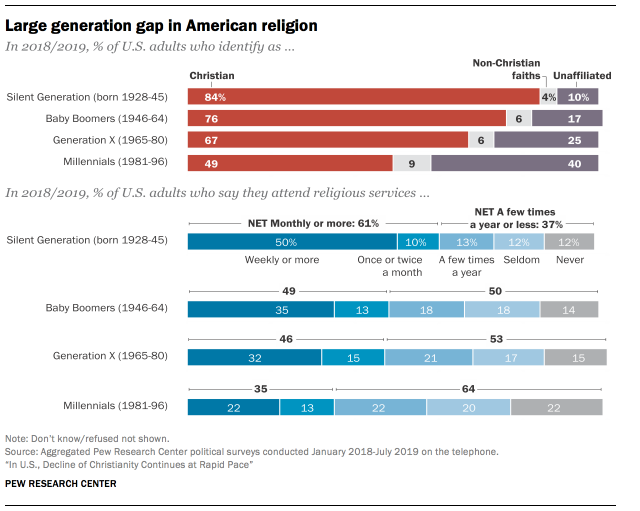
Per the latest Pew Research Center data on religion and American life, it sure looks that way.

The biggest takeaway from all this latest data? Millennials (yeah, those slackers, despite adults calling the younger generation slackers as far back as Aristotle) are a LOT less religious than their parents. A LOT less.

"Nones," the common word for those with no religious affiliation or identity, plus non-Christians, have as great an identity among Millennials as all Christian groups combined. No, really.


Now, this is a lot broader group than atheists or agnostics, despite Gnu Atheists talk of an "atheist surge," which has been going on for a decade or more now. (The talk, not any surge.) That said, self-identified atheists and agnostics have more than doubled over the 12-year range of the data, from 4 percent in 2007 to 9 percent in 2019.

It should be noted that "nones" may well have metaphysical beliefs. That's another reason for Gnus to stop poaching and crowing. Looking back 15 years or so, a woman on Match.com who originally wanted to meet me said "no" when she found out that "atheist" meant just that and NOT "spiritual but not religious" or Wiccan light or whatever. (It should also be noted, which Gnus don't, that millions of Buddhists around the world, mainly in the Theravada tradition, are both atheist and religious — and believe in metaphysical ideas, just not a personal god.)

That said, Nones are voting with their feet, not just their brains. In 2014, people who attend religious services just a few times a year first exceeded those who worship monthly or more. Among Millennials, it's just one-third who go to services once a month or more.

Among Americans overall, that growth is driven by a surge in those who NEVER attend, by self reporting. That's up to 17 percent.

Yes, one-sixth of Americans, even if they have some metaphysical beliefs (astrology, luck, Kabbalah or whatever) lurking somewhere, say they NEVER attend religious services. Related? Among those who say they attend once a month or more, the most ardent, the weekly attenders (or more) lost six percentage points, down to 31 percent. (If even that is correct; time and motion studies have shown that decades-old self-reported religious attendance surveys were consistently too high.)

Pew notes that the National Opinion Research Center, with different questions and framing, shows a similar number of Nones. It's at 22 percent for all ages vs 26 percent from Pew, even with somewhat different framing and questioning.

At the same time, Christian denominations seemed to have plugged the gap among the self-identified faithful. Worship rates among them have held pretty much steady over the past decade. But, with more and more of this being among the older generation, not just the Baby Boomers but the Silent Generation behind it, absolute numbers of Christians are declining due to death if nothing else.

That said, there are other takeaways. Despite the "give me that old time Christianity" (which type? Catholic? Lutheran? Reformed? Arminian? Anabaptist? Eastern Orthodox? Jacobite/Nestorian?) claim that it's those liberal Protestants (and cafeteria Catholics) who are all running away.

Not really.


Conservative mainline Protestants and conservative newer-line denominational Protestants (Southern Baptists, Disciples of Christ, etc.) are declining at almost the same rate as mainline Protestants (UMC, PCA, ELCA, Episcopaleans, UCC). I have theories on why.

They relate to the header.

It's true that the decline started before the Great Recession. It started with the slow recovery after the tech bubble burst in the early years of the George W. Bush presidency. But that recovery was anemic by historic standards, and the recovery from it and the post-9/11 slump (along with late-Clinton era and Bush era deliberately blind regulatory eyes) directly lead to the Great Recession.

Paul, in 1 Corinthians 15:19, said:
If we have put our hope in Christ for this life only, we should be pitied more than anyone.

But I think the flip side holds true.

If you tell Millennials, just like Southern massas told slaves who weren't in a position to challenge them, that their hope should only be in and for the next life, they'll laugh at you.

And, it's not just today. It's like the claim in Isaiah 7:14, the famously mistranslated almah passage:
Therefore Yahweh Himself shall give you a sign: behold, the young woman shall conceive, and bear a son, and shall call his name Immanuel.

No "virgin" was involved, of course, nor was any metaphysically divine Messiah being predicted. King Ahaz of Judah, worried about being invaded by Rezim of Syria and Pekah of Judah, would take cold comfort in being told to wait 700 years for a Metatron or whomever.

Instead, Isaiah was proclaiming in all likelihood that the new wife of Ahaz's son Hezekiah was going to give birth within a year, and per the rest of Isalah 7, before the child got much past the terrible twos, Rezin and Pekah would be smashed. Ironically, that baby would be King Manasseh, deemed the worst of Judah's rulers by biblical chroniclers.

I digressed a bit, but for a point. Contra Christians proof-texting the Old Testament, proclamations ("prophecies") were made for the people to whom they were directed.

So, today, with Millennials almost certain to have it worse off than not just smug Baby Boomers, but also Gen X, any church that can't address the here and now will get tuned out.

And, that's more than a soup kitchen or food bank. It's a job bank. It's sobriety support that may not be explicitly AA. It's church-based yoga and other exercise programs and more. Also, as America gets more ethnically diverse and it hits more than 50 percent non-white babies being born now, if that old church not only doesn't offer this support network, it's a bunch of old white people, the Millennials will tune out. Related to that? Unless they're conservative white Millennials, if they don't see social justice being addressed at that church (or synagogue, Orthodox and Conservative Jews), they'll tune out. 

And obviously already are.

And, given that they're young and debt-burdened in an era where income inequality continues to grow, they won't even be at success Gospel churches.


After all, per what I said about warning Christians about proof-texting the Tanakh, the preachers ("prophets") of the prophetic books were about preaching social justice, not "making predictions." And much of that social justice preaching was about wealth that was unearned, unshared, or both.

The situation is not directly parallel to World War II in Europe (and maybe in Japan?) where destruction was massive, and where deprivation lasted more deeply, not to mention pre-war and wartime political fissures that make America's look mild. But I think there are parallels.

For fundamentalist-type Christians who consider Europeans who aren't godless Communists to be mostly godless mostly Socialist, you're wrong to a degree today on belief (and way wrong on politics) and of short time sensibility.

European religious involvement closely tracked America's until the Great Depression started. It diverged some degree during then and the rearmament period, stayed about the same degree of difference during the war, then diverged more yet after World War II. But that shows it was a process. Jews lost god in the camps. Many Protestant and Catholic young German males, and their anxious families, lost god in Russian prison camps. Yet others on the Western side of the Iron Curtain lost god in postwar capitalism. (OK, the parallel fails there.)

But, it is happening, and unlikely to change. That's my analytical notes, including to my conservative Lutheran family.

Beyond that? I welcome it.

It's probably kind of like cigarette smoking. If the Nones who truly don't go to church at all continue that through age 30, they'll likely never be there. And, with that, contra the fakery of Supreme Court backtracking in rulings like Town of Greece, at some point, the First Amendment's freedom of religion meaning true freedom from government propping up religion in any way will maybe start to be realized. Beyond totally banning pre-meetings prayers, etc., I'm talking about things like churches not getting any tax breaks beyond those extended to nonprofit entities in general and things like that.

==

Update, with some related stats? In 2019, 23 percent of Americans went to church every week. Sounds fairly devoted, right, every week? But 29 percent never went once. Texas, Bible Belt stereotypes aside, is no exception. This site says that it was less than 20 percent, and they're a religious website.

Friday, November 08, 2019

A few thoughts on Catholic projectionism, partly Reformation connected

I'm using the word "projectionism" in its normal everyday psychological sense, made more popular perhaps by Freud but existing as an intellectual concept long before him.

As I noted before, Catholics don't seem to miss a dollar with church bulletin ads.

Nor, per my most recent post before this, do they miss a dollar with tchotchkes related to the Sacred Heart of Jesus cult.

And, even though Chimayó is not a wealthy place, the squabble between the Archdiocese of Santa Fe and other folks, plus the fact that it doesn't work even though it has swag for sale and takes donations, show that no dollar is missed there either.

And, the early modern Catholics who developed the Cult of the Sacred Heart (while condemning Aztecs for something, arguably in a symbolic sense no more grotesque) were lusting for gold in the New World.

And, on the reality side of legend vs reality on Martin Luther, the medieval indulgences system was a money-grubbing gold mine, and lots of Germans' beliefs about a ravenous Curia were true.

So, the projection?

First starting around, oh, 1095 CE and the First Crusade, then articulated by kings and emperors (often with Church-blessed titles) who didn't want to pay off bank loans, seems to me that about 1,000 years ago, and moving on from there, talked about "money-grubbing Jews."

Projectionism.

And, the bloodiness of the Sacred Heart, at least symbolically? The ancestors of the priests at Chimayo, the Franciscan missionaries who flagellated themselves (Puebloan society and moiety leaders also did)? The re-sacrifice of the Mass, which comes off not as metaphorical or symbolic, but, yes, as the church proclaims, a re-creation, a re-enactment, and which I also don't get as atheist or ex-Lutheran?

Versus those bloody pagan Aztecs, or other bloody pagans?

Projectionism.

I'm sure Tim O'Neill, cultural Catholic (maybe actual Catholic and not total atheist) proprietor of the deblogrolled History for Atheists will object.

Not that Protestants might not have some projectionism of their own on "pagans." Nor, given British then American capitalism and the so-called Protestant work ethic, that there's not Protestant projectionism on money-grubbing Jews.

But, I'd argue that, once we get past the early Baroque and into the Age of Enlightenment, Protestant monetary projectionism onto Jews was lower than Catholicism's. And, that lacking a cultus of sacrifice, that even if Luther himself held on to elements of the Sacred Heart myth, there still wasn't the same projectionism onto "savages" in this way.