“Go to the ant, you sluggard,” the biblical book of Proverbs advises the lazy-minded.
While not doubting that the lazy-minded exist in modern-day America, I know the opposite problem is more likely. What to do?
“Go to the oak tree, you harried and hurried-minded,” I would advise.
On the south side of our DeSoto office, we have a nice bur oak tree. It’s relatively young, but not so young as to not be able to put a quantity of the nice-sized acorns that earn it its name.
Between its leaves, among the largest of oak trees’ foliage, and the large-sized, larger-capped namesake acorns, bur oaks have very visible signs of growth. And that’s the basis for my adage.
In spring, with those large leaves, as over the past couple of weeks, it’s possible to easily observe day-to-day growth. And I do.
I usually park my car near or beneath the tree. (With our recent spate of record-smashing temperatures, I look for the possibility of “beneath” parking every day.)
So, I get a chance — and remember to take the chance — to stop a few seconds and look at the tree’s growth. Ditto in late fall, as I watch how the acorns mature each day, then drop from the tree. (Given the size of bur oak acorns, at this time of year, the parking option is definitely “near” and not “beneath.” I don’t need an oak tree to inflict the equivalent of light hail damage on my car.)
In either case, the slow steady growth of the oak in its leaves, or the slow steady output of its acorns, shows that slow and steady is still an important part of the world around us, if not for our own selves.
This holds true not just with a bur oak, but with spring in general.
I walk my neighborhood in Lancaster almost every day. In early-to-mid-February, I start looking at the trees on the streets, wondering which will be the first to start budding each year and when.
Going by the trees, will it be an early or a late spring?
After the first tree, what’s next?
I do the same thing at Ten Mile Creek Nature Park. Here, I will look at the different species. When will the first bois d’arc start budding? The first pecan?
And likewise in fall. When will the first pecans start forming? How long will it be until the first one falls and hits the ground?
I don’t always practice what I preach on living life in the slower lane, I’ll confess. I sometimes try to cram in too much time web surfing, attempt to cram 25 hours into 24-hour days and otherwise let myself get wound up too tightly.
That’s why this message is for me as well as for you, dear readers. But, sometimes, I do practice what I preach.
While on vacation a month ago, on my next to last day full day out, I was driving through the Mojave Desert of southern California, along a now-decommissioned section of Route 66. I then turned off to go south to Joshua Tree National Park. Just south of the junction, a series of salt flats, backdropped by mountain ranges, stretches to the horizon.
I stopped to take pictures of the geometric structure of the salt flats; another car had already done so. (For me, it was a chance to play with my ultrawide lens, to boot.)
But, after I had my fill of shooting, I realized that, especially with somewhat overcast weather, I was in no hurry to get to Joshua Tree. So, on a warmish 80-degree day, I took an hour on the flats to sit and meditate. I felt years younger after I got done.
The point is, sometimes, we may need to do more than just slow our lives down, we may need to sit and stop, however each of us does that.
Go to the oak tree? At times, it may be go to the desert.
The solitude and vastness of the desert will always put the rest of life in perspective, if we let it. Is it any wonder that religious and spiritual leaders, and some of history’s great artists as well, have found inspiration in the desert places?
Note: I appreciate people who have told me they like hearing about my travels and seeing my pictures. My latest are online in my Yahoo photo albums are here. I have a number of folders titled “2006 spring vacation” then the particular geographic site appended to the folder name. Pictures include a mating pair of American avocets wading in a shallow pool on the salt flats, a desert bighorn in Grand Canyon and several desert and red rock sunset and storm cloud pictures.

Sunday, May 07, 2006

Wednesday, May 03, 2006
Why I haven't posted here recently
This:
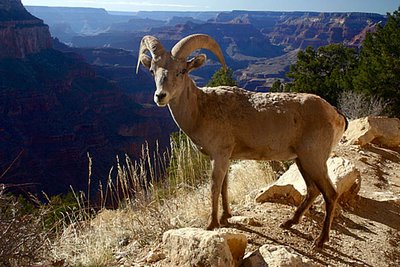
is part of why.
This is from the South Kaibab trail in Grand Canyon, a little over half a trail mile or so, and about 500 vertical feet, below the South Rim.
I was on vacation the second half of March, getting ready for it before then, and spending a fair amount of my free time for two weeks afterward editing photos, more of which are on my Yahoo profile.
This vacation definitely had its philosophical/personal growth/spiritual moments. One of the biggest of them was spending nearly a full hour meditating on a salt flat in the Mojave Desert. I felt almost five years younger when I finally got up.
Nature, and great nature photography opportunities like the one above, are similiarly "spiritual," in my secular way of understanding the word "spiritual(-ity)."

is part of why.
This is from the South Kaibab trail in Grand Canyon, a little over half a trail mile or so, and about 500 vertical feet, below the South Rim.
I was on vacation the second half of March, getting ready for it before then, and spending a fair amount of my free time for two weeks afterward editing photos, more of which are on my Yahoo profile.
This vacation definitely had its philosophical/personal growth/spiritual moments. One of the biggest of them was spending nearly a full hour meditating on a salt flat in the Mojave Desert. I felt almost five years younger when I finally got up.
Nature, and great nature photography opportunities like the one above, are similiarly "spiritual," in my secular way of understanding the word "spiritual(-ity)."
Thursday, March 02, 2006
Waxing poetic, philosophical and literary on selfhood
Note: This is the sixth part in a semi-regular series of posts about selfhood and related issues of cognitive philosophy. For more, see parts 1, 2, 3, 4 and 5.
Many poets have written about time and its flow, from the author of Ecclesiastes to Shakespeare and beyond.
I don’t claim to be old myself, and unlike an occasional “I’m getting old” column that today’s younger editorial staffers at my newspaper company have thrown up on its pages in the psat, I’m not going to pretend to be what I’m not.
However, although I’m not getting old, I am getting older. And since I’m on the far side of 40, I think I can offer a little comment on that.
Bear with me, those of you who like poetry, and literary allusions, through a poetic dialogue between myself and poets and authors of the past, and between Shakespeare and others of those poets and authors.
I loathe growing older,
And the way life,
With its past choices made and not made,
Python-like encoils my existential freedom.
I hate the constriction
Of a funnel-like previous history
Flowing downward into an ever-narrowing future
Which can often appear drain-like;
A metaphor with less than the most pleasant implications for tomorrow.
Ah, yes, tomorrow.
What was it Shakespeare said about tomorrow?
“Tomorrow, and tomorrow, and tomorrow,
Creeps in this petty place from day to day,
To the last syllable of recorded time,
And all our yesterdays have lighted fools,
The way to dusty death.”
Shakespeare knew.
He knew constriction.
The pettiness of that eternally recurring tomorrow,
The tableau of the anti-Proustian “Envisioning of Things Future,”
Produces not humility, but caution, restraint, tentativeness, apprehension.
Apprehension, yes, that’s it.
An apprehension of taking steps too big,
Lest I walk out on a fragile limb,
Getting stuck, cat-like, in the tree of life.
Eliot knew that apprehension,
Where a life measured in coffee spoons often results.
And yet, I appreciate the freedom of maturity
Even while I loathe the responsibility it entails, nay demands.
And struggle to live with, and embrace, the dichotomy.
But the future can also be expansive.
With songs of ourselves (do I not feel as brash as Whitman to sing of myself alone?) to be sung across seas of grass and time and space,
And across starless nighttime voids of the soul,
Yawning within, with their own expansiveness.
Who is this “I” to sing of himself?
“Who am I?” asked Dickinson.
Am I nobody, and you?
Or can we sing ourselves as somebodies?
“Who am I,” I ask, just like Dickinson.
Shakespeare admonishes again:
“To thine own self be true,
And it must follow, as the night the day,
Thou canst not be false to any man.”
Indeed, as he would have doubting, brooding Hamlet know,
Thou canst not be false to thyself if you but know it.
We hope.
But know myself?
Far back in the dust of history, beyond Shakespeare,
The ancient oracle of Delphi urges just that:
“Know thyself.”
And if I don’t?
If it is not possible?
Who is it that is making these choices that the world says are mine?
And the Bard saw true here as well, asking us whether that self that trods through life
Is but really walking the boards in front of the footlights,
But playing a part, or different parts for different stages, scenes and acts of life.
Is that me, or but a role that you see,
A convenience, a contrivance of my self to fit the scene,
To fit the clamor of the world around, or the madding crowd?
Do you know? Do I?
I don’t claim to have the answers for all of these questions,
To have asked the right questions,
Or even to have asked enough questions,
Enough to … know myself … very well.
At least, maybe I’ll buy some new, larger coffee spoons,
And stamp my name on them.
Perhaps I’ll brew a pot, and lift a cup high to old Will,
If he has been himself, and I myself.
Perhaps. Perhaps. Perhaps.
The word, like his “tomorrow,”
Can creep in this petty place from day to day.
Or not.
If only old Will had ever met Prince Siddhartha.
To thine own self be content, as well as true,
Or the closest you can;
And when you toe the mark, and exclaim your lines,
Accept them as your own, the best you can.
Many poets have written about time and its flow, from the author of Ecclesiastes to Shakespeare and beyond.
I don’t claim to be old myself, and unlike an occasional “I’m getting old” column that today’s younger editorial staffers at my newspaper company have thrown up on its pages in the psat, I’m not going to pretend to be what I’m not.
However, although I’m not getting old, I am getting older. And since I’m on the far side of 40, I think I can offer a little comment on that.
Bear with me, those of you who like poetry, and literary allusions, through a poetic dialogue between myself and poets and authors of the past, and between Shakespeare and others of those poets and authors.
I loathe growing older,
And the way life,
With its past choices made and not made,
Python-like encoils my existential freedom.
I hate the constriction
Of a funnel-like previous history
Flowing downward into an ever-narrowing future
Which can often appear drain-like;
A metaphor with less than the most pleasant implications for tomorrow.
Ah, yes, tomorrow.
What was it Shakespeare said about tomorrow?
“Tomorrow, and tomorrow, and tomorrow,
Creeps in this petty place from day to day,
To the last syllable of recorded time,
And all our yesterdays have lighted fools,
The way to dusty death.”
Shakespeare knew.
He knew constriction.
The pettiness of that eternally recurring tomorrow,
The tableau of the anti-Proustian “Envisioning of Things Future,”
Produces not humility, but caution, restraint, tentativeness, apprehension.
Apprehension, yes, that’s it.
An apprehension of taking steps too big,
Lest I walk out on a fragile limb,
Getting stuck, cat-like, in the tree of life.
Eliot knew that apprehension,
Where a life measured in coffee spoons often results.
And yet, I appreciate the freedom of maturity
Even while I loathe the responsibility it entails, nay demands.
And struggle to live with, and embrace, the dichotomy.
But the future can also be expansive.
With songs of ourselves (do I not feel as brash as Whitman to sing of myself alone?) to be sung across seas of grass and time and space,
And across starless nighttime voids of the soul,
Yawning within, with their own expansiveness.
Who is this “I” to sing of himself?
“Who am I?” asked Dickinson.
Am I nobody, and you?
Or can we sing ourselves as somebodies?
“Who am I,” I ask, just like Dickinson.
Shakespeare admonishes again:
“To thine own self be true,
And it must follow, as the night the day,
Thou canst not be false to any man.”
Indeed, as he would have doubting, brooding Hamlet know,
Thou canst not be false to thyself if you but know it.
We hope.
But know myself?
Far back in the dust of history, beyond Shakespeare,
The ancient oracle of Delphi urges just that:
“Know thyself.”
And if I don’t?
If it is not possible?
Who is it that is making these choices that the world says are mine?
And the Bard saw true here as well, asking us whether that self that trods through life
Is but really walking the boards in front of the footlights,
But playing a part, or different parts for different stages, scenes and acts of life.
Is that me, or but a role that you see,
A convenience, a contrivance of my self to fit the scene,
To fit the clamor of the world around, or the madding crowd?
Do you know? Do I?
I don’t claim to have the answers for all of these questions,
To have asked the right questions,
Or even to have asked enough questions,
Enough to … know myself … very well.
At least, maybe I’ll buy some new, larger coffee spoons,
And stamp my name on them.
Perhaps I’ll brew a pot, and lift a cup high to old Will,
If he has been himself, and I myself.
Perhaps. Perhaps. Perhaps.
The word, like his “tomorrow,”
Can creep in this petty place from day to day.
Or not.
If only old Will had ever met Prince Siddhartha.
To thine own self be content, as well as true,
Or the closest you can;
And when you toe the mark, and exclaim your lines,
Accept them as your own, the best you can.
Wednesday, February 15, 2006
Calling all music police: round up the Bernstein-Beethoven recordings
About five years ago, I got home one evening from somewhere, and turned on WRR, the Dallas classical radio station.
I immediately recognized the finale of Beethoven’s Ninth Symphony. I shortly thereafter recognized that this was probably the worst interpretation I ever heard.
Like watching a train wreck, mesmerized, I had to listen to the end to see who was conducting.
I found out it was Leonard Bernstein, specifically his fall of the Berlin Wall epic performance, if I may use the word “epic” loosely. (I had never heard it before.)
He had everything wrong, in my opinion — tempos, phrasings, nuances of dynamics, you name it.
Since that time, I have occasionally heard other Beethoven recordings of his on the radio, and I am convinced of one thing.
Lenny was clueless about Beethoven. Period.
So, I suggest we deputize some music police, confiscate every Bernstein recording of Beethoven, and destroy them all.
I immediately recognized the finale of Beethoven’s Ninth Symphony. I shortly thereafter recognized that this was probably the worst interpretation I ever heard.
Like watching a train wreck, mesmerized, I had to listen to the end to see who was conducting.
I found out it was Leonard Bernstein, specifically his fall of the Berlin Wall epic performance, if I may use the word “epic” loosely. (I had never heard it before.)
He had everything wrong, in my opinion — tempos, phrasings, nuances of dynamics, you name it.
Since that time, I have occasionally heard other Beethoven recordings of his on the radio, and I am convinced of one thing.
Lenny was clueless about Beethoven. Period.
So, I suggest we deputize some music police, confiscate every Bernstein recording of Beethoven, and destroy them all.
Saturday, February 11, 2006
Hey, is there anybody in there?
Who am I? Am I somebody? Am I an illusion? A collection of sub-somebodies? And, to borrow language from economics, how fungible is the sense of self after brain injury?
Science News tackles the latest in these issues here.
Science News tackles the latest in these issues here.
Mahler: the anti-Beethoven
How’s that?
Mahler’s first symphony clearly exhibits signs of being written as a deliberate aheroic, or even antiheroic, counterpoint to Beethoven’s Eroica.
How’s that?
First, the title of Mahler’s First: “Titan.” Selected by Mahler itself, and not at all modest for the title of a composer’s first symphony, it deliberately plays off Beethoven’s Eroica. Yet, unlike that work, it contains no dedication to a particular person nor was it ever written with that end in mind.
But the real anti-Beethoven, aheroic strains come out in the funeral march.
Those familiar with the symphony know that the theme of the march is the popular nursery rhyme “Frere Jacques,” suitable retarded, and put in the minor key. A nursery rhyme is anything but march-like. And the daily routine of a 4- or 5-year-old child is anything but heroic, let alone martial. The child in his mundane, everyday world, slowed down in sadness — the sadness that anticipates the Kindertotenlieder — is the Titan of Mahler’s symphonic world.
There are no heroes, and certainly not in a romantic sense, for Mahler’s musical canvas. And he is telling us that.
The theme continues, in my opinion. The resurrection of the Resurrection Symphony is not heroic in the sense of, say, Handel’s Messiah. And for Mahler, a converted Jew who had little formal religious connection, such heroism was not to be found there anyway. Resurrection was a wistful possibility for him, not a concrete certainty.
And the bombast of the Third, no matter how loudly or longly played, cannot force heroism. Nor does the tenderness of the Romantic, the Fourth, have a heroic edge to it.
Returning to the purely instrumental, the Fifth seems to hit a note of quiet resignation. The Sixth is known as the Tragic and its antiheroism speaks for itself through that moniker.
The Seventh? If I were to be naming Mahler symphonies, the would be the Pensive. Certainly not heroic.
The Eighth? Does the Veni, Creator Spiritus triumph over the Faust first movement? If so, the triumph is not a human one — it is purely spiritual and purely abstract.
That takes us to the Ninth, completed as Mahler’s life ebbed away, mired in the pain of knowing he had an unfaithful wife. The answer of this symphony is not a heroic rage against either physical restriction and decay on one hand, or lovlessness and faithlessness on the other. Rather, it is a degree of resignation greater, broader, deeper and more worn-out at end than the Fifth.
And finally, the Tenth, begun and unfinished as Mahler approached his deathbed. The death-knocks of the bass drum speak for themselves; stated firmly, if anything is heroic in this symphony, it is death itself.
Mahler’s first symphony clearly exhibits signs of being written as a deliberate aheroic, or even antiheroic, counterpoint to Beethoven’s Eroica.
How’s that?
First, the title of Mahler’s First: “Titan.” Selected by Mahler itself, and not at all modest for the title of a composer’s first symphony, it deliberately plays off Beethoven’s Eroica. Yet, unlike that work, it contains no dedication to a particular person nor was it ever written with that end in mind.
But the real anti-Beethoven, aheroic strains come out in the funeral march.
Those familiar with the symphony know that the theme of the march is the popular nursery rhyme “Frere Jacques,” suitable retarded, and put in the minor key. A nursery rhyme is anything but march-like. And the daily routine of a 4- or 5-year-old child is anything but heroic, let alone martial. The child in his mundane, everyday world, slowed down in sadness — the sadness that anticipates the Kindertotenlieder — is the Titan of Mahler’s symphonic world.
There are no heroes, and certainly not in a romantic sense, for Mahler’s musical canvas. And he is telling us that.
The theme continues, in my opinion. The resurrection of the Resurrection Symphony is not heroic in the sense of, say, Handel’s Messiah. And for Mahler, a converted Jew who had little formal religious connection, such heroism was not to be found there anyway. Resurrection was a wistful possibility for him, not a concrete certainty.
And the bombast of the Third, no matter how loudly or longly played, cannot force heroism. Nor does the tenderness of the Romantic, the Fourth, have a heroic edge to it.
Returning to the purely instrumental, the Fifth seems to hit a note of quiet resignation. The Sixth is known as the Tragic and its antiheroism speaks for itself through that moniker.
The Seventh? If I were to be naming Mahler symphonies, the would be the Pensive. Certainly not heroic.
The Eighth? Does the Veni, Creator Spiritus triumph over the Faust first movement? If so, the triumph is not a human one — it is purely spiritual and purely abstract.
That takes us to the Ninth, completed as Mahler’s life ebbed away, mired in the pain of knowing he had an unfaithful wife. The answer of this symphony is not a heroic rage against either physical restriction and decay on one hand, or lovlessness and faithlessness on the other. Rather, it is a degree of resignation greater, broader, deeper and more worn-out at end than the Fifth.
And finally, the Tenth, begun and unfinished as Mahler approached his deathbed. The death-knocks of the bass drum speak for themselves; stated firmly, if anything is heroic in this symphony, it is death itself.
Existential thoughts on Camus
I’m rereading Camus – currently on "The Stranger." As I was out for a walk tonight in what is really “normal” temperature but felt briskly chilly compared to what we’ve been having this year, I remembered, nearly verbatim, his lines in Mersault’s mouth on the last pages:
“For the first time, in that night alive with signs and starts, I opened myself to the gentle indifference of the world.” The world cares not whether I am alive or dead and has no world-soul to care, anyway. That thought can be either depressing or gladdening, I realized, depending one what mindset I bring to that thought in advance, what feelings and beliefs I am seeking to be confirmed or denied, and so forth. I felt vaguely but reassuringly comforted by that fact.
And how had Camus reached this point?
“As if that blind rage had washed me clean, rid me of hope,” he says just before the words above. Raw emotion, when undenied, can get us to bedrock within ourselves. I take Camus as saying he has been rid of the hope of false delusions, such as the delusion that the world really gives a damn about Mersault.
And so we go on.
“Finding it so much like myself — so like a brother, really — I felt that I had been happy and was happy again.” Mersault is one with himself after getting stripped of his self-delusions. And so, in a nonmetaphysical way, he can experience a certain degree of oneness with the world at large, as a relative of some sort.
And that leads us to Mersault’s final lines, where Camus lets us know that the homo existentialis always remains in at least partial control of his own emotional fate, if not his physical fate.
“For everything to be consummated, for me to feel less alone, I only had to wish that there be a large crowd of spectators the day of my execution and that they greet me with cries of hate.”
“For the first time, in that night alive with signs and starts, I opened myself to the gentle indifference of the world.” The world cares not whether I am alive or dead and has no world-soul to care, anyway. That thought can be either depressing or gladdening, I realized, depending one what mindset I bring to that thought in advance, what feelings and beliefs I am seeking to be confirmed or denied, and so forth. I felt vaguely but reassuringly comforted by that fact.
And how had Camus reached this point?
“As if that blind rage had washed me clean, rid me of hope,” he says just before the words above. Raw emotion, when undenied, can get us to bedrock within ourselves. I take Camus as saying he has been rid of the hope of false delusions, such as the delusion that the world really gives a damn about Mersault.
And so we go on.
“Finding it so much like myself — so like a brother, really — I felt that I had been happy and was happy again.” Mersault is one with himself after getting stripped of his self-delusions. And so, in a nonmetaphysical way, he can experience a certain degree of oneness with the world at large, as a relative of some sort.
And that leads us to Mersault’s final lines, where Camus lets us know that the homo existentialis always remains in at least partial control of his own emotional fate, if not his physical fate.
“For everything to be consummated, for me to feel less alone, I only had to wish that there be a large crowd of spectators the day of my execution and that they greet me with cries of hate.”
Subscribe to:
Posts (Atom)