It's easy to pontificate against a Bart Ehrman's approach to establishing the likelihood of the Jesus of history actually existing by establishing that different sources about him exist.
But that's exactly what Tom Dykstra does when pretending not to take sides between Ehrman and Thomas Brodie.
No, we don't have "Q." But we do have the Gospel of Thomas. But Dykstra nowhere mentions that.
We have John as a witness independent of the Synoptics. But Dykstra nowhere mentions him.
Given that Dykstra makes these claims, or lies by omission, in an academic paper, he seems pretty silly. And Dykstra in other writings has indicated he's mythicist-friendly.

Tuesday, March 24, 2020

Thursday, March 19, 2020
Radical freedom, road trip style

I saw the RV pictured above across the highway from my apartment complex a couple of weeks ago.
I'm not old by any means, but, the earliest version of Uncle Sam's finish line is less than a decade away. In the back of my mind, I still have hope for some mix of ongoing freelance and/or half-time or better contract work, while working in more travel and maybe some National Park Service volunteer work in between.
The idea being that I would have enough money saved up to junk the apartment life entirely for several years and snowbird and roam.
Details of the above beastie?
Yeah, the owner says it has new gaskets and just 53,000 miles on a vehicle that's $2,995.
OTOH, that's a 1980s RV, probably built on a Suburban body with an extended back end. It's got the gas-hog GM 454 engine, and the automatic tranny is probably just three-on-a-tree. (It was unlocked, and looking inside, in addition to most of the interior definitely looking 1983, I saw no overdrive button or lever, or any other indication it was beyond the normal 1980s automatic transmission.)
I would love something smaller, like the RVs you can get built on a full-sized van chassis. Two weeks after seeing that, I saw one of those on a Dodge body (not for sale, being used, with the owner younger than me) parked at the Wally behind me.
I presume that's running either their current 6.1 liter (366) or an older 5.7 liter (350) engine. Better gas mileage there. And shorter.
Ideally, I'd love something like that, with a hybrid drivetrain, and as much of the stove, fridge and other amenities powered off electricity as much as possible. Avoid the hassles of a newbie like me with propane tanks.
Then, instead of towing a car (or a Jeep), put a rack in back, where I could park a bike, an e-bike, or one of those three-wheel hybrid drive motorcycles or large scooters. That would take care of my travel needs while parked. Something that could easily and safely do 45mph, to get around on all city streets and within state or national parks, and relatively easily and safely do 55 to navigate non-freeway highways, maybe.
All still just thoughts at this time.
But yes, per Sartre, thoughts of personal radical freedom. I'm not using it exactly the way he does, but yes, in his spirit.
Of course, thoughts remain just thoughts until put into action.
That said, besides Sartre, reading three Chuck Bowden books — a Festschrift for him, if one will, by fellow Western (not novels, Western-iana) writers, the Charles Bowden Reader, and his Red Caddy set of essays on Ed Abbey — have made me cogitate on this more.
Radical freedom. It's just a pair of words for knowing I have nothing left to lose.
And, with the spread of coronavirus worries and half the country on, or threatening to be on, semi-lockdown, radical freedom is a siren song.
Of course, the empiricist part of the philosopher me says: It wouldn't be very radical freedom if you got stuck somewhere and ran out of supplies. Or maybe that's the philosophical (and psychological) pessimist part of me.
Saturday, March 14, 2020
My personal academic tie
to the Dead Sea Scrolls forgery story
And crude ones at that.
Ancient leather. Yeah, it's ancient, but leather, not parchment.
Modern ink.
Some were purchased from William Kando, son of the primary discoverer, or at least the primary peddler, I should say, of the actual scrolls. Others may trace back to him indirectly. The independent researchers hired by the museum in 2017 to investigate believe, but aren't sure, that all the forgeries were created by the same person or persons.
I've mentioned it elsewhere as the "BAR effect."
That's as in Biblical Archaeology Review, which promoted Holy Land-itis among evangelical Christians and has long run a thriving display advertising service for antiquities, as well as running puff pieces on things like the fraudulent James Ossuary.
I have a personal tie to this, not the forgery itself, but the investigation. I know the Jeff Kloha mentioned in the piece.

Yes, per the link to Museum of the Bible chief staff, he's Jeffrey Kloha today. But I went to seminary with Jeff Kloha. And, per his picture, he's aged better than I have.
First thought is not about the forgery but about how did Kloha get to this position? He looked ensconced at Concordia Seminary and certainly comfortable there. I didn't even know he had left. Frankly, I had him fingered as a candidate for seminary president in the future. (He had started there in 1999, I believe, as an associate professor and then became provost a few years ago.)
On the other hand, already back then, Kloha was argumentative (he'd be arguing with me over this piece, now, for sure), and, to the degree I can recall across the decades, politically pretty conservative as well, though not as much so as classmate and later (and still) seminary professor David Lewis. I can see him as seeing this as an opportunity in other ways. (I also wonder how much he and Lewie talked when Kloha had the opportunity come up three years ago.)
When we were at Concordia a "few" years ago as fellow M.Div. program students, he and I both concentrated on what's known as exegetical theology — the study of individual biblical books, their formation and related issues. I started a petition drive for a class in textual criticism, which, shockingly, a theoretically academically strong seminary with doctoral degrees, not a fly-by-night Bible college, didn't have one of. Jeff was one of the first people I approached to sign, he did, and we got the class, taught by Jim Voelz, who, even more than Kloha today, probably, looked for the bits of wiggle room he could find within conservative Lutheranism. (He was big on oral transmission ideas, following on Albert Lord's work, and encouraged us in his class to see Stanley Fish at Washington University, back when Fish was just starting to hit the really big time. That said, he ignored the limitations of oral transmission theory on non-poetic works and also rejected Markan priority theory on the Synoptic Gospels. But I digress. A bit.)
Eventually, I read enough critical theology, accepted most findings, and did intellectual judo on my conservative Lutheranism. Following in the general track of James Voelz, our prof in that class, Kloha found the small bits of wiggle room he could within conservative Lutheranism and its confined school of biblical interpretation, shared with many other conservative Protestants, or so I presume, and went his way.
Update: That said, speaking loosely from some personal conversation with a good friend, also from those days, I think that even the bits of wiggle room he had found were too much for too many in the Lutheran Church-Missouri Synod. He as provost along with the Seminary president were put on denominational hierarchy leashes on hiring decisions and more. So he bailed. Can't blame him. From the outside, I've been seeing the LCMS move more and more from conservativism to outright fundamentalism, like has happened with the conservative Presbyterian offshoot that left the PCUSA.
(Update to this update: Semi-wingnut LCMS jefe Matt Harrison is now facing a big legal [and ethical] imbroglio over the closure of Concordia University Portland.)
(Update,
Nov. 26, 2024: I don't know whether he left on his own, or got kicked
to the curb, but Kloha is no longer at the Museum of the Bible, per his LinkedIn. In a post, he says it was his decision, but, nonetheless, that could be a decision that was constrained or nudged in some way. Per this post
from his new freelance life? It's interesting. Maybe he's less
argumentative than in the past. That said, does his enlightenment about
political discourse also apply to political discourse?)
Had I not been in a state of some sort of chronic low-grade depression once I made my "commitment," I might have followed the path of a Bart Ehrman, but that didn't happen. This all relates to my story of how I became an atheist, which starts here with part 1.
Anyway, I want to comment on a couple of Kloha's comments at the story, as they're comments that come from him making his choice within the Missouri Synod Lutheranism world. They're comments and observations with which I disagree.
Basically, this is the biggie:
Had I not been in a state of some sort of chronic low-grade depression once I made my "commitment," I might have followed the path of a Bart Ehrman, but that didn't happen. This all relates to my story of how I became an atheist, which starts here with part 1.
Anyway, I want to comment on a couple of Kloha's comments at the story, as they're comments that come from him making his choice within the Missouri Synod Lutheranism world. They're comments and observations with which I disagree.
Basically, this is the biggie:
“The Dead Sea Scrolls are inarguably the most important biblical discovery of the last century,” Kloha says. “That pushed our knowledge of the biblical text back one thousand years from what was available at the time, and showed some variety—but especially the consistency—of the tradition of the Hebrew Bible.”
This is a mix of not true and narrow construal of the scrolls.
First, on the textual side, the Dead Sea Scrolls confirmed that major Septuagint variants from the Masoretic Texas in the order and content of Jeremiah, a number of Septuagint modest-moderate variants in Joshua, Judges and First and Second Samuel and a few in the Torah, especially Exodus all had old Hebrew-original support. And, in a few cases, we found the DSS disagreeing with both the Masoretes and the LXX.
Beyond that, Kloha has an unrevealed "anchor" within his "consistency" claim. As a fundamentalist Lutheran, he believes that (with a few asterisked verses like his own death) Moses large wrote the Torah circa 1200 BCE, or circa 1,200 years before Qumran. So, "hey look at how authentic Moses is!" The reality, of course, is that the Torah only reached its final form under Ezra, and if you take a late, 400 BCE date for him, you've whacked two-thirds of Kloha's timespan away.
That said, the greater variants in books like the Former Prophets shows their lesser relevance to early Judaism or proto-Judaism. And, why not? They're mainly about rulership, irrelevant to Jews again until 164 BCE.
Continuing ...
Within the Wikipedia entry, I note it quotes the Oxford Companion to Archaelogy:
While some of the Qumran biblical manuscripts are nearly identical to the Masoretic, or traditional, Hebrew text of the Old Testament, some manuscripts of the books of Exodus and Samuel found in Cave Four exhibit dramatic differences in both language and content. In their astonishing range of textual variants, the Qumran biblical discoveries have prompted scholars to reconsider the once-accepted theories of the development of the modern biblical text from only three manuscript families: of the Masoretic text, of the Hebrew original of the Septuagint, and of the Samaritan Pentateuch. It is now becoming increasingly clear that the Old Testament scripture was extremely fluid until its canonization around A.D. 100.
Sadly, overall, Wiki's entry is very, very uneven. In this same section, it has Presbyterian scholar Millar Burrows and conservative evangelical Gleason Archer wrongly agreeing with Kloha's take. (But of course!) And, Wiki's own introductory paragraph makes the same claim. (Even worse, elsewhere in the entry, Wiki called BAR founder and antiquities-monger Hershel Shanks a scholar, as in a biblical scholar. He's not. He's a lawyer by training, and not a constitutional law scholar or any other type of legal scholar that I know of. I made an edit, and in my explanation, told Wiki not to reverse it.)
Did any of these variants have Yahweh called Satan or Judah called Edom? No.
But, within those books that form, in the Hebrew canon, the "Former Prophets," which includes First and Second Kings, they showed a number of discrepancies in details of alleged pre-kingly Israelite history. Such variations support critical scholarship's questioning of biblical historicity and to some degree, within that, support Copenhagen School-type radical questioning. And, they also show that broader textual fluidity that, in turn, would point to larger doctrinal and sectarian fluidity.
That leads me onward.
Outside of textual criticism? Here, Kloha is engaged in "framing," and a framing of the issue that's different than mine. (His comment about "Hebrew tradition" is referring to textual tradition, not the larger theological tradition, but that's where I'm headed next.) Framing is what he was doing earlier with his unspoken stance on who wrote what when.
The typical blue-haired lady pearl-clutcher in an upper Midwest conservative Lutheran congregation, just as much as the chic pearl-flaunter at whatever megachurch in Oklahoma City the Greens attend, probably think the Dead Sea Scrolls is all biblical stuff.
And, of course, it's not. And, of course, Kloha knows that.
And, when we talk about the totality of the DSS and the totality of the Hebrew Bible, and what the Scrolls are believed to show about the sectarians who are believed to have lived at Qumran, it's a different story.
Approximately 60 percent of the DSS is non-biblical scrolls, first. Of that, half is from what was not canonized for Jews, but was already known elsewhere. Some of this entered the Catholic and Orthodox Christian bibles as "deuterocanonical" material; the majority, though, is apocalyptic material like 1 and 2 Enoch. The other half of the non-biblical material, or 30 percent of the whole, was brand new, though. And it's this material that refutes Kloha's framing.
The Community Rule, the War Scroll, the Damascus Document (a DSS but discovered before the 1946 dam-breaker), the Son of God text and other documents show that Judaism at the turn of the eras was far, far more sectarian than previously believed, first of all. That, in turn, presents the rise of Christianity as one version of Jewish sectarianism in a new light. (Some elements of the Nag Hammadi corpus present the rise of Mandeanism, a sectarian competitor based on a non-Christian interpretation of John the Baptizer, in a similarly new light, and even more, shed light on Christian Gnosticism.) And, per the Oxford Companion comment, these other materials at Qumran were not just written before 100 CE, many were written before the change of eras and some may well have been written before 100 BCE.
And, tying that back to Kloha's comment? Certainly from a Christian-only perspective, rather than Judeo-Christian, the DSS are NOT "inarguably the most important biblical discovery of the last century," depending on what exactly one means by that phrase.
• First, Gnostic gospels like those at Nag Hammadi were Gospels for Gnostics, even if there never was an organized Gnostic church to declare a Gnostic canon.
• Second, similar holds true for second-generation and third-generation Gnostic Christian writings. Between points one and two, The Apocryphon of James, Apocryphon of Paul, Gospel of Truth, The Thunder Perfect Mind, and Gnostic Apocalypse of Peter are all major Gnostic works. Having nearly complete to complete copies of them allows modern scholarship to no longer have to read them through a lens of "orthodox" Christian church fathers. It also allows for improved dating of them, putting estimates on several of them at pre-200.
• Third, as a New Testament scholar and exegete, he knows the discovery of the full Gospel of Thomas at Nag Hammadi was huge. (It gave underpinning to a theoretical "Q" source as part of a two-source theory of the synoptic gospels. [Side note: Twentieth-century proponents of a two-gospel theory of the synoptics claiming that independent writing was in part because of Deuteronomy 19:15's call for "two or three witnesses," I find laughable. Side note two: Independent transmission theorists' claims that the three synoptics really don't look that similar on closer inspection I find almost as laughable.])
• Fourth, which is itself a framing issue, Kloha doesn't mention that for reasons related in part to the formation of the state of Israel, only Christians (or lapsed ones) but no Jews were on the initial Qumran scholars group. Read this long and interesting interview of John J. Collins for more.
But conservative scholars can't spin Nag Hammadi. So, all you can do is try to lessen it. (Or, slam it as "heresy.") I know this is a strong reaction, seemingly, to what he's saying. But, I know Jeff Kloha's mind from decades ago, and there's a lot of vinegar behind that "inarguably." When connected with the "especially the consistency" claim about the Jewish Tanakh/Christian Old Testament, it can't go unchallenged by me. In other words, while LCMS wingnuts challenged even the relatively small wiggle room within historical-grammatical exegetical ideas, versus a flat-out "god revealed it," at the same time, I think Kloha, if that wiggle room wasn't challenged, was comfortable staying within it.
And, tying that back to Kloha's comment? Certainly from a Christian-only perspective, rather than Judeo-Christian, the DSS are NOT "inarguably the most important biblical discovery of the last century," depending on what exactly one means by that phrase.
• First, Gnostic gospels like those at Nag Hammadi were Gospels for Gnostics, even if there never was an organized Gnostic church to declare a Gnostic canon.
• Second, similar holds true for second-generation and third-generation Gnostic Christian writings. Between points one and two, The Apocryphon of James, Apocryphon of Paul, Gospel of Truth, The Thunder Perfect Mind, and Gnostic Apocalypse of Peter are all major Gnostic works. Having nearly complete to complete copies of them allows modern scholarship to no longer have to read them through a lens of "orthodox" Christian church fathers. It also allows for improved dating of them, putting estimates on several of them at pre-200.
• Third, as a New Testament scholar and exegete, he knows the discovery of the full Gospel of Thomas at Nag Hammadi was huge. (It gave underpinning to a theoretical "Q" source as part of a two-source theory of the synoptic gospels. [Side note: Twentieth-century proponents of a two-gospel theory of the synoptics claiming that independent writing was in part because of Deuteronomy 19:15's call for "two or three witnesses," I find laughable. Side note two: Independent transmission theorists' claims that the three synoptics really don't look that similar on closer inspection I find almost as laughable.])
• Fourth, which is itself a framing issue, Kloha doesn't mention that for reasons related in part to the formation of the state of Israel, only Christians (or lapsed ones) but no Jews were on the initial Qumran scholars group. Read this long and interesting interview of John J. Collins for more.
But conservative scholars can't spin Nag Hammadi. So, all you can do is try to lessen it. (Or, slam it as "heresy.") I know this is a strong reaction, seemingly, to what he's saying. But, I know Jeff Kloha's mind from decades ago, and there's a lot of vinegar behind that "inarguably." When connected with the "especially the consistency" claim about the Jewish Tanakh/Christian Old Testament, it can't go unchallenged by me. In other words, while LCMS wingnuts challenged even the relatively small wiggle room within historical-grammatical exegetical ideas, versus a flat-out "god revealed it," at the same time, I think Kloha, if that wiggle room wasn't challenged, was comfortable staying within it.
Besides questioning Kloha, on the provenance of these faked scrolls, I find this by Emanuel Tov simply laughable:
I will not say that there are no unauthentic fragments among the MOB fragments, but in my view, their inauthenticity as a whole has still not been proven beyond doubt. This doubt is due to the fact that similar testing has not been done on undisputed Dead Sea Scroll manuscripts in order to provide a base line for comparison, including the fragments from the Judean Desert sites that are later than Qumran. The report expects us to conclude that abnormalities abound without demonstrating what is normal.
First, the burden-shifting attempt is laughable.
Second, all major authentic DSS have had radiocarbon dating and he knows that.
Third, per his background, Tov is FAR from a disinterested observer.
I also am simply incredulous that as big a DSS scholar as James Charlesworth ever even halfway signed off on these scrolls' authenticity. This isn't quite as bad as Hugh Trevor-Roper and the Hitler diaries, but it's not that far off, in my opinion.
Update: A new blog post by me, discussing the details of Augean stable-cleansing work that Kloha faces, and wondering if he's fully up to speed on the Greens' history of ill-gotten booty.
Update: A new blog post by me, discussing the details of Augean stable-cleansing work that Kloha faces, and wondering if he's fully up to speed on the Greens' history of ill-gotten booty.
Update to that, July 27, 2021: With the DOJ getting a court ruling today that Hobby Lobby must forfeit the Gilgamesh Dream Tablet, sounds like Jeff Kloha has more Cleanup on Aisle 6 to do. Details? The tablet was shipped to the US in 2003 by Jordanian Antiquities Authority, without proper paperwork but with the claim it was found in miscellaneous rubble in 1981. In reality, like much other stuff the Green family got its mitts on, it was apparently looted from Iraq. There is no honor among thieves, and we'll see how much remorse there is. (I'll primarily update off that first update link.)
Thursday, March 12, 2020
Beware the Ides of March and Indo-European cognates
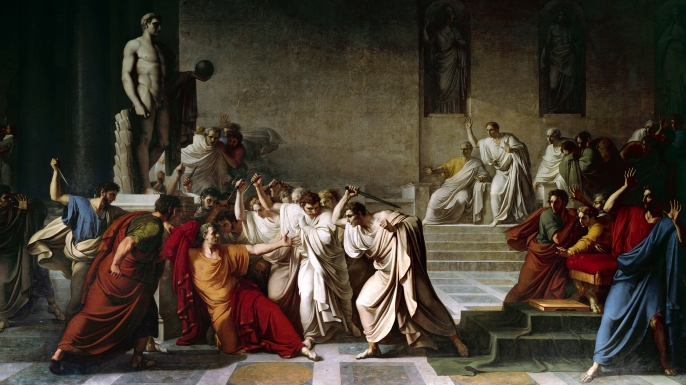
March 15, 2,063 years ago in 44 BCE (there was no 0 BCE and no 0 CE, so when counting from one era to the other, you have to subtract a year) Julius Caesar was murdered in the Roman Senate chambers by Brutus, Cassius and others
Why?
Supposedly, after twice turning down an offer to be named king (anathema in the Roman Republic since its founding, likely some few but not too many years after 509 BCE), he was going to be made the offer a third time, and accept. He had already been named perpetual dictator, going beyond the original Republican idea for a temporary emergency leader.
Shakespearean witch warnings to beware the Ides of March aside, as well as his wife's supposed fear, this is of course reality. And given the reality of Caesar's wife, it appears that both the plot, and the expectation that Caesar would again be offered, and would accept, the title were real as well.
So, what was this title?
Rex it was in Caesar's Latin. Derived cognates include rey in Spanish and roi in French.
Cognates from other Indo-European languages and language groups include raja or similar in Indian languages and shah or similar (picture raja losing the initial syllable, not uncommon if it started with a liquid consonant) in Iranian languages. It's rí in Irish and rígh in Scots Gaelic. (However, it's brenin or mrenin in Welsh. However, that could be related to the Latin regnum, which is of course related to rex.)
BUT!
The linguistic tail doesn't end there.
German knows no such kingly title. Rather, it's koenig there. Kong or similar in the Scandinavian languages.
But, the word is still there in German. Did Hitler not talk of a Third Reich, following that of the Hollenzollerns and the Holy Roman Empire? Indeed he did, and the word is cognate with our old friend rex.
What if we step further east? It's król in Polish, kralj in Slovenian and similar in other Slavic languages. It's karalius in Lithuanian, paralleling the Slavic. (Note the Finnish composer Sibelius' "Karelia Suite." I'm not sure if the name of the territory derives from the Balto-Slavic root or not.)
But, that in turn seems connected to a similar word in English, and its cognates in German and Scandinavian languages.
That would be "earl." That, in turn is, yes, related to the name Karl, from the old German karal, which in turn gave the old English ceorl, which was simply the base level of freeman in medieval England. (The German freiherr is the English "baron," but is literalistically "free lord.") That is, in turn, behind the name of Charlemagne / Karl der Grosse / Carolus Magnus.
So, so far, we have cognate words, but a reordering of ranks.
Back to Germany's three empires.
The Romance languages borrowed from Latin imperium or similar for both "empire" and "emperor" while the Germanic languages all did takeoffs on the actual name of our would-be king for the word "emperor." Kaiser. etc.
The Slavic, and Baltic, languages follow the Germanic on on the same two words and differentiation of roots for "empire" and "emperor." Tsar. Etc. (Tsars after, IIRC, Peter the Great actually emphasized the Russian equivalent of imperator more than tsar.
Something that is quite different, at least among Indo-European languages with which I have a modicum of familiarity?
Greek.
There, it's βασιλέας for "king." Modern Greek has αυτοκράτορας for "emperor." But the Byzantines maintained Roman tradition.
Anyway, βασιλέας migrated north. Think of the common Russian name "Vasily." But, as an actual cognate word? Can't think of one in any Indo-European language to the west or north. Nor can I think of any cognates with the Welsh, though it also lists, on Google Translate, words like rhí and riau, obviously cognate with the many others above.
As for one other tragically great actual, not would-be, king of Shakespeare, Caesar was not Thane of Tibur. As for Macbeth's pre-kingly status, though Macbeth was in Scotland, he was, like most kings, a lowland Scot. Middle English, and pre-Norman Viking invasions, had affected Scots language. Thegn, in Old English, was a low-level knight-type person. Think "Sir" in modern British English. Or huskarl in Old Norse, where that Karl from Germanic names and Slavic regency pops back up! (So do witches, but, even within language groupings within the Indo-European family, the etymology on words for those creatures is all over the map.)
As for Caesar's last words? Shakespeare took huge poetic license. Suetonius and Plutarch both have him saying nothing, though Suetonius says that others claimed he said, in Greek, και συ τεκνoν?, which is "you too, child?" in English, to Brutus. (Brutus was just 15 years younger and not Caesar's spawn.)
In any case, he died as neither rex, nor imperator, nor, other than by personal name, as Caesar.
Bonus etymology: If you're wondering about the word "ides," go here.
==
Update, March 16, 2023: Caesar was indeed killed for wanting to be proclaimed rex. But, it wasn't just his idea. This piece from JSTOR notes that Antony, among others, thought that he needed to be proclaimed king before battling the Parthians, among other things. I don't follow Antony's reasoning; Pompey had defeated kings in the eastern Mediterranean, already. But, it's a good read for the timing of Caesar's assassination and other motives the plotters had.
Thursday, March 05, 2020
There is no "theology of the Bible"
Unfortunately, both conservative AND liberal Christians think there is.
This is a follow-up of my post two weeks ago about Elizabeth Warren being ignorant about both philosophy and theology with an out-of-context quote of "whatever you have done to the least of these" from Matthew 25.
The fundies and conservative evangelicals are way wrong on this, of course, trying to mine the Tanakh for proof texts about Jesus. Of course, that's only 1, 925 years old, as the guy who wrote Matthew, most likely in the early 90s CE, was doing it.
But, liberal Christians haven't always abandoned that. And, in claiming that, say, "god is love" is the theology of the bible? They ignore the Yahweh who ordered holocausts, the Yahweh whose love for his own allegedly chosen people was conditional, and more.
Beyond that, "love" or "peace"?
Yes, both Isaiah and Micah say "Beat your swords into plowshares." (Micah probably wrote first.)
But Joel 3:10 says "Beat your plowshares into swords." And also reverses the second half of the Isaiah-Micah line, to "Beat your pruning hooks into spears."
Joel 3 in general talks about Yahweh restoring the fortunes of Israel, and that his people need to gird for war for their part in that. Micah 4, seemingly referenced by Isaiah 2, is a "latter days" passage. (I don't use "end times," let alone "apocalyptic," as those have Xn overtones.)
Now, at this point, both conservative and liberal Christians, despite my holocaust comments above, will probably still try to claim there is a theology of the bible.
There isn't. Back to Matthew 25. Doing good works appears to be the key to being a sheep or a goat. But Paul, in Romans 3:23, says "all have sinned and fall short of the glory of god," backgrounding his fudged through Greek quote of Habakkuk two chapters earlier and in Galatians that "the righteous will live by faith." (The better translation is of Habakkuk 2:4 that "the righteous shall live by his faithfulness," that is, to use Christian doctrine terminology while still rejecting an overarching theology of the bible, that Habakkuk is talking about sanctification, not justification.)
This is a follow-up of my post two weeks ago about Elizabeth Warren being ignorant about both philosophy and theology with an out-of-context quote of "whatever you have done to the least of these" from Matthew 25.
The fundies and conservative evangelicals are way wrong on this, of course, trying to mine the Tanakh for proof texts about Jesus. Of course, that's only 1, 925 years old, as the guy who wrote Matthew, most likely in the early 90s CE, was doing it.
But, liberal Christians haven't always abandoned that. And, in claiming that, say, "god is love" is the theology of the bible? They ignore the Yahweh who ordered holocausts, the Yahweh whose love for his own allegedly chosen people was conditional, and more.
Beyond that, "love" or "peace"?
Yes, both Isaiah and Micah say "Beat your swords into plowshares." (Micah probably wrote first.)
But Joel 3:10 says "Beat your plowshares into swords." And also reverses the second half of the Isaiah-Micah line, to "Beat your pruning hooks into spears."
Joel 3 in general talks about Yahweh restoring the fortunes of Israel, and that his people need to gird for war for their part in that. Micah 4, seemingly referenced by Isaiah 2, is a "latter days" passage. (I don't use "end times," let alone "apocalyptic," as those have Xn overtones.)
Now, at this point, both conservative and liberal Christians, despite my holocaust comments above, will probably still try to claim there is a theology of the bible.
There isn't. Back to Matthew 25. Doing good works appears to be the key to being a sheep or a goat. But Paul, in Romans 3:23, says "all have sinned and fall short of the glory of god," backgrounding his fudged through Greek quote of Habakkuk two chapters earlier and in Galatians that "the righteous will live by faith." (The better translation is of Habakkuk 2:4 that "the righteous shall live by his faithfulness," that is, to use Christian doctrine terminology while still rejecting an overarching theology of the bible, that Habakkuk is talking about sanctification, not justification.)
Thursday, February 27, 2020
Christianity-spouting presidential candidates versus philosophy and biblical interpretation

Well ... it's not so nice, in two ways that I mention on Twitter and one way that I'll add to that.
So,.what is this dilemma?Matthew 25 & "the least of these" is nice, but if you really need a deity to tell you that?— I'll Be Biden Time in South Carolina primary 🚩🌻 (@AFCC_Esq) February 26, 2020
You probably need to learn what the Euthyphro Dilemma is.
It's called #Philosophy, folks, something not enough Americans know as is. Here's a chance to learn a bit https://t.co/W8XSPVIH8J
Per the link (and you can find it at any basic philosophy website, too, as I slack on a vow to use Wikipedia less this year and stop rewarding its Zionist owner), it's pretty simple, and it comes from Plato. Whitehead wasn't right that all philosophy, or even all Western philosophy, is but footnotes to Plato, but most of pre-1900 Western philosophy mostly is. But I digress.
Plato had Socrates ponder to Euthyphro:
"Is the pious loved by the gods because it is pious or is it pious because it is loved by the gods?"And it IS a dilemma.
In case you don't want to think it through, let me help.
Substitute the word "good," and it becomes yet more stark.
If something good is loved by the gods because it is good, then the idea of goodness stands outside of the gods. If something is good because it's loved by the gods, then divine decrees could be arbitary.
And, yes, Plato used "the gods" plural. But, many classical Greeks were some sort of henotheists, at a minimum. Besides, it actually applies in spades to the Greek-extracted omnipotent + omnibenevolent god of Christianity.
(I had a graduate student at Harvard Divinity, a deep drinker from the "Ground of Being" [use solemn voice] Paul Tillich idea of god claim it didn't, but he was simply wrong.)
So, that's the philosophy issue: Trying to ground human ethics on a divine pronouncement gets you in trouble.
And, per that Wiki link, it's not a false dilemma and the idea exists independently of Platonism.
Per the tag, I've obviously blogged about this before.
==
And now for the biblical interpretation side.
Click this link to read Matthew 25, especially the last part from which Warren extracts "the least of these," if you're not familiar.
Three originally independent chunks of text, with a loose unity, come together.
The Parable of the Wise and Foolish Virgins is about being prepared for the Last Judgement.
The Parable of the Ten Talents is about manifesting one's faith while living a life expecting the return of the king — "The Return of the King" — it's about expecting the Last Judgement and manifesting faith, not about expecting Aragorn. The parable talks of the "master," to be honest, not a "king," but I couldn't resist the joke.
It doesn't come off as much of a parable as the Virgins, but, the passage begins with "again," indicating that it too should be regarded as a kingdom parable.
The Sheep and Goats ends us.
I don't call it a parable at all, though many commentators do. There is no "again" connecting it, and there is no "the kingdom is like" introduction. "Pronouncement story" (extended) or something like that is a better descriptive.
Anyway ...
It's a story about that Last Judgment to which the two parables above point.
Yes, Jesus does say to the "sheep" just what Warren quotes.
He also sends the goats to an eternal hell. It says that quite explicitly at the end of the story.
So, my second tweet:
And, yes, all of that, including the Tertullian stuff, is quite true. Yes, it's a punishment based on good works, not Pauline faith, faith, faith. Still, it's an eternal punishment based on this-world temporal evil. Arguably, the Jehovah's Witnesses idea of annihilation is less painful.Let us also remember that Matthew 25 is overall a biblical chapter about the Christian Last Judgment, with a vengeful omnipotent god sending people to an eternal hell.— I'll Be Biden Time in South Carolina primary 🚩🌻 (@AFCC_Esq) February 26, 2020
Early Xn Fathers like Tertullian got their jollies by imagining part of the fun of heaven wld be watching hell.
But, this is the Golden Rule, right?
Yes, and ...
The Silver Rule, as it's often called, is better. It's more laissez-faire. It's less meddling.
And, it is?
"Do NOT do unto others what you do NOT want done unto yourself."
In other words, live and let live in an ethical sense.
So, all political candidates, above all, presidential ones? "Judge not (by what biblical passages you cite) lest ye be judged."
Thursday, February 06, 2020
Lord, Liar, or Lunatic — and mythicist!
C.S. Lewis once infamously posited the false trilemma that Jesus must either be who he said, the Lord, or else a liar or lunatic. Critical scholars have of course countered with a fourth L of legendary accretions. (That's not to say that such accretions aren't at times outright lies by the authors of New Testament books. Nor is it to say that maybe the historical Jesus himself wasn't one, or a bit meshuggah at times.)
Anyway, I recently — due to someone I once "followed" on Disqus and for whom Disqus still gives me notifications even though I no longer follow him (social media click-baitery) stopped at the site of Jonathan M.S. Pearce on Patheos.
Under discussion was a guest post about Jesus mythicism.
The mythicists, of course, would change "Legendary accretions" simply to "Legend."
That said, the light bulb came on soon enough to recognize that Lewis' original trilemma, and their own fourth L, applies to many of them.
Lord — lording it over respondents and thinking they're always right.
Liar — busted some straight-up lies, as I did not too long ago at Godless in Dixie.
Lunatic — not literally, but, some of them are crazy in a everyday sense.
Legend — in their own mind, yes.
The Lord part? Many of them (not saying most, but am saying many) refuse to accept critical scholarship, whether its biblical criticism, archaeology or more.
===

First, that's not the same as rejecting the findings. Second, new archaeological study, from 2015 and ongoing to the degree it can, has found new evidence that says yes it did exist then. His response? Handwaving and talking about Helena. (He then pulled out Jesus ben Pandera, with his one mythicist website claiming he lived circa 100 BCE. Wrong. That's conflating the idea that the HJ may have been based on a Jesus crucified by Alexander Jannaeus with the ben Pandera of the Toledoth Yeshu.) More here on the actual existence of first-century Nazareth. Tis true that we cannot date to more precisely in the first century, but that alone undercuts mythicists.
(Pictured at right: A house in Nazareth dated to the first century CE and believed by some Christians to be the house of Jesus' childhood.)
Update, Dec. 20, 2020: And, Pearce himself is looking ever more like a mythicist fellow traveler at a minimum. From a new post, I quote.
Rene Salm’s thesis in The Myth of Nazareth: The Invented Town of Jesus that Nazareth did not exist at the time of Jesus, according to archaeological analysis, and not until at least 70 CE.
This is simply not true. One cannot generally date archaeological evidence of habitation to that precise of a time. I'm sure Pearce's quoted author would say something like "but the Judean revolt." And I would respond: Rome did not put every village in Galilee and Judea to fire and the sword. Oh, and I'll take Ken Dark, author of the second linked piece three paragraphs above, over Rene Salm any time. James McGrath, whom I will also take over Salm, offers indirect further evidence for the existence of Nazareth at the time of Jesus.
I want to quote McGrath, as it's another line that to some degree is applicable to mythicists in general:
For those who may have bought into the “Nazareth never existed” nonsense, I encourage you to reflect on the fact that you have listened to the archaeological equivalent of young-earth creationists. They might well be genuinely skeptical in other areas, but in this one they’ve bought into a conspiracy theory, and one that simply does not fit the evidence we’ve long had, much less the evidence that has come to light more recently.
Sorry, but it's true.
Dark also notes elsewhere how soon after Jesus' death Christians were to put labels on some sites as being part of Jesus' history. They still may not be accurate, but the earliest of the labelings could reflect an oral history going back further than the first written sources and so, at a minimum, should NOT be rejected out of hand.
Pearce says he's "not sold on mythicism" (my emphasis) but he certainly doesn't reject it, claiming he finds Salm's work "interesting though." It must be noted that Salm is not an academic, or even close. Shades of Joe Atwill, he's a music teacher!!! If anything, he's anti-academic vis-a-vis biblical scholarship. You may not be "sold" on mythicism, Jonathan ... but you're close to duck-quacking.
(Update, June 12: Pierce says now he leans away from mythicism, and actually, see below as for what the term is about, cites things like the scandal of particularity to boost a historical Jesus claim.)
Finally, there's the scandal of particularity, perhaps strongest in John, where Nathaniel sneers in John 1:45, "Can anything good come from Nazareth?" and John 7 having the rhetorical question about the Messiah not coming from Galilee. Per Pearce's post in question at his comment, I agree with him than Matthew 2 mangles "netzer." BUT ... Matthew is doing pesher on the Tanakh via the Septuagint. (The author of the Gospel was almost certainly a Greek-speaker.) And, perhaps, this is his attempt to explain away where Jesus is from with hand-waving, or to deliberate conflate different Hebrew words into a bad pun or three, shades of the Yahwist. The wrongness, deliberate mangling, or whatever, is no proof that Nazareth didn't exist. None.
The most likely story, given he had one known Zealot (anachronistic to a degree) and one possible Sicarian disciple is that Jesus was born and raised in Nazareth, and that this was indeed an embarrassment. As gospelers reached the second and third generations, they not only invented a birth for him in Bethlehem, but also invented a Davidic family tree which most likely is totally untrue in both Matthew and Luke.
===
Back to the original.
A second outright liar? This person, "pofarmer," not just to me but to others, posits "academic essentialism." In other words, because Bart Ehrman did his undergrad at a Bible college, he can never be really trusted. My response is that because Joe Stalin went to an Orthodox seminary, then he must have remained a secret Xn all of his life. I posted that in response to him, then in the mains. I called him out a second time in mains, and when he wouldn't respond, blocked him.
Lunatics? Well, not lunacy, but psychological projection — beyond the fact that many mythicists, as Gnu Atheists, are the atheist equivalent of Christian fundamentalists, is real.
Legends in their own mind? Yes.
So, the block function on Disqus got a workout. Both liars and two lunatics? Gone.
I have long thought that many Gnu Atheists feel they "Have to" disprove the existence of a historical Jesus to disprove the belief system of Christianity, and that simply doesn't logically follow. I don't have to disprove the existence of Siddhartha Gautama re Buddhism, or, although he wasn't divinized, Muhammad on Islam.
Otherwise, I'm sympathetic to a high degree of legendary accretions, perhaps more than a, say, Bart Ehrman. (He has other issues, such as misinterpretation of the We passages in Acts.)
But, I also know the history of Jesus mythicism, and that its first go-round happened at the same time as the first search for the historical Jesus and a first push for Buddha mythicism.
That said, I wonder if with Gnus, part of it is also the angle that Camus posited in "The Rebel." They feel they have to fight against this Jesus, and the "best" way to "win" this fight is allegedly prove he didn't exist.
That said, although it was a guest post, and I'm not sure of Pearce's own stand on mythicism, any philosophizing type (I think he's got a master's at least in the field) who claims to be "presenting a wealth of evidence in support of a deterministic worldview" is himself a liar. I posted something politely to that effect in the main thread and got no response.
Subscribe to:
Posts (Atom)