Working at a newspaper, I finally decided the only way this secularist could deal with it was to do a running blog post on the most ... to do a word mash-up ... insipidly tragic ones.
From an obit for a 1-year-old: "Returned to Jesus' arms." Why did Jesus let him escape for a year in the first place?
Similar, for an elderly person: "Lifted into the Lord's hands." Who lifted her out?

Wednesday, November 16, 2011

Sunday, November 13, 2011
Free will - a "god of the gaps" parallel?
Is "free will," at least as "compatibilists" generally strive to
define (and save) it, a philosophical equivalent of "a god of the gaps"?
I say the answer is an arguable yes.
Philosophy professor Eddy Nahmias is the latest to try to defend some neo-traditionalist, if you will, version of free will.
Of course, when you start with a straw man howler like this, it's easy for you to get called "a free willer of the gaps":
Then, there's this:
Finally, to riff on Samuel Johnson, Nahmias enters into the last refuge of a free-will philosophy scoundrel: He makes the "fatal" is-ought error.
Some other thoughts from Wikipedia on free will, including reference to Haggard, here.
That said, I think it IS possible to talk about free will in some way, but only in a way that includes subselves and subconscious processes.
UPDATE, Nov. 26: Massimo Pigliucci actually defends Nahmias, claiming he "provides a nuanced and intelligent brief discussion of the topic." Massimo is often thought-provoking and never dumb, but he's just off base on this one. (In the same post, he says that way too much is read into Libet. I'll split the difference and say that somewhat too much may be read into him, and that what Libet's experiments study are somewhat imprecise. But, to claim he's pretty much irrelevant to discussions of free will is a stretch, at the least.)
UPDATE, Nov. 27: Add this excellent essay to your reading. From a neuroscience perspective, it argues that brain systems that evolved to detect actual (or apparent) "intentionality" are a focal point for the rise of an illusion of "self." And, here's the journal essay that influenced that blog essay.
This ties in with Dan Dennett's "heterophenomenology." We assume "selves" in others because of this 'intentionality set" that appears to be built into our brains. But, Dennett doesn't quite note this is a two-way street. Per modern social psychologists, the "self," or what we call a "self" for ourselves, is in part a construct based on our interaction with others. That includes them seeing, and noting, seeming "intentionality" in ourselves.
So, even if there isn't a unitary self, not only do we act "as if" there is, we find it hard not to do so because of this outside conditioning as well as our own brain's mindset.
Now, a Buddhist meditation adept, or a devotee of deep self-hypnosis, might be able to transcend that to some degree. But (and this is why I only half-jokingly say "the only good Buddhist is a dead Buddhist") the person who recognizes, and more than just intellectually understands, that "self" is to some degree an illusion is generally unable to hold on to that idea. The Zen monk rejoins the rest of the monastery; the hypnosis adept walks out the door and into the larger world. And "conventional" ideas of self get reinforced again.
Philosophy professor Eddy Nahmias is the latest to try to defend some neo-traditionalist, if you will, version of free will.
Of course, when you start with a straw man howler like this, it's easy for you to get called "a free willer of the gaps":
When (neuroscientist Patrick) Haggard concludes that we do not have free will “in the sense we think,” he reveals how this conclusion depends on a particular definition of free will. Scientists’ arguments that free will is an illusion typically begin by assuming that free will, by definition, requires an immaterial soul or non-physical mind, and they take neuroscience to provide evidence that our minds are physical.First, not all neuroscientists make that assumption. And, philosophers like the Daniel Wegner whom you linked at the start of the column definitely don't link free will, or its absence, to dualism, or its lack.
Then, there's this:
Many philosophers, including me, understand free will as a set of capacities for imagining future courses of action, deliberating about one’s reasons for choosing them, planning one’s actions in light of this deliberation and controlling actions in the face of competing desires. We act of our own free will to the extent that we have the opportunity to exercise these capacities, without unreasonable external or internal pressure. We are responsible for our actions roughly to the extent that we possess these capacities and we have opportunities to exercise them.These capacities for conscious deliberation, rational thinking and self-control are not magical abilities.Well, if you're not going to wrestle with what consciousness is, let alone what standing free will at the level of consciousness has in the absence of a Cartesian theater, you may have a problem. Nahmias does eventually get around to tacking Benjamin Libet and the famous 200-millisecond gap, but only to wave it away:
First of all, it does not show that a decision has been made before people are aware of having made it. It simply finds discernible patterns of neural activity that precede decisions. If we assume that conscious decisions have neural correlates, then we should expect to find early signs of those correlates “ramping up” to the moment of consciousness.Ahh, this is a petard hoister. It's all in how you define "decisions" as well as "free will," isn't it? Under the Dan Dennett multiple drafts model, this is rather the subconscious impulse that "wins out" to the level of consciousness.
Finally, to riff on Samuel Johnson, Nahmias enters into the last refuge of a free-will philosophy scoundrel: He makes the "fatal" is-ought error.
We need conscious deliberation to make a difference when it matters — when we have important decisions and plans to make.Need? As in "ought to have"? Ooops.
Some other thoughts from Wikipedia on free will, including reference to Haggard, here.
That said, I think it IS possible to talk about free will in some way, but only in a way that includes subselves and subconscious processes.
UPDATE, Nov. 26: Massimo Pigliucci actually defends Nahmias, claiming he "provides a nuanced and intelligent brief discussion of the topic." Massimo is often thought-provoking and never dumb, but he's just off base on this one. (In the same post, he says that way too much is read into Libet. I'll split the difference and say that somewhat too much may be read into him, and that what Libet's experiments study are somewhat imprecise. But, to claim he's pretty much irrelevant to discussions of free will is a stretch, at the least.)
UPDATE, Nov. 27: Add this excellent essay to your reading. From a neuroscience perspective, it argues that brain systems that evolved to detect actual (or apparent) "intentionality" are a focal point for the rise of an illusion of "self." And, here's the journal essay that influenced that blog essay.
This ties in with Dan Dennett's "heterophenomenology." We assume "selves" in others because of this 'intentionality set" that appears to be built into our brains. But, Dennett doesn't quite note this is a two-way street. Per modern social psychologists, the "self," or what we call a "self" for ourselves, is in part a construct based on our interaction with others. That includes them seeing, and noting, seeming "intentionality" in ourselves.
So, even if there isn't a unitary self, not only do we act "as if" there is, we find it hard not to do so because of this outside conditioning as well as our own brain's mindset.
Now, a Buddhist meditation adept, or a devotee of deep self-hypnosis, might be able to transcend that to some degree. But (and this is why I only half-jokingly say "the only good Buddhist is a dead Buddhist") the person who recognizes, and more than just intellectually understands, that "self" is to some degree an illusion is generally unable to hold on to that idea. The Zen monk rejoins the rest of the monastery; the hypnosis adept walks out the door and into the larger world. And "conventional" ideas of self get reinforced again.
Monday, October 10, 2011
Do animals have souls?
The headline is facetious, of course. I'm a materialist, a philosophical as well as methodological naturalist.
But, in reference to ontological dualists, there's more good reason to be facetious.
Dogs and cats, even, and certainly other primates, might experience out of body experiences and near death experiences? Very interesting, and, neuroscience argues, likely true. Now the headline was fluff; dogs and cats, at least, surely don't have anything close to what we call "spiritual experiences."
But, a chimpanzee dancing himself or herself into a trance at the base of a waterfall? That's a different thing.
That said, of course, it doesn't have a soul, either.
But, in reference to ontological dualists, there's more good reason to be facetious.
Dogs and cats, even, and certainly other primates, might experience out of body experiences and near death experiences? Very interesting, and, neuroscience argues, likely true. Now the headline was fluff; dogs and cats, at least, surely don't have anything close to what we call "spiritual experiences."
But, a chimpanzee dancing himself or herself into a trance at the base of a waterfall? That's a different thing.
That said, of course, it doesn't have a soul, either.
Friday, September 23, 2011
Gnu vs. "thoughtful" atheism - a bit of history
First, about that title.
Rather than have Gnu Atheists label (and as a pejorative, to boot) people like me as "accommodationist," to the degree I identify myself as an atheist at various times and in various venues and discussions, I thought, while not label myself, if a label is sometimes needed?
And, calling myself a "thoughtful atheist"? If you infer that I'm implying something about Gnu Atheists, well, there's nothing I can do about your inferences.
 Now, the history. I believe that the history of atheist (in the western, naturalistic sense, not Theravada Buddhist sense) divisions can be traced back about 250 years to interactions between David Hume and the Baron D'Holbach during Hume's sojourn in France. (Wikipedia links for both.)
In its Hume entry, though I believe it overstates things a bit, we see this noted:
Meanwhile, per his entry, even many of the French philosophes found d'Holbach too radical and too acerbic. Again, no further comment, but what others do with inferences, I can't control.
Beyond style, I think Hume found d'Holbach too black-and-white in his thinking in general, as well as being, per Dan Dennett, a bit of a "greedy reductionist." Were d'Holbach around today, we'd maybe accuse him of scientism. And d'Holbach probably would have called Hume, the most thoughtful of people, an "accommodationist."
Anyway, this "tension," if you will, is nothing new.
But, for those of us who are nuanced, who are thoughtful .. we have a secular "patron saint." Fittingly, of course, we recently marked the 300th anniversary of Hume's birth.
Celebrate. Be ... reasonable. But not rationalistic!
Rather than have Gnu Atheists label (and as a pejorative, to boot) people like me as "accommodationist," to the degree I identify myself as an atheist at various times and in various venues and discussions, I thought, while not label myself, if a label is sometimes needed?
And, calling myself a "thoughtful atheist"? If you infer that I'm implying something about Gnu Atheists, well, there's nothing I can do about your inferences.
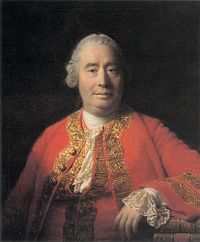
In its Hume entry, though I believe it overstates things a bit, we see this noted:
It is likely that Hume was skeptical both about religious belief (at least as demanded by the religious organisations of his time) and of the complete atheism promoted by such contemporaries as Baron d'Holbach. Russell (2008) suggests that perhaps Hume's position is best characterised by the term "irreligion". O'Connor (2001, p19) writes that Hume "did not believe in the God of standard theism. ... but he did not rule out all concepts of deity". Also, "ambiguity suited his purposes, and this creates difficulty in definitively pinning down his final position on religion".I would at least agree with Russell, but think that O'Connor overstates that. Beyond that, some recent scholarship argues that "A Treatise on Human Nature" was a carefully crafted, carefully couched/disguised argument for atheism.
Meanwhile, per his entry, even many of the French philosophes found d'Holbach too radical and too acerbic. Again, no further comment, but what others do with inferences, I can't control.
Beyond style, I think Hume found d'Holbach too black-and-white in his thinking in general, as well as being, per Dan Dennett, a bit of a "greedy reductionist." Were d'Holbach around today, we'd maybe accuse him of scientism. And d'Holbach probably would have called Hume, the most thoughtful of people, an "accommodationist."
Anyway, this "tension," if you will, is nothing new.
But, for those of us who are nuanced, who are thoughtful .. we have a secular "patron saint." Fittingly, of course, we recently marked the 300th anniversary of Hume's birth.
Celebrate. Be ... reasonable. But not rationalistic!
Wednesday, September 21, 2011
Another Gnu Atheist, another lie about "growth"
It's getting kind of tiresome, Gnu Atheists (whether explicitly self-identifed as such or not) who claim there's an "atheist growth explosion" in this U.S. When there's not.
The latest? Some B-ranker named Greg Paul at the Washington Post freelance forum, who wayyyy gets it wrong. Atheism is not growing. Period. That said, looking at the author's Wiki page, which I will not link, he seems disposed to overblown claims. The author doesn't explicitly call himself a "Gnu" there, but it wouldn't surprise me. In the column, he also repeats the Gnu canard that atheism, or "democratic atheism," as he notes (trying to cut Stalin and Mao out of the loop) are morally superior to theism. Since we don't have that long a time frame for democratic atheism, there's not much of the "scientific proof" that he claims, first. He also distorts information from Gallup polls, ignores the part in the Harris polls that undercuts him and more.
For someone who touts science in the same breath with "democratic atheism," he's got a lot of chutzpah.
Reality? As I've blogged before, the comprehensive 2008 ARIS survey does show a strong growth in the "irreligious," but they include people "spiritual but not religious," Christians tired of organized denominations, neopagans, New Agers and many others who either believe in one or more gods, or if technically atheist (some New Agers and Buddhists fit there) nonetheless have anti-naturalistic metaphysical beliefs.
The latest? Some B-ranker named Greg Paul at the Washington Post freelance forum, who wayyyy gets it wrong. Atheism is not growing. Period. That said, looking at the author's Wiki page, which I will not link, he seems disposed to overblown claims. The author doesn't explicitly call himself a "Gnu" there, but it wouldn't surprise me. In the column, he also repeats the Gnu canard that atheism, or "democratic atheism," as he notes (trying to cut Stalin and Mao out of the loop) are morally superior to theism. Since we don't have that long a time frame for democratic atheism, there's not much of the "scientific proof" that he claims, first. He also distorts information from Gallup polls, ignores the part in the Harris polls that undercuts him and more.
For someone who touts science in the same breath with "democratic atheism," he's got a lot of chutzpah.
Reality? As I've blogged before, the comprehensive 2008 ARIS survey does show a strong growth in the "irreligious," but they include people "spiritual but not religious," Christians tired of organized denominations, neopagans, New Agers and many others who either believe in one or more gods, or if technically atheist (some New Agers and Buddhists fit there) nonetheless have anti-naturalistic metaphysical beliefs.
Saturday, September 17, 2011
‘Critical’ Xns not any more rational than fundys?
Or at the least, they can be just as determined in their
habits and depth of motivated reasoning, perhaps.
In one particular case, I know that’s true.
In an extended debate on Google Plus with a new Harvard
Divinity School student, I wound up learning a number of things along that line.
I started the thread with this post:
If God wants us to be unselfish and think of others first, then why does he want us to think above him above everyone else?
I explained that this was influenced by an actual religion
column by a conservative, mainline Protestant (Lutheran) but nonfundamentalist
minister.
Eventually, Mr. Harvard Div responded:
When you base your joke on an if that presumes the Christian God, you leave the question of whether God exists behind. You enter a world that assumes such a God exists.
So, thing No. 1 I learned?
This person thinks a rhetorical device use of “if” thinks
that I’m actually committed to the propositional statement that follows the “if.”
Either he’s clueless about use of rhetoric, or he’s willing to distort my
rhetorical stance that much that he’s willing to engage in intellectual
dishonesty. Or a bit of both.
Anyway, he then goes on to make a claim I expected more from
a conservative, non-critical-scholarship Christian.
So you seriously think that, granting a creator of everything, literally an author of everything, that one could effectively do good without loving the author?-- and further you believe that so strongly that you think it's not even a passably good argument?
I responded in two ways, saying, basically, I
and many other secularists feel that way, and we have nearly 2,500 years of philosophical
history behind us.
Plato raised this issue 2500 years ago in the Euthyphro – are things good because god(s) say(s) so, or is/are god(s) good because they follow an order of goodness outside it/them? Plato saw way back then that one cannot logically anchor morality on the existence of adivinity. I know many Christian apologists claim he presents a false dilemma, but their counterarguments are weak. … The answer to your question, not just from me, but from many secularists of all sorts of nametags ... is YES. Yes, I believe one can do good without loving a creator, and that logically, claiming a creator is necessary is horribly illogical.
By this point, I wasn’t expecting him to
accept Plato’s argument. And he didn’t, with this response:
Plato's gods in the Euthyphro are not all that similar to the Christian God which you were here critiquing, and Christian thinkers have described their God largely in terms that avoid the Euthyphro dilemma.
To which, and other things, I said,
basically, “that’s your perception.” It wasn’t the first time in the thread
where he made a statement of his opinion, IMO, assuming it was right.
Beyond that, the Wiki article on the
Euthyphro dilemma, linked above, directly addresses his absurd claim that Plato’s
thought can’t apply to the Christian god.
The dilemma can be modified to apply to philosophical theism, where it is still the object of theological and philosophical discussion, largely within the Christian, Jewish, and Islamic traditions. As Leibniz presents this version of the dilemma: "It is generally agreed that whatever God wills is good and just. But there remains the question whether it is good and just because God wills it or whether God wills it because it is good and just; in other words, whether justice and goodness are arbitrary or whether they belong to the necessary and eternal truths about the nature of things."
The fact that hordes of Christian, Jewish and Islamic philosophers
worried about it shows they damn well knew just how much it applies.
And, the disingenuousness of their response shows that, too.
Still from the Wiki article:
Anselm scholar Katherin A. Rogers observes, many contemporary philosophers of religion suppose that there are true propositions which exist as platonic abstracta independently of God. Among these are propositions constituting a moral order, to which God must conform in order to be good. Classical Judaeo-Christian theism, however, rejects such a view as inconsistent with God's omnipotence, which requires that all that there is is God and what he has made. "The classical tradition," Rogers notes, "also steers clear of the other horn of the Euthyphro dilemma, divine command theory." From a classical theistic perspective, therefore, the Euthyphro dilemma is false. As Rogers puts it, "Anselm, like Augustine before him and Aquinas later, rejects both horns of the Euthyphro dilemma. God neither conforms to nor invents the moral order. Rather His very nature is the standard for value.”
The last two sentences, per the analytic philosophy that
said Harvard Div student showed elsewhere he (for good reasons, I guess, from
his point of view) doesn’t like, are basically meaningless. The last sentence,
if anything, accepts the first “horn” of the dilemma, that things are good only
because (a) god says they are.
The second-last sentence, combined with it, if
it came out of Paul Tillich’s mouth, would be calling God the “ground of moral
being.” But, wordplay can’t escape logic.
He follows with this:
Now, you may find such a God logically impossible, but it is still a mis-representation to say that if this logically impossible God exists, then he couldn't do X because it is logically impossible (ha ha, let's all have a laugh because of how these people didn't think of this). They did think of this. Their answer is fully consistent with the nature of God that they point out; if God's nature is the embodiment of moral value, as in Christian thought, then it follows that to love him is to love what is good.
I realize how wedded he is to Tillich-type thought
with that statement. In fact, in an earlier thread, on Facebook, he more
directly referenced Tillich, in the same comment as saying how he rejected
analytic philosophy.
Yep, and we know why.
Well, sir, Paul Tillich is as dead as god,
and so is Tillich’s theology. Really, if that’s the best a supposedly
broad-minded student can bring to Harvard (it’s his first semester, so, I won’t
blame it ON Harvard yet). In fact, I’m surprised the Wiki article on the
Euthyphro dilemma didn’t bring Tillich into the discussion. After all, his
theology is largely based on ontology, and, as I’ve blogged before about Anselm’s
ontological argument for the existence of god, it fails because …
Here’s that damned analytic philosophy again …
Because it commits a category mistake. “Existence”
is NOT an attribute.
And, that said, I know where Mr. Harvard Div’s
claim that Platonic gods are not like the Xn god comes from. They’re not “the
ground of being.” And, that’s why people like this don’t like analytic theology
– because it cuts through the attempted word play to get at actual meaning and
content.
Anyway, lesson learned. Any time I should again
get in a discussion of morals, ethics or related issues, let alone the “problem
of evil,” with a “critical scholar” Christian, I’ll ask questions first.
Starting with what they think about Tillich in particular and modern “ontological
theology” in general.
That said, and again, it’s meant to be snarky
… what if a Hindu claimed Krishna was the “ground of being”? I suspect that at
least some “enlightened, tolerant” critical-thinking Christian scholars would
first laugh, then go on the critical-philosophical attack.
UPDATE: Speaking of, a Western academic Buddhist, on a FB thread, says "Karma and reincarnation aren't falsifiable claims." So, this isn't even a liberal-vs-conservative Christianity deal, with them being the two sides of the same coin, it's really a religion vs. naturalism claim.
I of course responded that David Hume first pointed out, even if not using Carl Sagan's words, that "extraordinary claims require extraordinary evidence." I also, riffing on Ben Johnson's comment about patriotism, politely said the claim "metaphysical stance X isn't falsifiable" was the last refuge of the religious, without adding the word "scoundrel."
UPDATE: Speaking of, a Western academic Buddhist, on a FB thread, says "Karma and reincarnation aren't falsifiable claims." So, this isn't even a liberal-vs-conservative Christianity deal, with them being the two sides of the same coin, it's really a religion vs. naturalism claim.
I of course responded that David Hume first pointed out, even if not using Carl Sagan's words, that "extraordinary claims require extraordinary evidence." I also, riffing on Ben Johnson's comment about patriotism, politely said the claim "metaphysical stance X isn't falsifiable" was the last refuge of the religious, without adding the word "scoundrel."
For both conservative and liberal Christians,
not only is Yahweh jealous – so are his followers. That's the second lesson learned.
Friday, September 16, 2011
Liberals "project" themselves on conservatives
A fair amount of this post involves politics, more than I normally post at this blog. But, there's psychological and philosophical angles behind that, so I'm putting it here.
Whether it's Chris Mooney thinking that conservative climate change denialists should be easy to convert to a Harvard Divinity School attendee really thinking that many conservative Christians operate on a love first, not a fear first (or anger or hate first), understanding of God, or whether it's Barack Obama in December 2010 thinking that John Boehner and other GOPers wouldn't hold the budget hostage to the national debt ceiling, I see a certain stripe of liberals do this time after time: Assume that conservatives think the same way, have their thought processes motivated the same way, and more.
Mooney, at least, even knows better. He's written before about "authoritative" reasoning styles and conservative-liberal thinking differences.
Obama has no excuse for not knowing better, if he doesn't.
And, liberal religionists? As I said on Google Plus, ever since hell came into the monotheistic theology workbook, fear, or better, a fear/anger/hatred mix, has pretty much always been the main driver of many religious conservatives. I really don't see that having changed today. Now, is it the primary driver, both from their own emotions, or what emotional drivers they see in their view of god, for all conservative religionists? No. But, in the monotheistic tradition, if you take hell literally, and don't try to spin it like C.S. Lewis as unbelivers' self-divorce from god, it has to be at least part of your emotional makeup.
Beyond that? The same people who reject evolution also reject the evolution of religious ideas.
Let's look further at the fear/anger/hate mix.
In times of uncertainty, people look to pass down stress and stressors by "kicking" the "other," whomever the "other" may be. And, yes, conservative people do that too, whether it's the social Darwinism of the Success Gospel, the "god hates gays" of homophobia or other things.
Beyond the fear of uncertainty, there's the fear of god. To nuance this by claiming it's healthy respect or whatever, no. Luther wanted to drive Jews out of their homes, hated peasants, and his own monastery-conversion superstitious fear never left him. Calvin burned heretics at the stake just like Catholics. Beyond the fear, and allied with it, was anger. The anger of people acting out of control. The anger of people thinking independently. And, beyond that, the hate. The hate of people waiting for vengeance. The hate of people at times seeing themselves as self-anointed prophets to bring about vengeance themselves.
And, look at the Nazarene himself. Angry at an unfruitful fig tree, even though it was out of season? Claiming that Bethsaida would "get it worse" than Sodom and Gomorrah? Anger there, and in the second case, jealousy behind it.
And, it plays out besides religion. Fear of actual problems with the climate becomes fear of being "stuck." That then becomes fear of the government taking something (even if the government's benefited you before.) It becomes fear of not having control, including control of information. From there, it becomes anger at those who claim to know more. And, from there, hatred. Yes, hatred. Look at death threats against climate scientists.
Now, active haters may be a small minority today. But, in an indirect riff on Martin Niemoller, how often are they condoned by others, in fear and anger?
That said, I'm not going to claim that fear, anger or hate have no part in being among my emotional drives. Of course they do. But, to the degree I rise above that, whether through "nature" or "nurture' or some mix, I don't assume others have.
Besides, if conservatives in general value maintaining the "status quo," so-called "negative" emotions generally make that easy to do.
Beyond that, liberal-minded people generally not only value the role of rational thought, but believe more in its potency than conservatives do. So, the very idea that conservatives will change their ideas on a rational-discussion basis is often a bit of a non sequitur.
As for me, I'd rather be a realistic pessimist here, just as I am elsewhere in life.
I'll never assume religious conservatives in general are motivated by love of god before fear of god. I'll never assume climate denialists are going to respond rationally even to "self-love by climate protection" arguments rather that anger at "scientific elites." I'll never assume Republicans will lovingly "act for the good of the country" or whatever.
This leads me to think of Hume's is/ought, and evolutionary psychology. We aren't limited to evolutionary nature, tis true. But, it is a constraint. And, when linked with nurture, is a double constraint.
People change, tis true. But not often. And often, not deeply. And even less often are multiple deep changes.
As part of the "dark side of the Internet," tribalism may well rise, not fall.
Whether it's Chris Mooney thinking that conservative climate change denialists should be easy to convert to a Harvard Divinity School attendee really thinking that many conservative Christians operate on a love first, not a fear first (or anger or hate first), understanding of God, or whether it's Barack Obama in December 2010 thinking that John Boehner and other GOPers wouldn't hold the budget hostage to the national debt ceiling, I see a certain stripe of liberals do this time after time: Assume that conservatives think the same way, have their thought processes motivated the same way, and more.
Mooney, at least, even knows better. He's written before about "authoritative" reasoning styles and conservative-liberal thinking differences.
Obama has no excuse for not knowing better, if he doesn't.
And, liberal religionists? As I said on Google Plus, ever since hell came into the monotheistic theology workbook, fear, or better, a fear/anger/hatred mix, has pretty much always been the main driver of many religious conservatives. I really don't see that having changed today. Now, is it the primary driver, both from their own emotions, or what emotional drivers they see in their view of god, for all conservative religionists? No. But, in the monotheistic tradition, if you take hell literally, and don't try to spin it like C.S. Lewis as unbelivers' self-divorce from god, it has to be at least part of your emotional makeup.
Beyond that? The same people who reject evolution also reject the evolution of religious ideas.
Let's look further at the fear/anger/hate mix.
In times of uncertainty, people look to pass down stress and stressors by "kicking" the "other," whomever the "other" may be. And, yes, conservative people do that too, whether it's the social Darwinism of the Success Gospel, the "god hates gays" of homophobia or other things.
Beyond the fear of uncertainty, there's the fear of god. To nuance this by claiming it's healthy respect or whatever, no. Luther wanted to drive Jews out of their homes, hated peasants, and his own monastery-conversion superstitious fear never left him. Calvin burned heretics at the stake just like Catholics. Beyond the fear, and allied with it, was anger. The anger of people acting out of control. The anger of people thinking independently. And, beyond that, the hate. The hate of people waiting for vengeance. The hate of people at times seeing themselves as self-anointed prophets to bring about vengeance themselves.
And, look at the Nazarene himself. Angry at an unfruitful fig tree, even though it was out of season? Claiming that Bethsaida would "get it worse" than Sodom and Gomorrah? Anger there, and in the second case, jealousy behind it.
And, it plays out besides religion. Fear of actual problems with the climate becomes fear of being "stuck." That then becomes fear of the government taking something (even if the government's benefited you before.) It becomes fear of not having control, including control of information. From there, it becomes anger at those who claim to know more. And, from there, hatred. Yes, hatred. Look at death threats against climate scientists.
Now, active haters may be a small minority today. But, in an indirect riff on Martin Niemoller, how often are they condoned by others, in fear and anger?
That said, I'm not going to claim that fear, anger or hate have no part in being among my emotional drives. Of course they do. But, to the degree I rise above that, whether through "nature" or "nurture' or some mix, I don't assume others have.
Besides, if conservatives in general value maintaining the "status quo," so-called "negative" emotions generally make that easy to do.
Beyond that, liberal-minded people generally not only value the role of rational thought, but believe more in its potency than conservatives do. So, the very idea that conservatives will change their ideas on a rational-discussion basis is often a bit of a non sequitur.
As for me, I'd rather be a realistic pessimist here, just as I am elsewhere in life.
I'll never assume religious conservatives in general are motivated by love of god before fear of god. I'll never assume climate denialists are going to respond rationally even to "self-love by climate protection" arguments rather that anger at "scientific elites." I'll never assume Republicans will lovingly "act for the good of the country" or whatever.
This leads me to think of Hume's is/ought, and evolutionary psychology. We aren't limited to evolutionary nature, tis true. But, it is a constraint. And, when linked with nurture, is a double constraint.
People change, tis true. But not often. And often, not deeply. And even less often are multiple deep changes.
As part of the "dark side of the Internet," tribalism may well rise, not fall.
Subscribe to:
Posts (Atom)