I'd been meaning to write a post like this for some time. Various issues within the worlds of science, philosophy, skepticism (which has a foot in both science and philosophy) and related issues have finally nudged me forward.
The first biggie was Sam Harris' "The Moral Landscape." I was pleasantly surprised when philosopher Massimo Pigliucci's review on Amazon largely agreed with mine in not only noting that Harris didn't have a good handle on morals and ethics issues in general, but also engaged in thought processes that rightfully could be called scientism.
Then, having read P.Z. Myers (he denies it, but Bob Carroll has a similar take on P.Z.) and Vic Stenger, amongst so-called Gnu Atheists, at least halfway claim to have proved the nonexistence of god, led me a bit further forward in this direction.
Add in the fact that, on a few recent posts on Skepticblog, some commenters there don't get, or else choose to ignore, the difference between empirical evidence for/against a particular idea of god vs. philosophical issues about what versions of a deity might logically be able to exist, and the issue grows.
Add in that a Michael Shermer post about SETI adds to what I see as one problem with many of its most ardent boosters: a quasi-religious faith that extraterrestrial life must exist.
Finally, some browsing on Amazon today, where a couple of reviews of a couple of books, bring back to mind claims that fundamentalist Christians make about horrific atheist murderers, i.e., Hitler, Stalin, Mao, and atheists, especially but not just Gnu Atheists, claiming that none of that terrible trio were atheists.
Well, now that I've laid all that out, here's where my thoughts go.
I'm going to tackle issues of religious belief, or lack thereof, and morality.
First, the "terrible trio."
Hitler? Yes, we know that he had a Catholic background and upbringing. What his adult religious beliefs are, we don't know. He cozied up to the Catholic church enough to get it to cozy up to him, while yet, early in his reign, ignoring it when he euthanized the mentally handicapped and others. So, let's bracket him.
Stalin? Yes, he went to an Orthdox seminary as a juvenile. So what. John Loftus went to a seminary. So did I. By this weak argument of atheists, John and I are both still Christians. Fact of the matter is, Stalin actively clamped down on Christianity in the Soviet Union, and otherwise gives clear indications of being an atheist. Beyond that, as Wikipedia notes in its article on Marxism and religion, the USSR was officially atheist.
Mao? We still don't know a lot about his personal life, but he gives no indication of being religious in any way.
As for studies which show that fundamentalist and evangelical Christians divorce as much as atheists in particular or nonreligious in general, that's also true. Two observations, though.
First, divorce is only one marker for morals, and isn't even that strong of a marker. Second, if the divorce rates are the same, that doesn't mean religious people are less moral, at least on marriage, just that they're tied.
Finally, because there are so many more religious than irreligious people in the world, for both better and worse, on both sides of the aisle, confirmation bias can easily raise its head. On the side of religious exemplars, that's because they're so many of them. On the side of irreligious exemplars, that's because deviations away from the moral mean stand out so much more.
This all said, more scientists could stand a little more grounding in philosophy. Not anything huge, but a basic college intro course, or better, an intro to logic course.
This leads to another issue, and back to what is called "skepticism" today.
I have a number of observations to make here.
First, many "skeptics" are unfamiliar with skepticism as a philosophy. I politely suggest addressing that.
Second, per my comment above on scientists, many "skeptics" don't know that much philosophy in general.
Third, many "skeptics" are somewhat to very selective in their skepticism. I'm not expecting perfection, but I politely suggest addressing that.
Fourth, true skepticism has become politicized, in part because of reason No. 3 above. I'm not looking for a "purge" of skeptics, unlike P.Z. Myers wanting to purge conservatives from atheism. A conservative skeptic who is honest about anthropogenic global warming is still a skeptic. A conservative "skeptic" who is dishonest about anthropogenic global warming isn't a real skeptic.
And this is why, like a couple of friends of mine, I weary of the world of "professional skepticism" at times. But, per that last point, if pseudoskeptics, including online trolls, aren't stood up to, they win.

Saturday, July 23, 2011

Wednesday, July 20, 2011
"Emotional dissonance" - a term that needs more use?
I have briefly mentioned the phrase, as a parallel to "cognitive dissonance," with support groups and friends.
In a comment on a SkepticBlog post about The Amazing Meeting 9 and cognitive dissonance, I mentioned the idea there.
Look at the religious right segment of the GOP, which continually votes on emotion even though the party's corporatist leaders really don't care about it that much. Ditto on tea partiers letting themselves be astroturfed and not starting a third party. Many "moderate" antivaxxers who aren't into conspiracy theories let themselves be swayed by emotions even though they know, intellectually, that expert medical opinion is usually right.
Hume reminded us, after all, that reason needs to follow the passions, not the other way around. This doesn't mean that reason accepts what the passions within us say, but it does mean it accepts as a starting point what the passions are saying to us.
If we want to take "emotional dissonance" more narrowly .... it affects our decision making all the time. We're conflicted about going to a family gathering because we like some people but hate others. We're emotionally conflicted about taking a new job. Etc.
In a comment on a SkepticBlog post about The Amazing Meeting 9 and cognitive dissonance, I mentioned the idea there.
As cognition is not done as a sterile intellectual exercise ... I think we need to stress this more.One person responded that s/he thought that "emotions" were included in cognition, and in cognitive dissonance. I responded:
Understood on what “cognitive” entails. That said, it’s my guess that the “average Joe/Jane” thinks “intellectual” when they hear the term “cognitive,” though, or may at the least think the “intellectual” is being emphasized to the degree of less to much less attention on the emotions.This person then, in my opinion, undercut her previous comment. I will quote this person:
And, that, in term, gets to the “image of skepticism,” if you will. My skepticism (or better yet, per David Hume, my empirical stance) is driven by the interaction of the passions and reason.
Obviously, emotions are visible when one is being a dick, rather than when one is not … but showing positive emotional reasons for skepticism is the “hearts” of the “hearts and minds” battle.
“(E)motional dissonance” implies that emotions are to blame for poor reasoning, which is usually not the case.I humbly but firmly beg to differ.
Look at the religious right segment of the GOP, which continually votes on emotion even though the party's corporatist leaders really don't care about it that much. Ditto on tea partiers letting themselves be astroturfed and not starting a third party. Many "moderate" antivaxxers who aren't into conspiracy theories let themselves be swayed by emotions even though they know, intellectually, that expert medical opinion is usually right.
Hume reminded us, after all, that reason needs to follow the passions, not the other way around. This doesn't mean that reason accepts what the passions within us say, but it does mean it accepts as a starting point what the passions are saying to us.
If we want to take "emotional dissonance" more narrowly .... it affects our decision making all the time. We're conflicted about going to a family gathering because we like some people but hate others. We're emotionally conflicted about taking a new job. Etc.
Tuesday, July 19, 2011
Updating T.S. Eliot's "Hippopotamus" - "The Hippocampus"
Updating TS Eliot, on the hippocampus and fearmongering. I kept in the "god" references so I didn't have to edit more, to change more rhymes, but I was actually thinking more of secular fearmongering such as the "War on Terror."
The broad-backed hippocampus
Rests on its axis in the brain;
Although it seems so firm to us
It is hard to explain.
Flesh-and-blood is weak and frail,
Susceptible to nervous shock;
While the True Fear can never fail
For it is based upon a rock.
The hippo's feeble steps may err
In compassing material ends,
While the True Fear need never stir
To gather in its dividends.
The 'campus can never reach
The mango on the mango-tree;
But fruits of pomegranate and peach
Refresh the Fear from over sea.
At mating time the hippo's voice
Betrays inflexions hoarse and odd,
But every week we hear rejoice
The Fear, at being one with God.
The hippocampus's day
Is passed in sleep; at night he hunts;
God works in a mysterious way --
The Fear can sleep and feed at once.
I saw the 'campus take wing
Ascending from the damp savannas,
And quiring angels round him sing
The praise of God, in loud hosannas.
Blood of the Lamb shall wash him clean
And him shall heavenly arms enfold,
Among the saints he shall be seen
Performing on a harp of gold.
He shall be washed as white as snow,
By all the martyr'd virgins kist,
While the True Fear remains below
Wrapt in the old miasmal mist.
The broad-backed hippocampus
Rests on its axis in the brain;
Although it seems so firm to us
It is hard to explain.
Flesh-and-blood is weak and frail,
Susceptible to nervous shock;
While the True Fear can never fail
For it is based upon a rock.
The hippo's feeble steps may err
In compassing material ends,
While the True Fear need never stir
To gather in its dividends.
The 'campus can never reach
The mango on the mango-tree;
But fruits of pomegranate and peach
Refresh the Fear from over sea.
At mating time the hippo's voice
Betrays inflexions hoarse and odd,
But every week we hear rejoice
The Fear, at being one with God.
The hippocampus's day
Is passed in sleep; at night he hunts;
God works in a mysterious way --
The Fear can sleep and feed at once.
I saw the 'campus take wing
Ascending from the damp savannas,
And quiring angels round him sing
The praise of God, in loud hosannas.
Blood of the Lamb shall wash him clean
And him shall heavenly arms enfold,
Among the saints he shall be seen
Performing on a harp of gold.
He shall be washed as white as snow,
By all the martyr'd virgins kist,
While the True Fear remains below
Wrapt in the old miasmal mist.
Saturday, July 09, 2011
First Pop Ev Psych, now Pop Ev Sociology?
Remember those stories of a year or two ago about how things like obesity could be "socially contagious"?
Well, not so fast. It appears that they had a variety of statistical errors, the "research" behind them had never been published in a peer-reviewed scientific journal and other things.
That said, that didn't prevent the authors from giving a snazzy TED talk (it seems like TED is devolving more and more into pop science of various sorts and not always accurate pop science), and otherwise "selling" their findings.
That includes Fowler appearing on Colbert, where he made claims about losing weight himself as to not "infect" others. But, Fowler wants it both ways; he said he shouldn't have his research judged on comments like that.
Worse, showing once again that even actual science, not alleged science, isn’t perfect, the NEJM, per the story, is standing behind the claims.
And, that's sad, since the mainstream media never gives debunking stories the same play as it does original claims. If the NEJM isn't going to be a better gatekeeper, it's not so "good." Especially since it rejected a piece of debunking research. In short, professional journals like NEJM can "pull a Mooney," not just pseudoscience ones.
And, also "worse" is that Christakis and Fowler shoot legitimate research in the foot with antics like this:
Well, not so fast. It appears that they had a variety of statistical errors, the "research" behind them had never been published in a peer-reviewed scientific journal and other things.
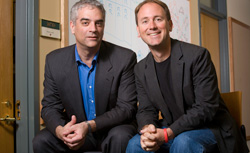 |
| Nicholas Christakis and James Fowler |
That includes Fowler appearing on Colbert, where he made claims about losing weight himself as to not "infect" others. But, Fowler wants it both ways; he said he shouldn't have his research judged on comments like that.
Worse, showing once again that even actual science, not alleged science, isn’t perfect, the NEJM, per the story, is standing behind the claims.
And, that's sad, since the mainstream media never gives debunking stories the same play as it does original claims. If the NEJM isn't going to be a better gatekeeper, it's not so "good." Especially since it rejected a piece of debunking research. In short, professional journals like NEJM can "pull a Mooney," not just pseudoscience ones.
And, also "worse" is that Christakis and Fowler shoot legitimate research in the foot with antics like this:
So is obesity contagious? What about happiness and divorce and poor sleep? One irony of the contagion battles is that even if their methods are suspect Christakis and Fowler are obviously correct that peer influence exists and that it may be even more important than we realize. ...In other words, correlation is not always causation. And, to the degree causation is behind correlation, one had better get the correct order of cause and effect understood. Christakis and Fowler appear to be bad social scientists right there.
But just because contagion is important in one context doesn't mean something like obesity spreads like a virus—much less one that can infect someone as remote from you as your son's best friend's mother. (For the record, I and my best friend's mother will eat our hats if it turns out to be true, as Christakis and Fowler claim, that loneliness is infectious, too.) Yes, we influence each other all the time, in how we talk and how we dress and what kinds of screwball videos we watch on the Internet. But careful studies of our social networks reveal what may be a more powerful and pervasive effect: We tend to form ties with the people who are most like us to begin with.
Friday, July 08, 2011
THE GREATEST IS HOPE
St. Paul was wrong,
Especially if we remove religious and metaphysical overtones
From “faith, hope and love.”
Love cannot abide without hope,
Whether the hope that a lover, or an adult child,
Will change bad behaviors.
Or the hope that a parent will accept an adult child
With different values and beliefs.
Without such hope, love cannot abide.
And faith, not metaphysical faith in things unseen,
But, faith in the sense of trust?
Faith cannot abide, either,
Without hope that a person, or a place,
Will improve, even if we don’t yet know how.
Even faith in our own selves cannot abide,
Without hope that we have some degree of control,
If but in a small corner,
Over our own lives and selves.
The greatest, and most basic, of these
Is hope.
Especially if we remove religious and metaphysical overtones
From “faith, hope and love.”
Love cannot abide without hope,
Whether the hope that a lover, or an adult child,
Will change bad behaviors.
Or the hope that a parent will accept an adult child
With different values and beliefs.
Without such hope, love cannot abide.
And faith, not metaphysical faith in things unseen,
But, faith in the sense of trust?
Faith cannot abide, either,
Without hope that a person, or a place,
Will improve, even if we don’t yet know how.
Even faith in our own selves cannot abide,
Without hope that we have some degree of control,
If but in a small corner,
Over our own lives and selves.
The greatest, and most basic, of these
Is hope.
Wednesday, July 06, 2011
Democracy: An intrinsic good or "only" a utilitarian one?
A British philosopher of science, Philip Kitcher, makes the argument that in at least some science issues, and specifically that of anthropogenic global warming, it's clear that democracy's "good" in general is "only" utilitarian, and that in the specific case of AGW, it has, at least right now, no intrinsic good at all.
In other words, to put this bluntly, sometimes, as in this case, democracy is bad.
Do we need this, or Kitcher to tell us that, though? Probably not.
Stereotypes about it aside, specifics of how democracy was structured in Weimer Germany show it was utilitarianly bad, in the end. Ditto for the fledging socialist democracy of Russia between the two 1917 revolutions.
When democracy in a specific situation is bad for structural reaons, that doesn't mean other versions of democracy would be bad in that situation. The more stable-post WWII Germany democracy might well have survived Weimar. A different Russian leader than Alexander Kerensky, western democracies not threatening a loan cutoff if Kerensky took Russia out of the war, or both, would have increased the survival odds for 1917 democracy.
That said, those historical issues all center on matters readily understandable by laypeople. The average citizen, though, as the SciAm blog points out ... just doesn't get global warming. Or other science issues.
Now, as the article notes, Kitcher's proposed solution is both expensive and unwieldy. Beyond that, psychologically, as Chris Mooney and others have noted, many people reason and argue to strengthen in-tribe beliefs, and Kitcher's program simply isn't likely to overcome that.
So, in a place like the U.S., a nonparliamentary democracy where the use of executive orders has steadily expanded over the last decades, how much democracy should a president "sacrifice" if he or she is really ready to "go to the mat" on this one?
I should add a bit about my philosophical inclinations, as part of why I think Kitcher has some good thoughts.
I'm an anti-absolutist in general, and specifically, somewhat related to this, an anti-idealist. So, I generally shy away from claims of things having intrinsic value, unless it's something like clear, evolutionarily-grounded questions of ethics.
At the same time, though, I'm not a utilitarian, certainly not ion the narrow philosophical sense, because utilitarianism has a boatload of philosophical problems, some of them ethical (as Sam Harris, probably unwittingly, demonstrated in "The Immoral Landscape.") What means are "allowable" to maximize the greatest good for the greatest number? If we decide, in dire emergencies, to "weight" needs of children vs. senior citizens, by how much do we do that? And who decide? How much of a supermajority, speaking of democracy, should be required for many "hedonistic" calculus" issues? Bentham, Mill and their followers, including Mr. Harris, basically ignore or dodge these and related questions.
So, really, my answer is that democracy doesn't have an intrinsic value, and that, in principle, we can never agree on how much utilitarian value most things in life do or do not have. That's kind of where Walter Kaufmann comes from on "Without Guilt or Justice" which pretty much demolishes Rawls, and by extension and indirectly, utilitarianism in general.
In other words, to put this bluntly, sometimes, as in this case, democracy is bad.
Do we need this, or Kitcher to tell us that, though? Probably not.
Stereotypes about it aside, specifics of how democracy was structured in Weimer Germany show it was utilitarianly bad, in the end. Ditto for the fledging socialist democracy of Russia between the two 1917 revolutions.
When democracy in a specific situation is bad for structural reaons, that doesn't mean other versions of democracy would be bad in that situation. The more stable-post WWII Germany democracy might well have survived Weimar. A different Russian leader than Alexander Kerensky, western democracies not threatening a loan cutoff if Kerensky took Russia out of the war, or both, would have increased the survival odds for 1917 democracy.
That said, those historical issues all center on matters readily understandable by laypeople. The average citizen, though, as the SciAm blog points out ... just doesn't get global warming. Or other science issues.
Now, as the article notes, Kitcher's proposed solution is both expensive and unwieldy. Beyond that, psychologically, as Chris Mooney and others have noted, many people reason and argue to strengthen in-tribe beliefs, and Kitcher's program simply isn't likely to overcome that.
So, in a place like the U.S., a nonparliamentary democracy where the use of executive orders has steadily expanded over the last decades, how much democracy should a president "sacrifice" if he or she is really ready to "go to the mat" on this one?
I should add a bit about my philosophical inclinations, as part of why I think Kitcher has some good thoughts.
I'm an anti-absolutist in general, and specifically, somewhat related to this, an anti-idealist. So, I generally shy away from claims of things having intrinsic value, unless it's something like clear, evolutionarily-grounded questions of ethics.
At the same time, though, I'm not a utilitarian, certainly not ion the narrow philosophical sense, because utilitarianism has a boatload of philosophical problems, some of them ethical (as Sam Harris, probably unwittingly, demonstrated in "The Immoral Landscape.") What means are "allowable" to maximize the greatest good for the greatest number? If we decide, in dire emergencies, to "weight" needs of children vs. senior citizens, by how much do we do that? And who decide? How much of a supermajority, speaking of democracy, should be required for many "hedonistic" calculus" issues? Bentham, Mill and their followers, including Mr. Harris, basically ignore or dodge these and related questions.
So, really, my answer is that democracy doesn't have an intrinsic value, and that, in principle, we can never agree on how much utilitarian value most things in life do or do not have. That's kind of where Walter Kaufmann comes from on "Without Guilt or Justice" which pretty much demolishes Rawls, and by extension and indirectly, utilitarianism in general.
Saturday, July 02, 2011
Why you shouldn't believe Shermer's 'Believing Brain'
If you want to know why you shouldn't believe Michael Shermer's "The Believing Brain," as well as why, for parts that are any good, you should go to more original resources, read my latest Amazon reviews.
A sample:
A sample:
Here's derivative and blind spots intersecting -- Shermer briefly, but briefly talks about Kahneman and Tversky's study in behavioral economics (without also citing Ariely, among others). One will learn much more about how irrational human behavior is in matters of economics, and related psychology, by going to the source. Shermer could have had a better book with a whole chapter just on this field.If you know Michael Shermer, and know he's not all he cracks himself up to be, you're not surprised by that. If you think you know Shermer, but don't necessarily worship the ground he walks on while thinking he is nonetheless a great skeptic, there's plenty more after those first two paragraphs of my review, so click the link and get enlightened.
So, why didn't he? I suspect because he knows how totally behavioral economics chops into little bitty pieces the claims of his beloved Ayn Rand and the Austrian School of Economics.
Subscribe to:
Posts (Atom)