Saturday, July 09, 2011

First Pop Ev Psych, now Pop Ev Sociology?

Remember those stories of a year or two ago about how things like obesity could be "socially contagious"?

Well, not so fast. It appears that they had a variety of statistical errors, the "research" behind them had never been published in a peer-reviewed scientific journal and other things.
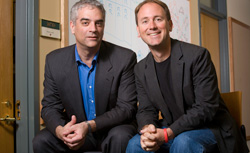
Nicholas Christakis and James Fowler
That said, that didn't prevent the authors from giving a snazzy TED talk (it seems like TED is devolving more and more into pop science of various sorts and not always accurate pop science), and otherwise "selling" their findings.

That includes Fowler appearing on Colbert, where he made claims about losing weight himself as to not "infect" others. But, Fowler wants it both ways; he said he shouldn't have his research judged on comments like that.

Worse, showing once again that even actual science, not alleged science, isn’t perfect, the NEJM, per the story, is standing behind the claims.

And, that's sad, since the mainstream media never gives debunking stories the same play as it does original claims. If the NEJM isn't going to be a better gatekeeper, it's not so "good." Especially since it rejected a piece of debunking research. In short, professional journals like NEJM can "pull a Mooney," not just pseudoscience ones.

And, also "worse" is that Christakis and Fowler shoot legitimate research in the foot with antics like this:
So is obesity contagious? What about happiness and divorce and poor sleep? One irony of the contagion battles is that even if their methods are suspect Christakis and Fowler are obviously correct that peer influence exists and that it may be even more important than we realize. ...

But just because contagion is important in one context doesn't mean something like obesity spreads like a virus—much less one that can infect someone as remote from you as your son's best friend's mother. (For the record, I and my best friend's mother will eat our hats if it turns out to be true, as Christakis and Fowler claim, that loneliness is infectious, too.) Yes, we influence each other all the time, in how we talk and how we dress and what kinds of screwball videos we watch on the Internet. But careful studies of our social networks reveal what may be a more powerful and pervasive effect: We tend to form ties with the people who are most like us to begin with.
In other words, correlation is not always causation. And, to the degree causation is behind correlation, one had better get the correct order of cause and effect understood. Christakis and Fowler appear to be bad social scientists right there.

Friday, July 08, 2011

THE GREATEST IS HOPE

St. Paul was wrong,
Especially if we remove religious and metaphysical overtones
From “faith, hope and love.”
Love cannot abide without hope,
Whether the hope that a lover, or an adult child,
Will change bad behaviors.
Or the hope that a parent will accept an adult child
With different values and beliefs.
Without such hope, love cannot abide.
And faith, not metaphysical faith in things unseen,
But, faith in the sense of trust?
Faith cannot abide, either,
Without hope that a person, or a place,
Will improve, even if we don’t yet know how.
Even faith in our own selves cannot abide,
Without hope that we have some degree of control,
If but in a small corner,
Over our own lives and selves.
The greatest, and most basic, of these
Is hope.

Wednesday, July 06, 2011

Democracy: An intrinsic good or "only" a utilitarian one?

A British philosopher of science, Philip Kitcher, makes the argument that in at least some science issues, and specifically that of anthropogenic global warming, it's clear that democracy's "good" in general is "only" utilitarian, and that in the specific case of AGW, it has, at least right now, no intrinsic good at all.

In other words, to put this bluntly, sometimes, as in this case, democracy is bad.

Do we need this, or Kitcher to tell us that, though? Probably not.

Stereotypes about it aside, specifics of how democracy was structured in Weimer Germany show it was utilitarianly bad, in the end. Ditto for the fledging socialist democracy of Russia between the two 1917 revolutions.

When democracy in a specific situation is bad for structural reaons, that doesn't mean other versions of democracy would be bad in that situation. The more stable-post WWII Germany democracy might well have survived Weimar. A different Russian leader than Alexander Kerensky, western democracies not threatening a loan cutoff if Kerensky took Russia out of the war, or both, would have increased the survival odds for 1917 democracy.

That said, those historical issues all center on matters readily understandable by laypeople. The average citizen, though, as the SciAm blog points out ... just doesn't get global warming. Or other science issues.

Now, as the article notes, Kitcher's proposed solution is both expensive and unwieldy. Beyond that, psychologically, as Chris Mooney and others have noted, many people reason and argue to strengthen in-tribe beliefs, and Kitcher's program simply isn't likely to overcome that.

So, in a place like the U.S., a nonparliamentary democracy where the use of executive orders has steadily expanded over the last decades, how much democracy should a president "sacrifice" if he or she is really ready to "go to the mat" on this one?

I should add a bit about my philosophical inclinations, as part of why I think Kitcher has some good thoughts.

I'm an anti-absolutist in general, and specifically, somewhat related to this, an anti-idealist. So, I generally shy away from claims of things having intrinsic value, unless it's something like clear, evolutionarily-grounded questions of ethics.

At the same time, though, I'm not a utilitarian, certainly not ion the narrow philosophical sense, because utilitarianism has a boatload of philosophical problems, some of them ethical (as Sam Harris, probably unwittingly, demonstrated in "The Immoral Landscape.") What means are "allowable" to maximize the greatest good for the greatest number? If we decide, in dire emergencies, to "weight" needs of children vs. senior citizens, by how much do we do that? And who decide? How much of a supermajority, speaking of democracy, should be required for many "hedonistic" calculus" issues? Bentham, Mill and their followers, including Mr. Harris, basically ignore or dodge these and related questions.

So, really, my answer is that democracy doesn't have an intrinsic value, and that, in principle, we can never agree on how much utilitarian value most things in life do or do not have. That's kind of where Walter Kaufmann comes from on "Without Guilt or Justice" which pretty much demolishes Rawls, and by extension and indirectly, utilitarianism in general.

Saturday, July 02, 2011

Why you shouldn't believe Shermer's 'Believing Brain'

If you want to know why you shouldn't believe Michael Shermer's "The Believing Brain," as well as why, for parts that are any good, you should go to more original resources, read my latest Amazon reviews.

A sample:
Here's derivative and blind spots intersecting -- Shermer briefly, but briefly talks about Kahneman and Tversky's study in behavioral economics (without also citing Ariely, among others). One will learn much more about how irrational human behavior is in matters of economics, and related psychology, by going to the source. Shermer could have had a better book with a whole chapter just on this field.

So, why didn't he? I suspect because he knows how totally behavioral economics chops into little bitty pieces the claims of his beloved Ayn Rand and the Austrian School of Economics.
If you know Michael Shermer, and know he's not all he cracks himself up to be, you're not surprised by that. If you think you know Shermer, but don't necessarily worship the ground he walks on while thinking he is nonetheless a great skeptic, there's plenty more after those first two paragraphs of my review, so click the link and get enlightened.

Thursday, June 30, 2011

Computer software confirms 'documentary hypothesis

Ever since the idea was first proposed more than a century ago by Julius Wellhausen, nonfundamentalist biblical scholars (of course, fundamentalist, by self-definition, aren't full-fledged biblical scholars) have postulated, developed and refined a "documentary hypothesis" for the writing, then later editing together of various sections of the Torah/Penteteuch, or the first five books of the Tanakh/Christian bible, which the nonscholars allege was written by Moses.

The hypothesis says that a "Yahwist," called the J author because Wellhausen was German, and the J has the y-sound there, ja, wrote large chunks, especially of Genesis, that focus on the use of the divine name. Theoretically, this author lived about 900 BCE in the southern "kingdom" of Judah after a united Israel (if it existed, as Old Testament minimalists question) split.

Another author, writing slightly later, is the "Elohist" or E author. He allegedly wrote slightly later, from the post-split northern kingdom of Israel, which included Ephraim (an "E" help mnemonic, as Judah is for the "J").

Then, a third author, a "Deuteronomist," is posited as the primary author of the book of Deuteronomy, just in time for Josiah, king of Judah, to "discover" about 621 BCE.

Fourth, a "Priestly' author wrote down all the ritual observances, the first version of the Genesis creation story, the dietary laws and similar stuff, after leaders of Judah were carted off to exile in Babylon.

Some say this person may have lived later and been the scribe Ezra, of the book of that name. Some postulate an original priestly author, but Ezra as a major redactor.

Well, at least between the priestly and nonpriestly sections, new computer research confirms the division. That's despite this background:
Three of the four scholars are religious Jews who subscribe in some form to the belief that the Torah was dictated to Moses in its entirety by a single author: God.
Just a reminder that religious fundamentalism isn't limited to Christianity.

Anyway, the computer software found multiple authors elsewhere, not just in the Torah. The software sees multiple authors in Isaiah, as do critical scholars.

Sunday, June 12, 2011

Chomsky should think again - within himself

Sounds like this is a definite book to read: The Recursive Mind: The Origins of Human Language, Thought, and Civilization.

Michael Corballis, as noted in this review, thinks its recursive thinking, done without any special fluency in language, let alone a language "module," that makes us human.

I've not read that one, but, at my nearest semi-major library, I did find another book by Corballis,  "The Truth About Language" (Goodreads review).

And extractions from that:

The Truth about Language: What It Is and Where It Came From

The Truth about Language: What It Is and Where It Came From by Michael C. Corballis
My rating: 5 of 5 stars

Excellent book from the preface on.

Many people know the name of Noam Chomsky, but they may not know that, while he dethroned B.F. Skinner’s behaviorist approach to linguistics, his own theory, which broadly falls into humanist linguistics, has itself become largely passé.

Two major newer schools, with a fair amount of overlap but with distinct emphases, are in the lead today: functionalist and Darwinist schools of linguistics. Michael Corballis comes from the later, though he’s conversant with the former. In the same broad train of thought as a Michael Tomasello, he talks in this book about the likely route for development of human language.

Corballis says straight up that he knew he would butt heads with Chomsky, Gould and others. He rejects Chomsky’s massive modularity of the brain (as does most modern neuroscience) and rejects Gould for saltationist ideas about the origin of language.

Corballis says that he sees normal, incremental neo-Darwinian evolution at work.

Early in part 1, chapter 1, he calls out Chomsky for ignoring most of the vast variation between languages in his attempt to posit a universal grammar. He even QUOTES Chomsky to that effect.

“I have not hesitated to propose a general principle of linguistic structure on the basis of observation of a single language.”

This is basically like the old “spontaneous emergence” idea of maggots in rotten meat, Galen’s claiming the human liver has seven lobes because monkey livers do, or similar.

Now, after refuting Chomsky, what ideas does Corballis offer up?

First is that language probably in part evolved from gestural issues. He notes that human babies point to things just to note them as an object of attention, vs chimps who point because they want.

Next, he notes humans’ ability to mentally time travel. Tis true, he notes, that corvids may not immediately revisit seed caches if they think another of their species has been spying on them, but that’s about it as far as looking to the future among animals. Elephants and primates seem to retain some memory of deceased loved ones, but of itself, that doesn’t reflect mental time travel backward, really. Only humans seem to have that in great degree. This, in turn is part of larger “displacement” in language, moving ourselves spatially as well as temporally. Related to that is that, in English at least, many prepositions can have both spatial and temporal functions.

Beyond that, he postulates that humans (and possibly earlier members of the genus Homo) having third-order theory of mind, vs primates (and presumably, cetaceans) having only second-order TOM, and a restricted and species-specific one at that, is probably a big factor in language development. Language recursiveness and nesting would seem to underscore this.

In all of this, though, Corballis notes that primates have some gesture usage, and that even dogs can recognize specific human words.

Next, it’s off to grammar. After a basic look at parts of speech, Corballis notes how and why, in English and other language, some things like “helping verbs” evolved … and then, in some successor languages, devolved again. As part of this, and the idea that languages in general started as noun-verb only items similar to modern pidgins, Corballis notes the role of cultural evolution.

Corballis ends with his “Crossing the Rubicon” of how he things language began. (I’ll end there to avoid spoiler alerts.)

UPDATE, July 5, 2024:

Beyond that? Carl Zimmer reports that new research indicates language evolved primarily for communication, and NOT for thinking. Fun sidebar? This is another overturning of Chomsky's claims about language. (I can't say "research," since Chomsky did basically none.) Also, this would tie in with people like Corballis stressing cultural evolution's role in the development of language.


View all my reviews

Tuesday, May 31, 2011

How and why I became an atheist, Part 6

In part 1 of this series, I look at my conservative Lutheran childhood, above all my conservative Lutheran minister father's influences.

Part 2 gets into my high school and college years.

And Part 3 gets to my trying to follow in dad's footsteps at a Lutheran seminary, or divinity school.

In Part 4, I look at my "conversion" or transition period of my last year of school there and the first year after

In Part 5, I look at further personal, philosophical, unreligious and antimetaphysical development in my life during three years of living with my dad.

It's now 1997 and I'm on my own, editing a weekly paper. Working 60-70 hours a week, moving it from the red and into the black. Getting burned out. Drinking on the job.

At the same time, I'm now exploring more in things like cognitive science/philosophy, recognizing the origins in human brain dysfunctions of visions and hallucinations, etc. In short, I'm becoming more and more of not just an atheist, but an antimetaphysician in general.

I was eventually fired, for whatever reason. I listened to someone, and some inner part of myself, and quit drinking. And looked for support.

Well, the only game I knew of at the time for that was the religious-based sobriety support program of Alcoholics Anonymous. (And, that's what it is; don't believe the canard that "it's a spiritual program.")

Well, I was in such a post-alcohol mental fog, I didn't totally recognize that at the time. And, when I did, I was in a group, surprising for a small town in Texas, with many New Agey types and little in the way of people even approaching orthodox Christians. Well, I'd had enough happen in the last few months that I actually tried some Matthew Fox reading, even A Course in Miracles.

And, some degree of New Agey "power"-ness, but not a personal deity, "stuck" for a year or so.

That said, as noted on the previous part of this installment atheists (usually the P.Z. Myers type of "Gnu Atheists" who talk about religion as a psychological crutch don't get the time of day from me. I understand the desire for its comforts, still today. I don't find that necessary for myself today, but I'm not going to mock the people who have, not for 2,000, or even 5,000, but going by things like French cave paintings and some burials, but who have for 20,000 years sought out some sort of metaphysical support to help face the vicissitudes of life.

Anyway, I eventually moved on in many ways. I found a "secular sobriety" support group; I found a great group therapy counselor, and group, for some "childhood issues," after I moved to Dallas.

And, I moved beyond "just atheism." I could call it "positive atheism," or I could use the good old phrase "secular humanism."

I continued reading in philosophy of mind, cognitive science/philosophy and related subjects.

I saw more and more of how many of the allegedly metaphysical "artifacts" of religious belief, such as various visual and auditory "visions," deja-vu type events and more, were all parts of the wonder — and the humility — of the evolutionary cobbling together of the human brain and the eventual rise of what we could call an epiphenomenon, almost — human consciousness.

I saw that that, as well as Yosemite National Park and its falls, Grand Canyon and its vistas, Beethoven and the C sharp minor quartet and more, could all be approached with wonder, even with gratitude without having to be grateful to anybody, divinities included.

As I said in an op-ed column, riffing on Shylock in Merchant of Venice: "I am an atheist. Prick us; do we not bleed?"

But, as I said, at this point in my life, whether the term I use is "atheist," "secular humanist," "philosophical naturalist," "skeptic" or something else, I feel reasonably comfortable about where I am.