This is a slice of my philosophical, lay scientific, musical, religious skepticism, and poetic musings. (All poems are my own.) The science and philosophy side meet in my study of cognitive philosophy; Dan Dennett was the first serious influence on me, but I've moved beyond him. The poems are somewhat related, as many are on philosophical or psychological themes. That includes existentialism and questions of selfhood, death, and more. Nature and other poems will also show up here on occasion.
Friday, July 28, 2017
Poem: SITTING SHTETL FOR THE LIVING
Wednesday, July 12, 2017
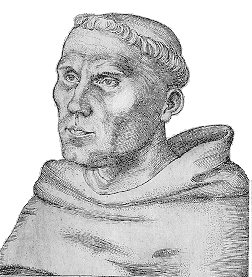
Luther legend shitstorm about to hit (extensively updated)
He wasn't the son of peasants, either. His father owned copper-smelting operations and relatives of his mother advanced him the money to buy in. One of his mother's brothers was a doctor. A more distant relative was mayor of Eisenach at one time.
Oh, and Luther himself apparently started the "son of peasants" myth. That said, Eric Metaxas, who refutes that in his new Luther bio, repeats a polished-up version of the 95 Theses myth, along with several others in a book that won't get more than 3 stars on my review.
(That said, the link has been updated to my Goodreads review of the book. It SUCKS. It got 1 star because he does far worse than that, including running Luther through an American evangelical sheep dip, including neoconservativism and Islamophobia.)
What else can it do? If you're a literalistic church body on things like the inspiration of scripture itself, you probably have to double down and be literalistic on the Textus Receptus history of your founder.
It's clear that on the theses, they were only submitted to Luther's superior, Archbishop Albrecht of Mainz, under cover of an explanatory level. Most the myth-busters note that the doors of churches, in general, were not used as community bulletin boards or even ecclesiastical ones. Had Luther wanted to provoke discussion, he would have posted a copy somewhere within the university, instead.
Also, the second "here" that is linked above notes that Luther granted indulgences himself early in his ecclesiastical career. He just didn't sell them.
A good bio of Luther shows he was sincerely tormented with guilt over sinfulness. And, contra Erickson, this was not misplaced Freudian paternal-directed anger. At the same time, he was far from alone. His anger seems to have become more intense, and floated to the surface, as he realized more how much the medieval church had strayed from its, say, pre-400 or pre-500 roots or semi-roots.
(Of course, Luther didn't look at how much the post-Nicene church strayed from its pre-200 roots in erecting a theological edifice that probably would have astounded Jesus and his followers.)
His anger was mixed with a stubborn obstinacy that spilled beyond indulgences and related issues, not only to the authority of the papacy, but to the formation of a new tradition.
That said, the church of Luther's era was not only led by corrupt popes, it was also increasingly ossified. Indulgences had been a problem for 300 years or more by the time Luther drafted his theses, yet neither the Fourth Lateran Council nor the Council of Constance, among other church meetings, seriously and lastingly addressed the issue.
Combined with incipient proto-German nationalism, the abuse was ripe for the plucking.
Update: Since first writing this, I've read Michael Manning's dual bio of Luther and Erasmus. Worth a read.
POST-1517
Peasants' Revolt
A lighter-hearted mythbusting site, from within the liberal wing of Lutheranism, itself gets a thing or two partially wrong. Luther perhaps may not have hated all peasants. But, citing the fact that his grandfather was a farmer is proof of nothing, in part because his father wasn't. Many acorns fall close to the tree, but to reverse the cliche, the dandelion seed head blows far away. It seems pretty clear that he DID hate "uppity" peasants, especially ones who might be trying to implement a 1500s version of social gospel, let alone liberation theology. Luther's "Admonition" to both peasants and lords was not as 50-50 as claimed. In any case, even for that day and age, arguably, The Twelve Articles of the Swabian Peasants are more irenic than, say, something written in conjunction with the Wat Tyler Revolt in England 150 years earlier. A further reading of them would indicate that the first article, wanting full congregational control over the ministry, might have been a stumbling block right there.
The real issue is that, when he wrote "On the Thieving, Murderous Hordes," and afterward, Luther (in my own debunking of another myth) refused to admit he was wrong. Appeals to people to prove him wrong were, by 1525 at the latest, nothing more than rhetorical tropes.
Given his father being a member of the ownership class, and his mother coming from a family background both richer and much more educated, and more politically connected, a few conclusions can be drawn.
Above all, that is that Luther was much closer to being a proto-capitalist than a proto-Marxist, despite East Germany's attempts to exploit Luther 450th anniversary events.
Meanwhile, as noted above, by 1525, that stubborn obstinacy at the core of Luther's character spilled elsewhere, with further major consequences.
Dealings with the Reformed
He shows this clearly in his dealings with non-Lutheran Reformed brethren, starting with, but by no means limited to, Ulrich Zwingli. Even a middleman like Martin Bucer came in for Luther's wrath. In general, he used the same language on Reformed leaders as he did on Catholics, even though their language in response was, and remained, much more irenic.
If there's a "fault," beyond irreconcilable doctrinal issues, that, in Germany and beyond, there wasn't a more united Protestantism (until the Prussian Union in much of Germany, and the rise of more liberal theology in general), the fault lies with Martin Luther more than any other single person.
As far as the keystone there, Luther's take on the "Real Presence" in the Eucharist, this was a literalistic vs more humanistic take on what the human nature of Jesus implied. (It's also not supported by the original Greek, the "Real Presence." Obviously, neither is the "real" body/blood behind Catholic transubstantiation. Interestingly, the Orthodox, with more connection to the original Greek, apparently simply ignore this problem.) That said, even in his post-Resurrection appearances, Jesus in a Pauline spiritual body, while shown appearing out of nowhere, is never shown as appearing in multiple ways at the same time.
On the other hand, neither Luther nor his Reformed brethren at the Marburg Colloquy appeared to wrestle with John 6 — only the Synoptics.
Speaking of, as Orthodoxy accepts John's timeline for the Passion, and more pertinently, rejects Augustinian ideas of original sin, a good bio of Luther, unlike Metaxas, will do at least a bit of putting Luther into the context of ALL Christianity, not just its western variants. Many Orthodox post-Nicaea theologians, or, per the real breaking point time, post-Carolingian ones, would have laughed, if nothing else, at Luther's turmoils. However, unlike a Cajetan telling Luther to just say "revoco" and follow Rome, Orthodox thinkers would have laughed for other serious reasons.
Also, while Orthodoxy believes in penance as a sacrament, and in a quasi-purgatory, it has never had a practice of indulgences. Luther himself, other than noting the Eastern churches were free of Rome, made no real effort to learn about post-Nicene, and certainly not about post-Carolingian, Orthodoxy.
(Prayers for the dead, on which purgatory is partially based, have some tenuous New Testament basis. And more, below that, from early Christian tradition.) And, per Wiki (follow links) Philip Melanchthon accepted that prayers for the dead were part of Christian tradition in the Apology to the Augsburg Confession (XXIV 96). (That's of note given that Luther mailed out his 95 Theses copy on All Saints Eve.)
Transubstantiation, the Real Presence and the pre-Reformed
The Reformed theologians, along with Luther, agreed in rejecting transubstantiation. Whether the Reformed thought about it or not, beyond their actually expressed reasons, they had others for rejecting Luther's stance.
Basically, Luther was trying to walk a petard between two horns of a dilemma with his stance, although neither he nor the Reformed appear to have seen that.
The horns?
One was ex opere operato, in other worse, the very thing that Luther found lying behind transubstantiation when he rejected it. In this case, if it is faith itself that makes Jesus bodily present for a believer in the sacrament, well that too is ex opere operato. Luther might raise two objections — the biggie is that belief comes from the Holy Spirit.
That leads to another problem. In that case, going beyond Luther's single-predestination version of predestination, a human in this case becomes nothing more than an automaton, a playtoy for Jethro Tull's "Bungle in the Jungle." Luther would also reject that, but he'd have no grounds for that other than his own stubbornness, or else appeals to god's inscrutability. THAT, in turn, leads to the Psychological Problem of Evil, about which I've blogged before, more than once.
The other horn? Scholasticism, and angels on heads of pins. If neither a state of faith nor a particular statement of faith at the time of the blessing and offering of the Eucharist makes Jesus bodily present, then exactly when and exactly how IS he? Does the reading of the Biblical words of the Institution, not as a priestly act, but simply the presence of the words, do it? In that case, the words of the bible are themselves close to becoming the fourth person of the Trinity. Islam, in some extremely "high" versions of theology of the nature of the Quran, ran into similar issues.
Infant baptism faces similar horns, unless one ditches Lutheran ideas and instead treats it merely as a sign of grace or entrance into a Christian covenant, paralleling circumcision.
Antichrist
Oh, and he was wrong about the papacy being the Antichrist. Antichrist, whether a person or spiritual stance, in 1 John, is not the same as the "man of lawlessness" in 2 Thessalonians. (That sets aside, of course, the issue of whether "the man of lawlessness" is the papacy. And, even on a literalist, even fundamentalist, reading of 2 Thessalonians, that's a hard stance to take.) 1 John mentions nothing about Antichrist being in a position of authority.
Critical theology, not mentioned much at the Wiki page, at least MY critical theology, says that, instead of Nero, the pseudo-Pauline author, like the Synoptic gospels, may have been envisioning the Jewish revolt, temple takeover and temple destruction, which also gives us a terminus a quo for the book.
Assuming the author wrote before Titus, in the name of Vespasian, finished the conquest, that would have us talking late-60s CE. I'd argue that it most likely refers to one or more of the Jewish leaders who took over the temple and started the revolt.
I've since dealt with both members of this duopoly, plus the "beast" of Revelation, in much more detail.
The Jews
Luther is well known for his violence-laden invective against Jews. That said, most people think it was confined to the latter years of his life, and his apologists use this, and his health issues then, as an excuse.
Not true. As Michael Massing notes in his great new "Fatal Discord," a parallel dual biography of Luther and Erasmus which is reviewed here, Luther was already expressing such thoughts in his pre-95 Theses lecture notes on the book of Psalms, right in the mix of the Reuchlin-Pfefferkorn controversy.
That said, he wasn't alone. His disputation opponent Johann Eck was a pretty virulant anti-Semite too.
Today
The "yes I'm right" stance of Luther himself, not only vis-a-vis things where he clearly was, but other issues, such as versus the Reformed on the Eucharist, versus many Reformed and other Lutherans on the issue of adiophora and more, seems to still run strong in much of the conservative wing of Lutheranism. (Let's not forget that Luther thought he was competent to condemn Copernicus' heliocentric theory of the solar system, and rushed to do so when his book was published.)
That's not a total surprise, though. Fundamentalist versions of Christian denominations, just like fundamentalist strains in other world religions, stay fundamentalist due to mindsets.
Outside of being the largest single fulcrum for the Reformation, and secondly, the anti-Semitic issue, Luther contributed little to the larger world. No German state had any New World colonies, for one thing. Many individual Lutheran emigrants to early America were Mennonite, not Lutheran.
NB: Expect one major update three-plus years from now, with a further look at the Diet of Worms.
Protestantism
Yes, Luther was, per Breunig, perhaps as much catalyst as creator. That's why not mentioning the likes of Wyclif or Hus as predecessors is also "interesting," even if the focus is on Luther. And, though her focus is on new books, and it's not technically a biography, Diarmaid MacCullough's massive "Reformation" deserved a tout.
And, is Protestantism a "love affair with god"? Maybe, but it also at times seems to be as much a "guilt trip from god" as stereotypical views of Catholicism or Judaism.
But, a liberal evangelical Protestant, or a liberal mainliner, whichever Breunig is, has their own PR.
Monday, April 10, 2017
Say goodbye to History for Atheists (updated)
Well, Mr. Tim O'Neill's History for Atheists blog, which had been linked here, is gone again. (He'd originally been placed here and one other blog after he'd commented favorably on something I wrote.)
His blog is primarily about refuting Gnu Atheist claims about religious figures and ideas in history. And, on people such as Giordano Bruno, he has some good refutation. (And he's not alone in that.)
I won't link to him, though.
When he's wrong, he can sometimes be howlingly wrong. And a new update only underscores that.
And he was, a month ago, in trying to defend the papacy in general, and Pope Pius XII in particular, against charges of anti-Semitism.
One medieval papal bull he cited was honored as much in the post-Crusades-era breach as in the observance. And ...
He refused to even discuss the much later, 1860s-era, Papal States kidnapping of Edgardo Mortara. And, it's hugely relevant to refuting his claims.
So is Catholic hierarchy in the US ignoring physical anti-Semitism as late as World War II. (About halfway down the piece.)
He refused to discuss books by professional historians — non-Jewish as well as Jewish — that undermine his claims about Pius XII. And, I've read several such books.
One such book is "The Popes Against the Jews," just read and reviewed by me here. Its author, David Kertzer, previously wrote "The Kidnapping of Edgardo Mortara" and "The Pope and Mussolini," both of which I have read, and reviewed the latter here. (Pius XI comes off as better than Pius XII, but that's praising with faint damns one of the worst popes of the last 200 years or more. And don't forget that Pius XII, as Vatican Secretary of State, negotiated and signed the Reichskonkordat.) And Kertzer won a Pulizer for "The Pope and Mussolini," dude.
Then, he says, after I told him I hadn't listened to his podcast attached to the post — but without answering at all to Mortara, high-placed priests' post-WWII involvement in the "ratline" and more — his only answer is "go listen" to the podcast" followed by a stream of insults.
Update, Sept. 8, 2020: Kertzer has a new piece in The Atlantic, based on material now available from the Vatican archives, about Pius XII's silence about two Jewish survivors from the death camps forcibly baptized in France, as well as offering more information about Pius and the deportation of Rome's Jews. It further removes the mask from O'Neill's bullshit. On the two children, Pius himself, with the Curia, acted just like Pius IX on Mortara.
And, shock me, when I presented O'Neill with this on Twitter?
I used Price (who I know has scoffed at O'Neill; see below) as one example of several. I then responded:I'ver never had any direct contact or encounter with Robert Price. And I've never made the claim you attribute to me above about the Vatican and anti-Semitism. Perhaps you're confusing me with someone else. You certainly seem highly confused. And wrong.— Tim O'Neill (@TimONeill007) September 8, 2020
There we are. Same old person.Ahh, same History for Atheists Tim O'Neill. Surprised you aren't telling me to next "listen to my video" as you did before. I myself have argued, then walked away from that, over your attempts to defend Pius XII. No, not confused. But, again walking away (and updating blogs).— Again: Fuck Jesse Ventura & his lying cult 🚩🌻 (@AFCC_Esq) September 8, 2020
Anyway, read away. It's some very good stuff, and sad stuff, by Kertzer. It's also VERY in-depth. That Pius XII would pull this nearly 100 years after Mortara is disgusting.
Kertzer had an earlier piece in March, talking about the opening of the Vatican archives. Per his wondering there:
With the new piece, we need not wonder now. Pius XII's postwar actions are clearly those of an antisemite.
Public attention, naturally enough, is focused on the war years. But the postwar years are likely to provide their own surprises and insights. In Europe, this was a tense and eventful time.
And, I'm hoping he finds enough for a new book.
Back to the original. Well, Tim, I've got a response back for you.
Go fuck yourself. (Repeatedly, per the update.)
Beyond that, my most charitable explanation is that, even though he's an atheist himself, he's still some sort of "cultural Catholic." Or, more accurately, given his much higher regard for Rodney Stark than I have, perhaps he's a "Christianist" in the same vein as Samuel Huntington et al. In that case, his "History for Atheists" is, throughout, designed to be apologetics, not pedagogics. Light bulb just came on as part of the update. The fact that he attempt to gaslight people who have the goods on him make this clear. I also was just reminded of a piece I wrote last year about Catholic projectionism of some of their own cultural DNA onto Jews. Indeed, I mentioned him there, but forgot to link it.
If it's the same Tim O'Neill being referenced here on an online forum, he's also wrong about other issues related to the Holocaust. (O'Neill claimed no Nazi ever denied the Holocaust, only claimed they didn't know. He's refuted kind of well, but not as well as people there think. WARNING that I should have put up long ago. It's a "revisionist" site that I in no way agree with in general, and is full of conspiracy theorizing as part of that.)
Among other issues related to Nazi Germany he's wrong about? Hitler did not come to power via a "backroom deal." Instead, he was duly accepted as chancellor by President Hindenburg as the agreed-upon representative of a parliamentary coalition. That's the way chancellors, premiers and prime ministers are selected. And, his particular selection, as far as negotiations between coalition partners, was no more of a backroom deal than with any other parliamentary coalition in Germany or any other country.
(Oh, and others besides myself, like Robert Price and friends of his, know this dirty part of O'Neil. So do Quora commenters. Oh, geez, they kick him in the nuts over there. But, per somebody posting a link to this post on a June 2019 O'Neill butt-kissing of popes, he still can't let go, including letting go of the idea that his podcast is SO precious, and cannot be typed up and transcribed, so people MUST listen to it.)
Update, April 19, 2021: What's really behind this, IMO, is a "no true Scotsman" type argument. I say that as I am in the middle of a Twitter argument with Andrew Sullivan, over a claim that because he's a Catholic, he can't be a eugenicist. Not to mention, for both O'Neill and Sully, but the German Catholic Church, decades later, copped an official plea of guilty to complicity with Hitler.
Update, July 7, 2023: Forgot to add earlier that David Kertzer has another new book further kicking O'Neill in the nads.
Update, June 5, 2024: O'Neill likes to be hair-splitting, like in this piece claiming that the closure of the Platonic Academy by Justinian wasn't all that. First, I presume that the likes of Grayling, like me, knew this wasn't the Academy actually founded by Plato. Second, it doesn't matter that the second Academy was a fount of Neoplatonism that Plato might not recognize. What matters is its closure by Justinian was part of a larger assault against philosophy. It was part of Justinian's MO in general, as documented in a new biography. O'Neill eventually sort of gets there. Wiki gets a much shorter summation without O'Neill's axe-grinding.
Finally, as for his about? He's lying on the last bullet point, of course. There's various degrees of strawmanning otherwise. And, the biggest reason I know he's a fucking liar? Search his site for Kertzer; you won't find him. You also won't find him on O'Neill's other site.
Finally, even though he taught at an unaccredited theological school, calling Price "an amateur or hobbyist" is risible.
Update, Oct. 26, 2025: And, due to a response to me elsewhere? On Twitter, he does comment about Kertzer, to say he thinks Kertzer "has an agenda." On one other Tweet, he comes close to dipping his toes in something that isn't anti-Zionism but ....
I responded to said commenter, who I don't think is offering a blanket defense of O'Neill, that I had not l looked at his Twitter. That said, it's funny to see him comment about Kertzer there and not his website. I also noted that I, like O'Neill, am on Goodreads, and I haven't seen him post a review of a single Kertzer book.
Monday, March 27, 2017
#Philosophy can't justify dumb wars, setting the issue of justice aside
NOTE: This is an updating of a 2011 blog post about the Libyan bombing campaign and a philosophical attempt to justify it. What follows is a lightly edited version of the original, along with extended follow-up.
You can slice and dice logical arguments to support all sorts of claims. That includes what evidence you include as warrants vs. what countervailing empirical evidence you exclude from discussion.
Especially in real-world informal logic, how you frame the parameters of the argument is another way of slicing and dicing an issue to an already-held conclusion.
Take Massimo Pigliucci's argument for bombing Libya.
Sure, in a vacuum of Libya and no other foreign policy worries, might be great. But, why Libya and not Yemen? Or, why not Cote d'Ivoire a year ago?
Massimo goes on, in what is nearly 100 posts down the list, in response to me, to say he has non-humanitarian reasons, as well, to support intervention in Libya. I've asked what they are, because I don't see any that aren't either directly or indirectly related to oil. Terrorism? Since we intercepted the ship with nuclear supplies headed to Libya several years ago, Gadhafi had become "our guy," so scratch that, even if Massimo makes that claim.
Massimo also limits the parameters of the argument by saying his support for air strikes doesn't mean support for intervention. But, given criticism of the Obama Administration, that it doesn't have an exit policy, and that our British and French allies have pushed going beyond air strikes, if necessary, that "restriction" might work in formal logic, but, in a real-world political situation, doesn't.
Massimo also, basically, tried to claim in his last comment to me that I didn't know what I was talking about on just war. Actually, I do. But, since he apparently cares not to read Walter Kaufmann's "Without Guilt and Justice," which I highly, highly recommend, he doesn't really understand where I'm coming from. (Should Massimo see this, I'll leave it to his personal judgment as to whether or not he was trying that hard to understand, wanted that much to understand, or wanted to try that hard to understand.
That said, I'm going to further deconstruct, or just plain refute, some of his claims.
The idea that the air campaign was supported by the UN is tenuous at best, per Wiki's piece on the intervention in Libya. That "at best" would be seeing the air strikes as one interpretation of how to support the no-fly zone the UN called for.
I visit, and comment on new posts, at Massimo's blog regularly, and have totally agreed with his take on people like Sam Harris and Jonathan Haidt.
But here? Being logical isn't the same as being right.
At the least, without engaging in serious multi-valued logic, with answers that would include things like "maybe" and "maybe not." With that in mind, I wouldn't say Massimo is wrong on his support for Libyan air strikes. I would say that, to use the old Scottish jury verdict, he's only reached the "not proven" state.
And, I wouldn't say I, or others, are "right" to argue against air strikes.
At bottom line?
Not only is being logical not the same as being right, the use of bipolar western logic to try to "prove rightness" is often wrong.
Arguably, such situations are even a good example of Hume's famous dictum: "Reason must be the slave of the passions."
Again, there's not necessarily a "right" or a "wrong" involved. But, in this particular case, since Massimo is claiming non-humanitarian reasons for Libyan intervention, and I doubt he can name a good non-oil-related one, I think, on the passions, he's wrong. (That said, some Humeans forget that he still called on reason to take a role in guiding the passions.
I should note that I've hinted before that Massimo practices "philosophism," the hyper-philosophic parallel to scientism. And, I think it sticks here. I don't know if Massimo would go as far as Dan Kaufmann in admitting that philosophy doesn't have final answers for many of the questions it addresses. But, maybe that would help. At a minimum, non-classical Western philosophies reject such certainty.
I mean, per the above, I probably could invent a multidisciplinary, intersectionality-driven new discipline called "the philosophy of political science" or something, but why? It wouldn't add anything significant to the academic study of political science as currently constituted.
Or, per that piece linked above, and again here, on refuting his claim on just war, maybe he needs to expand his Weltanschaaung to include non-Western philosophies.
Per Iranian philosopher Idries Shah's famous dictum (he himself being non-Western, of course):
“To 'see both sides' of a problem is the surest way to prevent its complete solution. Because there are always more than two sides.”
Thursday, March 09, 2017
"What color are these strawberries?" is ultimately a philosophical question, not scientific
I haven't actually opened the picture in Photoshop, but I'll take at face value the claim it has no red pixels.
But, what does that actually mean?
Photoshop's default on color pictures is to present a photo in "RGB" format. That's Red, Green, and Blue — the three primary colors. But, many Photoshop commands let one manipulate not only those three colors, but the three commonly accepted secondary colors of Cyan, Magenta and Yellow, plus a channel for Black. If you've ever heard of CMYK (B already used for Blue) photo editing, that's where it comes from. The Black channel is necessitated by the conversion of primary colors back to secondary.
Anyway, back to RGB colors. Several thoughts here.
First, many colors, even in "normal lighting," whatever that is, aren't what we think. If you use Photoshop much, you'll see that the "green" in grass is about one-third yellow.
Second, does Photoshop's 256-bit format for each color channel imply a level of digital accuracy that doesn't exist? I mean, we can peg light to 500 nanometers. But, is that blue or is that cyan, or turquoise, if we use a non-technical color, or what? Wiki has a full piece on "spectral color" which raises such issues.
And, with that, we're into various issues of philosophy.
Setting aside some aspects of epistemology, we've got what would be either informal logic or linguistic philosophy, first. That is the issue of categories and definitions.
Per what I posted above, where does one color "stop" and another "begin"? That's not a science issue, that's a philosophy issue.
We also have linguistic philosophy issues on how one defines color. Setting aside the Sapir-Whorf hypothesis, which is nonetheless of a certain degree of strength, some languages distinguish between more colors than others. Isaac Newton, with the rainbows produced by his prism, famously distinguished indigo as a seventh color of the spectrum.
To the degree the above photo is an optical illusion, it trades on something else which is related to epistemology, and to David Hume's project of empiricism. That is the idea of qualia, or why do things seem to be the way they are.
The idea of qualia, if accepted in one of its several forms and definings, undercuts the "blank slate" idea of human perception stressed by Hume, and to fair degree by fellow empiricists. A child old enough to point to a red splotch in normal light, when shown this picture above, would not be able to point to claim it has a color similar to that red splotch on the blank slate theory of the human mind. (I frame the example this way to try to bracket the issue of the baby's mind being "contaminated" by explicit written or oral conversation.)
As to opponents of the idea of qualia? As I've gotten older, and more read in modern philosophy, I find Dan Dennett's arguments more and more lacking. The more and more we do current research in robots, artificial intelligence and similar, the more and more we realize human minds don't work that way. Dennett's other objections are somewhat functionalist in nature.
A side issue is that discussions of qualia often get wrapped up with issues of ontological dualism, even though in reality the two are separate items.
There is no logically necessary reason to invoke ontological dualism to explain qualia. That's doubly the case if one understand consciousness and the mind through the lens of embodied cognition and not Dennett's crudely mechanical and scientism-driven computer models.
Let's take this in terms of color. My cone cells in my eye may have slightly different wavelength sensitivities than yours. My optic nerve neurons may respond slightly differently to my cone cell impressions than your neurons do to your cone cells. That's a thumbnail on embodied cognition and color.
Next, let's head to psychology.
If your father, or mother, was a firefighter, your "suchness" of the color red will be far different than mine, at least if their fire department still uses traditional fire-engine red colored vehicles.
Or, as an adult, let's take yellow. If you're a salesperson for French's, as in French's mustard, your "suchness" for yellow will be different than mine if I'm a salesperson for Dole banana. Or for Sunkist, and Sunkist lemons.
Friday, March 03, 2017
St Paul puffer acts like Jesus Seminar fellows he excoriates
Saint Saul: A Skeleton Key to the Historical Jesus by Donald Harman AkensonMy rating: 2 of 5 stars
Short on scholarship, long on coprolite polishing
I really wanted to like this book, after seeing it at the local library. And parts of it, upon review, I do — above all, Akenson’s critique of the latest version of the search for the historic Jesus, especially as conducted by most of the fellows of the Jesus Seminar.
But, at the same time, Akenson gets a LOT wrong in this book — and, at the risk of concern-trolling for academics, I suggest that he might reconsider jumping from history to biblical studies with any more books.
Some of his errors, per that above, are whoppers.
The New Testament is NOT a “single artifact.” The theology of Paul is not the same as that of the Synoptic Gospels — which Akenson himself discusses!
Second, Yahwism does NOT go back to 1600 BCE. It’s no earlier than 1000 BCE, in all likelihood, and certainly no earlier than that in an organized state called Israel, if it’s even that old.
Now, some more specific errors.
Paul, in his passage in 1 Corinthians on marriage, was NOT giving halachic correction to Jesus’ “don’t get divorced and remarried” passage from Mark and softened parallels. First, Paul and Jesus were operating in totally different Sitz im Leben. Paul is speaking, I believe, in terms of the End Times, and thus, this passage is similar to his “neither Greek nor Jew, neither slave nor free” in Galatians. He’s telling believers don’t change your status in life. Second, he admits in 1 Corinthians 7 this is HIS teaching and not “from the Lord.” Jesus, on the other hand, if we call him a quasi-Pharaisee, WAS offering a statement of halakah.
Next, his accusation that “Questers” want to date Mark pre-70 just to have something before the destruction of the Temple is untrue. Rather, the Markan apocalypse is lacking some vaticinium ex eventu that are in Matthew and Luke, and thus, like Daniel, gives us a dating hook.
Next, claiming the Talmud has nothing historical, or nearly so, about this era? The “gardener protecting his cabbage” from the Toledoth Jeshu was knows to Tertullian, so it at least includes myth from the middle second century.
Soon after that, he is too credulous to Robert Eisenman.
Now, Paul “versus” James and other things. First, how do we know James only believed after Jesus’ death? Paul’s word plus Synoptic disparagement of his family. Now, I don’t believe in Eisenman’s earthly dynasty, but Akenson makes a statement with slim warrant.
Next, the food sacrificed to idols and blood, re 1 Corinthians and whatever council met on this. The meat sacrificed to ideas was not kosher, as he notes. But Akenson then commits either a big “oops” or a huge rewrite. The law on blood in meat is NOT Jewish; it’s Noahide. I’m sure he knows that, and thus is doing a deliberate rewrite, softening up Paul.
Next, if the Mishnah is not historically accurate, how do we know mitzvoth were numbered at 613 in the time of Paul and Jesus? Actually, the number 613 isn’t even mentioned until the Talmud. And, what they are isn’t itemized until Maimonides. Oops! More Judahism pseudo-authenticity by Akenson gets torpedoed!
On the criterion of embarrassment in the gospels, he ignores the variant “he was angry” reading in Mark 1 with the unclean man. Oops again, or deliberate rewrite again?
A bigger possible rewrite is ignoring the idea that Paul may have “invented” the Eucharist out of similar meals from pagan mysteries. Akenson here is bad in general.
Even worse, finally, is his claim that Mark may well have known about the Virgin Birth myth and deliberately discarded the idea. This underplays how oral tradition plays out and eventually becomes concretized, as shown in Mark, then the other Synoptics, then the Protoevangelium of James, etc.
The bottom line that Akenson seems to have, that Saul is a reliable witness to the historic Jesus, as well as a reliable anchor to a semi-unitary development of the move from Jesus to Christ, pretty much fails.
His smackdown of the Jesus Seminar and related issues are probably the primary things saving this from a one-star rating, which is ironic, because in his construction of Paul, he comes off as not a lot better than some of the Jesus Seminar fellows he excoriates.
And, I forgot to mention until now that he says he's going to use the KJV as his English text because of its poetic language or whatever, and he, first cite of it, talks about how it's a bad translation.
View all my reviews
Sunday, February 19, 2017
Another failed book on Jesus and his alleged Davidic dynasty family

The Invention of Jesus: How the Church Rewrote the New Testament by Peter Cresswell
My rating: 2 of 5 stars
Good on textual criticism; gobs of gibberish elsewhere
Cresswell does good work on textual criticism of Codex Sinaiticus, and related topics, such as its relation to Codex Vaticanus and the possibility that Sinaiticus was created to serve as an exemplar for the creation of 50 bibles Constantine wanted Eusebius to do.
Much of the rest of the book is rank speculation, and no, that comment is not coming from a conservative Christian, but from someone at least as educated in critical biblical scholarship as Cresswell.
First rank speculation is the idea that "Pauline Christianity" is largely derived from Mithraism. First, take the Eucharist, as first articulated by Paul in 1 Corinthians. Many Greek mysteries had similar fellowship meals; this isn't something unique to Mithraism. (Greek guilds also had monthly or so community leaders; the idea that
this, rather than one of the mysteries or another, was a prime influence
on Paul is the one good idea I got from an otherwise craptacular new book from Westar / the old Jesus Seminar.) Second, other themes allegedly from "Pauline Christianity," such as miraculous birth of the savior-god and a dying-rising savior god, were of course known around the eastern Mediterranean long before the rise of Mithraism. Indeed, a lot of scholarship shows that the development of Mithraism was itself influenced by these other mysteries, as part of what made it become a mystery religion itself.
Wikipedia, in its piece on Greco-Roman mysteries, lists a full dozen of them. Indeed, in its piece on Sabazios, it notes Jews were accused of worshiping this mysteries god, under confusion of Sabazios with either the Sabbath or Yahweah Sabaoth.
Third, for Paul allegedly incorporating so much of Mithraism into Christianity, at least in this book, Cresswell doesn't tell us what he considered genuine Pauline letters.
And, though not mentioned here, Cresswell would probably cite the Dec. 25 date of Christmas as showing Mithraic influence. Really? Why isn't that a sign of the influence of Saturnalia instead? Of more likely, of Sol Invictus? Or what about Christmas in early Egypt being placed at Nov. 18, which just so happened to be the date of a major Osiris festival — which gets us back to a non-Mithraic mystery?
Besides, a lot of the Mithra-Christ bullshit comes from that astrologically minded Gnu Atheist/New Ager, the late Acharya S., as the author of the History for Atheists blog explains in detail. That ignores Robert M. Price, who also seems to be more and more of a New Ager along with being a Gnu Atheist, and explains his favorable blurbing of so much of her stuff.
Next, on to the idea that Jesus and Davidic family members were quasi-Zealots not only revolting against Rome, but a dynasty of sorts. This Eisenman-Tabor-DaVinci Code idea has no support within the canonical New Testament and has little in other early Christian literature, until one goes mucking around in the Pseudo-Clementines or else taking a "sectarian" (I see what I did there) view of the Dead Sea Scrolls as reflecting a fight between Paul and heirs of Jesus, rather than being sectarian, non-Christian Jewish literature covering a wide range of issues.
Jesus might have been a revolutionary — with OR WITHOUT being being part of a Davidic dynasty. Or he might have been Geza Vermes' et al's Jewish faith healer. Or he might have been the Jewish Cynic of Burton Mack, and at one time of John Crossan. The fact is, the Second Quest for the historic Jesus and its extension through the Jesus Seminar etc has brought us no closer to a denouement than did the First Quest. Jesus might have been one of the Pharisees crucified by Alexander Jannaeus for all we know.
There's also an element of petard-hoisting here. While claiming limited historicity for gospels allegedly edited by the Constantinian and post-Constantinian church, Cresswell, Eisenman, Tabor et al will nonetheless do their own mining of the gospels for anything alleged to support their Davidic family dynasty ideas. But — how do you know Jesus family passages were edited? if we do have some evidence, how do you know what they were edited from? Cresswell does show some cases where we can know this. In others, he engages again in rank speculation, the biggest of course being that Mary Magdalene was Jesus' wife.
Elsewhere, Cresswell presents himself as having insightful learning only to later shoot himself in the foot. He rightly points out that the "barjona" of "Simon Barjona" in Matthew likely does not mean "son of John" but is the Aramaic for "outlaw." He then, later, laughably claims that "Arimathea," as in Joseph of, is a botched transliteration of "ab Maria," as in "mother of Mary." The reality is that it is a place-name surname, after a Jewish village. Indeed, Eusebius himself, so touted in discussing the text-critical history of Sinaiticus, makes the specific village identification.
That, in turn, undercuts a claim made elsewhere by Cresswell that such place-based namings were rare in the New Testament — a claim he (along with Eisenman and others) employ to claim that "Jesus of Nazareth" must be "Jesus the Nazorean." (Contra mythicists, we know a village existed at the site of Nazareth in the 1st century CE; that battleship has been sunk, and I've personally done it to a couple of mythicists.) Truth is, per Joseph of Arimathea's name (and dispute over whether Judas Iscariot is "Judas the man from Kerioth" or "Judas the Sicarian") we don't know. But, re Nazareth, we now know convincingly Nazareth existed in the 1st century CE.
And I haven't mentioned until now that Cresswell's idea that the "we" sections of Acts reflects a separate document from the third-person narratives of Acts is also laughable. Sherwin-White in his "Roman Law" has addressed this, noting that switching to a "we" narrative was a literary commonplace in the 1st-2nd centuries CE in this type of literature whenever the protagonist was on a shipboard journey.
Also laughable is his claim that Matthew (in Cresswell's attempt to give credibility to Papias) originally worked with an Aramaic version of Q, combined with Mark, and wrote his Matthew in Aramaic.
And, all of this information undercutting Cresswell (and Eisenman, Tabor, et al, to the degree they hold it) is easy to find.
Yet another stupidity is this take on Josephus "versus" Paul, which totally mangles the relationship of Josephus to Acts and more.
So, contra breathless blurbs, this is NOT a "pivotal" or "groundbreaking" book, other than on the textual criticism areas, perhaps.
View all my reviews