-->
This is a slice of my philosophical, lay scientific, musical, religious skepticism, and poetic musings. (All poems are my own.) The science and philosophy side meet in my study of cognitive philosophy; Dan Dennett was the first serious influence on me, but I've moved beyond him. The poems are somewhat related, as many are on philosophical or psychological themes. That includes existentialism and questions of selfhood, death, and more. Nature and other poems will also show up here on occasion.
Monday, November 20, 2017
Who wrote the book of Revelation?
-->
Sunday, October 29, 2017
A Luther bio not worth reading
I could tell it was a pop bio not an actual history. But, even by those standards, Eric Metaxas has written dreck.
Martin Luther: The Man Who Rediscovered God and Changed the World by Eric MetaxasMy rating: 1 of 5 stars
Meh at best as a pop bio from a conservative evangelical POV; worse than that otherwise
Per the first half of my header, that's the only reason I rated this book with two stars rather than one. Even though Metaxas discusses Luther's differences with the Reformed on the Eucharist, and a lesser degree on other things, and even tries to take a look at both the philosophy and theology behind this (while failing as much as succeeding), Metaxas still tries to paint Luther as a modern American conservative Evangelical rather than as a German Evangelical, ie, Lutheran.
The epilogue, trying to pretend Luther was some sort of forerunner of modern Western democracy, only made this worse — and more laughable at the same time. Again, though, the fact that it's being tried, and will probably be tried by others from now through maybe 2030, with the 500th anniversary events, gets it that second star rather than 1.
That said, there's other errors, mainly errors of fact, though a few others of interpretation, like those above.
I actually was originally going to rate it three stars, despite the above, but two errors late in the book got it knocked down to two stars, and almost to one, in spite of me wanting to hold it up as an example.
OK, let's dive into those errors.
First, after debunking several Luther myths in the introduction, Metaxas perpetuates two BIGGIES himself.
In reality, the consensus of good historians is that Luther did NOT nail, paste, or otherwise affix a sheet or two of 95 Theses to the door of the Castle Church in Wittenberg on Oct. 31, 1517.
A similar consensus says that Luther did NOT say "Here I stand" at the Diet of Worms.
OK, next. Erasmus did NOT restore first-century Greek to his edition of the New Testament. Instead, his "textus receptus" was similar to that in the Orthodox world of this time. Erasmus didn't have Sinaiticus, Vaticanus or other older codices, nor did he have the treasure of modern papyri finds. Also, Erasmus had no detailed methodology of textual criticism.
Tonsuring? It's Christian martyrological legend that emperors inflicted it upon apostles or later generations of Christians. That said, per the likes of Candida Moss, the severity and broadness of Roman Imperial persecution of Christians has itself been mythologized. Finally, although in these cases it involves shaving the head entirely, not just in spots, tonsuring-like practices are known to other world religions.
The idea that Luther didn't have a "modern" idea of consciousness? Well, Metaxas sets up a straw man by claiming that what he calls the "modern" idea of consciousness is modern. Less than a century after Luther, Shakespeare has Polonius in Hamlet say "To thine own self be true." And, a full 2,000 years earlier, the oracle at Delphi said "Know thyself." And, from that, Socrates said, "The unexamined life is not worth living." Of course, Metaxas is here ultimately setting up a bank shot for how Luther was different from today, but yet, was a lead-in to Merika or something.
After Erasmus, Metaxas trips on his Greek New Testament again. While the verb synago is in the New Testament in various forms, including as a participle for gathering together for worship, including gathering for the Eucharist, the noun synaxis is not. It is used in post-NT writings, I believe beginning as early as the Didache, but the noun is not in the NT.
Now, the two biggies, which give the game up.
On page 391, Metaxas claims that Suleiman the Magnificent, as part of expanding the Ottoman Empire, was trying to expand sharia law.
Tosh and rot. The Turks, and their Central Asian Turkic cousins, have been known for their generally moderate interpretation of Islam. And the Ottoman Empire was known for its millet system, which gave a relatively high degree of freedom to its Christian — and Jewish —residents.
Given that Metaxas, if not a full blown right-winger, hangs out with a lot of conservative politicos and is a talking head for a major right-wing radio network, I can only consider this to be rank pandering.
Page 417 follows in its train.
Metaxas claims that Luther, in his anti-Jewish diatribes, was influenced by "Victory over the Godless Hebrews," which he claims contain things "which we now know to be untrue." Among this, he lists Jewish blasphemies against Jesus and Mary, and claims by Jews that Jesus did his miracles by kabbalistic magic.
Deleting the "kabbalistic," as it didn't exist 2,000 years ago, and actually, these things ARE true.
Metaxas is either ignorant of some things written in the Talmud, and even more in the Toledoth Yeshu, or he's heard about such things and refuses to investigate, or thirdly, he fully knows about them and covers them up.
In any case, I suspect political leanings not just of general conservativism, but specifically neoconservativism, are now in play.
And, with that, I decided that this book could be held up as an example of wrongness AND get one star instead of two as well.
View all my reviews
Friday, October 20, 2017
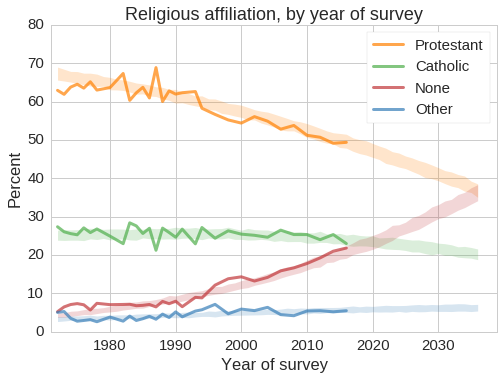
In the year 2020, the Nones will ...
Don't be so smug, you Baptists and Church of Christers, either.
By 2035, Nones will catch you, too.
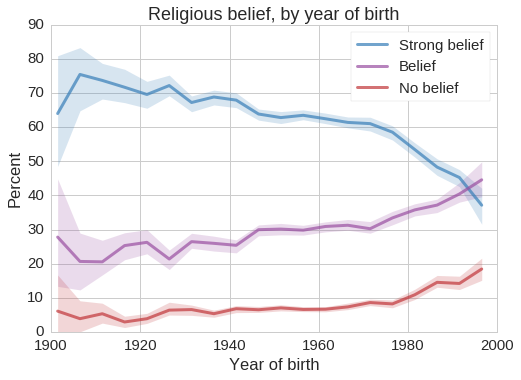
And, you should, in fact, be even less smug, per this image:
That comes from the author's own blog, linked at the bottom of the SciAm piece.
In other words, the liberal wing of Lutherans, Methodists, Presbyterians and Episcopalians has already caught you Baptists, etc.
Sure, they may go to church less — setting aside the fact that time and motion studies show that most of you don't go to church as much as you claim — but they don't feel the guilt-tripped NEED to go to church.
==
In a follow-up in 2019, Allen Downey notes that the number of Nones decreased slightly in 2018.
Update, with some related stats? In 2019, 23 percent of Americans went to church every week. Sounds fairly devoted, right, every week? But 29 percent never went once. Texas, Bible Belt stereotypes aside, is no exception. This site says that it was less than 20 percent, and they're a religious website.
Friday, September 29, 2017
Robert Wright writes about religion again (Buddhism), fails again
And, that all said, regular readers of this blog know that I am in general unfriendly toward attempts to pass Buddhism off as something it is not. Above all, that's when it's done by — speaking of "secular Judaism" — so-called BuJews.
Monday, September 25, 2017
Why neither Buddhism nor Robert Wright is true
Why Buddhism is True: The Science and Philosophy of Enlightenment by Robert WrightMy rating: 1 of 5 stars
Wrong from the title on
Ignore the blurbs, it’s still a bad book
There are several reasons for that.
First, IMO, Wright is overrated. I rated “The Evolution of God” as a one-star. This one had a chance to get lucky, even though it was starting minus 1 star due to the title alone. That title, and ding, along with puffery from too many others, though, cost it that chance to do better.
Now, within specific reasons it’s a bad book.
First, ev psych isn’t nearly as true as Wright claims. And, as I said in the review of “The Evolution of God” if you want to apply something like that to religion, try the evolutionary anthropology of Scott Atran or Pascal Boyer.
Second, the Stephen Batchelor denatured, demetaphyticized “Buddhism” that Wright presents isn’t Buddhism. (Wright even backhandedly, and out of the side of his mouth, admits this in the first chapter.
Third — or, if it is, then Unitarianism is just as much Christianity as is what Wright et al call “Buddhism.” And, it’s not.
Fourth — If Unitarianism WERE that, yet, nobody writes a book called “Christianity is true” unless they’re a fundamentalist.
That alone should show what’s wrong with the book.
But BuJews like Sam Harris on one hand, and BuGoys like Wright et al on the other, find millions of people who can still be conned this way.
Fifth, it is possible, indeed, that Buddhist secularism has special mediation insights derived from its religious roots. It’s also possible Christianist secularism does, too. It’s also possible neo-Stoicism does, and derived from its original philosophical roots. Maybe self-hypnosis does, derived from original empirical results followed by trial-and-error fine tuning. Or that modern science does, and influenced by a Buddhist-derived general idea of mediation, but NOT by anything specific.
(From what I know, there is indeed at least some degree of truth to all of the above. That’s from reading a new bio of Rorschach, on precursors to modern science; from some experience with self-hypnosis; from a philosopher friend who teaches neo-Stoicism counseling; and more. And, much of these things started happening before Batchelor, or precursors, started popularizing Buddhist-derived meditation ideas in the west.)
Sixth, note my adjectives two paragraphs above. Non-metaphysicians within Unitarianism would practice Christianist secularism, not Christianity. (Not all Unitarians are non-metaphysical.)
Wright seems to make the assumption that only Buddhism, among world religions, has unique insights that can be secularly distilled. Tosh. I haven’t even mentioned Taoist secularism. (Confucianism? I agree with many philosophers of religion that it’s a philosophy, not a religion.)
(Sidebar update: Buddhism IS a religion.
Religion is about:
Metaphysical matters of ultimate concern, within a social group setting; and
How one orients oneself within that group to a better relationship to these metaphysical matters of ultimate concern.)
None of this is to say that meditation is bad. I think it can be good, indeed, for reasons in the book and beyond. So, don’t feel discouraged if the meditation Wright derives from Buddhist secularism doesn’t float your boat.
Seventh, Wright ignores the irony of people — selves — reporting on the idea that there is no self. This is part of a larger issue that certain Buddhist principles should be ineffable. Wright also ignores this connection to karma, vis-à-vis what is, and is not, reincarnated, and why the whole idea of karma is senseless at best and repulsive at worst if there is no “self” yet we have punishing karmic reincarnations based on actions of past selves.
Of course, he ignores it in part by presenting Buddhist secularism as “true,” and as true without having to look at its religious and metaphysical background.
In fairness, he does note that issues related to this are raised by “maverick” Buddhists.
Eighth, Wright, like other BuJews and BuGoys ignores that real, actual Buddhism has its own version of fundamentalism, violence against other religions, etc. Take the 969 Movement, leading the attack against Muslim Rohingya in Burma.
And, no, please no “no true Scotsman” claims that this is modern, and just one small offshoot. Before Buddhism in its Indian homeland went over the mountain to China and then was pushed out of India by a new, reformed Hinduism (Vedism or Brahamnism or similar are better terms for the main religion of India at the time of Siddhartha Gautama), Buddhists are documented as persecuting Jains.
Beyond Buddhism, he gets things wrong elsewhere. That includes muddling emotions and instincts, which he does so baldly and badly.
Finally, the title.
Often, it may be an editor at a publishing house that chooses a title. In this case, I highly doubt it; I’m sure that’s Wright’s baby. It is provocative and smug as well as wrong.
==
If Wright were just offering up a book called “Buddhist-based meditation tools and ideas,” he might get another star. But, he earned the low rating.
View all my reviews
Friday, August 04, 2017
Philosophy food fight falls flat
Massimo, per that link, is a "reducitarian." So am I, but for different reasons and for a different moral compass. And, he's very ardent about it.
Fueling the comments fire was, first, Rita Wing, a hardcore vegan, and second, and interesting, or sometimes "interesting," but not-favorite philosopher, philosophical friend, and sparring partner of Massimo's, Dan Kaufman. He's not a philosopher enemy; he's more a semi-frenemy.
And now, our philosophers, with their "philosophy food fight falls flat."
Massimo comes off as defensive, and very defensive for an admirer of Stoicism who even has a second blog about modern Stoic-based advice, "How To Be a Stoic." It's an "if you're not for me, you're against me," defensiveness.
Dan comes off as smug. (That's not new, even more so on his own blog site, The Electric Agora.) That said, Dan seems to largely reject animal rights issues, and not just an extreme, Peter Singer version of them, but all of them. (More on that below, though.)
Behind the "smug," I think Dan's stance is twofold:
1. People can become preachy on this issue without warrant;
2. This isn't that big of a deal for him.
Now, to comments.
First, Wing comes off as sanctimonious, especially when she appeared ignorant about Jainism, notably, "sky-clad" Jains and the most rigorous of them starving themselves to death because they believe even plants have some senses.
I mentioned that vegans, without supplements, have Vitamin B-12 deficiency. Massimo, after critiquing her for an appeal to nature fallacy, called mine a naturalistic fallacy.
I think not, when I unpack the shorthand.
Yes, I can get B-12 from a pill. But that's coming from animal products that, if the whole world went vegan, we'd have to raise just for that purpose. That would be costly, wasteful and have environmental burdens. (More on that in a minute.)
Let me state one other thing for the record, before I dive into the two protagonists.
I'm not a moral realist, but, if I'm presented that as an issue of two polarities, moral realism vs. "moral non-realism," I reject that.
I consider myself some sort of moral semi-realist.
I don't think empirical facts, whether findings of science, recordings of history or other things, should control moral investigation, articulation of positions and stances, etc. I do think, though, that empirical findings should guide such things, and on a case-by-case basis.
As I told Ms. Wing, I'm a definite Humean, and with him, I affirm the "is ≠ ought," IF that means, "an is doesn't necessarily imply an ought." Because an "is" may imply an "ought," and certainly, the extreme idea, that any "is" should have zero consideration on any "ought," is flat wrong.
Back to Massimo, and first with a prelude.
He called extreme Jainism's belief "bizarre." Yeah? So are other religious and quasi-religious arcane dietary beliefs. Kosher rules are just such an example. And I believe veganism is just such a quasi-religious system.
Per the matter at hand, and animal pain, that means getting the best scientific information, and interpretation of it, on what animals can feel pain, or something like it. The "interpretation" issue means no anthropomorphizing.
That also includes the "folk science" issue of knowing that, if an animal is capable of feeling pain, it's not just factory farming that causes pain. The act of killing an animal, unless you've shot it up with morphine or gassed it with ether first, also inflicts pain.
Massimo also didn't really like this observation. Nor various spinoffs, largely from me, but also from others.
On the commercial side, of empirical facts in record, for reducitarians to ponder, it is to be noted that major fish, such as salmon and catfish, are factory farmed. Therefore, above and beyond the note above, a reducitarian, for even a partial moral cover, must logically avoid factory farmed fish as well as beef, hogs, etc. (And, I'm venturing that a significant minority, at least, do not.)
One smaller note on issues of philosophy, and even more, of psychology, THEN the protagonists.
I see scales and shades of gray in many things, not just what I mentioned above.
However, Massimo rightly calls out Kaufman for calling Peter Singer shallow. And he's right. Dan unconvincingly appeals to other philosophers. I disagree with Singer less than Dan — and probably find him a bit more discomfiting. Shallow, though, he is not.
That said, given the degree of Massimo's emotional angst, I suspect Singer hits kind of close to home for him, and he'd like to dismiss him.
What I see Arnold as saying is that we're never going to truly transcend "it ≠ ought" issues, and we're certainly not going to expand our addressing of them, on natural issues, if our attempts to transcend a Hobbesian state of nature remain selective. And, yes, that's what I think Massimo is doing.
Contra sky-glad Jains, I do not think plants feel pain. Therefore, if one wants to be vegetarian, as long as they don't preach at me, I think they've got a pretty strong moral standing.
Veganism? Milking a dairy animal causes no pain, per se. Factory dairy farming may, but that's a different critter. Therefore, if one "sources" one's cheese, butter, etc., one can make a legit claim to dairy products. Eggs? It's possible a hen feels a psychological pain from egg theft, so, maybe leave them out. Clothing? If the cow's dead for other reasons, don't waste the leather. Wool-shearing, as long as sheep aren't too exposed to elements, is not painful. Down? If taken from natural molting, no pain.
So, one can certainly ethically wear animal-based clothing. Ms. Wing is wrong, and sanctimonious.
Finally, the issue of animals suffering pain ANYWAY. A leopard or lion would kill a wild cow. Something might kill a wild hog. Varieties of animals kill wild sheep and goats. Bears kill wild salmon. Etc., etc.
Other animals don't have a second-level sense of others, like we do. Even if it cared, an obligate carnivore leopard, can't stop killing a cow anyway.
Is the fact that we can sense pain of other creatures of itself enough reason to stop?
Back to utiltarianism.
What if ... ants and flies sensed pain.
Are sprays and swatters always OK, or, how do you justify it? I'm sure many vegans who aren't sky-clad Jains haven't thought about this and would prefer not to.
Some opponents of factory farms will talk about broader "quality of life" issues rather than pain.
Dan's blog discusses a piece by Cora Diamond which partially, but not entirely, parallels my thought.
However, without reading Diamond's original, I think Dan's piece isn't totally relevant to Massimo's piece, as he is not adopting a quasi-Singerian position. And MPBoyle in comments is one reason I not only stopped writing for Dan but largely stopped reading.
I do think he in particular, Boyle, misses friend Thomas' points. And, one of those is that Diamond, and from her, Kaufman, may push some things too far.
On the other hand, Massimo's own stance is presented largely in terms of the western world, and beyond that, a more privileged subset of it.
And, I mean that. Not all Americans, with our factory agriculture, can afford to pay to be vegetarians, let alone vegans. Many can't easily even afford Massimo's reducitarianism.
Finally, in an interesting sidebar from the non-human portion of the natural world: sometimes vegans, under duress, become cannibals!
==
As noted, my animal ethics is based on environmentalism, and two subgrounds.
One is that it takes 10 pounds of food to put a pound of weight on a cow, about 8 for a hog, etc. Except in places, like savannah plains that are semi-dry, and not suitable for much agriculture, where we should ranch animals like cows (or better, in the US, the native bison), we have too much livestock. We can feed people better with a more vegetable-based diet.
This is even more true in places in the world where most cannot yet afford the Western hankering for meat.
Second is global warming, and things like cow farts.
Too much livestock is killing our future. And, killing it more rapidly than most conservative-minded scientists want to admit — along with all the other causes of global warming.
Finally, there's good non-ethical reasons to avoid not meat in general, but modern factory farmed meat, especially in the US, or countries making special trade with the US. Food safety reasons. That article ignores the fact that the USDA's own stateside food safety programs suck as is.
There's yet other issues.
A stance like Massimo's, to get back to capitalism, involves a certain amount of privilege. I mentioned that in a late comment that he didn't address. So, too, do other moral issues that are in part, aesthetics issues in disguise.
Next, it's not just veganism, or even vegetarianism, that are arcane dietary systems. Some, as those of a Kamchatka Peninsula people, are culture-wide.
Finally, one last thought.